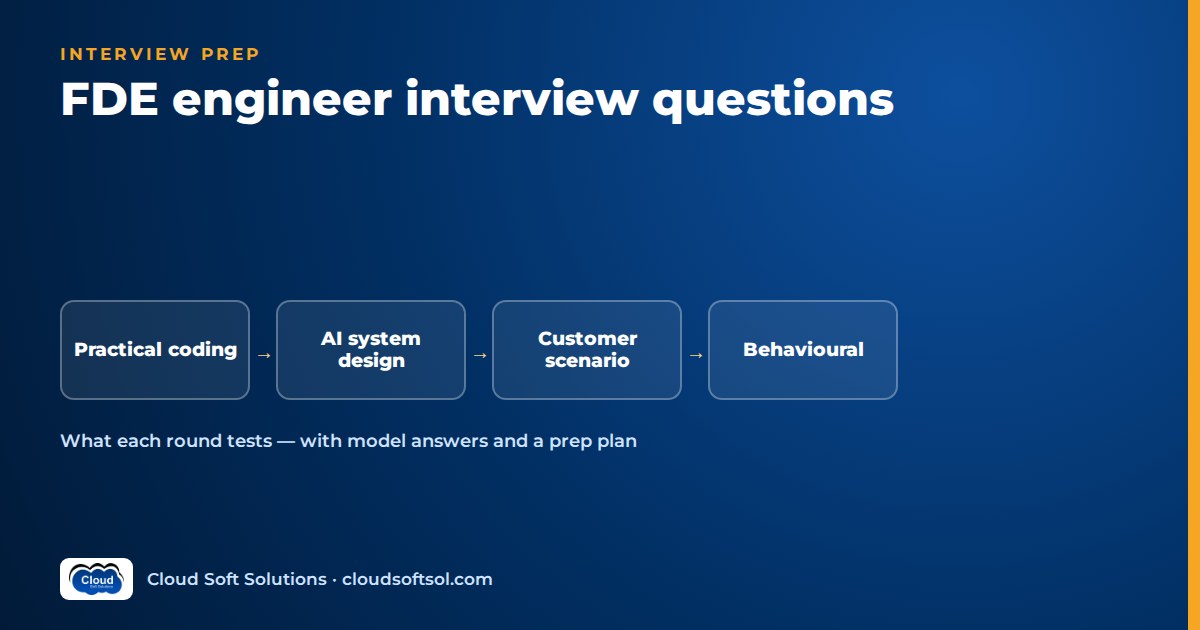
FDE engineer interview questions test whether you can do the job on day one: write working code against messy data and flaky APIs, design a RAG or agent system that respects enterprise identity and security, deploy it on a customer's cloud, prove it works with evaluation, and handle a difficult customer conversation without losing the room. This guide collects 80 high-value forward deployed engineer interview questions with model answers, organised by topic and mapped to the interview rounds where they commonly appear.
How to use this guide:
- Freshers and early-career engineers: master the fundamentals, coding and GenAI sections, and be ready to defend every decision in your own projects.
- Experienced developers, DevOps and cloud engineers: expect depth in RAG, agents, integration, identity and cloud, and at least one full system design.
- Senior candidates: interviewers weight the troubleshooting, stakeholder and system design scenarios heavily and look for trade-offs, evaluation and operations in every answer.
- Practise answers out loud. The wording here is a model, not a script.
Contents:
- The FDE interview process, round by round
- FDE fundamentals: the role and how it differs
- Customer discovery and requirements
- Practical coding questions (Python, APIs, data handling)
- GenAI and LLM fundamentals
- RAG interview questions for FDEs
- Agentic AI, tools, MCP and A2A
- Enterprise integration and identity
- Cloud (AWS and Azure) for FDE interviews
- Security and governance
- Evaluation, observability and AgentOps
- Production troubleshooting scenarios
- Customer-facing and stakeholder scenarios
- System design scenarios
- Key takeaways
- Interview preparation checklist
- FAQ
The FDE interview process, round by round
Loops differ between AI labs, enterprise software vendors, global capability centres in Hyderabad and Bengaluru, and services firms, so treat this as a common shape rather than any one company's process. After a recruiter screen, most FDE loops include some version of these rounds:
| Round | Format | What it really tests | Questions in this guide |
|---|---|---|---|
| Practical coding | Live coding or a short take-home: parse data, call an API, fix a bug | Working code, edge cases, tests, reading unfamiliar code | 14 to 21 |
| AI system design | Whiteboard or doc: RAG assistant, agent, evaluation setup | Requirements first, access control, failure modes, evaluation, cost | 22 to 41, 77 to 80 |
| Cloud, integration and security | Often folded into design: deployment, identity, secrets, networking | Whether the design survives a security review and on-call | 42 to 62 |
| Troubleshooting | A broken system and its logs or traces | Method, hypotheses, evidence, prevention | 63 to 68 |
| Customer scenario / role-play | Interviewer plays a vague, sceptical or demanding customer | Discovery, honesty, scoping, calm under pressure | 8 to 13, 69 to 73 |
| Behavioural | Past experience: ownership, ambiguity, failure | Evidence that you finish things and own mistakes | 74 to 76 |
The customer round is what separates an FDE loop from a standard software engineering loop. Many strong coders prepare for it least and lose the offer there. Across all rounds, interviewers tend to score the same dimensions:
| Dimension | Weak signal | Strong signal |
|---|---|---|
| Requirements | Jumps to a solution | Asks about users, data, systems and success criteria first |
| Coding | Happy-path code, silent on errors | Validation, timeouts, retries, idempotency and a test or two |
| Security | Mentioned only when prompted | Identity, authorisation and data flow raised unprompted |
| Evaluation | "It looked good in testing" | Test set, metrics, release gates and online monitoring |
| Operations | Deployment ends at "push to cloud" | IaC, CI/CD, observability, rollback and runbooks |
| Customer handling | Over-promises or argues | Listens, scopes, says no with an alternative, writes things down |
FDE fundamentals: the role and how it differs
Interviewers open with these to check that you understand what the job actually is. Answer crisply; a rambling definition is an early negative signal.
1. What is a Forward Deployed Engineer, in one minute?
Answer: A Forward Deployed Engineer is a software engineer who works embedded with a customer to ship a production system that solves a specific business problem, and owns it from discovery through deployment to a measured outcome. Palantir popularised the model of engineers being "forward deployed" into customer organisations; AI labs and enterprise software companies now hire FDEs to get GenAI and agent systems running inside real enterprises.
"Forward" means close to the customer's data, identity provider, network, approval processes and people. The work product is running code in the customer's environment, not slides. For the full picture, see what a Forward Deployed Engineer does.
2. How is an FDE different from a software engineer, solutions architect, consultant and ML engineer?
Answer: All five can write or design systems, but they differ in who sets the requirements, who owns the running system and what they are measured on. The FDE is the one accountable for a working, adopted system in one customer's environment.
| Role | Main focus | Typical output | Measured on |
|---|---|---|---|
| Product software engineer | Features for many customers from a roadmap | Code in the vendor's product | Feature quality and velocity |
| Solutions architect | Designs that fit the platform to the customer | Reference architectures, guidance, reviews | Technical win and design quality |
| Consultant | Advice, process, programme management | Assessments, roadmaps, recommendations | Engagement delivery |
| ML engineer | Models, training and serving pipelines | Models and ML infrastructure | Model quality and reliability |
| Forward Deployed Engineer | One customer's problem, end to end | Production code and integrations in the customer's stack | Business outcome in production |
Interview tip: Do not disparage the other roles. Say where they overlap and where the FDE's accountability is different. FDE vs solutions architect vs solutions engineer goes deeper.
3. Isn't an FDE just a solutions architect who codes?
Answer: No. The difference is ownership of the production system. A solutions architect shapes the design and often hands over to a delivery team; an FDE writes the integration service, debugs the identity flow at 11 pm before go-live, sets up evaluation and stays until the system is used.
4. How is an FDE different from an IT consultant or a services delivery engineer?
Answer: A consultant is usually paid for advice and a services engineer for delivering a defined scope; an FDE is expected to find the right problem, build the engineering solution and feed reusable patterns back into a product or platform.
In practice the lines blur, and many FDEs in Indian services firms and GCCs work on customer engagements. The distinguishing habits are engineering depth (you can read and change the customer's code), a bias for shipping small working increments, and turning one-off fixes into reusable components such as a connector, an evaluation harness or a deployment template.
5. How is an FDE different from an ML engineer? Who owns the model?
Answer: An ML engineer optimises models and the pipelines that train and serve them. An FDE usually consumes models through APIs or managed platforms and owns everything around them: data access, retrieval, tools, identity, security, deployment, evaluation and adoption.
With foundation models, most enterprise value comes from the system around the model, so the FDE's job is choosing and constraining the model rather than training it. An FDE should still understand embeddings, fine-tuning trade-offs and evaluation well enough to know when to bring in an ML specialist.
6. Is an FDE a support or customer-success role?
Answer: No. Support resolves issues in an existing product and customer success drives adoption and renewals. An FDE designs and builds the system the customer's business process depends on, frequently makes the architecture decisions, and carries production responsibility for it.
The customer exposure is a multiplier on engineering impact, not a substitute for it. A strong FDE turns a customer's vague goal into a running system, and the patterns from that engagement often become product features.
7. Why are cloud providers and AI companies investing in forward deployed engineering now?
Answer: Because the hard part of enterprise AI has moved from building a demo to running a governed system against real data and systems of record. That gap needs engineers inside the customer's environment.
AWS, for example, has publicly described a Forward Deployed Engineering organisation that embeds engineers with customers to co-develop and deploy agentic AI, and in June 2026 it extended that model to consulting partners in an AWS Partner Network blog post, "Introducing Forward Deployed Engineering for Partners". The post frames the work as moving "from counsel to outcomes" and delivering systems built for customer self-sufficiency.
The FDE path looks like this, and interviewers often probe each stage:
Customer problem -> Discovery -> Requirement
  -> Data -> AI architecture -> RAG / Agent
  -> Tools / MCP -> APIs -> Security -> Cloud
  -> Deploy -> Observe -> Evaluate -> Optimise
  -> Business outcome
Customer discovery and requirements
Discovery is where FDE loops differ most from standard engineering loops. The interviewer wants to see you slow down, ask the right questions and narrow scope before designing anything.
8. "We want AI for our operations team." That is all the customer says. What do you do?
Answer: Run discovery before proposing anything. Ask who the users are, which task costs the most time or causes the most errors today, what data and systems are involved, what "better" would look like and who signs off. Then narrow to one measurable use case and propose a small first deliverable with explicit non-goals.
Shadowing two or three users for an hour usually reveals more than a workshop. Confirm data access and security constraints early, because those decide feasibility more often than model capability.
9. What do you ask in the first discovery session for an internal knowledge assistant?
Answer: Questions that decide scope, feasibility and success: who asks what today, where the answers live, who is allowed to see what, and how you will know it works.
- Users, their top ten questions, and how they get answers today
- Source systems (SharePoint, Confluence, file shares, ticket history), owners and update frequency
- The permission model: groups, confidential documents, regional restrictions
- Languages, for example English plus Hindi or Telugu queries
- Where users will ask: Teams, a portal, the ServiceNow service portal
- Compliance needs: retention, logging, personal data under the DPDP Act
- The success metric and the baseline, and who signs off on go-live
The method is covered in AI use case discovery.
10. How do you define success metrics for an AI pilot?
Answer: Agree four kinds of metric in writing before building: a business metric, a quality metric, an operational metric and a safety metric, each with a baseline and a threshold.
- Business: average handling time, first-contact resolution, hours saved per week
- Quality: answer correctness and faithfulness on an agreed test set, task success rate for agents
- Operational: p95 latency, availability, cost per successful task
- Safety: zero unauthorised actions, no cross-permission leakage, escalation rate
Without a baseline you cannot prove value, and without a threshold every review turns into an opinion contest.
11. How do you decide whether a problem needs an LLM, an agent, or neither?
Answer: Use the simplest thing that meets the requirement. Rules, SQL or a normal integration for deterministic work; an LLM call for language tasks such as summarising or extracting; a fixed workflow with LLM steps when the path is known; an agent only when the path genuinely cannot be decided in advance.
Agents add cost, latency, non-determinism and a larger security surface. An interviewer is pleased when you talk a customer out of an agent they do not need.
Real-world example: Consider a retailer that wants an "agent" to answer "where is my order?". A tool call to the order API plus a templated response covers most cases; the LLM is only needed to understand the question and phrase the reply.
12. How do you assess whether the customer's data is ready?
Answer: Run a short data spike in the first week: get real access, sample the data and measure quality against the use case, instead of trusting a description of it.
Check access paths and approvals, ownership, duplicates and conflicting versions, missing permission metadata, scanned versus digital documents, personal data, and how often the data changes. Write the findings down with a feasibility call.
13. What goes into the scope document for a short pilot?
Answer: Enough that anyone can tell what is being built, what is not, and how the pilot will be judged: problem statement, users, in-scope workflows, explicit non-goals, data sources, integrations, security assumptions, success criteria, risks, milestones, the sign-off owner and the change process.
Practical coding questions (Python, APIs, data handling)
FDE coding rounds lean towards realistic integration work rather than puzzles. You are judged on whether the code runs, handles bad input and could be maintained by someone else. Python is the common choice for AI FDE roles.
14. Parse this CSV/JSON export from a customer's system and produce a cleaned summary.
Answer: Inspect the data and ask about it first: encoding, delimiters, duplicates, missing fields, date formats and size. Then write a small parser with explicit validation, collect bad rows into a rejects list with reasons instead of crashing, and only then transform and aggregate.
Use a Pydantic model or typed dataclass per row. Test with a fixture containing a malformed row, an empty file and a duplicate. If the file could be large, stream it rather than loading it all into memory, and report counts of accepted and rejected rows.
15. Call a third-party REST API that is rate-limited and occasionally fails. Make it reliable.
Answer: Put a timeout on every request, retry only retryable failures (timeouts, connection errors, 429 and 5xx) with exponential backoff and jitter, respect Retry-After, handle pagination, and use idempotency keys on writes so a retry cannot create duplicates.
for attempt in range(max_retries):
    try:
        r = client.get(url, timeout=10)
        if r.status_code in RETRYABLE:
            raise Retryable(r)
        r.raise_for_status()
        return r.json()
    except (Retryable, Timeout):
        sleep(backoff(attempt))
raise GaveUp(url)
16. This integration worked yesterday and fails today. Here are the logs. Debug it.
Answer: Reproduce the failure, read the actual error, then test hypotheses in order of likelihood: expired credential or rotated secret, changed API schema or version, certificate or DNS change, rate limit, a deployment on either side, or bad input data.
Ask "what changed?" across deploys, config and secrets on both sides, and narrow with evidence instead of changing several things at once. After the fix, add a test or alert so the same failure is caught earlier next time.
17. Write a function that maps records from System A's schema to System B's.
Answer: Get both schemas and agree which system is the source of truth. Keep the mapping explicit and testable, as a declarative table of field rules rather than nested conditionals, decide what happens to unmapped fields and invalid values, and record every transformation for audit.
Strong candidates raise ID reconciliation without being asked: how a record in B is matched to its record in A, and what happens on conflicts or partial updates.
18. Wrap a slow internal API behind a clean service the AI layer can call.
Answer: Build a small FastAPI (or similar) service with input validation, typed responses, timeouts, caching only where data is safe to cache, structured errors and health checks. Most importantly, pass the user's identity through so the AI acts with the user's permissions, not a superuser account.
This is the same pattern you use when exposing the API as a tool through MCP (Model Context Protocol): narrow contract, clear errors the model can act on, and authorisation enforced in the service.
19. Write a webhook receiver for ticket events that is safe against duplicates and replays.
Answer: Verify the signature, check a timestamp window, store the event ID and ignore ones already processed, acknowledge quickly, and do the real work asynchronously from a queue.
Most ticketing and CRM platforms retry deliveries, so duplicates are normal, not exceptional. Make the processing idempotent (an upsert keyed on the event or record ID), send failures to a dead-letter queue, and expose a replay tool so you can recover after an outage without hand-editing data.
20. The LLM must return JSON for a downstream system. How do you make that reliable in code?
Answer: Use the provider's structured-output or tool-calling feature with a schema, validate the result with Pydantic anyway, and on failure retry once with the validation error included. If it still fails, route to a fallback rather than passing bad data downstream.
class Claim(BaseModel):
    policy_no: str
    amount: Decimal
    category: Literal["motor", "health"]

try:
    claim = Claim.model_validate_json(raw)
except ValidationError as e:
    claim = retry_with_feedback(raw, e)
Validate business rules too, not just types: an amount above the policy limit is valid JSON and still wrong.
21. You need to call an API for 20,000 records quickly without getting throttled. How?
Answer: Use bounded concurrency, for example asyncio with a semaphore or a worker pool sized to the API's documented limits, combined with backoff on 429, checkpointing so a crash resumes rather than restarts, and a report of failed records for reprocessing.
GenAI and LLM fundamentals
You will not be asked to derive attention, but you will be asked how model behaviour affects cost, reliability and design. Answer in engineering terms.
22. Why do tokens and context windows matter to an FDE?
Answer: Because cost and latency scale with input and output tokens, and the context window caps how much instruction, history and retrieved content fits in one call. Both directly shape architecture and the customer's bill.
Stuffing more context is not free: it costs more, slows responses and can dilute attention so relevant facts in the middle get missed. FDEs budget tokens per request, trim retrieved context and summarise long histories.
23. What does temperature control, and is a model deterministic at temperature zero?
Answer: Temperature controls randomness in token sampling: low values for extraction and classification, higher for drafting. Even at zero, outputs are not reliably identical across runs or model versions, so systems must not depend on exact wording.
24. What causes hallucinations, and how do you reduce them in an enterprise system?
Answer: Models generate plausible text from patterns, not from a verified fact store, so they fill gaps confidently. Reduce it by grounding answers in retrieved sources, requiring citations, allowing "I don't know", constraining outputs to schemas, and checking high-risk answers with a verification step.
25. How does function calling (tool calling) work, and who executes the function?
Answer: You describe tools with names and JSON schemas; the model returns a structured request to call one with arguments; your code validates and executes it, then returns the result to the model. The model never executes anything itself.
That separation is the security boundary: authorisation, input validation and rate limits live in your code, so a manipulated model can only ask, not act.
26. How do you choose a model for an enterprise use case?
Answer: Shortlist on constraints, then decide on evidence. Constraints: data residency and region availability, approved hosting (Amazon Bedrock, models in Microsoft Foundry, Vertex AI), licensing, context length and latency. Evidence: quality on the customer's own evaluation set and cost per successful task.
Smaller models are often enough for routing, classification and extraction; reasoning models suit multi-step planning but cost more and respond more slowly. Design so the model can be swapped behind an interface, because it will be.
27. When would you choose RAG, fine-tuning or a plain API integration?
Answer: RAG when answers depend on changing or permissioned knowledge and need citations. Fine-tuning for consistent format, tone or a narrow task with plenty of examples, not for adding facts that change. A plain integration or SQL query when the answer lives in structured data; not everything needs an LLM.
RAG interview questions for FDEs
RAG is the most common first enterprise use case, so expect depth here. For a larger retrieval question bank, use the RAG interview questions page; this section keeps the FDE angle.
28. Walk me through a production RAG pipeline end to end.
Answer: Ingestion: connect sources, parse, chunk, embed and index with metadata (source, version, access groups). Query time: authenticate the user, optionally rewrite the query, retrieve with hybrid search filtered by permissions, rerank, assemble a bounded context, generate with citations, and abstain when evidence is weak. Around it: evaluation, tracing and refresh jobs.
Sources -> parse -> chunk -> embed -> index(+ACL)
User -> SSO -> query rewrite -> hybrid retrieve
  -> ACL filter -> rerank -> LLM + citations
  -> answer / abstain -> trace -> eval
29. How do you choose a chunking strategy?
Answer: Follow the document's structure: split on headings, sections and list boundaries rather than fixed character counts, keep chunks small enough to be specific and large enough to stand alone, and carry the section title and document metadata into each chunk.
Parent-child chunking (retrieve a small chunk, send its parent section) helps with policies and manuals. Do not argue chunk sizes in the abstract: compare two strategies on the evaluation set.
30. Why use hybrid search and reranking instead of vector search alone?
Answer: Vector search handles paraphrase but is weak on exact identifiers; keyword search (BM25) catches policy numbers, error codes and product names. Fusing both, then reranking the top candidates with a cross-encoder or reranking model, usually improves precision noticeably.
Real-world example: Consider a GCC IT helpdesk where users paste error codes. Pure vector search returns generically similar articles; keyword matching finds the one article that mentions that exact code.
31. The source documents are scanned PDFs with tables. What do you do?
Answer: Treat parsing as a first-class engineering problem: OCR for scans, layout-aware extraction, tables converted to structured rows or markdown with headers repeated, and page numbers kept for citations. Check extraction quality on samples before indexing anything.
Bad parsing silently caps answer quality, and no model can fix it later.
32. How do you keep the index fresh, including deletions and permission changes?
Answer: Run incremental sync using change feeds or content hashes, delete or tombstone chunks when the source document is removed, re-sync access groups on a schedule or on change events, and version documents so superseded ones stop being retrieved.
Production consideration: Changing the embedding model means re-embedding the whole corpus, because vectors from different models are not comparable. Plan it as a migration with a parallel index and an evaluation comparison.
33. How do you enforce document permissions in RAG?
Answer: Filter at retrieval time using access metadata synced from the source system and the user's identity and groups from the identity provider. Never rely on the prompt to hide content, because anything that reaches the model can leak.
Test with negative cases: a user from group A must get zero chunks from group B's documents, and a revoked user must lose access within the agreed sync window. Question 78 applies this in a full design.
34. When would you use agentic RAG or GraphRAG instead of a single retrieval step?
Answer: Agentic RAG, where the model plans several retrieval steps or chooses sources, helps for multi-part questions across systems. GraphRAG helps when answers depend on relationships between entities, such as which suppliers are linked to which contracts. Both add latency and cost, so use them when evaluation shows single-step retrieval fails.
Agentic AI, tools, MCP and A2A
Agents are where enterprise risk concentrates, because they act on systems of record. Interviewers look for control, not cleverness. The agentic AI interview questions page has more depth on patterns.
35. What makes something an agent rather than a workflow?
Answer: In a workflow, your code decides the sequence of steps; in an agent, the model decides the next step at runtime by choosing tools in a loop until it judges the goal met. Many production "agents" are really workflows with one or two model-driven decisions, and that is usually a good thing.
Explain the trade-off: autonomy buys flexibility at the price of predictability, cost and testability. Bound it with step limits, allowed tool lists per state and explicit stop conditions.
36. What makes a good tool for an agent?
Answer: A narrow, well-named action with a strict input schema, clear descriptions of when to use it, idempotent behaviour where possible, and errors written so the model can recover. Separate read tools from write tools, and make destructive actions require approval.
Prefer propose_status_change plus an approval step over a generic update_ticket that accepts any field. Fewer, sharper tools reduce wrong calls and make policy enforcement simple.
37. What is MCP, and when would you use it instead of calling an API directly?
Answer: MCP (Model Context Protocol) is an open protocol, introduced by Anthropic in late 2024, for connecting AI applications to tools and data. A host application uses MCP clients to talk to MCP servers, which expose tools, resources and prompts over stdio locally or HTTP remotely, with OAuth-based authorisation defined for HTTP transports.
Use MCP when the same capability should be reusable across several AI hosts or agents, or when the customer standardises on it. A direct API call is fine inside a single application with one fixed integration. The MCP interview questions go deeper.
Interview tip: Point out that MCP standardises the connection, not the security. Authorisation, input validation and audit still live in your server.
38. You are building an MCP server that exposes ServiceNow incident lookups. What do you get right?
Answer: Read-only tools first, narrow schemas, the end user's identity propagated to ServiceNow rather than a shared admin account, pagination and field filtering so responses fit the context window, rate limiting, redaction of personal data, and structured logs for every call.
Implementation detail worth knowing in 2026: in version 2 of the official MCP Python SDK the high-level server class is MCPServer (from mcp.server import MCPServer), previously FastMCP; check current SDK documentation before an interview. The MCP server Python tutorial walks through a build.
39. How does A2A differ from MCP?
Answer: MCP connects an agent to tools and data; A2A (Agent2Agent) connects agents to other agents. A2A is an open protocol created by Google and now hosted as a Linux Foundation project. Agents advertise capabilities through Agent Cards and exchange tasks and messages over HTTP using JSON-RPC.
Use A2A when independently built and owned agents, possibly from different vendors, must delegate work to each other. Inside one team's system, plain function calls or a graph framework are simpler. See A2A protocol explained.
40. How do you design agent memory for an enterprise assistant?
Answer: Separate short-term state (the current conversation and task) from long-term memory (preferences or facts kept across sessions), scope long-term memory per user or tenant, store it with provenance and expiry, and let users see and delete it.
Risks to name: personal data retained longer than policy allows, stale facts overriding current records, and memory poisoning where injected text gets saved and reused. Systems of record remain the source of truth; memory is a cache of context, not a database.
41. Design an agent that updates support tickets in ServiceNow or Jira safely.
Answer: First ask whether it needs to be an agent; a fixed workflow may be enough. If it does, give it a small set of narrow tools (read ticket, add comment, propose status change), explicit state, a bounded step count, and human approval before any write that changes priority, assignment or closure. Every action is audited with the user, inputs, tool call and result.
Discuss prompt injection from ticket text, the ticketing API's rate limits, and a kill switch. Graph frameworks such as LangGraph make the approval pause explicit with interrupts and checkpoints; the LangGraph interview questions cover that mechanism.
Enterprise integration and identity
Most FDE time goes into integration and identity, and most go-live delays come from here. These questions separate people who have shipped from people who have demoed.
42. Should an AI agent act as the user, as a service account, or as itself?
Answer: Default to acting on behalf of the user with delegated, scoped tokens, so the agent can never do more than the user could. Use a dedicated agent identity with narrowly scoped permissions for background tasks, and never a shared admin account.
With Microsoft Entra ID that means flows such as on-behalf-of token exchange for downstream APIs; other identity providers have equivalent token-exchange patterns. Log both the human and the agent identity on every action. AI agent identity and access covers the patterns.
43. What practical issues do you expect when integrating with Salesforce, ServiceNow or Jira?
Answer: API rate limits and quotas, pagination, field-level and record-level security, heavily customised fields and workflows per customer, separate sandbox and production instances, API version changes, and webhook or event delivery that retries.
Read the customer's actual instance metadata before writing mappings; two ServiceNow customers can have very different incident forms. Agree a test instance with realistic data early, because many integration bugs only appear with real customisations.
44. How do you wire Entra ID sign-in into an AI app and use it for retrieval permissions?
Answer: Sign users in with OpenID Connect, validate tokens on the API (signature, issuer, audience, expiry), read group or role claims, and map them to the access filters used at retrieval and tool authorisation.
A detail interviewers like: when a user belongs to many groups, the token may carry an overage indicator instead of the full group list, so the API must look groups up through Microsoft Graph. Cache that lookup briefly and handle revocation.
45. Batch sync or event-driven integration: how do you choose?
Answer: Event-driven when freshness matters and the source emits reliable events, for example ticket updates feeding an agent. Batch when the source has no events, volumes are large, or the business accepts a daily refresh. Many designs use events for changes and a periodic batch reconciliation to catch missed ones.
46. The customer's core system is legacy with no REST API. How do you integrate?
Answer: Work down a ladder of options: an existing SOAP or vendor SDK interface, read replicas or views agreed with the DBA, file exports on a schedule, a message queue the system already uses, and UI automation only as a last resort with explicit risk sign-off.
Wrap whatever you use behind a clean internal API so the AI layer never touches the legacy mechanism directly, and the integration can be replaced later without changing agents or prompts.
Cloud (AWS and Azure) for FDE interviews
You are not expected to be a cloud architect, but your design must survive the customer's security review and operations team. Many FDE teams work primarily on AWS, with Azure common in Microsoft-centric enterprises.
47. How would you deploy an AI assistant securely in the customer's AWS or Azure account?
Answer: Containerise the service, deploy through infrastructure as code (Terraform) and a CI/CD pipeline, run it in private subnets, reach the model service over private endpoints where available, use least-privilege roles per component, SSO through the customer's identity provider, encryption in transit and at rest, and separate dev, staging and production.
Add logging with redaction, budgets and alerts, and a documented rollback. Say you would align with the customer's landing zone and tagging standards rather than inventing your own.
48. Where do secrets live, and how do they rotate?
Answer: In a managed secrets store (AWS Secrets Manager, Azure Key Vault or equivalent), never in code, images, environment files in git, or prompts. Workloads get access through their own identity (IAM roles, managed identities), rotation is automated, and the service picks up new credentials without a redeploy.
49. The service works locally but cannot reach the model endpoint inside the customer's VPC.
Answer: Trace the network path hop by hop with evidence, then check identity, instead of changing several things at once.
What I would check:
- DNS: does the endpoint resolve to the private endpoint address from inside the subnet?
- Route tables and any proxy or egress firewall rules
- Security groups and network ACLs on both sides
- The private endpoint or VPC endpoint policy
- IAM or role permissions for the model, and whether the model is enabled in that region
Production consideration: Write the working network path into the runbook; the same issue will reappear in the next environment.
50. On AWS, which services would you reach for to build and run an agent in 2026?
Answer: Amazon Bedrock for model inference, with Knowledge Bases for managed retrieval and Guardrails for content controls; Amazon Bedrock AgentCore for running agents in production, with services such as Runtime, Gateway (which exposes tools to agents, including as MCP tools), Memory, Identity and Observability that can be used independently. Surrounding services are the usual ones: IAM, VPC endpoints, Secrets Manager, CloudWatch, ECS or EKS.
Know the naming change: the original Amazon Bedrock Agents is now Amazon Bedrock Agents Classic, in maintenance mode and closed to new customers from 30 July 2026, and AWS recommends AgentCore for new agent development. More in AWS for AI FDE engineers.
51. What is the equivalent stack on Azure?
Answer: Microsoft Foundry (previously Azure AI Foundry) for models, including Azure OpenAI models, agents and evaluation; Azure AI Search for retrieval; Microsoft Entra ID for identity; Key Vault for secrets; Private Link for network isolation; Azure Monitor and Application Insights for telemetry; AKS or Container Apps for hosting.
For code-first agents, Microsoft Agent Framework is the open-source successor to Semantic Kernel and AutoGen. Service names and features in this space change often, so say "I'd confirm against current Microsoft Learn documentation" when unsure.
52. Containers or serverless for an AI service, and what does the CI/CD pipeline look like?
Answer: Serverless functions suit short, spiky, event-driven steps; containers on ECS, EKS, AKS or Container Apps suit long-running streaming responses, agent loops and services with steady traffic. Many systems use both.
The pipeline should build and scan the image, run unit tests, run the offline evaluation set against the changed prompt or configuration and block on a quality drop, deploy to staging through Terraform, then promote with a canary and an easy rollback.
Reading answers is not the same as defending them under questioning. If you want to practise these rounds against realistic systems, the AI Forward Deployed Engineer course builds a ServiceNow AI agent via MCP, a secure banking AI assistant and an IT-ops multi-agent platform, and includes mock interviews with resume and portfolio review.
Security and governance
Security reviews are a gate every enterprise AI project passes through. Raise these topics unprompted in design rounds. The AI security interview questions page has a deeper bank.
53. What is prompt injection, and how do you defend against it?
Answer: Prompt injection is untrusted text, typed by a user or hidden in a document, email, web page or ticket, that tries to override the system's instructions. Indirect injection through retrieved content is the bigger enterprise risk. Defend in layers, because no prompt fully prevents it.
- Treat retrieved and tool-returned text as data, clearly separated from instructions
- Least-privilege tools, with authorisation enforced in code outside the model
- Approval for high-impact actions and allow-lists for destinations such as email recipients
- Input and output filtering, and red-team test cases in the evaluation set
54. How do you handle personal data and India's DPDP Act in an AI application?
Answer: Minimise what reaches the model, mask or tokenise identifiers where the task allows, keep data in approved regions and services, set retention for prompts, traces and memory, record the purpose of processing, and support deletion requests across indexes and logs.
The Digital Personal Data Protection Act makes consent, purpose limitation and security safeguards concrete obligations; FDEs make sure the architecture can honour them.
55. What layers of guardrails would you put around an LLM application?
Answer: Input checks (injection patterns, off-topic requests, personal data), retrieval controls (permission filters, trusted sources only), generation controls (system instructions, structured outputs, grounding checks), output checks (toxicity, data leakage, policy rules), and action controls (tool policy, approvals, rate limits).
Managed options such as Amazon Bedrock Guardrails or content filters in Microsoft Foundry cover some layers; business rules usually need your own code. Measure false positives too, because over-blocking kills adoption.
56. What does AI governance look like on a real engagement?
Answer: A use-case register with risk ratings, named owners, approved models and data sources, documented evaluations before release, change control for prompts and models, incident handling, and periodic review. FDEs supply the evidence: evaluation reports, data-flow diagrams, audit logs.
Some customers align with ISO/IEC 42001 for an AI management system, and teams serving EU users must consider the EU AI Act.
57. How would you threat-model and red-team an agent before go-live?
Answer: Map assets (data, systems, credentials), entry points (chat, documents, tool outputs, email), and the actions the agent can take. Then attack each path: injection through every input channel, privilege escalation via tools, data exfiltration through outputs or links, denial of wallet through runaway loops.
Evaluation, observability and AgentOps
"How do you know it works?" is the question behind every FDE interview. Have a concrete answer with test sets, metrics, traces and release gates.
58. The assistant is live. How do you know whether it is any good?
Answer: Combine offline and online evaluation. Offline: a test set built from real user questions with expected answers or sources, measuring retrieval relevance, faithfulness and answer correctness on every prompt, model or index change. Online: traces for every request, user feedback, sampled human review, and the business outcome metric.
Tools such as Ragas, LangSmith or Langfuse help, but the curated test set is the real asset. See RAG evaluation metrics for the metrics.
59. What would you put in observability for an AI system?
Answer: Standard logs, metrics and traces (OpenTelemetry), plus AI-specific spans: prompt version, model, retrieved document IDs and scores, token counts, tool calls with inputs and results, latency per step, cost, and guardrail decisions.
Build dashboards for error rate, latency, cost and quality signals, alerts on spikes, and the ability to open the full trace behind any user complaint with sensitive fields redacted.
60. How do you evaluate an agent, not just a single answer?
Answer: Evaluate the outcome and the trajectory: did it complete the task, did it call the right tools with valid arguments in a sensible order, did it respect policy, and how many steps, tokens and seconds did it take.
Use scenario-based test suites with mocked tools and seeded data, including adversarial and edge cases, and track task success, tool-call accuracy, policy violations and cost per task over time.
61. When is LLM-as-a-judge reliable, and what are its pitfalls?
Answer: It is useful for scaling evaluation of qualities like faithfulness or tone, provided you calibrate it against human labels on a sample and use specific rubrics. Pitfalls: position and length bias, preference for its own style, inconsistency across runs, and silent drift when the judge model changes.
Pin the judge model and prompt, report agreement with humans, and keep deterministic checks (schema, citation present, exact-match facts) wherever possible.
62. What is AgentOps, and how do you release changes to prompts, tools and models safely?
Answer: AgentOps is the operational discipline for agents: versioning prompts, tools and model configurations together, gating releases on evaluation, rolling out gradually, monitoring quality and cost in production, and rolling back quickly.
Production troubleshooting scenarios
Scenario rounds hand you a broken system and watch your method. Narrate hypotheses, the evidence you would collect and how you would prevent a repeat.
63. Users report that the RAG chatbot gives wrong answers. How do you debug it?
Answer: Collect concrete failing examples, open their traces, and classify each failure as retrieval (the right content never reached the model), generation (the right content was there but the answer was wrong) or data (the source itself is wrong or outdated). Fix by class, not by tweaking the prompt blindly.
What I would check:
- Is the correct document in the index at all, in its latest version, and parsed correctly?
- Did retrieval return it in the top results? If not, check chunking, hybrid search, query rewriting and metadata filters
- Did a permission filter wrongly exclude it?
- If it was retrieved, was it cut off by context trimming or buried among many chunks?
- Are users asking a question type the system was never designed for?
Production consideration: Add every confirmed failure to the evaluation set before fixing it, so you can prove the fix and catch regressions.
64. Retrieval is correct: the right chunk is in context, but the answer is still wrong. What now?
Answer: This is a generation or context-assembly problem. Check whether conflicting or near-duplicate chunks confuse the model, whether the instructions are ambiguous, whether the answer needs reasoning across several chunks, and whether the model is too small for the task.
What I would check:
- Context order and volume: is the correct chunk drowned among loosely related ones? Rerank and send fewer
- Conflicts: are old and new policy versions both present? Filter by version
- Instructions: do they require answering only from context, citing, and abstaining?
- Format: is the model asked to compute or compare tables? Pre-structure the data or use a tool
- Model: does a stronger model fix it on the eval set, and is the cost justified?
Production consideration: Track faithfulness separately from retrieval metrics, so you can tell which half of the system regressed.
65. An agent created a ServiceNow ticket that the user was not authorised to raise. Walk through the fix.
Answer: Treat it as a security incident first: contain (disable the write tool or the agent), assess impact from the audit log, notify the owners. Then find where the control chain failed, because a model choosing an action must never be enough to execute it.
identity -> authorisation -> tool policy
  -> input validation -> risk scoring
  -> approval (if needed) -> execution
  -> audit log
What I would check:
- Identity: did the call carry the real user's identity, or a shared service account?
- Authorisation: was the user's permission for this ticket type checked in code, server-side?
- Tool policy: was this tool even allowed for this user, agent and state?
- Validation: were category, assignment group and fields validated against allowed values?
- Risk and approval: should this action type have required human approval?
- Audit: does the log show who, what, why and with which tool arguments, enough to reconstruct the event?
Production consideration: Add the case to the agent's regression suite and to the red-team set, and review every other write tool against the same chain before re-enabling.
66. Cost per request is around ₹8 and the target is ₹0.50 (illustrative). How do you get there?
Answer: Measure where the money goes, then cut the biggest items first. Typical culprits are a large model used for every step, oversized retrieved context, agent loops with many calls, no caching, and retries.
| Illustrative driver | Fix |
|---|---|
| Large model for every step | Route classification and extraction to a small model; keep the large one for hard answers |
| Twenty chunks of context per call | Rerank and send the top few; summarise long histories |
| Agent loop averaging many calls | Cap steps, use a fixed workflow where the path is known |
| Repeated FAQs answered from scratch | Prompt caching for static prefixes; a semantic cache for common questions where safe |
| Retries and failed calls | Fix validation failures upstream; count cost per successful task, not per call |
Report the result as cost per successful task alongside quality on the evaluation set, so nobody hits the cost target by quietly breaking answers. Cloud cost optimisation for AI covers the tooling.
Production consideration: Put per-tenant or per-team budgets and alerts in place; a single runaway loop can wipe out a month of savings.
67. Users say answers have become worse this week. Walk me through it.
Answer: Find what changed, confirm the regression with data, and roll back if needed before investigating at leisure.
What I would check:
- Model or model version, prompt version, retrieval settings or index refresh
- New or changed source documents, or a parsing change
- Re-run the evaluation set on current and previous configurations
- Pull traces for reported bad answers and classify them as retrieval or generation
- Check for a shift in the questions users ask
Production consideration: Add the failing cases to the test set and make the evaluation gate block the type of change that caused it.
68. After launch, p95 latency jumps and some requests fail with throttling errors from the model service.
Answer: You are probably hitting model quota or concurrency limits, made worse by retries and long contexts. Stabilise first, then fix capacity and efficiency.
What I would check:
- Throttling and quota metrics for the model, by region and model ID
- Retry storms: is client retry logic multiplying load? Add jitter and a circuit breaker
- Token volume per request: did context size grow?
- Streaming: are users waiting for full responses unnecessarily?
- Capacity options in the platform: quota increases, provisioned capacity, cross-region inference where permitted by data-residency rules
Production consideration: Load-test with realistic token sizes before go-live, and set a latency budget per step so you know which stage to optimise.
Customer-facing and stakeholder scenarios
In these role-plays the interviewer is the customer or a senior stakeholder. There is rarely one right answer; they are watching what you ask, whether you stay honest and whether you protect the outcome. Answer behavioural questions with a specific situation, what you did, the result and what you would change.
69. The customer's security team is sceptical and wants to block the project.
Answer: Treat them as partners. Ask exactly what worries them: data leaving the tenancy, model providers training on their data, access control, logging, prompt injection. Answer each specifically and offer a written security note with a data-flow diagram, storage locations, retention, identity integration and a threat model.
Accept constraints you cannot argue away, such as a required private deployment, and redesign around them. A security team that co-authored the controls becomes your strongest advocate.
70. Your demo fails in front of the customer's leadership.
Answer: Stay calm, say plainly what happened, and switch to a recorded run or fallback environment if you have one. Do not blame the model or the customer's data in the room. Afterwards, find the root cause, send a short written note with the fix, and add the case to the test set.
Prevention is part of the answer: rehearse on the customer's real data, freeze the configuration before the demo, and keep a recorded backup. The patterns are in why AI demos fail in enterprise production.
71. Mid-project, the customer keeps adding "small" requests.
Answer: Acknowledge the value of each request, then make the trade-off visible: what it costs in time, risk or delay to the agreed milestone. Log changes in writing, propose a later phase for new items, and agree priorities with the person who owns the outcome.
72. The customer insists on an agent that closes tickets with no human review. You think it is a bad idea.
Answer: Say no to the risky version and yes to the goal. Explain the risk in their terms: wrong closures, audit findings, frustrated users. Offer a safer path: draft-and-approve first, measured accuracy over a few weeks, then automation for the lowest-risk categories once evidence supports it.
Put the recommendation and their decision in writing. If they still choose the risky option after hearing the evidence, it is their call, but your note protects both sides.
73. You are behind schedule. Give the steering committee a two-minute update.
Answer: Lead with the status and the decision you need, then the reason, the recovery plan and the risk. Executives want clarity, not a tour of the architecture.
Status: amber. Go-live moves 2 weeks.
Why: HR data access approved late.
Done: RAG answers pass eval on 3 of 4 areas.
Plan: parallel testing, scope cut on area 4.
Decision needed: accept phase-2 for area 4?
Interview tip: Bad news delivered early with a plan builds trust. Bad news discovered by the sponsor destroys it.
74. Tell me about something you owned end to end, including unclear requirements.
Answer: Pick a story where you carried the work from an ambiguous start to a working result, including the unglamorous parts: questions you asked, assumptions you wrote down, the small version you shipped for feedback, documentation, handover and monitoring.
75. Walk me through a root cause analysis you wrote.
Answer: Give the timeline, impact, root cause (not just the trigger), contributing factors, the fix, and follow-up actions with owners and dates. Keep it blameless.
If you have never written one, write one for a failure in your own project before the interview; it is one of the most convincing artefacts you can bring.
76. Tell me about a time you were wrong in front of a stakeholder.
Answer: Choose a real mistake, how quickly you acknowledged it, how you fixed it and what you changed so it would not recur.
System design scenarios
Open every design answer with clarifying questions about users, data, systems, volumes, security constraints and success. Then draw, then cover failure modes, evaluation, cost and operations.
77. Design an agent that works across Salesforce, Jira, ServiceNow and AWS for a GCC's customer-escalation process.
Answer: A thin orchestrator (a graph or workflow) calls narrow tools exposed through MCP servers or an internal tool gateway, one per system, each enforcing the end user's permissions. Reads are free; writes go through policy checks and, for high-risk actions, human approval.
User (Teams) -> SSO -> Orchestrator (graph)
  -> Tool gateway / MCP servers
     -> Salesforce: account, entitlements
     -> Jira: linked bugs, release status
     -> ServiceNow: incident, change records
     -> AWS: CloudWatch metrics (read-only)
  -> Policy + approval -> write actions
-> Audit log + traces -> evaluation- Per-system identity: delegated user tokens where supported, scoped agent identities elsewhere
- Consistent correlation ID across all four systems so one escalation can be traced end to end
- Partial failure handling: if Jira is down, return what is known and say what is missing
- Rate limits and quotas per system, with backoff and caching for reference data
- Evaluation scenarios that span systems, with mocked tools and seeded records
Production consideration: Start with read-only summarisation of an escalation across the four systems. It delivers value quickly and earns the trust needed before enabling writes.
78. Design a permission-aware RAG assistant for a bank's internal policies.
Answer: Ingest from SharePoint and Confluence with structure-aware chunking, embed into a vector store such as PostgreSQL with pgvector, and attach access groups, version and effective date to every chunk. At query time, authenticate through Entra ID, retrieve with hybrid search filtered by the user's groups, rerank, generate with citations, and abstain when evidence is weak.
User -> SSO (Entra ID) -> API
  -> retrieve(query, user_groups, latest)
  -> rerank -> LLM + citations
  -> answer / abstain -> trace -> eval
Sync job: docs + ACLs -> index (tombstones)
Cover the refresh job so revoked or superseded documents leave the index, personal-data handling in logs, private networking to the model service, an evaluation set reviewed by the compliance team, and negative tests for cross-group leakage.
79. Design an IT-operations multi-agent platform that triages alerts and proposes remediations.
Answer: A triage agent groups related alerts and pulls context (recent deploys, runbooks, similar past incidents); a diagnosis step queries metrics and logs through read-only tools; a remediation step proposes actions from an approved runbook catalogue. Execution of any change goes through change management and human approval.
Discuss why separate agents (clear responsibility, separate permissions) versus one agent with many tools (simpler, fewer hand-offs), and justify the split with permissions rather than fashion. Add loop limits, cost budgets per incident, and evaluation on replayed historical incidents.
80. Design a claims-document processing system for an insurer with strict cost and accuracy targets.
Answer: Use a pipeline, not an agent: classify document type with a small model, extract fields with structured outputs into a validated schema, apply deterministic business rules, and route low-confidence or high-value cases to a human reviewer. Store extractions with source page references for audit.
Batch non-urgent work to reduce cost, measure field-level accuracy against a labelled sample, monitor the human-review rate as a quality and cost signal, and design for model replacement behind an interface.
Key takeaways
- FDE is a high-impact engineering role: you own a production system and its business outcome inside one customer's environment.
- Start every design and role-play with discovery: users, data, systems, permissions and the success metric.
- Enforce security in code, not prompts: identity, authorisation, tool policy, validation, approval and audit.
- Debug RAG by classifying failures as retrieval, generation or data before changing anything.
- Measure everything that matters: quality on a test set, cost per successful task, latency per step.
- Use the simplest architecture that works; saying "this does not need an agent" is a strong signal.
- Communicate early and in writing, especially bad news, scope changes and risky customer requests.
Interview preparation checklist
- Two or three deployed projects you can defend: a permission-aware RAG assistant, an agent with approvals touching a ticketing system, and an integration service. See projects every AI FDE should build.
- For each project: a design note, an evaluation report with a test set, a security note and a cost estimate.
- Timed coding drills: messy file parsing, paginated and rate-limited APIs, schema mapping, idempotent webhooks, validated LLM JSON.
- Out-loud system design practice on questions 77 to 80, always ending with evaluation and operations.
- One clear explanation each of MCP, A2A, tool calling and agent memory, with when not to use them.
- Current cloud naming for your target stack: Amazon Bedrock and AgentCore, or Microsoft Foundry and Agent Framework.
- Customer role-plays with a friend playing a vague, sceptical or demanding stakeholder; record and review for over-promising.
- Six behavioural stories (ownership, ambiguity, failure, conflict, an RCA, saying no) and a two-minute executive update.
- A resume and portfolio that show outcomes, not tool lists.
- Read the job description as a test plan: prepare one example for each responsibility it lists.
FAQ
What skills are required to clear an FDE interview?
Practical Python and API coding, RAG and agent design, enterprise integration and identity, cloud deployment basics, security and evaluation, plus customer communication. Interviewers look for all of them working together rather than deep expertise in one.
How should I prepare for FDE interview questions in 2026?
Build two or three deployed projects you can defend, drill practical coding, practise system design out loud, rehearse customer role-plays with another person, and learn the current names of the cloud AI services your target employers use.
Is there DSA in FDE interviews?
Some loops include a data structures and algorithms screen, so keep basic fluency with arrays, hash maps, sorting and complexity. Most of the weight usually goes to practical coding, AI system design and customer rounds.
Which programming language should I use in FDE coding rounds?
Use the language you write most fluently unless the posting names one. Python is the most common choice for AI FDE roles because of its libraries for APIs, data handling and LLM frameworks.
Can freshers get Forward Deployed Engineer roles?
Freshers are more often hired into adjacent roles first, but a fresher with deployed projects, clear documentation and good communication can be competitive. Expect deep questions on every decision in your projects.
Is FDE a good career for DevOps and cloud engineers?
It can be a strong fit, because deployment, identity, networking and observability are a large part of FDE work. The usual gaps to close are RAG, agents, evaluation and customer-facing communication.
Is a Forward Deployed Engineer a support role?
No. An FDE designs, builds and deploys production systems inside a customer's environment and is accountable for the business outcome. Customer exposure adds to the engineering responsibility rather than replacing it.
Do I need cloud certifications for FDE interviews?
Certifications can help with resume screening, but interviews test whether you can deploy and secure a real system. A project running in a cloud account with infrastructure as code, private networking and scoped permissions is stronger evidence.
How do I prepare for the customer role-play round?
Practise with someone playing a vague or hostile customer. Ask discovery questions, summarise what you heard, be honest about limits, propose a small first step, and review a recording for over-promising.
If you want structured preparation rather than practising alone, Cloudsoft's FDE PRO program runs 12 weeks of live sessions, four engineering sessions and one Customer Engagement Lab each week, with 60+ labs, five enterprise projects and the simulated "GlobalBank" customer engagement capstone, plus mock interviews and placement support until you're placed. Join in the classroom beside Ameerpet Metro or live online, and call +91 96660 19191 for a free demo. If you want a broader foundation across AI, ML, cloud and cyber security first, look at the APEX AI, ML, Cloud and Cyber Security program.