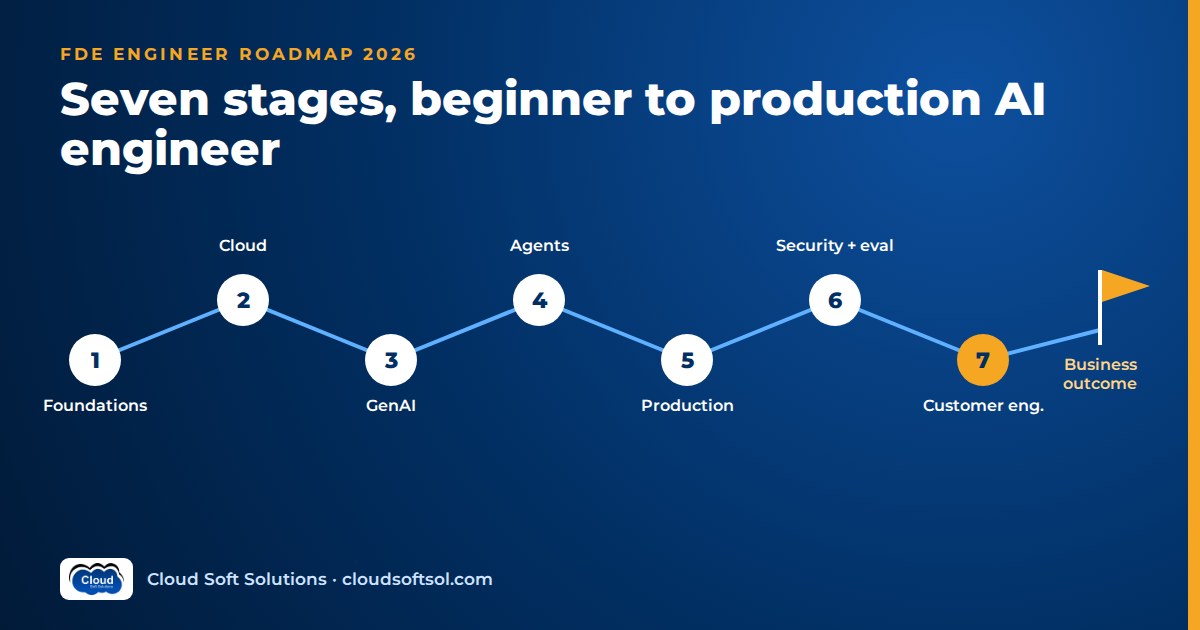
An FDE engineer roadmap has seven stages: engineering foundations, cloud fundamentals, GenAI engineering, agents and integration, production and DevOps, security and evaluation for AI, and customer engineering. The order matters because each stage depends on the one before it. You can't secure an agent you can't deploy, and you can't deploy one you can't build. Every stage below has a goal, a topic list, a milestone project, a checklist that tells you when to move on, and the trap that catches most learners.
This is a skills roadmap, not a career-switch guide. If you want to know which route suits a fresher, a Java developer or a DevOps engineer, read how to become an AI Forward Deployed Engineer. If you're still deciding whether the role suits you, start with what a Forward Deployed Engineer actually does.
The roadmap at a glance
A traditional engineering track goes Requirement → Code → Deploy. The forward deployed engineer roadmap is longer because the job is longer. It starts with a customer problem and ends with a business outcome, and data, AI architecture, integration, security, deployment, observability and evaluation all sit in between.
Stage 1  Engineering foundations
   |     Python, Git, Linux, SQL, HTTP, FastAPI
   v
Stage 2  Cloud fundamentals
   |     IAM, networking, compute, storage
   v
Stage 3  GenAI engineering
   |     LLM APIs, structured output, RAG, evals
   v
Stage 4  Agents and integration
   |     tool calling, LangGraph, MCP, OAuth
   v
Stage 5  Production and DevOps
   |     Docker, Kubernetes, Terraform, CI/CD
   v
Stage 6  Security and evaluation for AI
   |     least privilege, injection, PII, evals
   v
Stage 7  Customer engineering
         discovery, HLD/LLD, SOW, demo, RCA
         = from AI demo to enterprise outcome
Stages 1 and 2 are general engineering. Stages 3 to 6 make you a production AI engineer. Stage 7 turns that engineer into an FDE, and it should be practised alongside the others, not saved for last.
Stage 1: Engineering foundations
Goal: write, version and run a small backend service on a Linux machine without needing a tutorial open in another tab.
What to learn
- Python: functions, classes, type hints, virtual environments, exceptions,
async/await, reading and writing JSON, and calling HTTP APIs with a client library. - Git: branches, pull requests, rebasing, resolving conflicts and readable commit messages.
- Linux: the shell, permissions, processes, environment variables,
ssh, logs,curl. - SQL: joins, aggregations, indexes, transactions, and enough schema design to model a ticket, a customer or an order.
- HTTP and REST: methods, status codes, headers, authentication headers, pagination, idempotency and rate limits.
- FastAPI: routes, Pydantic models, dependency injection, background tasks, and the auto-generated OpenAPI docs.
Milestone project
Build a ticket-tracking API in FastAPI backed by PostgreSQL. Include create, list, filter and update endpoints, input validation, proper error codes and a few tests. Push it to GitHub with a README that explains how to run it.
You're ready to move on when…
- You can explain why an endpoint returns 422 rather than 500.
- You can debug a failing request from the logs alone.
- You can write a SQL query with a join and a
GROUP BYwithout searching for the syntax. - Your repo has a clean commit history and someone else can run it from the README.
Common trap
Jumping to LLMs before you're comfortable with plain backend code. Many production GenAI bugs are ordinary ones: a timeout, a malformed payload, a missing retry, an unindexed query.
Stage 2: Cloud fundamentals
Goal: deploy your stage 1 service on a cloud account securely and be able to explain who can access what.
What to learn
- IAM: users, roles, policies, the principle of least privilege, and why workloads should use roles rather than long-lived access keys.
- Networking: VPCs, public and private subnets, security groups, NAT, load balancers, DNS and TLS certificates.
- Compute: virtual machines, containers on managed services, serverless functions, and when to use each.
- Storage: object storage, managed relational databases, backups and encryption at rest.
- AWS first: go deep on one provider, then learn the Azure and Google Cloud equivalents (Entra ID, Azure OpenAI, Vertex AI, Cloud Run) by concept.
Milestone project
Deploy the ticket API behind a load balancer, with the database in a private subnet, secrets kept in a managed secrets store, and an IAM role that grants only what the service needs. Then draw the architecture and annotate every network path.
You're ready to move on when…
- You can explain why the database is unreachable from the internet.
- You can read an IAM policy and say exactly what it allows.
- You can map each AWS service you used to its Azure and Google Cloud counterpart.
Common trap
Granting broad admin permissions "just to get it working" and never removing them. On a customer site, that is how a security review stalls your project. Build the least-privilege habit now; stage 6 applies it to agents.
Stage 3: GenAI engineering
Goal: build an LLM application whose answers are grounded in real documents, return structured output and can be measured.
What to learn
- LLM APIs: messages, temperature, token limits, streaming, retries and timeouts, across Amazon Bedrock, Azure OpenAI and Gemini.
- Prompt and context engineering: clear instructions, few-shot examples and deciding what goes into the context window.
- Structured output: JSON schemas, validating the model's output with Pydantic, and recovering when validation fails.
- Embeddings: what a vector represents, similarity search, and storing vectors in PostgreSQL with pgvector.
- RAG with citations: chunking strategy, metadata, hybrid search, re-ranking, and returning the source passage with every answer so a user can verify it.
- Evaluation basics: building a small golden question set, scoring faithfulness and relevance, and checking whether a change made things better or worse.
Milestone project
Build a knowledge assistant over a set of policy PDFs. Every answer must cite the document and section it came from, and the assistant must say "I don't know" when retrieval finds nothing relevant. Write a golden set of around fifty questions and report how the assistant scores on it.
You're ready to move on when…
- You can explain why a given chunk was retrieved, or why the right one wasn't.
- Your output always parses against a schema, or fails cleanly.
- You can show an eval result before and after a change to chunking or prompting.
- You can answer the questions in the RAG interview questions set from your own experience, not from memory.
Common trap
Judging quality by eye. Without an eval set you can't tell whether a new chunk size helped, and a customer will find the failures you never measured.
Stage 4: Agents and integration
Goal: build an agent that takes real actions in enterprise systems, safely, with a human able to approve the risky steps.
What to learn
- Tool calling: defining tools with clear schemas, validating arguments, handling tool errors, and stopping loops that never end.
- LangGraph: graph state, nodes and edges, conditional routing, checkpoints for persistence and resumption, and human-in-the-loop interrupts before sensitive actions. LangChain is useful for components. LangGraph is where you control the flow.
- MCP servers: the Model Context Protocol is an open protocol, introduced by Anthropic in late 2024, for connecting AI applications to tools and data. Learn to build an MCP server that exposes tools and resources, and to connect a client to it.
- Enterprise integrations: the ServiceNow, Jira and GitHub APIs, including incidents, issues, pull requests, webhooks and pagination.
- SSO and OAuth: OAuth 2.0 flows, OpenID Connect, tokens and scopes, and integrating with an identity provider such as Microsoft Entra ID so the agent acts with the right user's permissions.
Milestone project
Build an IT-ops agent with LangGraph that reads a ServiceNow incident, searches related Jira issues and recent GitHub commits through an MCP server, drafts a root-cause summary, and pauses for human approval before it updates the ticket. Checkpoint the state so a crashed run can resume.
You're ready to move on when…
- You can draw your agent's graph and explain every edge.
- A tool failure produces a graceful outcome, not a stack trace.
- Write actions cannot happen without an approval step.
- You can work through the LangGraph interview questions and the agentic AI interview questions with examples from your own build.
Common trap
Giving the agent too much freedom. A fully autonomous agent with ten tools makes an impressive demo and a frightening production system. Enterprise agents are usually narrow, explicit graphs with a human checkpoint.
Stage 5: Production and DevOps
Goal: make your AI system reproducible, deployable through a pipeline, observable and affordable.
What to learn
- Docker: multi-stage builds, health checks, non-root users.
- Kubernetes: deployments, services, ingress, config maps, secrets, resource limits and autoscaling, with EKS as a managed example.
- Terraform: modules, state, plan and apply, and environments, so infrastructure is code rather than console clicks.
- CI/CD and secrets: GitHub Actions for tests and builds, Argo CD for GitOps deployments, and secrets kept in a managed store, never in code or images.
- Observability with traces: OpenTelemetry for services, plus LLM tracing with LangSmith or Langfuse so you can see each prompt, retrieval, tool call, latency and token count in a single trace.
- Cost: tokens per request, caching, smaller models where good enough, budgets and alerts.
Milestone project
Take the stage 4 agent to Kubernetes. Provision the infrastructure with Terraform, build and test in GitHub Actions, deploy with Argo CD, and wire up end-to-end traces. Add a dashboard that shows latency, error rate and cost per conversation.
You're ready to move on when…
- A merged pull request reaches production with no manual steps.
- Given a slow user complaint, you can find the slow span in a trace.
- You can say roughly what a thousand conversations cost and what drives that number.
- You can destroy and rebuild the whole environment from code.
Common trap
Treating observability as optional. When a customer asks why an answer was wrong last Tuesday, "the model hallucinated" is not a root cause.
Want to move from AI concepts to production-grade enterprise AI engineering with structured guidance? Cloudsoft's FDE PRO program covers stages 3 to 7 through guided projects, in classroom or live online.
Stage 6: Security and evaluation for AI
Goal: show a customer's security and risk teams that your system is safe to run on their data, and prove its quality with numbers.
What to learn
- Least privilege for agents: scoped tool permissions, per-user authorization on retrieval so users only see documents they're entitled to, and read-only defaults.
- Prompt injection: direct and indirect injection through retrieved documents, emails or tickets, plus mitigations such as input isolation, output validation, tool allow-lists and human approval for actions.
- PII handling: detection and redaction, data minimisation, logging policies that keep sensitive data out of traces, and data residency questions.
- Red-teaming: building adversarial test suites for jailbreaks, data exfiltration and policy violations, and running them on every release.
- Offline and online evaluation: golden datasets in CI, regression gates, and online signals such as user feedback, escalations and sampled human review.
- Ragas-style metrics: faithfulness, answer relevance, context precision and context recall, along with knowing what each one can and can't tell you.
Milestone project
Consider a bank that wants an internal assistant for its operations staff. Harden your stage 3 assistant for that setting: enforce document-level access control, redact account numbers from logs, add an injection test suite, and put a Ragas evaluation gate in CI that blocks a deploy when faithfulness drops.
You're ready to move on when…
- You can demonstrate an injection attack on your own system and show the fix.
- A user can't retrieve a document they aren't allowed to see.
- Your pipeline fails when quality regresses.
Common trap
Treating security as a final checklist. In regulated industries such as banking, insurance and healthcare, security questions decide whether a project goes live at all. Design for them from the first architecture diagram.
Stage 7: Customer engineering
Goal: turn a vague business problem into a scoped, delivered and supported AI system, and be the engineer the customer trusts.
What to learn
- Discovery: stakeholder interviews, mapping the current workflow, finding where the data actually lives, and separating the stated request from the real problem.
- HLD and LLD: high-level design for architects and approvers, and low-level design with components, data flows, APIs and failure modes for the build team.
- SOW: scope, deliverables, assumptions, acceptance criteria and what is explicitly out of scope.
- ROI case: a baseline of current effort, the expected improvement stated as an assumption to validate, and the running cost. Honest beats optimistic.
- Executive demo: a short story told through the user's workflow, not your architecture, with limitations stated.
- Handover: runbooks, dashboards and training for the customer's team.
- RCA: a blameless root-cause analysis covering timeline, cause, impact and corrective actions.
Milestone project
Pick a scenario, such as a GCC IT team in Hyderabad that wants to reduce repetitive L1 incident handling. Run a mock discovery with a friend playing the stakeholder. Write the HLD, an LLD for one component, a two-page SOW and an ROI case built on stated assumptions. Then give a ten-minute demo of your stage 4 agent to someone non-technical.
You're ready to move on when…
- You can say no to a feature request and explain the trade-off.
- Your SOW has acceptance criteria that someone could actually test.
- A non-engineer understands your demo without asking what RAG means.
- You've written at least one RCA, even for a bug in your own project.
Common trap
Assuming soft skills will develop on their own. Practise discovery and writing on purpose. For how this differs from a typical AI engineer's day, see FDE vs AI Engineer.
FDE skills summary table
| Stage | Key skills | Milestone | Cloudsoft course to go deeper |
|---|---|---|---|
| 1. Engineering foundations | Python, Git, Linux, SQL, REST, FastAPI | Ticket API with PostgreSQL and tests | Python training |
| 2. Cloud fundamentals | IAM, VPC networking, compute, storage | Secure deployment in a private network | AWS training |
| 3. GenAI engineering | LLM APIs, structured output, embeddings, RAG, evals | Cited policy assistant with a golden set | AWS Bedrock GenAI training |
| 4. Agents and integration | Tool calling, LangGraph, MCP, ServiceNow/Jira/GitHub, OAuth | IT-ops agent with human approval | AI, GenAI and Agentic AI course |
| 5. Production and DevOps | Docker, Kubernetes, Terraform, CI/CD, tracing, cost | Agent on Kubernetes via GitOps with traces | Kubernetes training |
| 6. Security and evaluation | Least privilege, injection defence, PII, red-teaming, Ragas | Hardened assistant with an eval gate in CI | DevSecOps training |
| 7. Customer engineering | Discovery, HLD/LLD, SOW, ROI, demo, handover, RCA | Mock engagement pack and demo | AI Forward Deployed Engineer course |
A capstone that ties it together
A capstone proves you can combine the stages under realistic constraints. Here is an illustrative example. Consider an insurer whose claims team spends hours searching policy documents and copying details between a claims system and a ticketing tool. Your capstone is a full simulated engagement:
- Understand: write discovery notes and a problem statement that names the users, the workflow and the success measure.
- Design: produce an HLD covering data sources, RAG, the agent graph, MCP tools, identity, network boundaries and the evaluation plan.
- Build: a cited RAG assistant over policy documents, plus a LangGraph agent that drafts claim summaries.
- Integrate: MCP tools for the ticketing system and SSO through an identity provider, so the agent acts with the logged-in user's permissions.
- Deploy: Terraform, containers on Kubernetes, CI/CD and secrets management.
- Observe: end-to-end traces, a cost dashboard and alerts.
- Improve: a Ragas eval gate, an injection test suite, and one documented improvement cycle with before-and-after results.
- Deliver value: an executive demo, a handover runbook and an RCA for one incident you deliberately introduced.
These eight steps mirror the stations in Cloudsoft's FDE PRO. A public repo with this capstone, its design documents and its eval results says more to an interviewer than a list of certificates.
How long does the FDE roadmap take?
Honestly, it varies, and anyone who promises a fixed timeline is guessing. It depends on where you start, your weekly hours, and whether you build the milestones or only watch videos. A backend developer may move through stages 1 and 2 quickly, while a DevOps engineer may find stage 5 familiar and stage 3 new. Freshers should expect to spend real time on the foundations.
If you can already program, a structured program can shorten the later stages. Cloudsoft's FDE PRO compresses stages 3 to 7 into 12 guided weeks, with 5 enterprise projects and a capstone: a Customer Integration Service, an Enterprise Knowledge Assistant, a ServiceNow AI Agent via MCP, an IT-Ops Multi-Agent Platform, a Secure Banking AI Assistant, and the "GlobalBank" capstone, which simulates a customer engagement.
Frequently asked questions
Where should a beginner start on the FDE roadmap?
Start with stage 1: Python, Git, Linux, SQL and HTTP, then build a small FastAPI service backed by a database. Skipping the foundations to jump straight into LLMs is the most common reason beginners stall later, because most production AI problems turn out to be ordinary engineering problems.
Do I need to learn all three clouds?
No. Go deep on one cloud, ideally AWS, and learn the Azure and Google Cloud equivalents at a conceptual level. Customers run different clouds, so you should recognise their identity, networking and AI services, but depth in one provider transfers well to the others.
Is Kubernetes necessary for an FDE?
You don't need to be a cluster administrator, but you should be able to deploy, configure, debug and scale a containerised service on Kubernetes. Many enterprise customers standardise on it, and an FDE who can't read a deployment manifest will rely on others for every release.
Should I learn LangChain or LangGraph first?
Learn the raw LLM API first, then pick up LangChain components for things like loaders, retrievers and model wrappers, then move to LangGraph for agents. LangGraph gives you explicit state, checkpoints and human-in-the-loop control, which is what enterprise agents need.
Do FDEs need DSA?
Some interviews include data structures and algorithms rounds, so basic fluency with arrays, hash maps, trees, graphs and complexity is worth having. Day-to-day FDE work, though, depends far more on system design, debugging, integration and communication than on solving algorithm puzzles.
What projects prove I am ready for an FDE role?
A RAG assistant with citations and an eval set, an agent that integrates with real tools such as ServiceNow, Jira or GitHub with human approval, a deployment with infrastructure as code, CI/CD and traces, and a capstone with design documents and an RCA. Together these show you can take AI from demo to enterprise outcome.
If you're ready to work through the later stages with a trainer, real enterprise tools and a simulated customer engagement, learn Forward Deployed Engineering with Cloudsoft. Classes run in Ameerpet, beside Ameerpet Metro, or live online. Call +91 96660 19191 to book a free demo session.