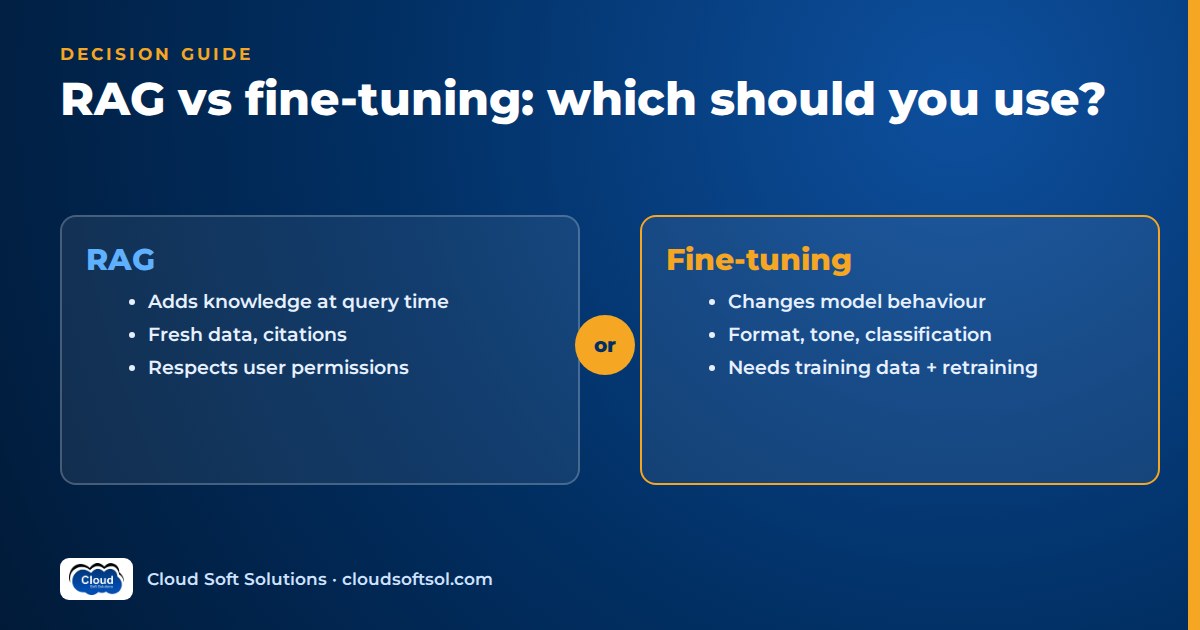
If you are deciding between RAG vs fine-tuning, here is the short answer. Use retrieval-augmented generation (RAG) when the model needs to know things — your policies, products, tickets or contracts — and use fine-tuning when the model needs to behave differently: follow a fixed output format, adopt a house tone, or perform a narrow task such as classification more consistently. Most enterprise assistants are knowledge problems, so RAG is usually the right first build. Before either, try prompt engineering and few-shot examples, because they solve more problems than people expect at a fraction of the effort.
What each technique actually does
Fine-tuning changes the model
Fine-tuning continues training a pre-trained model on your own examples, usually pairs of input and desired output. The training process adjusts the model's weights so that, afterwards, it responds differently to similar inputs even with a short prompt. What it learns well is patterns: a response structure, a classification scheme, a writing style, the vocabulary of a domain, how to call a particular tool schema. What it learns poorly and unreliably is specific facts. A model fine-tuned on your HR handbook may sound like your HR team, yet still state the wrong leave entitlement with full confidence, and it cannot tell you which page it got the answer from.
RAG supplies knowledge at query time
RAG leaves the model untouched. When a user asks a question, the system searches your content (typically by embedding chunks of documents into a vector store such as PostgreSQL with pgvector, often combined with keyword search), retrieves the most relevant passages, and places them in the prompt alongside instructions to answer from that context. The model reasons over evidence it has just been handed. Update a document and the next answer reflects it; restrict a document and users without access never see it retrieved. For the full pipeline — chunking, embeddings, retrieval, reranking and grounding — read our explainer on what RAG is and how it works.
A simple mental model: fine-tuning is training an employee; RAG is giving the employee the right file before they answer.
RAG vs fine-tuning: detailed comparison
| Dimension | RAG | Fine-tuning |
|---|---|---|
| What changes | The prompt: retrieved context is added per request | The model weights (or a small adapter on top of them) |
| Knowledge freshness | As fresh as your index; re-index a document and answers update | Frozen at training time; new facts need a new training run |
| Citations | Natural: you know which chunks were supplied and can show them | Not available: the model cannot point to where a learned pattern came from |
| Access control | Enforceable at retrieval by filtering on user identity, roles or document metadata | Not enforceable: anything trained in is potentially available to every user of that model |
| Cost profile | Ongoing costs for embedding, vector storage, retrieval and longer prompts; little upfront cost | Upfront cost for data preparation and training runs, plus hosting the custom model; shorter prompts per request |
| Latency | Adds a retrieval step and more input tokens per request | No retrieval step; shorter prompts can make responses faster |
| Data needed | Your existing documents, cleaned and chunked; no labelled examples required to start | A curated set of high-quality input–output examples that represent the behaviour you want |
| Maintenance | Ingestion pipelines, index freshness, chunking and retrieval tuning | Dataset versioning, retraining when requirements or base models change, regression testing |
| Typical failure modes | Wrong or missing chunks retrieved, stale index, answer ignores or misreads context | Confident wrong facts, overfitting to training examples, loss of general ability, behaviour drift after retraining |
| Typical use cases | Policy and product Q&A, support assistants, document search, research over internal knowledge | Strict output formats, consistent tone, classification and extraction, domain jargon, smaller cheaper models for a narrow task |
Two rows deserve emphasis for enterprise work. Access control is often decisive on its own: if a branch employee and a credit-risk analyst should see different documents, that rule must be applied at retrieval time, and fine-tuning cannot honour it. Citations are frequently a compliance requirement in banking, insurance and healthcare, where a reviewer needs to verify an answer against its source.
Start cheaper: prompt engineering and few-shot
Before committing to either technique, find out how far the base model gets with a well-designed prompt. Clear instructions, an explicit output schema, a handful of worked examples (few-shot prompting) and the structured-output or JSON modes offered by most model providers will fix a surprising share of "the model doesn't do what we want" complaints.
It is fast, it gives you a baseline to measure RAG or fine-tuning against, and it produces the evaluation set and output specification that fine-tuning would need anyway.
Prompting stops being enough when the examples you need no longer fit comfortably in the prompt, when behaviour stays inconsistent across many runs despite clear instructions, when long prompts make cost or latency unacceptable at volume, or when the model simply does not know the facts. The last case points to RAG; the others point toward fine-tuning.
A decision flow you can use
Start: what is failing?
        |
  Try prompt + few-shot first
        |
  Good enough? --yes--> Ship, keep evaluating
        | no
        v
  Missing or changing facts?
  Need citations or per-user access?
        |                     |
       yes                    no
        |                     |
        v                     v
       RAG          Format / tone / task
        |           inconsistent at scale?
        |                     |
        |                    yes
        |                     v
        |              Fine-tune (LoRA)
        |                     |
        +------> Both? <------+
          RAG for knowledge,
          fine-tune for behaviour
Notice that the first branch is about the nature of the failure, not the technique you would prefer to build.
Illustrative enterprise examples
Customer support assistant at a retailer: RAG
Consider a retailer that wants an assistant to answer agents' questions about return policies, warranty terms and order status. Policies change with every sale season, terms differ by product category, and agents need to quote the source when a customer disputes an answer. This is a knowledge problem with frequent updates and a citation requirement. The right build is RAG over the policy repository, with metadata filters for region and product line, plus a tool call to the order system for live status.
Claims triage at an insurer: fine-tuning
Now consider an insurer that receives free-text claim descriptions and needs each one classified into a fixed set of categories, with severity and a few extracted fields in a strict JSON schema that a downstream workflow consumes. The facts are in the claim itself; nothing needs retrieving. The problem is consistency at high volume. After few-shot prompting plateaus, fine-tuning a smaller model on a few thousand reviewed examples can produce more consistent labels with shorter prompts, which lowers cost per request.
Internal report drafting at a bank: often both
Consider a GCC IT team in Hyderabad building a tool that drafts credit-review summaries. The content must come from the current customer file and policy documents (RAG, with access control by role), while the summary must follow the bank's exact section structure and cautious house tone every time (a fine-tuning candidate, if prompting cannot hold it). This is where combining the two earns its complexity.
When to combine RAG and fine-tuning
Combining is legitimate, but it should be a deliberate second step rather than a starting architecture. Common patterns:
- Fine-tune for format, RAG for facts. The model learns to produce a specific structure or tone; retrieval supplies the content. This is the most common and most defensible combination.
- Fine-tune the model to use retrieved context better. Train on examples that pair retrieved passages with answers that cite them correctly and decline when the context is insufficient.
- Fine-tune the retrieval components. Sometimes the weakest link is not the generator but the embedding model or reranker, which may not understand your domain vocabulary. Adapting those on query–document pairs can improve retrieval without touching the LLM.
- Fine-tune a smaller model for a narrow step. In an agent pipeline, a fine-tuned small model can handle routing or classification cheaply, while a larger model with RAG answers the open-ended questions.
Every combination adds a component to version and maintain, so add the second technique only when evaluation shows the first has hit its limit.
Parameter-efficient fine-tuning and LoRA, plainly
Full fine-tuning updates every weight in the model. For large models that needs substantial GPU memory, produces a complete copy of the model for every variant, and risks the model forgetting general abilities. Parameter-efficient fine-tuning (PEFT) methods avoid most of that by training only a small number of extra parameters.
LoRA (Low-Rank Adaptation) is the most widely used PEFT method. It works like this:
- The original model weights are frozen; they are not changed during training.
- For selected weight matrices (commonly in the attention layers), LoRA adds a pair of small matrices whose product represents the change to that layer. Because their inner dimension (the "rank") is small, they hold far fewer parameters than the layer.
- Only these small matrices are trained. The result is an adapter file that is tiny compared with the base model.
- At inference, the adapter's update is added to the frozen weights, either on the fly or merged in permanently. You can keep one base model and swap different adapters for different tasks.
A related variant, QLoRA, loads the frozen base model in a quantised (lower-precision) form to reduce memory further while training LoRA adapters on top. Managed platforms such as Amazon Bedrock, Azure OpenAI and Vertex AI offer fine-tuning for selected models without you managing GPUs; check each provider's current documentation for which models and methods are supported, since this changes frequently.
What LoRA does not change is the core trade-off. It makes fine-tuning cheaper and more practical, but a LoRA adapter is still learned behaviour, not a searchable, citable, access-controlled knowledge base.
Data and risk considerations
For fine-tuning, quality beats quantity. A smaller set of examples that domain experts have reviewed usually outperforms a large scrape of historical outputs, which tends to contain the very inconsistencies you are trying to remove. Strip personal data you do not need: whatever is trained into a model is hard to remove, and models can reproduce fragments of training data. Keep a held-out test set that is never used in training.
For RAG, the risks sit in the pipeline: missing permission metadata, stale content and prompt injection hidden in retrieved documents. Treat retrieved text as untrusted input and enforce identity in the retrieval layer, not the prompt.
Evaluate either approach the same way
The only honest way to choose between RAG and fine-tuning — or to justify combining them — is measurement against a fixed evaluation set built from real user questions and reviewed answers. Run the prompt-only baseline, then each candidate, on the same set.
- For RAG, measure retrieval and generation separately: did the right passages come back (context precision and recall), and is the answer faithful to them? Tools such as Ragas help score these, and tracing with LangSmith or Langfuse shows which chunks each answer used.
- For fine-tuning, measure task accuracy per category, format validity, and regressions on general capabilities you still rely on. Compare against the base model with few-shot prompting, not against a weak zero-shot prompt.
- For both, track cost and latency per request, and re-run the suite on every change to prompts, index, adapter or base model.
Our guide to LLM evaluation covers how to build the evaluation set, choose metrics and use LLM-as-judge responsibly. If you are preparing for interviews, the RAG interview questions page is a good self-test on these trade-offs.
Want to build these systems hands-on rather than only read about them? Cloudsoft's AI, GenAI and Agentic AI course covers prompting, RAG with pgvector, fine-tuning trade-offs and evaluation with practical labs, in our Ameerpet classroom or live online.
What changes in production
In a demo, RAG versus fine-tuning looks like a modelling choice. Inside an enterprise it becomes an architecture choice that touches identity, data governance, cloud cost, deployment and monitoring. Who can see which document, how the index stays in sync, where a custom model is hosted, and how you prove an answer was correct months later decide whether the system survives real users. Our article on why AI demos fail in enterprise production covers those failure modes in depth.
Making those decisions with a specific customer, inside their environment, and owning the result is what Forward Deployed Engineers do; if that is the career you are aiming for, look at the AI Forward Deployed Engineer course (FDE PRO), whose Enterprise Knowledge Assistant project is a production RAG build.
Frequently asked questions
Is RAG better than fine-tuning?
Neither is better in general; they solve different problems. RAG is better when the model needs current, citable, access-controlled knowledge. Fine-tuning is better when the model needs to behave more consistently, such as following a strict format, tone or classification scheme. For most enterprise knowledge assistants, RAG is the right starting point.
Can fine-tuning teach an LLM new facts?
Only unreliably. Fine-tuning is good at teaching patterns and behaviour, but facts learned this way are hard to update, cannot be cited, and may be reproduced inaccurately. If the problem is that the model does not know your information, use RAG.
When should I fine-tune an LLM?
Fine-tune when prompt engineering and few-shot examples have plateaued and you still need more consistent output format, tone, classification or extraction, or when you want a smaller, cheaper model to perform a narrow task well at high volume. You also need a curated set of high-quality examples and an evaluation set to prove the improvement.
Is fine-tuning more expensive than RAG?
The cost profiles differ. Fine-tuning has upfront costs for data preparation, training runs and hosting a custom model, but can reduce prompt length per request. RAG has little upfront cost but ongoing costs for embeddings, vector storage, retrieval and longer prompts. Which is cheaper depends on your volume and how often knowledge changes.
What is LoRA in fine-tuning?
LoRA, or Low-Rank Adaptation, is a parameter-efficient fine-tuning method. It freezes the original model weights and trains small additional matrices for selected layers, producing a compact adapter. This needs far less memory than full fine-tuning and lets you swap different adapters on the same base model.
Can I use RAG and fine-tuning together?
Yes. A common pattern is to fine-tune for output format or tone and use RAG to supply the facts. You can also fine-tune the embedding model or reranker to improve retrieval. Add the second technique only when evaluation shows the first has reached its limit on a specific problem.
Does RAG work with access control?
Yes, and this is one of its main enterprise advantages. Retrieval can filter documents by the user's identity, roles or document metadata, so users only receive answers based on content they are allowed to see. Fine-tuned weights cannot enforce per-user permissions.
How do I know whether RAG or fine-tuning is working?
Build a fixed evaluation set from real questions with reviewed answers, measure a prompt-only baseline, then compare each approach on the same set. For RAG, score retrieval quality and answer faithfulness separately; for fine-tuning, score task accuracy, format validity and regressions. Track cost and latency too.
Ready to move from AI concepts to systems you can deploy? Join Cloudsoft's GenAI and Agentic AI training in Hyderabad — classroom beside Ameerpet Metro or live online. Call +91 96660 19191 to book a free demo session.