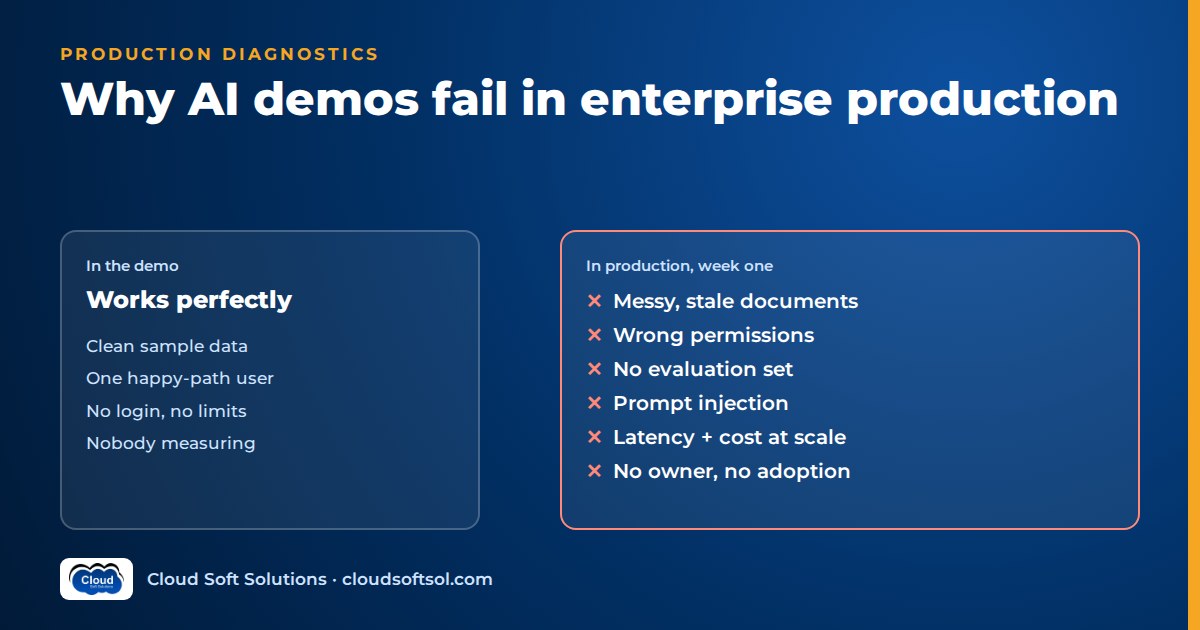
AI demos fail in enterprise production because the demo removed every hard condition production must survive: messy data, real permissions, concurrent users, adversarial input, cost limits and people who have to change how they work. The model is rarely why an AI project fails in production; the system around it is, and most of those failures are predictable, detectable early and fixable with ordinary engineering discipline. This article is a diagnostic catalogue of twelve failure modes: how each shows up, why it happens and what to do about it.
For the career argument behind this work, read why the future of AI engineering is Forward Deployed Engineering. This piece is the practical companion: what breaks, and how to catch it first.
Why AI demos look better than they are
A proof of concept answers "is this possible?", so it quietly strips out everything that complicates the answer. Most AI POC failures trace back to one of these simplifications:
- Curated data. A handful of clean, current PDFs, instead of thousands of duplicated, contradictory and outdated ones.
- The happy path. The demo questions were written by the builder, so they match the documents and the prompt.
- A single user. One request at a time, no rate limits, no queueing.
- No authentication. One service account, so everyone sees everything.
- No cost pressure. Nobody multiplies per-query token cost by real traffic.
- No adversarial input. Nobody is trying to trick the system, and no document contains hidden instructions.
That is what a demo is for. The mistake is treating a successful demo as evidence the system is nearly finished, when it has only proven the easiest part.
Twelve failure modes of enterprise AI in production
Each failure mode has three parts: the symptom you see once real users arrive, the root cause, and the fix as a concrete engineering practice. They apply to retrieval-augmented generation (RAG) assistants, agents and embedded LLM features.
1. Messy, duplicated and stale documents
Symptom: Confident answers that were true two years ago, or different answers to the same question depending on which copy of a document was retrieved.
Root cause: The corpus was ingested as-is. Enterprise document stores hold drafts, superseded versions, regional variants and copies of copies, and nothing in the pipeline knows which is authoritative.
Fix: Treat ingestion as data engineering. Agree authoritative sources with document owners, deduplicate by content hash, attach metadata (owner, version, effective date, region, status) to every chunk and filter retrieval on it. Schedule re-ingestion and alert when a source goes stale.
2. The assistant shows data a user should not see
Symptom: An innocent question returns a quote from a restricted folder: a salary review, a disciplinary file, another region's customer data.
Root cause: The vector index was built with one privileged account, so every chunk is retrievable by every user. Source-system permissions were lost at ingestion.
Fix: Carry access control lists into the index as chunk metadata and filter retrieval by the signed-in user's identity and groups before anything reaches the model. Integrate the enterprise identity provider (for example Microsoft Entra ID) rather than inventing a parallel permission model. Never rely on a system prompt telling the model not to reveal something. Add permission tests: "a user in group A must never retrieve document X".
3. Retrieval quality collapses at scale
Symptom: Answers that were good over fifty documents turn vague or wrong over fifty thousand. The right document exists but is not in the top results.
Root cause: Chunking and embedding choices that worked on a small, homogeneous set cannot separate similar content in a large one. Many policies or runbooks look semantically alike.
Fix: Measure retrieval separately from generation, using recall and precision on a labelled query set. Use hybrid keyword-plus-vector search, add re-ranking, chunk along document structure rather than fixed sizes, and narrow the search space with metadata filters. Our RAG interview questions go deeper.
4. No evaluation set, so regressions go unnoticed
Symptom: Someone tweaks the prompt or swaps the model to fix one complaint, and other kinds of questions quietly get worse until users complain.
Root cause: Quality is judged by impression. With no fixed set of questions and known good answers, versions cannot be compared.
Fix: Build an evaluation set from real user questions, with reference answers and sources verified by domain experts. Score retrieval relevance, faithfulness and correctness with a framework such as Ragas, plus human review on a sample. Run it in CI on every change to prompts, chunking, models or retrieval settings, and block releases that regress.
5. Hallucinated or misattributed citations
Symptom: The answer cites a policy section that says something else, or does not exist. Users stop trusting citations entirely.
Root cause: Citations were produced as free text, so the model generated plausible-looking references not tied to what was actually retrieved.
Fix: Pass retrieved chunks with stable identifiers and require structured output that cites only those IDs. Validate every citation in code: if an ID was not in the context, or the quoted text is not in that chunk, reject or flag the answer. Render citations as links to the exact passage.
6. Latency under real load
Symptom: Responses that took seconds in the demo crawl at peak hours, time out behind the corporate gateway or hit provider rate limits.
Root cause: The demo made one call at a time. Production adds concurrency, multi-step agent loops, long contexts, provider quotas and proxy hops, none of which were load tested.
Fix: Load test with realistic concurrency and question mixes. Stream tokens, cap agent steps, trim context, cache frequent retrievals and answers, secure adequate quota or provisioned capacity, and implement retries with backoff plus a clear fallback when the provider is unavailable.
7. Token cost surprises
Symptom: The first monthly bill is far higher than anyone expected, and finance asks who approved it.
Root cause: Nobody modelled cost per request times expected volume. Long system prompts, oversized context, agent loops and retries multiply token usage invisibly.
Fix: Log input and output tokens per request, feature and team from day one, with budgets and alerts. Route simple requests to smaller models, use prompt caching where supported, cut redundant context and hard-limit agent iterations. Track cost in evaluation alongside quality.
8. Prompt injection via documents and emails
Symptom: On certain inputs the assistant ignores its instructions, leaks its system prompt or, in an agent, takes an action nobody asked for after reading an email or uploaded file.
Root cause: The model cannot reliably separate instructions from data. Any text it reads, including corpus documents, customer emails or web pages, can carry instructions that override intended behaviour.
Fix: Assume injection will happen and limit the damage. Give agents minimum tools and permissions, run tools under the user's identity rather than a super-user account, require human approval for consequential actions, delimit untrusted content, apply input and output guardrails, and red-team before launch. The DevSecOps course covers building such checks into the delivery pipeline.
9. Brittle tool calls and API changes in agents
Symptom: An agent that worked last week fails halfway through tasks, calls a tool with wrong arguments or loops on the same broken call.
Root cause: Tools were thin wrappers over internal APIs with loose schemas and no contract tests. When a downstream API changed a field, its authentication or its error format, the agent could not cope.
Fix: Put a small tested service between the agent and each enterprise system, with typed inputs and outputs, validation, idempotency and error messages the model can act on. Expose narrow tools rather than raw APIs, through a standard interface such as the Model Context Protocol (MCP) where it fits. Add contract tests per downstream API and give the agent's control flow (for example in LangGraph) explicit retry limits and failure states. The rise of agentic AI makes this more common.
10. No observability, so you cannot debug a bad answer
Symptom: A senior manager forwards a screenshot of a wrong answer and asks why. The team cannot reproduce it and has no record of what was retrieved or sent.
Root cause: The system logs HTTP status codes, not the AI pipeline: query, retrieved chunks and scores, final prompt, model version, tool calls, tokens and per-step latency.
Fix: Trace every request end to end with LangSmith, Langfuse or OpenTelemetry, showing a trace ID in the UI so users can report it. Redact sensitive fields before storage. Attach user feedback to traces and route bad answers into the evaluation set. Give the AI service dashboards, alerts and on-call ownership like any production service; the SRE course teaches that discipline.
11. Legacy integration and network constraints
Symptom: It works in the developer's cloud sandbox but cannot reach systems of record in production. Calls time out, TLS fails behind an inspection proxy, or security refuses a firewall route to an external model endpoint.
Root cause: The POC ignored where the data lives: on-premises databases, mainframe exports, SOAP services behind VPNs, private networks with strict egress rules and data residency requirements.
Fix: Map network paths and residency requirements during discovery, not in the last week. Use managed model services inside the enterprise's own cloud account and region, private endpoints instead of public calls, and approved connectivity to on-premises systems. Get network and security sign-off before building.
12. No owner, no adoption and no definition of success
Symptom: Usage spikes for a few days after launch, then fades. Months later leadership asks what value it delivered and nobody can answer.
Root cause: Engineering owned the project, not the business process it was meant to improve. Nobody defined a baseline or target, changed the workflow to include the tool or gave users a reason to trust it.
Fix: Before building, name a business owner and agree a measurable outcome against today's baseline, such as ticket resolution time, escalations or hours spent on a specific task. Embed the assistant in tools users already use, train champions, collect feedback and report the metric regularly.
Want to practise diagnosing and fixing these problems on realistic systems rather than just reading about them? Cloudsoft's AI Forward Deployed Engineer course takes each project through evaluation, observability and security, not just a working demo.
An illustrative scenario: the HR-policy assistant that failed in week one
Consider a retailer with stores across several states and a large head office. HR answers the same questions daily: leave entitlements, shift swaps, maternity benefits, travel reimbursement. A small team builds an HR-policy assistant over the policy library. In the demo it answers twenty questions perfectly, with citations, and is rolled out to all employees. Within the first week, four failure modes appear together:
- Stale documents (failure mode 1). A store employee asks about festival leave and gets last year's policy, because both versions sat in the same shared folder. Fix: HR names one authoritative folder, documents carry effective dates and retrieval excludes superseded versions.
- Permissions (failure mode 2). A store associate asks how bonuses are decided and receives an excerpt from a manager-only pay-band document. Fix: the index is rebuilt with folder permissions as metadata, retrieval filters by the employee's identity groups, and permission tests run in CI.
- Hallucinated citations (failure mode 5). An answer about notice periods cites a clause that does not exist. HR staff screenshot it and trust collapses. Fix: citations are restricted to retrieved chunk IDs, validated in code and linked to the exact paragraph.
- No owner (failure mode 12). When complaints arrive, nobody knows whether HR or IT owns the assistant, so nothing is fixed for days. Fix: an HR business owner is named, flagged answers are reviewed weekly, and success is defined as fewer repetitive HR tickets on covered topics.
None of these were model problems; a newer model would have failed the same way. The relaunch works because the team treats it as an enterprise system with data ownership, access control, evaluation and an owner.
Summary: early warning signs and prevention
| Failure mode | Early warning sign | Prevention |
|---|---|---|
| Messy, stale documents | Same question, different answers | Authoritative sources, version metadata, dedup |
| Permission leakage | Index built with one service account | ACL metadata, identity-filtered retrieval, permission tests |
| Retrieval collapse at scale | Right document exists but is not retrieved | Retrieval metrics, hybrid search, re-ranking |
| No evaluation set | Quality judged by "looks good" | Expert-verified eval set run in CI |
| Hallucinated citations | Citations generated as free text | Chunk-ID citations validated in code |
| Latency under load | No load test before launch | Load testing, streaming, caching, step caps |
| Token cost surprises | No per-request token logging | Cost tracking, budgets, model routing |
| Prompt injection | Agents read untrusted content with broad tools | Least privilege, approvals, guardrails, red-teaming |
| Brittle tool calls | Tools wrap raw APIs with loose schemas | Typed tool services, contract tests, retry limits |
| No observability | Bad answers cannot be reproduced | End-to-end tracing with trace IDs and feedback |
| Legacy and network constraints | POC runs only in a sandbox | Network and residency mapping in discovery |
| No owner, no success metric | Nobody can state the baseline | Named business owner, agreed outcome metric |
Pre-production readiness checklist
Run this before any LLM app reaches real users. Each item needs an owner and evidence.
- Authoritative sources are agreed with their owners; superseded content is excluded.
- Every chunk carries source, version, effective date and permission metadata.
- Retrieval is filtered by the signed-in user's identity, and permission tests pass in CI.
- An expert-verified evaluation set built from real questions runs on every change.
- Retrieval quality and answer faithfulness are measured separately, with agreed release thresholds.
- Citations reference retrieved chunks only and are validated in code.
- Load testing at expected peak concurrency is done, with timeouts and fallbacks defined.
- Token usage and cost are logged per request, with budgets and alerts.
- Prompt injection has been red-teamed; agent tools are least-privilege, with approval for consequential actions.
- Every tool has typed inputs, contract tests and bounded retries.
- Every request is traced end to end, sensitive fields are redacted, and users can see a trace ID.
- Network paths, private endpoints and data residency are approved by security and network teams.
- A business owner and an incident support owner are named.
- A baseline and target metric are agreed, with a date for the first value review.
- Users are trained, feedback capture is live, and a rollback plan is documented.
Who catches these failures
Every failure mode above sits on a boundary between teams: data and HR, retrieval and identity, the model and the network, engineering and the business. Someone has to own the whole path from discovery to outcome, and increasingly that person is a Forward Deployed Engineer, embedded with the business or customer team to build, integrate, deploy and measure the system. Our guide What Is a Forward Deployed Engineer? explains the role in full.
Knowing the failure modes is half the job. The other half is a delivery process that forces each one to be addressed at the right stage; for that stage-gate playbook, read how FDEs take AI from POC to production.
Frequently asked questions
Why do most AI pilots not reach production?
Most pilots are built to prove something is possible, not to survive real conditions. They use curated data, one user, no authentication, no cost limits and no evaluation. When the project meets enterprise data, permissions, security review, legacy systems and real users, the gaps appear at once, and often nobody owns the business outcome that would justify fixing them.
How do you evaluate an LLM app before launch?
Build an evaluation set from real user questions with reference answers and sources verified by domain experts. Measure retrieval and generation separately, using metrics such as context relevance, faithfulness and answer correctness with a framework like Ragas, plus human review on a sample. Add adversarial and permission test cases, agree release thresholds and run the evaluation automatically on every change.
What is prompt injection?
Prompt injection is an attack where text the model reads, such as a user message, document, email or web page, contains instructions that override the system's intended behaviour. Because models cannot reliably separate instructions from data, the defence is to limit impact: least-privilege tools, actions run under the user's identity, human approval for consequential steps, guardrails and red-team testing.
How do you control LLM cost in production?
Log input and output tokens for every request and attribute them to features and teams. Then cut waste: trim retrieved context, shorten system prompts, use prompt caching where supported, route simple requests to smaller models, cache frequent answers and cap agent iterations. Set budgets and alerts so cost increases are noticed within days, not at month end.
How long should an AI POC take?
It depends. The main factors are how accessible and clean the data is, how many systems must be integrated, how strict the security and compliance review is, whether the use case is retrieval-only or involves agents taking actions, and how quickly domain experts can help build an evaluation set. Keep a POC short enough to stay focused, but include evaluation and a realistic data sample, or it proves very little.
Is a better model the fix for a failing AI project?
Rarely. Most production failures come from data quality, retrieval design, permissions, missing evaluation, integration and ownership. A stronger model may improve answers at the margin, but it will not fix a stale document, a leaked permission or a missing success metric. Diagnose the failure mode first, then decide whether the model is really the bottleneck.
If you want to learn to build AI systems that survive these failure modes, from data and identity through evaluation, observability and business outcome, explore the Cloudsoft FDE PRO program: 12 weeks, 60+ labs, five enterprise projects and a simulated customer engagement capstone, in our Ameerpet classroom beside Ameerpet Metro or live online. For a free demo, call +91 96660 19191.