AI is now easy to get access to. Any developer can call a large language model through an API, wire up a retrieval pipeline over a weekend, or spin up an agent from a framework tutorial. What enterprises still find hard is everything around the model: messy data, legacy systems, security reviews, identity, compliance, deployment, evaluation, cost and getting people to change how they work. The future of AI engineering belongs to engineers who can take a real enterprise problem and turn it into a production AI system that delivers a measurable outcome. That is the work of the Forward Deployed Engineer. The job title may change over the next few years. The skills behind it will not.
AI is easy to access and hard to deliver
Not long ago, language understanding meant training your own model. Today foundation models are managed services on every major cloud: Amazon Bedrock, Azure OpenAI and Gemini on Google Cloud. Open frameworks like LangChain and LangGraph give you retrieval-augmented generation (RAG), tool calling and multi-agent orchestration as library calls. The Model Context Protocol (MCP), an open protocol Anthropic introduced in late 2024, standardises how AI applications connect to tools and data sources. A capable developer can build a convincing chatbot over company documents in an afternoon.
So why do so many enterprise AI initiatives stall after the first demo? Ask anyone who has taken one to production in a bank, insurer, hospital or GCC IT team, and you hear the same list:
- Messy data scattered across SharePoint, scanned PDFs, mainframe exports and spreadsheets nobody owns, some of which should never reach a model.
- Legacy applications that hold the systems of record behind SOAP services, batch files or nothing at all.
- Security and compliance reviews asking where data goes, how prompts are logged and how the system fails.
- Authentication and authorisation that must flow through the AI layer. If a branch officer can't see a record in the core system, the assistant can't show it either.
- APIs, integration and business workflows, with approvals, exceptions and handoffs that a generic chat interface ignores.
- Deployment, observability and reliability on approved infrastructure, including surviving model provider outages.
- Evaluation: evidence, not impressions, that answers are grounded and correct.
- Cost: token spend that looked trivial in a demo becomes a budget line at enterprise volume.
- Change management and measurable ROI: users must adopt the tool, and leadership wants to see a number move.
Almost none of this is about the model. The model is the part that got easy.
The bottleneck moved from the model to integration
For most of applied machine learning's history, the model was the bottleneck, and people who could build models were the scarce resource. Foundation models changed that. For a large class of enterprise problems, such as summarising, classifying, extracting, answering questions over documents or drafting responses, a hosted model is already good enough out of the box. The question an enterprise asks has shifted from "can AI do this?" to "can we make AI do this safely, inside our systems, for our users, at a cost we accept?"
That second question is an engineering and integration problem. To answer it you need someone who understands the model's behaviour well enough to design around its weaknesses, and who also understands identity providers, API gateways, Kubernetes, data pipelines, audit logs and the people in the business who will use the result. Few engineers cover both sides. Enterprises feel that gap, and the Forward Deployed Engineer role exists to fill it.
Palantir popularised the term, sending engineers "forward deployed" into customer organisations to make its software work on real problems and real data. AI labs and enterprise software companies now hire FDEs for the same reason: a powerful platform does nothing for a customer until someone integrates it into that customer's world. If you are new to the role, our guide What Is a Forward Deployed Engineer? covers the responsibilities in detail.
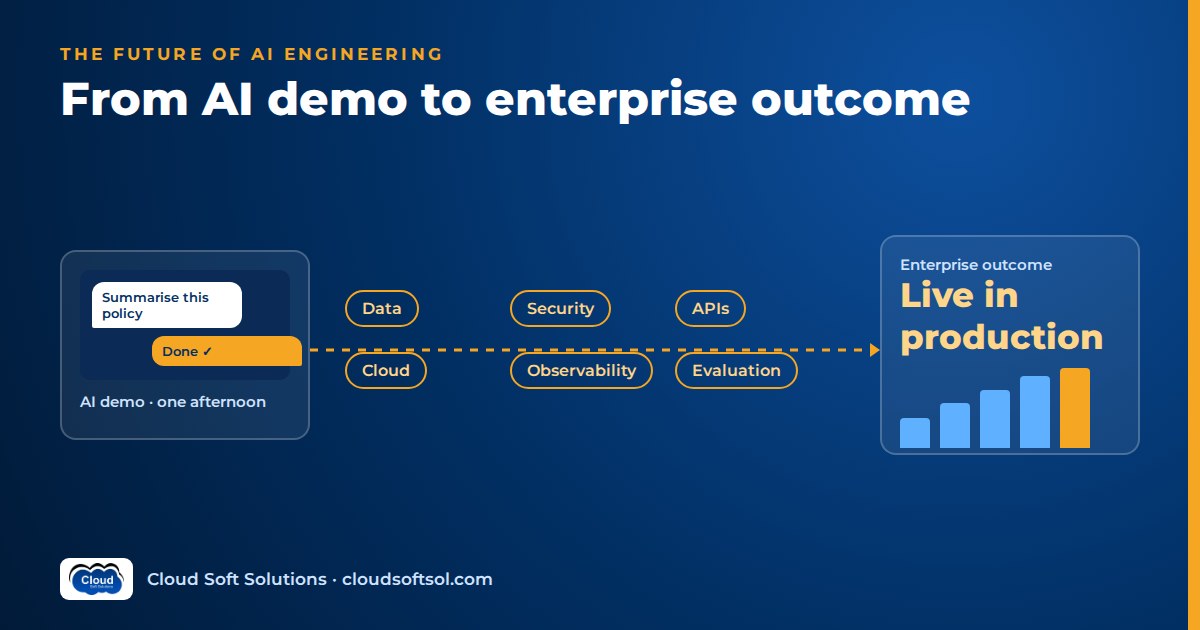
From AI demo to enterprise outcome
At Cloudsoft we sum up this shift in one phrase: From AI demo to enterprise outcome. A demo proves that something is possible. An outcome proves it was worth doing. Most of the engineering, and most of the career value, sits in the distance between the two.
Compare it with how most engineers were trained to think about delivery:
TRADITIONAL ENGINEERING

  Requirement --> Code --> Deploy


FORWARD DEPLOYED ENGINEERING

  Customer problem
     --> Discovery
     --> Business requirement
     --> Data
     --> AI architecture
     --> RAG / Agent
     --> Tools / MCP
     --> APIs
     --> Security
     --> Cloud
     --> Deployment
     --> Observability
     --> Evaluation
     --> Optimization
     --> Business outcome
The traditional chain assumes someone else has already turned the business problem into a clear requirement, and that "deployed" means "done". The FDE chain starts earlier and ends later. It starts with a customer problem that nobody has written down properly yet, and it ends only when the business can point to a result. In between, the engineer owns the decisions that decide whether an AI system survives contact with an enterprise: what data to trust, which actions an agent may take, how identity flows, how quality is measured and how cost is controlled.
An illustrative scenario: an insurer's claims assistant
Here is how the gap plays out in practice. Consider a mid-sized general insurer whose claims team is drowning in paperwork. A claims handler reviewing a motor claim has to read the policy wording, check the endorsements, look at the surveyor's report, compare it with past claims on the same vehicle and draft a decision note. Leadership wants an AI assistant to speed this up.
Week one: the demo
An engineer takes a sample of policy PDFs, chunks them, stores embeddings in a vector database and puts a chat interface over a hosted LLM. In the demo, a handler asks "Is flood damage covered under this policy?" and gets a fluent answer with a citation. Everyone is impressed and the project gets funded.
What breaks on the way to production
- The data isn't what the demo assumed. Endorsements live in a separate system, surveyor reports are scanned images, and older policy wordings contradict newer ones. The assistant confidently quotes a withdrawn clause. Fix: the FDE maps authoritative sources with claims operations, tags every chunk with product version and effective dates, and filters retrieval by the policy actually attached to the claim, not by semantic similarity alone.
- The assistant can see too much. In production, a handler in one region must not see another region's claims, and health details on personal accident claims are restricted. Fix: the FDE integrates the insurer's identity provider (for example Microsoft Entra ID) so user groups filter retrieval before content reaches the model, rather than asking the model to "please not reveal" anything.
- Answers aren't enough; handlers need actions. Handlers want the assistant to pull claim history from the core system, which has an ageing API with inconsistent error handling, and to create follow-up tasks. Fix: the FDE wraps the core system in a small tested service with typed inputs, retries and audit logging, exposes a narrow set of tools to the agent (perhaps through MCP), and keeps human approval for anything that changes a claim's status.
- Security review blocks go-live. Information security asks where prompts are stored, whether data leaves the approved region, how prompt injection through uploaded documents is handled and what happens when the provider is down. Fix: the FDE documents the data flow, runs inference on a managed model service inside the insurer's cloud account, adds guardrails, redacts sensitive fields in logs and designs a graceful fallback.
- Nobody can say whether it's good. Some handlers say it is "sometimes wrong", and leadership asks for evidence. Fix: the FDE builds an evaluation set from anonymised claims verified by senior handlers, measures retrieval quality and faithfulness with tools like Ragas, traces interactions with LangSmith or Langfuse, and runs the evaluation on every change in CI.
- Cost and latency creep up. Long documents and multi-step agent reasoning make queries slow and expensive. Fix: caching, routing simple lookups to a smaller model, trimming context and per-team cost dashboards.
- Adoption stalls. Handlers don't trust what they can't check. Fix: the interface shows the exact clause behind every statement, and structured feedback from team leads flows back into the evaluation set.
The outcome
Success is not "we have a chatbot". It is a change the business can see: faster first decisions on routine claims, more consistent decision notes, fewer escalations from missed endorsements. Someone had to own every step from demo to that result. Here, that person is the Forward Deployed Engineer, working with data, security, platform and claims teams.
The same shape repeats in a bank's relationship-manager assistant, a hospital's discharge-summary tool or a GCC IT team's ServiceNow incident-triage agent. The model is rarely why a project fails. The integration usually is.
Want to practise this journey, from messy enterprise problem to deployed, evaluated system? Cloudsoft's AI Forward Deployed Engineer course is built around simulated customer engagements rather than isolated tool demos.
What gets commoditised vs what stays scarce
A useful way to plan a career is to ask which skills are getting cheaper and which are getting rarer. Here is how we see it, honestly and without hype:
| Getting commoditised | Staying scarce |
|---|---|
| Calling an LLM API and writing a basic prompt | Turning a vague business problem into a scoped, testable AI use case |
| Building a simple RAG chatbot over clean documents | Making retrieval trustworthy over messy, versioned, permissioned enterprise data |
| Following an agent framework tutorial | Designing agents with safe, narrow tools, approvals and audit trails |
| Spinning up a managed AI service in a console | Deploying AI on approved infrastructure with IaC, CI/CD, networking and identity |
| Knowing the names of the latest models and tools | Evaluating quality with evidence and catching regressions before users do |
| Generating boilerplate code (increasingly done by AI itself) | Integrating with legacy systems, internal APIs and real business workflows |
| Demo-ready prototypes | Observability, cost control and reliability at production scale |
| Generic "AI expertise" on a resume | Explaining trade-offs to security, compliance and business stakeholders, and earning their trust |
The left column is the entry ticket, but it shrinks as a share of an engineer's value as platforms and AI coding assistants make it easier. The right column depends on context, judgement and accountability, which are much harder to automate.
Will AI itself make this role unnecessary?
Honestly, nobody knows exactly how the tooling will evolve. AI coding assistants already write much integration code, and some of what an FDE does today will be automated. But look at what made the insurer's project hard. It wasn't typing code. It was deciding which documents are authoritative, agreeing an access model with security, negotiating what the agent may do without approval, defining "good enough" with senior handlers and being accountable when things went wrong. Those are judgement calls made inside an organisation. Better tools make an FDE faster; they don't remove the need for one.
We are less sure about the label. "Forward Deployed Engineer" may stay distinct, merge into "AI engineer" or "solutions engineer", or be renamed. Don't bet a career on a job title. Bet on the skills: discovery, integration, secure deployment, evaluation and delivering outcomes. For a closer look at how the roles overlap, see FDE vs AI Engineer.
What this means for engineers in India
India's engineers are well placed for this shift. Global Capability Centres in Hyderabad and Bengaluru increasingly own core platforms for their parent enterprises. Services firms run integration programmes across banking, insurance, healthcare and retail. Product companies are shipping AI features that must work inside customers' environments. All of them need engineers who can carry AI from prototype to production.
Freshers
Your risk is a portfolio of tutorials; recruiters see endless copies of the same "chat with your PDF" project. Stand out by taking one realistic problem further: authentication, a proper API, a database, containerised deployment, tracing and an evaluation report. Strong Python fundamentals and solid SQL matter more than knowing ten frameworks.
Application developers
If you already build APIs and integrate enterprise systems, you hold the scarcer half of the skill set. What you need to add is a working understanding of how LLMs behave: retrieval design, chunking and grounding, tool calling, agent control flow, prompt injection and evaluation. The AI, GenAI and Agentic AI course is a reasonable bridge, and our RAG interview questions are a quick way to test how deep your understanding goes.
DevOps, cloud and SRE engineers
You may be closer to this role than you think. Most production AI failures are deployment, identity, networking, observability and cost failures. If you already work with Terraform, Kubernetes, CI/CD and cloud IAM, you can learn the AI layer on top of that, starting with a managed model service such as Amazon Bedrock and adding OpenTelemetry-based tracing for LLM calls. Being the person who can make an AI system observable and affordable is a strong position.
For a stage-by-stage plan for each starting point, see How to Become an AI Forward Deployed Engineer in 2026.
Common mistakes engineers make
- Tool-collecting. Learning every new framework the week it launches without going deep on any. Enterprises hire for the ability to ship one system that works, not a list of logos.
- Demo-only portfolios. Projects that run on a laptop, with clean sample data, no users, no authentication and no evaluation. In an interview, the first question about access control or failure handling exposes them.
- Treating the model as the product. Spending weeks tuning prompts while ignoring data quality, retrieval design and the workflow the user actually follows.
- Skipping evaluation. "It looks right" is not evidence. If you can't show how you measured quality and caught regressions, a regulated enterprise can't trust your system.
- Ignoring security until the end. Bolting on identity, data boundaries and guardrails after the architecture is set usually means redesigning it.
- Avoiding the business conversation. FDEs spend real time with users, process owners and security teams, and need to earn their trust.
What to learn next: a practical plan
Inside FDE PRO we organise the work into eight stations: Understand → Design → Build → Integrate → Deploy → Observe → Improve → Deliver value. You can use the same structure for self-study, whatever your starting point.
- Understand: practise discovery. Take a process you know, such as an IT helpdesk or claims intake. Write down the users, pain points, systems, data, constraints and what a measurable improvement looks like.
- Design: decide whether the problem needs RAG, an agent with tools, a deterministic workflow with an LLM step, or no AI at all. Sketch the architecture, including identity and data boundaries.
- Build: implement it with Python and FastAPI, PostgreSQL with pgvector for retrieval, and a managed model service. Use LangChain or LangGraph where they help, not by default.
- Integrate: connect to at least one real-world system, such as Jira, GitHub or ServiceNow. Expose tools to your agent deliberately, and try MCP for a standardised tool interface.
- Deploy: containerise with Docker, deploy to a cloud with Terraform, and automate with GitHub Actions. If you can, run it on Kubernetes. The DevOps course covers this foundation.
- Observe: add tracing with LangSmith, Langfuse or OpenTelemetry. Track latency, token cost and failures per request.
- Improve: build an evaluation set, measure with Ragas or a similar framework, and make evaluation part of your pipeline. Change one thing, measure again.
- Deliver value: write a one-page outcome report: the problem, what you built, how you measured it, what it costs to run and what you would do next. This document often impresses interviewers more than the code.
For a week-by-week version of this progression, read the FDE Engineer Roadmap 2026.
Frequently asked questions
Is Forward Deployed Engineering a good career in 2026?
For engineers who enjoy solving real business problems and working across systems and teams, it is a strong direction. More job postings now use the FDE title, and the underlying skills of integration, secure deployment, evaluation and stakeholder communication are valuable even where the title is different. It suits people who like variety and ownership.
Will AI replace the need for Forward Deployed Engineers?
AI tools will automate parts of the job, especially routine coding. The core of the role is judgement inside a specific organisation: deciding what data to trust, what an agent may do, how security and compliance are satisfied and how success is measured. Better AI makes FDEs more productive rather than unnecessary, though the job title itself may evolve.
Is the FDE role only for AI companies?
No. AI labs and enterprise software companies hire FDEs to make their platforms work for customers. The same skills are needed inside enterprises, GCCs and IT services firms, wherever AI must go from prototype to production inside real workflows, often under titles like AI engineer or solutions engineer.
Does a Forward Deployed Engineer need cloud skills?
Yes. Enterprise AI runs on cloud infrastructure, and many production problems are cloud problems: identity and access, networking, data residency, deployment pipelines, scaling and cost. An FDE need not be a cloud architect, but should be comfortable with at least one major cloud, infrastructure as code, containers and CI/CD.
Can a fresher become a Forward Deployed Engineer?
A fresher can build the right foundation and target AI engineering or integration roles that lead toward FDE work. The fastest way to stand out is one or two end-to-end projects that include authentication, real integrations, deployment, observability and evaluation, rather than many demo-level chatbots.
How is an FDE different from an AI engineer?
The roles overlap heavily. An AI engineer typically focuses on building AI features and systems, while an FDE also owns customer discovery, integration into the customer's environment, deployment under their constraints and the business outcome.
What should I learn first to move toward FDE work?
Start with strong Python and API development, then learn how LLMs, RAG and agents behave, then add cloud deployment, security basics, observability and evaluation. Build one realistic project end to end and keep improving it, rather than collecting tools.
Will the title Forward Deployed Engineer last?
Nobody can say for certain. The title may stay, merge into broader AI engineering roles or be renamed. The skills it describes, turning enterprise problems into production AI systems with measurable outcomes, will remain in demand because the gap between AI demos and enterprise results is not closing on its own.
If you want a structured way to build these skills, the Cloudsoft FDE PRO program runs for 12 weeks with more than 120 hours of live sessions, 60+ labs, five enterprise projects and a simulated "GlobalBank" customer engagement as the capstone. It is led by Sreekanth Bathalapalli (20 years in cloud, DevOps and AI engineering) and includes placement support: resume and portfolio reviews and mock interviews. You can join in our Ameerpet classroom, beside Ameerpet Metro, or live online. Call +91 96660 19191 to book a free demo.