To become a Forward Deployed Engineer, you need evidence that you can take a messy customer problem, build an AI system that solves it, deploy it securely in a real environment, and explain the result to people who do not write code. No single degree or certificate proves that. What works is choosing the path that fits your starting point, closing the specific gaps it leaves, and building a portfolio that looks like customer work rather than a tutorial.
For the definition of the role, see what a Forward Deployed Engineer actually does. For the stage-by-stage skills, see the FDE engineer roadmap for 2026. This guide answers a narrower question: given where I am today, what do I do next?
What hiring managers look for in FDE candidates
FDE hiring leans on evidence more than most engineering hiring does. The people hiring are really asking one thing: if I put this person in front of a customer's architecture team next month, will they make progress without supervision? Certificates rarely answer that. These usually do:
- Deployed projects, not notebooks. A RAG assistant behind an authenticated API, with logging and a working URL, says more than a notebook that calls a model. It shows you have handled secrets, failures, retries and cost.
- Written design thinking. A short design note that explains why you chose retrieval over fine-tuning, or an agent over a fixed workflow, shows judgement. FDEs write these for customers all the time.
- Integration experience. Enterprise AI succeeds or fails on its connections to ticketing tools, identity providers, databases and internal APIs.
- Evaluation habits. A small test set, a measured quality score and a list of known failure cases put you ahead of most applicants.
- Clear communication. Your README and how you explain trade-offs are read as samples of how you will talk to customers.
A specific framework, cloud or research background is not on that list. Those are tools. The role is defined by the full chain, from customer problem through discovery, data, AI architecture, integration, security, deployment and evaluation to a business outcome. Hiring managers want to see you work across it, even at small scale.
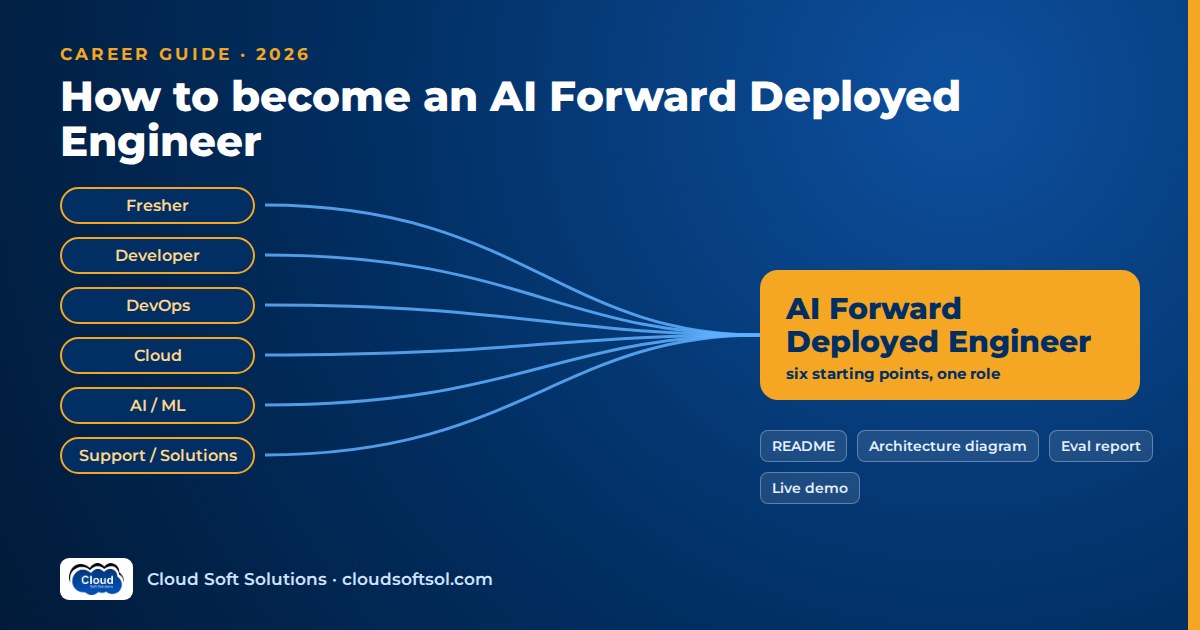
The six paths into an FDE role
Every starting point brings part of the FDE skill set and leaves gaps elsewhere.
| Starting point | What transfers | Biggest gap |
|---|---|---|
| Fresher | Learning speed, recent fundamentals | Production and customer experience |
| Software developer | APIs, code quality, debugging | LLM/RAG/agent patterns, deployment, requirement gathering |
| DevOps engineer | CI/CD, containers, IaC, reliability | Application-level AI engineering, evaluation |
| Cloud engineer | Networking, IAM, managed services | Building the AI application itself |
| AI/ML engineer | Models, data, experimentation | Integration, security, operations, communication |
| Solutions / support / implementation | Customer handling, troubleshooting | Engineering depth and code ownership |
Path 1: Fresher
What transfers: recent fundamentals and time to go deep. Freshers often pick up new AI tooling quickly because they have fewer habits to unlearn.
Gaps to close: production experience and customer context. To be honest about it, most FDE roles are advertised for experienced engineers. A realistic route is an adjacent first job, such as AI engineer, backend developer or implementation engineer, at a company doing customer-facing AI work.
First 3 actions:
- Get solid at Python (FastAPI, typing, tests) and at SQL on PostgreSQL.
- Learn one cloud well enough to deploy a containerised API with proper IAM.
- Build and publicly deploy one end-to-end RAG application, with a README a non-expert can follow.
Portfolio project: a policy assistant that answers questions over real PDFs. It should cite its sources, refuse when it does not know, run in Docker on a cloud service, and come with an evaluation report on a few dozen test questions.
Path 2: Software developer
What transfers: a lot. Most of the build step in FDE work is ordinary software engineering with a model in the loop.
Gaps to close: LLM patterns (chunking, embeddings, tool calling, agent failure modes), evaluation, and deployment ownership if a platform team has always handled that. Many developers have also only ever received requirements, never gathered them.
First 3 actions:
- Add an AI feature to a service you already know, such as a ticket summariser, so the AI parts are the only new variable.
- Evaluate it with a small golden dataset and a tool such as Ragas, and trace requests with LangSmith or Langfuse.
- Volunteer for requirement-gathering work in your current job. Internal stakeholders count as practice.
Portfolio project: a customer integration service. It should receive events from a ticketing or CRM-style system, enrich them with an LLM (classification, summaries, suggested replies), write the results back through an API, and handle retries and idempotency with an audit log.
Path 3: DevOps engineer
What transfers: the deploy, observe and operate stages, which many AI candidates are weakest at. A lot of enterprise AI work stalls at exactly this point, so that is a genuine advantage.
Gaps to close: writing application code rather than pipelines, understanding how RAG and agents behave, evaluation, and owning the product conversation as well as the platform.
First 3 actions:
- Strengthen your Python until you can write a clean FastAPI service with tests.
- Build a RAG service on PostgreSQL with pgvector and deploy it properly, using Terraform, Kubernetes or a managed container service, and GitHub Actions.
- Add AI-specific observability (token usage, per-step latency, retrieval traces, cost per request) using OpenTelemetry and an LLM tracing tool.
Portfolio project: an IT-operations assistant. It reads alerts, retrieves the relevant runbooks, proposes a fix and waits for human approval before acting. Deploy it with IaC and GitOps (for example Argo CD) so the infrastructure is part of the portfolio.
Path 4: Cloud engineer
What transfers: networking, IAM, private connectivity and cost awareness. In banks, insurers and hospitals, the hardest FDE questions are often cloud questions: where does the data go, who can call the model, and does traffic leave the private network?
Gaps to close: building the application layer, prompt and retrieval design, agent frameworks and evaluation. Provisioning a model endpoint is not the same as building a working assistant on it.
First 3 actions:
- Build a small Python application on your cloud's managed model service, whether that is Amazon Bedrock, Azure OpenAI or Gemini on Google Cloud. Go beyond the playground.
- Design a private deployment with private endpoints, least-privilege roles, a secrets vault and logging that excludes sensitive data. Write it up as a one-page architecture.
- Learn LangGraph or an equivalent so you understand how agents call tools and where guardrails belong.
Portfolio project: an enterprise knowledge assistant deployed inside a private network. It should use single sign-on through an identity provider such as Microsoft Entra ID and enforce document-level access control, and it should ship with security notes. The AWS Bedrock GenAI training covers the managed-model side.
Path 5: AI/ML engineer
What transfers: models, embeddings, data quality and experimentation. Evaluation will come naturally to you.
Gaps to close: the enterprise half. That means integrating with systems you do not control, identity, deployment, reliability, and explaining trade-offs without jargon. It also means shifting from "improve the model" to "solve the customer's problem", which sometimes means not using a model for part of the workflow. The comparison of FDE and AI engineer roles covers this shift.
First 3 actions:
- Productionise one existing project fully, with an API, authentication, a container, CI/CD and monitoring.
- Build an integration using the Model Context Protocol (MCP), the open protocol for connecting AI applications to tools and data.
- Practise explaining your evaluation results to a non-technical listener in three minutes.
Portfolio project: an agent that triages and updates tickets in ServiceNow or Jira through an MCP server. Give it permission boundaries, require human approval for risky actions, and evaluate how often it takes the correct action.
Path 6: Solutions, support or implementation engineer
What transfers: the customer half, which is the hardest part to teach. You already run calls, handle escalations and turn vague complaints into reproducible issues.
Gaps to close: engineering depth. FDEs write and own production code, and you need to build the system yourself rather than configure it or hand it off.
First 3 actions:
- Build small services every week until writing an API with tests feels routine.
- Turn a support problem you know well into an AI project.
- Document it as you would for a customer handover. That is your strength, so make it visible.
Portfolio project: a support copilot. It retrieves from product docs and resolved tickets, drafts replies with citations and flags low-confidence answers for review. Add a one-page summary of the expected benefit, written qualitatively with stated assumptions.
Want a structured route through these gaps, with live projects and a simulated customer engagement? Cloudsoft's AI Forward Deployed Engineer course follows this full chain, from discovery to deployment to evaluation.
The FDE portfolio: what a convincing one contains
Two or three deep projects beat ten shallow ones. Each flagship project should read like the handover pack from a real engagement:
- A README a customer could follow, covering the problem, the users, setup, configuration and what it does not do.
- An architecture diagram showing the components, data flow, trust boundaries and where the model is called.
- A design note on the options you considered and the trade-offs you accepted.
- An evaluation report with your test set, metrics (retrieval relevance, faithfulness, task success), results and known failures.
- Security notes on authentication, authorisation, secrets, prompt injection, data retention and what gets logged.
- A deployed demo (a live URL or recorded walkthrough) plus infrastructure as code.
- A one-page business summary in plain language: problem, users, expected outcome, next steps.
Customer problem
   -> Discovery notes + requirements
   -> Data + AI architecture (RAG / agent)
   -> Tools / MCP + APIs
   -> Security + cloud deployment
   -> Observability + evaluation
   -> Business summary
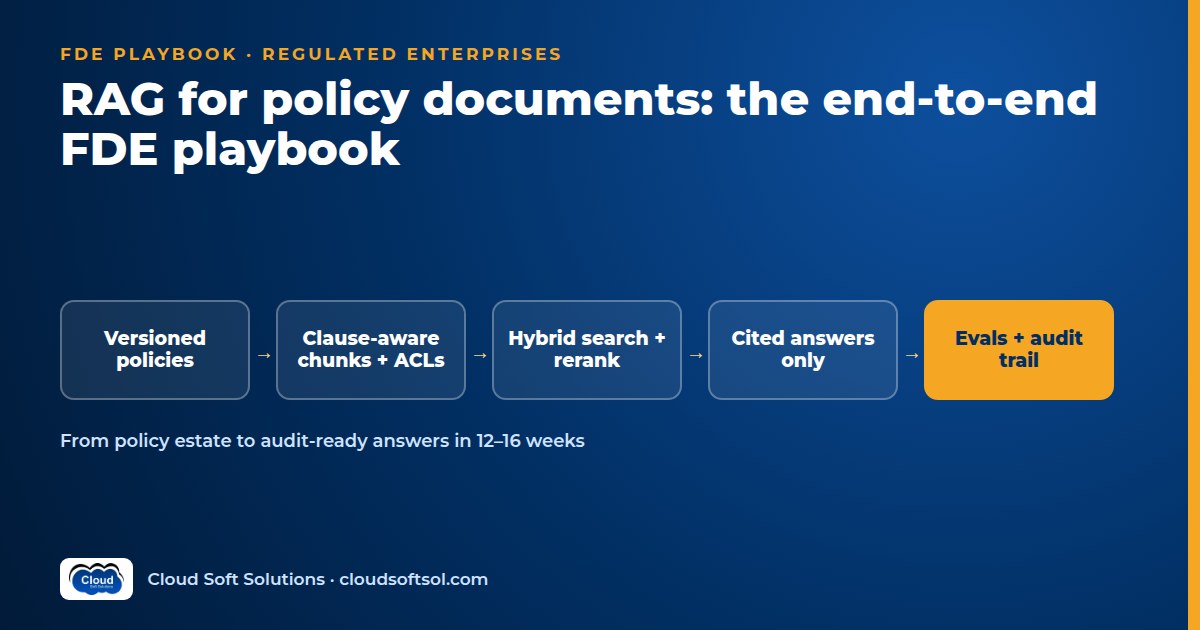
Consider an illustrative example. An insurer wants claims staff to get answers from hundreds of policy documents. A tutorial project stops at "upload PDFs, ask questions". An FDE-level version records who asks what, refreshes documents when policies change, restricts which staff see which policy lines, measures accuracy on realistic questions, logs answers for audit, and ends with a summary a claims manager can read. The core technology is the same, but the signal is completely different.
Practising customer skills
Customer skills are mostly practice, not personality. Three exercises cover most of what you need.
Run mock discovery calls
One person plays a stakeholder, such as a hospital operations head or an IT manager at a GCC in Hyderabad or Bengaluru, with a vague request like "we want AI for our service desk". You have thirty minutes to uncover the real problem, the users, data, systems, constraints and success criteria. Afterwards, write a one-page summary, then swap roles. After a few rounds you will find yourself asking about data access and approvals before you think about models.
Write a high-level design (HLD)
For each project, write a short HLD covering context, requirements, architecture, alternatives, security, deployment, risks and open questions. Interviewers often ask you to walk through one.
Demo to non-technical people
Show your project to a friend in finance or operations. Skip the architecture and show the problem, the result and the limits. If they cannot explain back what it does, refine the demo. This is how you get from AI demo to enterprise outcome.
Resume and interview preparation
Resume
- Lead with full-chain projects, giving one line each for the problem, what you built, and how it was deployed and evaluated.
- Reframe past work honestly in FDE terms: requirements gathered, integrations built, incidents resolved, stakeholders handled.
- Pin repositories that meet the portfolio checklist. List only the tools you can defend in an interview.
The FDE interview loop
Formats vary by company, but most loops combine these rounds:
| Round | What it usually tests | How to prepare |
|---|---|---|
| Practical coding | Building something working, such as consuming an API, transforming data or writing a small service | Build small services against the clock and extend unfamiliar code |
| AI system design | A RAG or agent design for an enterprise scenario, covering data, security, evaluation and scale | Whiteboard your own projects, then new scenarios such as a bank chatbot |
| Customer scenario | Scoping, pushing back and explaining trade-offs to an ambiguous stakeholder | Mock discovery calls, and practise saying what you can and cannot do in two weeks |
| Behavioural | Ownership, ambiguity, failure, collaboration | Specific stories with real detail, including what went wrong |
For concept drills, use the RAG interview questions and agentic AI interview questions.
Self-study vs a structured program: an honest view
Both work. People have moved into FDE-style roles through self-study, open-source work and side projects. The material is freely available in cloud docs, framework docs and open evaluation tools. Self-study suits you if you are disciplined, already work near AI or customers, and can find realistic problems and honest feedback on your own.
A structured program adds four things that are hard to get alone:
- Sequencing, so you learn integration, security and deployment in a sensible order.
- Realistic scenarios, such as simulated engagements with incomplete, shifting requirements.
- Feedback on the soft parts, meaning someone reviews your design documents, discovery calls and demos as well as your code.
- Accountability and pace, which keep you going when self-study would stall.
No program replaces the effort. You still have to build, break and fix things yourself.
If structure suits you, the Cloudsoft FDE PRO program runs for 12 weeks with 120+ hours of live sessions. Each week has four engineering sessions and one Customer Engagement Lab, and the program includes 60+ labs and five enterprise projects: a Customer Integration Service, an Enterprise Knowledge Assistant, a ServiceNow AI Agent via MCP, an IT-Ops Multi-Agent Platform and a Secure Banking AI Assistant. It ends with the "GlobalBank" capstone, a simulated customer engagement. The lead trainer is Sreekanth Bathalapalli, who has 20 years in IT across cloud/DevOps architecture and AI/GenAI engineering. Placement assistance covers resume and portfolio review and mock interviews.
Mistakes to avoid
- Collecting certificates instead of shipping. A certificate does not replace a deployed project.
- Laptop-only demos. If a project is not deployed, secured and observable, it reads as a prototype.
- Chasing every framework. Learn one agent framework and one cloud deeply.
- Skipping evaluation. "It looked right when I tried it" is a weak interview answer.
- Ignoring security. Prompt injection, data leakage and over-permissioned agents are the first things enterprise reviewers ask about.
- Filtering only on the "FDE" title. Similar work appears under titles like solutions engineer, customer engineer and applied AI engineer.
Frequently asked questions
Can a fresher become a Forward Deployed Engineer?
Yes, but usually not as a first job title, because most FDE roles expect production experience. A realistic route is to build two or three deployed, well-documented AI projects, join an adjacent role such as AI engineer or implementation engineer, and move into FDE work as you gain production and customer experience.
Can a DevOps engineer become an FDE?
Yes. DevOps is a strong starting point because deployment, reliability and observability are where many AI projects stall. The main gaps are application-level Python, RAG and agent design, and evaluation.
Do I need a computer science degree to become an FDE?
Not necessarily. Some employers list a degree, but FDE hiring generally weighs demonstrated ability heavily: deployed projects, design documents and how you handle customer scenarios in interviews.
Do I need deep machine learning math for an FDE role?
For most FDE roles, no. You need to understand how LLMs, embeddings, retrieval and agents behave, how they fail and how to evaluate them. Training models from scratch is rarely part of the job, though some research-adjacent roles expect more depth.
How long does it take to become an FDE?
It depends on your starting point, the time you can commit and how close your current work is to the role. An experienced developer or DevOps engineer may need a few focused months to close the gaps, while a fresher should expect a longer path that includes an adjacent first job. No plan can promise a fixed timeline.
Is certification needed to become an FDE?
No. Cloud or AI certifications can help structure your learning, but FDE hiring decisions usually rest on deployed projects, design thinking and interview performance.
Can I become an FDE in India?
Yes. AI labs, enterprise software companies, global capability centres and services firms all need engineers who can deploy AI into customer environments, and more job postings now use the FDE title or describe FDE-style work under related titles.
Ready to turn your current experience into FDE-level evidence? If you want to learn Forward Deployed Engineering through live projects and a simulated customer engagement, Cloudsoft runs FDE PRO as classroom training in Ameerpet, beside Ameerpet Metro, and live online. Call +91 96660 19191 for a free demo.