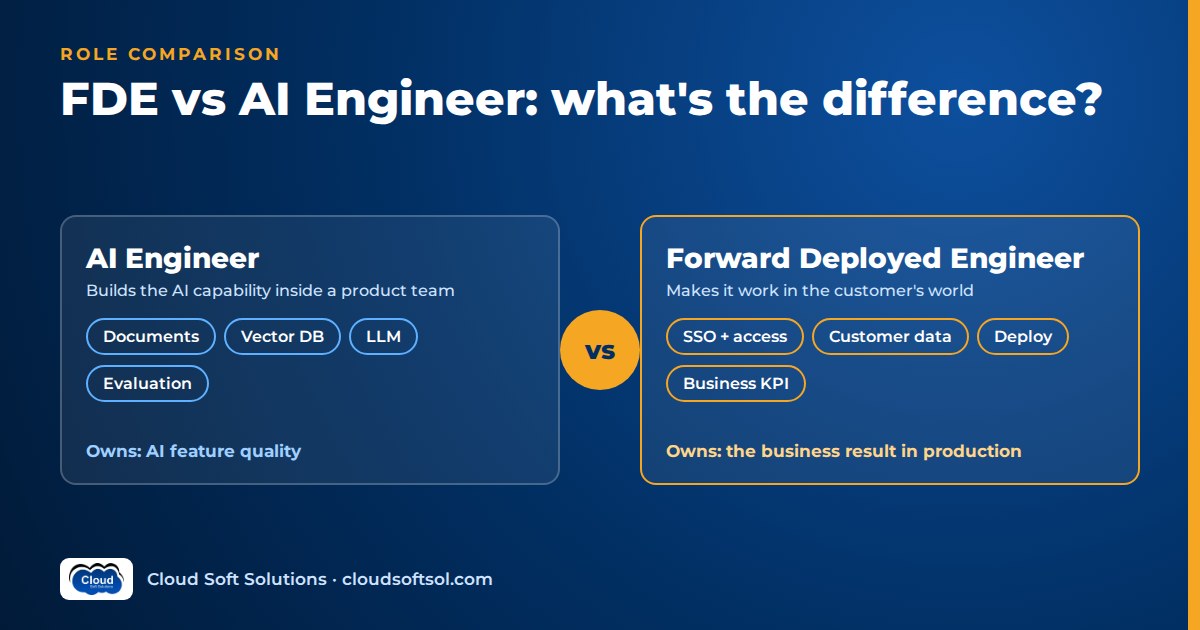
If you are weighing FDE vs AI engineer, here is the short answer. An AI engineer builds AI capability, usually inside one product or platform team; a Forward Deployed Engineer (FDE) makes AI work inside a specific customer's environment and owns the outcome there. The two roles share most of the same technical foundation (LLMs, RAG, agents, evaluation, cloud), so the real difference is not the stack. It is where you stand, who you answer to, and what "done" means.
This guide defines both roles precisely, compares them side by side, walks one project through both sets of eyes, and helps you decide which one fits you, whether you are a fresher, a developer or a DevOps engineer.
Defining the two roles precisely
What an AI engineer is
In most job descriptions today, "AI engineer" means an applied GenAI engineer, sometimes titled applied AI engineer or LLM engineer. This person builds features on top of foundation models: retrieval-augmented generation (RAG) pipelines, agents that call tools, prompt and context design, structured output handling, guardrails, and the evaluation harness that tells the team whether a change made answers better or worse. The work typically lives inside one codebase that the team owns long term, for example the "AI assistant" module of a SaaS product or an internal GenAI platform at a GCC in Hyderabad or Bengaluru.
How that differs from an ML engineer
An ML engineer is a related but distinct role. ML engineers train, fine-tune and serve models: feature pipelines, training jobs, model registries, GPU inference, drift monitoring. An AI engineer mostly consumes models through APIs such as Amazon Bedrock, Azure OpenAI or Gemini and engineers the system around them. The lines blur (an AI engineer may fine-tune occasionally, an ML engineer may build a RAG service), but if your day is about datasets and training loops you are closer to ML engineering; if it is about retrieval, prompts, tools and evals, you are an AI engineer.
What a Forward Deployed Engineer is
The FDE role was popularised by Palantir, which "forward deployed" engineers into customer organisations to make its software solve real operational problems. AI labs and enterprise software companies now hire FDEs for the same reason: a model that works in a demo rarely works unchanged inside a bank's network, a hospital's identity system or an insurer's claims workflow. The FDE writes production code, but they write it against a particular customer's data, security rules, integrations and business goals, and they stay accountable until the system delivers a measurable result. For a fuller picture, read what a Forward Deployed Engineer does.
A useful way to see the difference: traditional engineering often runs Requirement → Code → Deploy. The FDE runs the whole chain:
Customer problem -> Discovery -> Business requirement
  -> Data -> AI architecture -> RAG / Agent
  -> Tools / MCP -> APIs -> Security -> Cloud
  -> Deployment -> Observability -> Evaluation
  -> Optimization -> Business outcome
An AI engineer usually owns the middle of that chain deeply (AI architecture through evaluation). The FDE owns both ends as well, and the ends are where most enterprise AI projects stall.
FDE vs AI engineer: side-by-side comparison
| Dimension | AI Engineer | Forward Deployed Engineer |
|---|---|---|
| Primary goal | Build reliable, reusable AI features and platform capability | Make AI deliver a specific outcome inside one customer's environment |
| Who you work with | Product managers, other engineers, designers, data/ML teams | Customer engineers, security and IT teams, business owners, plus your own product team |
| Typical day | Improving retrieval, writing evals, shipping features, reviewing PRs | Discovery calls, integration work, debugging in customer infra, demos to stakeholders, feeding gaps back to product |
| Code ownership | Long-lived product or platform code you maintain for years | Integrations, connectors, configs and customer-specific services; some code gets upstreamed into the product |
| Success metric | Feature quality, eval scores, latency, cost, adoption across users | Customer go-live, business KPI moved, renewal or expansion of the account |
| Key skills | LLM APIs, RAG, agents, evaluation, Python, system design | All of those, plus integration, identity, networking, cloud deployment, communication and scoping |
| Customer exposure | Low to moderate; mostly through product feedback | High and direct; you are often the customer's main technical contact |
| Ambiguity level | Moderate; problems are framed by the product roadmap | High; the problem itself often has to be discovered and defined |
| Typical employers | Product companies, SaaS firms, GCC platform teams, AI startups | AI labs, enterprise software vendors, AI startups selling to enterprises, services firms with AI practices |
| Career next steps | Senior/staff AI engineer, AI platform lead, AI architect | Senior FDE, FDE lead, solutions architect, engineering manager, product or founder |
Notice what is not in the table: a difference in coding seriousness. Good FDE teams hire people who can ship production code, not presales staff who configure demos. The difference is the direction the code faces.
The same project seen through both roles
Consider an illustrative example: an enterprise knowledge assistant that lets staff ask questions over internal policies and procedures, with cited answers. A vendor sells it as a product. A hospital network with several facilities buys it to help nurses and administrative staff find clinical protocols and HR policies quickly.
The AI engineer's view (inside the vendor's product team)
- Designs the ingestion pipeline: parsing PDFs and intranet pages, chunking strategy, metadata, embeddings stored in PostgreSQL with pgvector.
- Builds hybrid retrieval and re-ranking, and tunes how many chunks reach the model.
- Implements citation-grounded answers and refusal behaviour when retrieval finds nothing relevant.
- Creates an evaluation set and tracks faithfulness and answer relevance with a framework such as Ragas, with traces in LangSmith or Langfuse.
- Makes the feature multi-tenant, cost-efficient and configurable, so it works for every customer, not just one.
The FDE's view (deployed into the hospital network)
- Discovery: learns that the real pain is night-shift nurses hunting for medication-handling protocols, not generic HR questions. That reshapes the first release.
- Identity: wires single sign-on with the hospital's identity provider (for example Microsoft Entra ID) so staff log in with existing credentials.
- Data access: maps document permissions so a ward nurse does not retrieve board-level or HR-confidential documents. Retrieval has to respect access control, which the generic product only partly anticipated.
- Network constraints: the hospital requires model calls to stay within an approved cloud region and over private connectivity; the FDE works with the hospital's IT team on routing, firewall rules and logging.
- Customer-specific evaluation: builds a test set from real questions nurses asked during the pilot and reviews failures with clinical staff.
- Change management: trains ward champions, sets up a feedback channel, and agrees what the assistant must never answer.
- ROI: agrees with the hospital's operations lead how success is measured (time to find a protocol, helpdesk tickets avoided) and reports against it.
- Feedback loop: turns the permission-aware retrieval gap into a product request, often with a working prototype the AI engineer can harden.
Same system, two different jobs. The AI engineer makes the assistant good; the FDE makes it used and trusted in one place. This is the shift Cloudsoft calls going from AI demo to enterprise outcome. Enterprise Knowledge Assistant is, in fact, one of the projects learners build in the AI Forward Deployed Engineer course, alongside a Secure Banking AI Assistant and a ServiceNow AI Agent via MCP.
Overlapping vs differentiating skills
| Shared by both roles | Stronger in AI engineers | Stronger in FDEs |
|---|---|---|
| Python and API development (for example FastAPI) | Deep retrieval tuning and ranking | Discovery and problem framing with non-technical stakeholders |
| LLM APIs (Bedrock, Azure OpenAI, Gemini) | Evaluation design at scale, regression suites | Enterprise integration: ServiceNow, Jira, GitHub, legacy APIs |
| RAG fundamentals and vector search | Prompt and context optimisation for cost and latency | Identity and access: SSO, Entra ID, permission-aware retrieval |
| Agents and orchestration (LangChain, LangGraph) | Multi-tenant platform design | Cloud networking, deployment in customer-controlled environments |
| Tool connectivity via MCP (Model Context Protocol) | Model selection and benchmarking | Security reviews, compliance conversations, data residency |
| Observability (OpenTelemetry, tracing) | Long-term code maintainability | Scoping, expectation management, ROI reporting |
| Docker, Git, CI/CD basics | Product sense for a broad user base | Working calmly when things break in front of a customer |
MCP is worth a note because it sits right on the boundary. It is an open protocol, introduced by Anthropic in late 2024, for connecting AI applications to tools and data. An AI engineer may build the MCP client into the product; an FDE often writes the MCP server that exposes a customer's ticketing system or internal database to the agent. If you want to test yourself on these topics, the RAG interview questions and agentic AI interview questions cover ground both roles are asked about.
Which role fits your work style?
Skills can be learned. Temperament matters more for long-term happiness. Answer these honestly:
- Do you enjoy talking to people outside engineering? If explaining a trade-off to a hospital operations head sounds draining, AI engineering will suit you better.
- Do you want depth or breadth? AI engineers go deep on one system over years. FDEs touch identity, networking, data and business process in the same week.
- How do you handle undefined problems? If "the customer isn't sure what they want" excites you, lean FDE. If you prefer a clear spec and a roadmap, lean AI engineer.
- Do you need to see the impact? FDEs see a real organisation change how it works. AI engineers see impact as metrics across many users.
- How do you feel about context switching and travel? FDE work can involve multiple accounts, customer-site visits and shifting priorities. Product teams are usually more predictable.
- Do you like owning code long term? If refactoring and maintaining a well-designed platform is satisfying, AI engineering rewards that directly.
Neither answer is "better". Strong companies need both, and the best AI products come from tight loops between them.
Can you switch between the two?
Yes, in both directions, and the switch is easier than between most engineering roles because the core stack is shared.
AI engineer to FDE
You already have the hardest technical piece. What you add is the enterprise layer: identity and SSO, network constraints, deploying into environments you don't control, and the communication skills of discovery and scoping. Practical steps: volunteer for customer escalations or pilot deployments in your current company, build one project end to end that integrates with a real enterprise system (a ticketing tool, an identity provider), and practise explaining your design to a non-technical audience. Read how to become an AI FDE for a step-by-step path.
FDE to AI engineer
FDEs who move into product teams bring something product teams often lack: a first-hand sense of what breaks in the field. To make the move, deepen evaluation discipline, platform design and multi-tenant thinking, and show that you can maintain code for years rather than ship and move on. Many FDEs make this move after they have upstreamed customer-built features into the core product.
Career progression in each role
AI engineer path: AI engineer → senior AI engineer → staff or principal engineer owning a GenAI platform → AI architect or engineering manager of an AI team. Growth is measured by the scope and reliability of systems you own and the technical direction you set.
FDE path: FDE → senior FDE handling the most complex accounts → FDE lead or manager → solutions architect, field CTO-style roles, product management, or founding a company. Growth is measured by the size and difficulty of customer outcomes you can deliver and the people you can lead. Because FDEs see many organisations' problems up close, the path toward product and entrepreneurship is unusually natural.
On pay: compensation for both roles varies a great deal by company, location, seniority and how the role is structured. Product companies, AI labs, GCCs and services firms pay differently even for the same title, so compare specific offers rather than relying on headline claims. The FDE engineer roadmap and Cloudsoft's broader career roadmaps lay out the skills at each stage.
If the FDE side appeals to you and you want structured practice with real enterprise integration, the Cloudsoft FDE PRO program runs 12 weeks with 60+ labs, five enterprise projects and a simulated "GlobalBank" customer engagement as the capstone, in classroom at Ameerpet or live online.
Which one should you target?
If you are a fresher
Build the shared foundation first: Python, APIs, SQL, one cloud, and hands-on RAG and agent projects. Early-career hiring for applied AI engineering is more common than for FDE roles, which often prefer some experience because you face customers. A strong route is to start as an AI engineer or in an engineering team that touches customers, and keep the FDE door open by building projects that integrate with real systems rather than toy chatbots. The AI, GenAI and Agentic AI course is the natural starting point for this foundation.
If you are a software developer
You can go either way. If you enjoy product engineering, add LLM, RAG, agent and evaluation skills and target AI engineer roles. If you have ever enjoyed debugging a client integration or sitting with a business user to understand a workflow, the FDE path rewards those instincts directly.
If you are a DevOps or cloud engineer
You are closer to FDE than you might think. Deploying into constrained environments, Terraform, Kubernetes, networking, identity and observability are exactly where enterprise AI projects get stuck. Add the AI layer (RAG, agents, MCP, evaluation) and the customer-facing skills, and you have a profile few candidates match. The future of AI engineering article explains why this combination is gaining value.
Frequently asked questions
Is FDE harder than AI engineer?
It is harder in a different way, not strictly harder. AI engineering demands deeper technical rigour on one system, especially in evaluation and platform design. FDE work demands broader technical range plus communication, ambiguity tolerance and accountability for a customer outcome. People who find one easy often find the other demanding.
Which pays more, FDE or AI engineer?
There is no single honest answer. Pay for both roles varies widely by company, city, seniority and how the role is structured, and the same title can mean different scope at different employers. Compare actual offers, including the scope of responsibility, rather than relying on generalisations.
Do FDEs need machine learning knowledge?
FDEs need solid applied AI knowledge: how LLMs behave, how RAG and agents work, how to evaluate outputs and why they fail. Deep ML theory such as training models from scratch is rarely required day to day, though understanding embeddings, fine-tuning trade-offs and evaluation metrics helps you make sound decisions in front of customers.
Is an FDE a type of AI engineer?
In AI companies, an AI FDE is effectively a customer-facing AI engineer: same technical core, different placement and accountability. The FDE title itself predates GenAI and also exists for data and software platforms, so not every FDE works on AI.
Can an AI engineer become an FDE?
Yes, and it is one of the most natural transitions. An AI engineer already has the technical core and needs to add enterprise integration, identity, deployment in customer environments, and discovery and communication skills. Volunteering for pilots and customer escalations is a practical way to start.
Which role is safer from automation?
No role is fully safe, and AI coding tools are changing both. Work that depends on understanding a specific organisation, earning trust, navigating security and politics, and owning an outcome is harder to automate than writing well-specified code. That favours FDE-style responsibilities, but AI engineers who own system design and evaluation judgement are also well placed.
Do I need to choose one role for my whole career?
No. Many engineers move between product and field roles more than once. Time as an FDE makes you a sharper product engineer, and product depth makes you a more credible FDE.
Whichever path you choose, the engineers who stand out are the ones who can take AI from a working demo to a system an enterprise relies on. If you want guided, project-based practice in that full journey, from discovery and integration to deployment and evaluation, you can learn Forward Deployed Engineering with Cloudsoft in Ameerpet or live online. Call +91 96660 19191 to book a free demo session.