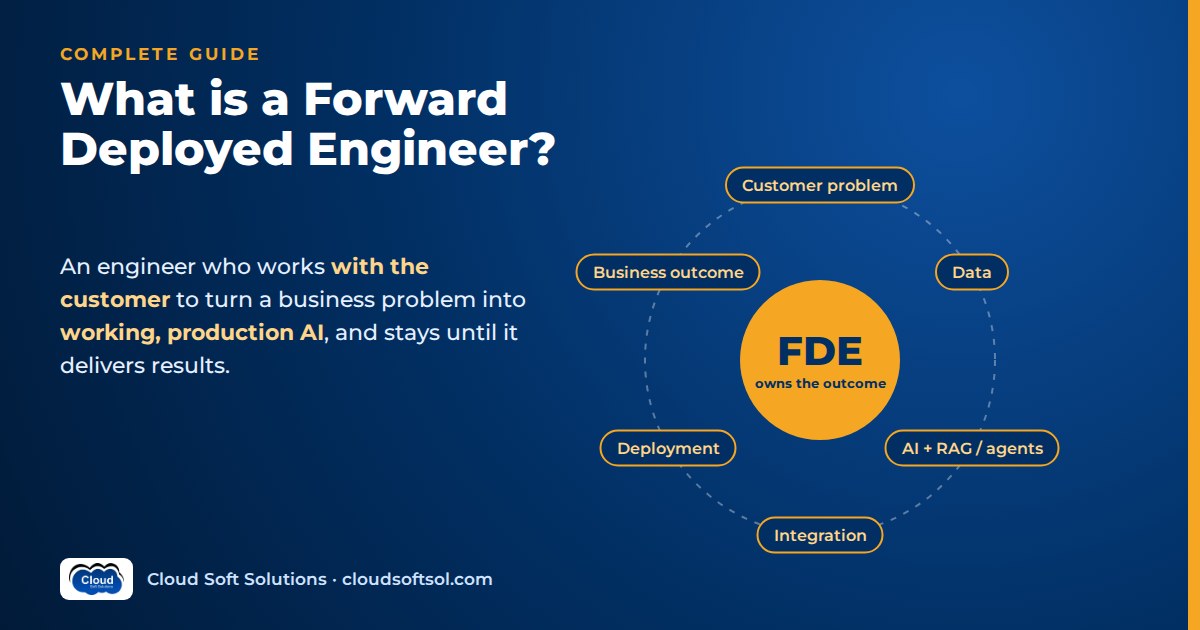
A Forward Deployed Engineer (FDE) is a software engineer who works directly inside a customer's organisation to turn a product or platform into a working, production solution for that customer's specific problem, owning everything from discovery and data integration to deployment, evaluation and handover. The role sits between product engineering and the customer: an FDE writes real code, but the code exists to deliver a business outcome rather than a generic feature. In AI companies, that usually means taking a model, a retrieval pipeline or an agent from an impressive demo to a secured, monitored system running against the customer's real data.
This guide goes deep on the definition: where the term came from, what an FDE does day to day, how the role differs from adjacent jobs, and whether it suits you. If you are looking for the training programme itself, the AI Forward Deployed Engineer course page covers the curriculum, projects and schedule, so we will not repeat that here.
Forward deployed engineer meaning, in plain terms
Break the title into its two parts. Engineer means you build software that runs in production: services, integrations, pipelines, infrastructure. Forward deployed means you do that work where the customer is, not behind a product roadmap. You sit with their teams, read their data, learn their constraints and ship something that works in their environment.
A traditional product engineer usually lives in a short loop:
Requirement -> Code -> DeployAn FDE's loop starts much earlier and ends much later. Nobody hands over a clean requirement; the FDE has to find it, and the job is not done when the code is deployed, it is done when the customer sees the outcome. That is why Cloudsoft describes the role with one phrase: from AI demo to enterprise outcome.
Where the term came from
The title was popularised by Palantir, which sent engineers "forward" into customer organisations, often government agencies and large enterprises, to configure and extend its data platforms on site. The logic was simple: complex software rarely works out of the box in a messy enterprise. Someone has to connect it to legacy databases, fix data quality and build the last mile of workflow, so the company put strong engineers in the field with product-level access.
The idea spread for the same reason it worked originally: the gap between a capable platform and a deployed solution is where most enterprise value gets lost. Three groups adopted the model:
- AI labs and AI platform companies. Large language models are general by design. Making them useful for a specific bank, hospital or insurer requires retrieval over private documents, tool integrations, guardrails and evaluation. AI companies now hire FDEs to do exactly this alongside their customers.
- Enterprise software platforms. Data platforms, workflow tools and developer platforms use FDEs to land large accounts, where a successful first deployment decides whether the contract grows.
- Consultancies and IT services firms. Services companies, including many with large delivery centres in India, have started using the FDE label for engineers who embed with client teams and build AI solutions end to end, rather than handing work across multiple departments.
Job postings increasingly use the FDE title, and many roles with names like "AI deployment engineer", "applied AI engineer" or "customer engineer" describe substantially the same work. For a wider view of why this shift is happening, read why the future of AI engineering is forward deployed.
What does an FDE do? A week in the life
The following is an illustrative week, not a real engagement. Consider an FDE at an AI platform company who has just been deployed into a mid-sized bank. The bank wants an assistant that helps its operations staff answer questions about internal credit policies and, eventually, raise service tickets on their behalf.
Monday: discovery
The FDE spends the morning with the operations team, watching how analysts currently find answers. It turns out the real pain is not search; it is that policy documents contradict each other across versions, and nobody knows which one is current. The afternoon goes to information security: what data may leave the network, which cloud regions are approved, how identity is managed. The FDE ends the day with a one-page problem statement and a list of open questions.
Tuesday: scoping and data
The FDE agrees a narrow first milestone with the business sponsor: answer policy questions for one department, with citations to the exact clause, restricted to the latest approved version of each document. Then the unglamorous part: getting read access to the document store, writing a script to extract text from scanned PDFs, and discovering that version metadata lives in a separate spreadsheet maintained by hand.
Wednesday: building
The FDE builds an ingestion service that chunks documents, attaches version and department metadata, and stores embeddings in a vector database inside the bank's cloud account. A retrieval API filters by user entitlements so an analyst only sees policies they are allowed to see. The FDE writes a first set of test questions with the operations lead, so there is a baseline to measure against.
Thursday: integrating and evaluating
The assistant has to sit inside the tools staff already use, so the FDE wires it to the bank's single sign-on and builds a small integration with the ticketing system, read-only for now. An evaluation run shows that answers are fluent but citations are wrong on a noticeable share of questions about older policies. The FDE traces the problem to chunking that splits tables mid-row, fixes it, and reruns the evaluation.
Friday: demo, feedback and product notes
The FDE demos to the sponsor and two analysts, using real questions rather than a scripted happy path. They agree on the next milestone. Before logging off, the FDE writes an internal note to the platform's product team: three customers have now needed entitlement-aware retrieval built by hand, and it should probably become a product feature. That note is part of the job, not an afterthought.
Interviews, security reviews, scripting, backend, cloud, evaluation, a demo and product feedback: that breadth is the role.
Core responsibilities of the FDE role
Across companies, the responsibilities cluster into eight areas:
- Discovery. Understand the business problem, the users, the current workflow and what "success" means in measurable terms.
- Scoping. Turn a vague ambition ("we want AI for customer service") into a first milestone that is small enough to ship and valuable enough to matter.
- Building. Write production-quality services, data pipelines, prompts, agent logic and infrastructure code.
- Integrating. Connect the solution to the customer's identity provider, databases, APIs and SaaS systems such as ticketing or CRM tools.
- Deploying. Ship into the customer's cloud or network with CI/CD, infrastructure as code, secrets management and approved configurations.
- Evaluating. Measure quality with test sets, automated metrics and human review, and keep measuring after go-live.
- Handing over. Document, train the customer's team, set up runbooks and monitoring so the solution survives after the FDE moves on.
- Feeding product back. Report patterns, gaps and repeated custom work to the product and engineering teams so the platform improves.
Cloudsoft's FDE PRO organises the same journey into eight stations: Understand, Design, Build, Integrate, Deploy, Observe, Improve and Deliver value. Whatever the labels, the point is that an FDE owns the whole path, not one slice of it.
FDE vs Solutions Engineer vs Solutions Architect vs Software Engineer vs Consultant
Titles vary between companies; the table shows typical patterns, not universal rules.
| Role | Main job | Customer-facing? | Writes production code? | Owns |
|---|---|---|---|---|
| Forward Deployed Engineer | Build and deploy a working solution inside the customer's environment | Yes, heavily and continuously | Yes, regularly | The deployed outcome for that customer |
| Solutions Engineer (pre-sales) | Show the product can solve the customer's problem, usually before the deal closes | Yes, during the sales cycle | Sometimes; mostly demos and proofs of concept | The technical win |
| Solutions Architect | Design the target architecture and guide implementation | Yes, at design and review stages | Occasionally; focuses on designs and reference code | The architecture and its fit to requirements |
| Software Engineer (product) | Build features for the core product used by many customers | Rarely | Yes, all the time | Product components and their quality |
| Consultant | Advise on strategy, process or technology choices; may manage delivery | Yes | Often not, depending on the firm | Recommendations and engagement delivery |
The cleanest distinction: a Solutions Engineer proves it can work, a Solutions Architect designs how it should work, and an FDE makes it actually work in production and stays accountable for the result. For a closer comparison with a role many readers are weighing, see FDE vs AI Engineer.
The AI forward deployed engineer
An AI FDE does everything above, with a stack centred on large language models. The technical core usually includes:
- Retrieval-augmented generation (RAG). Grounding model answers in the customer's own documents and data by retrieving relevant content at query time, then generating an answer that cites it. Most of the hard work is in ingestion, chunking, metadata, access control and retrieval quality, not the prompt.
- Agents. Systems in which a model plans steps and calls tools, such as querying a database, creating a ticket or calling an internal API, often orchestrated with frameworks like LangGraph. In an enterprise, agents need tight permissions, human approval for risky actions and full audit trails.
- MCP. The Model Context Protocol is an open protocol, introduced by Anthropic in late 2024, for connecting AI applications to tools and data sources through a standard interface. FDEs use it to expose customer systems, such as an ITSM platform or a knowledge base, to AI applications without writing one-off integrations for every client.
- Security. Identity integration, least-privilege access, data residency, prompt-injection defences, PII handling and logging that satisfies auditors. In banking or healthcare, this is often what decides whether a project ships at all.
- Evaluation. Test sets, retrieval and answer-quality metrics (tools such as Ragas), tracing (LangSmith, Langfuse, OpenTelemetry) and human review. Without evaluation you cannot tell a customer whether a change made things better or worse.
Put together, the AI FDE's work follows a chain like this:
Customer problem
   -> Discovery -> Business requirement
   -> Data -> AI architecture
   -> RAG / Agent -> Tools / MCP -> APIs
   -> Security -> Cloud -> Deployment
   -> Observability -> Evaluation
   -> Optimization
   -> Business outcome
Every arrow is a place where demos tend to fall apart in real enterprises. A chatbot that answers well in a notebook may fail on access control, latency, cost or audit requirements. The AI FDE is the person who carries the system through each link. If you want to test your understanding of the building blocks, the RAG interview questions and agentic AI interview questions are a good self-check.
Want to work through this chain on realistic enterprise scenarios rather than toy demos? Cloudsoft's FDE PRO is built around it, in Ameerpet classrooms or live online.
Skills an FDE needs
FDEs are hired for a combination that is genuinely uncommon: strong engineering plus the ability to work through ambiguity with non-technical stakeholders.
| Area | Technical skills | Customer-facing skills |
|---|---|---|
| Programming and APIs | Python, REST APIs (for example FastAPI), async code, testing | Explaining trade-offs in plain language |
| Data | SQL, PostgreSQL, vector search (for example pgvector), data cleaning | Asking the right questions about where data lives and who owns it |
| AI engineering | LLM APIs (Amazon Bedrock, Azure OpenAI, Gemini), RAG, agents, LangChain/LangGraph, MCP | Setting realistic expectations about what AI can and cannot do |
| Cloud and DevOps | AWS, Azure or Google Cloud, Docker, Kubernetes, Terraform, CI/CD | Working within customer change-management and approval processes |
| Security and identity | SSO, OAuth/OIDC, Microsoft Entra ID, secrets management, least privilege | Engaging security and compliance teams early instead of late |
| Quality and operations | Evaluation frameworks, tracing, monitoring, incident response | Reporting progress honestly, including bad news |
| Delivery | Documentation, runbooks, handover | Scoping, prioritising, saying no to scope creep without losing trust |
You do not need to be an expert in every cell on day one. You do need to be competent across the stack and willing to learn a customer's domain quickly. A solid base in Python and one cloud platform is the usual starting point.
Is FDE a software engineering role?
Yes. This is the most common misunderstanding about the job. It is not pre-sales or consulting with a technical flavour. FDEs are expected to write, test, review and deploy production code, and they are usually held to the same engineering bar as product engineers.
What differs is the shape of the engineering: FDEs build specific solutions quickly for one customer, in an environment they do not control, with incomplete information. That demands strong judgement about what to build properly and what to keep simple. Good FDE code is maintainable enough to hand over, because someone else will run it after you leave.
Pros, cons and realities
What people like about it
- Visible impact. You see the people who use what you build and the business result it produces.
- Breadth. You touch data, AI, backend, cloud, security and delivery, which builds unusually well-rounded engineers.
- Career options. FDE experience leads naturally to solutions architecture, engineering leadership, product management or founding a company.
What is hard about it
- Travel. Many FDE roles involve time on customer sites. Regulated customers often want people on premises during critical phases.
- Ambiguity. Requirements are unclear, data is messier than promised, and stakeholders disagree. You must be comfortable making progress without a spec.
- Context switching. A single day can move from a Kubernetes networking issue to a meeting with a compliance officer to debugging retrieval quality.
- On-call-style pressure. When a deployment breaks before a customer demo or a go-live date, you are the person in the room. It is not formal on-call in every company, but the accountability feels similar.
Who the FDE role suits
The role tends to suit engineers who:
- enjoy building and shipping more than polishing one component indefinitely;
- are curious about how businesses actually work, not just how systems work;
- can explain technical decisions to a manager, an analyst and a security auditor in the same week;
- stay calm when the plan changes.
In the Indian market, several backgrounds map well. Developers at services firms already know client delivery and can add AI and cloud depth. DevOps and cloud engineers bring deployment, infrastructure and security skills that many AI-first engineers lack. AI/ML engineers who have built models but never shipped them into an enterprise environment gain the integration and customer side. Engineers in GCCs in Hyderabad and Bengaluru often work as internal FDEs already, embedding with business units of the parent company, even when the title is different.
How to get started
Becoming an FDE is about building evidence that you can carry a problem end to end: a few portfolio projects that start from a business problem, use real-looking data, include security and evaluation, and are deployed to a cloud with monitoring. We cover this in detail elsewhere rather than repeating it here:
- How to become an AI Forward Deployed Engineer covers backgrounds, portfolio projects and interviews.
- The FDE engineer roadmap lays out the skills in a month-by-month sequence.
- If you need AI fundamentals first, the AI, GenAI and Agentic AI course is a gentler entry point. Broader paths are on our career roadmaps page.
Frequently asked questions
What does FDE stand for?
FDE stands for Forward Deployed Engineer: a software engineer who works directly with a customer, often inside their organisation, to build, integrate and deploy a production solution on top of a product or platform.
Is FDE a software engineering role?
Yes. FDEs write, test and deploy production code and are usually held to the same engineering bar as product engineers. The difference is that their work is focused on delivering one customer's outcome, in that customer's environment, rather than building general product features.
Do FDEs travel?
Often, yes. Many FDE roles include time on customer sites, especially during discovery, critical integrations and go-live. The amount varies by company and customer; regulated industries such as banking and healthcare tend to want more on-site presence.
Can freshers become FDEs?
It is possible but harder, because the role needs both engineering depth and customer judgement. Freshers improve their chances with strong fundamentals in Python, APIs, databases and one cloud, plus end-to-end portfolio projects that show discovery, integration, security, deployment and evaluation. Many people start in a developer, DevOps or AI engineering role and move into FDE work.
What is the difference between an FDE and a consultant?
A consultant typically advises on strategy, process or technology choices and may manage delivery, while an FDE builds and ships the working system and stays accountable for whether it performs in production. Some consultants write code, but for an FDE writing production code is the core of the job.
Is FDE related to agentic AI?
Closely. Agentic AI systems, where models plan steps and call tools, are among the hardest AI systems to deploy safely in an enterprise because they touch real systems and data. AI FDEs design the tool integrations, permissions, approval steps, observability and evaluation that make agents usable in production.
What tools do FDEs use?
It depends on the company, but AI FDEs commonly use Python and FastAPI, PostgreSQL with vector search, LLM services such as Amazon Bedrock, Azure OpenAI and Gemini, frameworks such as LangChain and LangGraph, MCP for tool integration, evaluation and tracing tools such as Ragas, LangSmith and Langfuse, and cloud tooling such as Docker, Kubernetes, Terraform and GitHub Actions.
If you have read this far, you know whether the FDE role fits the way you like to work. To build the skills on realistic enterprise projects with a trainer who has spent 20 years in cloud, DevOps and AI engineering, explore the Cloudsoft FDE PRO program. It runs in our Ameerpet classroom, beside Ameerpet Metro, or live online. Call +91 96660 19191 to book a free demo session.
Related Cloudsoft resources