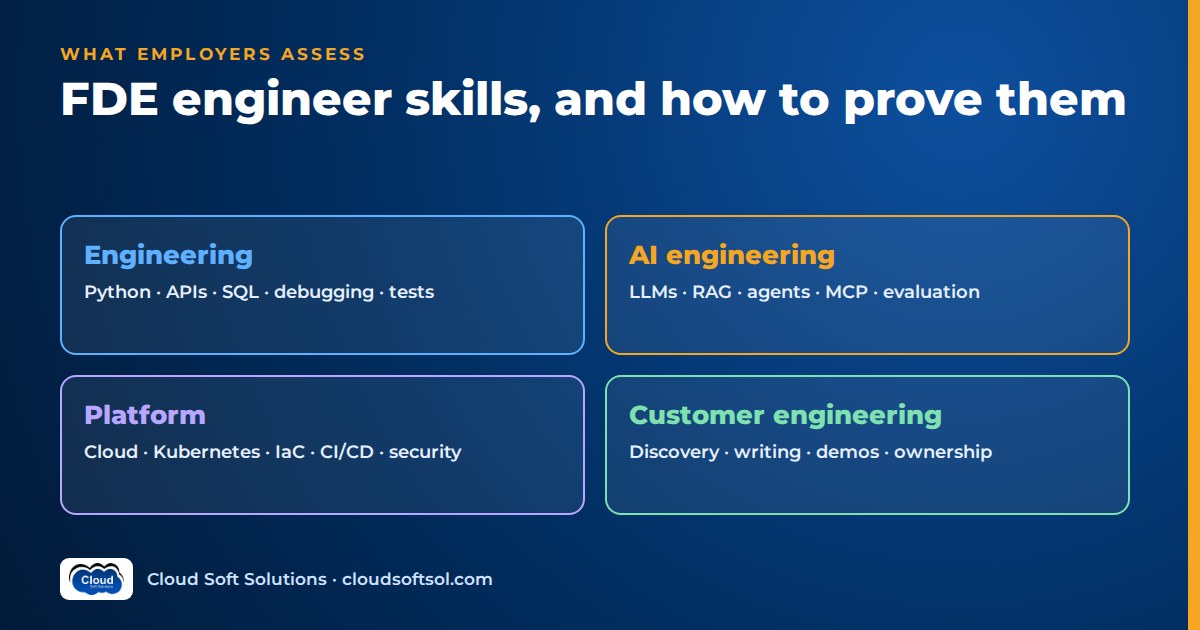
The FDE engineer skills employers look for fall into four groups: production engineering, AI engineering, platform engineering and customer engineering, and hiring teams want evidence across all four rather than depth in one. A strong Forward Deployed Engineer can write and debug production Python, build a RAG system or agent that respects access control, deploy it securely on the customer's cloud, and explain it to a sceptical executive. This article takes the employer's side of the table: what each skill looks like on the job, and the artefact or interview signal that proves you have it.
If you need the role defined first, read what a Forward Deployed Engineer does. For the order in which to learn these skills, use the FDE engineer roadmap. For routes from fresher, developer, DevOps or ML backgrounds, see how to become an AI FDE. This page is about how the skills get assessed.
How FDE job descriptions are typically structured
FDE postings differ between AI labs, enterprise software vendors, global capability centres and services firms, but most share a shape that predicts what the interview loop will test.
- "About the role." You will work directly with customers, often embedded in their teams, to get a product or AI system into production. Phrases like "own outcomes" and "high ambiguity" signal that customer rounds carry real weight.
- "What you will do." Build integrations, design and deploy solutions, lead technical discovery, feed product gaps back to core engineering. Each line maps to a skill group below.
- "What you have." The hard filter: engineering experience, a primary language (often Python), cloud experience and, frequently, shipping LLM applications to production. Read "production" literally; the recruiter screen will.
- "Nice to have." Kubernetes, Terraform, a specific cloud, MCP, evaluation tooling, banking or healthcare domain knowledge, consulting experience. These are tie-breakers.
- "How we work." Words like "bias to action" and "low ego" describe the behavioural interview.
Notice that requirements are written as outcomes ("deploy to production", "lead discovery") rather than tool lists. That is why each table below pairs a skill with what good looks like and how to prove it.
Group 1: Engineering skills
The base layer. An FDE who can't write reliable code loses the customer's engineering team in the first week, however much AI they know.
| Skill | What "good" looks like on the job | How to prove it |
|---|---|---|
| Production Python and APIs | Typed, readable services (FastAPI or similar) with validation, timeouts, retries, structured logging and sensible errors. Can wrap a messy legacy system behind a clean API quickly. | A deployed service with a clear README, OpenAPI spec, environment-based config and tests in CI. Interview: live coding where you handle edge cases unprompted. |
| Data handling and SQL | Confident with joins, window functions and migrations. Profiles customer data before designing and spots duplicates, nulls and stale records. Knows when SQL beats a vector store. | A project ingesting messy, realistic data into PostgreSQL with a schema and data-quality note. Interview: you ask about data shape and volume before proposing architecture. |
| Debugging unfamiliar systems | Drops into code or infrastructure they have never seen, forms a hypothesis, reads logs and traces, and fixes the problem without the original author. | A written debugging story: symptom, hypotheses, evidence, root cause, fix. Interview: a "here are the logs" exercise where you reason out loud. |
| Testing | Unit tests for logic, integration tests for external calls, a regression test for every bug fixed. Tests are the safety net for changing code on a customer's system. | Tests on critical paths running in GitHub Actions. Interview: you mention testing when describing a design without being asked. |
If your Python is still tutorial-level, fix that first. Python training that ends in a deployed API is a better use of time than another AI framework.
Group 2: AI engineering skills
This group separates an AI FDE from a classic integration engineer. Employers are not checking whether you can call a model. They are checking whether you can make a model-backed system behave predictably inside an enterprise.
| Skill | What "good" looks like on the job | How to prove it |
|---|---|---|
| LLM integration | Structured outputs, rate-limit and timeout handling, versioned prompts, tracked token cost and latency. Can switch between Amazon Bedrock, Azure OpenAI or Gemini when customer policy requires it. | A service calling a model behind your own API, with schema-validated output, retries and a cost log. Interview: you raise failure modes (malformed output, refusals, latency) yourself. |
| RAG with citations and access control | Chunking and retrieval designed for the actual documents, cited answers, document-level permissions so users only retrieve what they may see, and an index that stays fresh. | A RAG assistant with citations, per-role metadata filters and a refresh job. Practise with RAG interview questions; expect "how do you stop a junior employee retrieving HR files?" |
| Agents and tool calling | Explicit state, bounded loops and clear tool contracts (LangGraph or equivalent), human approval before risky actions, and a fixed workflow when an agent isn't needed. | An agent that updates Jira or ServiceNow tickets with an approval step and audit log. Interview: you can explain when not to use an agent. See agentic AI interview questions. |
| MCP (Model Context Protocol) | Treats MCP as an open protocol for connecting AI applications to tools and data, can build an MCP server around an internal system, and scopes authentication for every tool exposed. | A small MCP server wrapping one internal-style API, with per-tool permissions documented. Interview: you can describe the trust boundary between client, server and backend system. |
| Evaluation | A test set built from real questions, measured retrieval relevance, faithfulness and task success (Ragas, LangSmith or similar), evals on every change, honest failure reporting. | An evaluation report per AI project: dataset, metrics, results, failures, what changed. Interview: asked "is it good?", you answer with how you measured it. |
Group 3: Platform skills
Many AI projects stall here, as covered in why AI demos fail in enterprise production. A customer's platform team won't accept a system it can't deploy, monitor or audit.
| Skill | What "good" looks like on the job | How to prove it |
|---|---|---|
| One cloud, deeply (IAM and networking) | Designs least-privilege IAM, explains VPCs, subnets, private endpoints and security groups, and debugs "it can't reach the model endpoint" alone. Reads other clouds by analogy. | A project on AWS, Azure or GCP with private networking, scoped roles and a diagram. Interview: trace a request across network and identity boundaries. AWS training is a solid first cloud. |
| Containers and Kubernetes | Clean Dockerfiles; deploys and scales on Kubernetes; diagnoses crash loops, failed probes and resource limits. | Your AI service on a managed cluster such as EKS, with health checks and config separated from code. Kubernetes training helps if you've only used Docker locally. |
| Infrastructure as code | Provisions environments with Terraform, manages state safely, reproduces environments from code rather than console clicks. | A Terraform module that builds your project's infrastructure from scratch. Interview: how you promote the same code from dev to prod. |
| CI/CD | Every change goes through lint, test, evaluate, build and deploy (GitHub Actions, Argo CD or similar). Rollback is routine. | A visible pipeline that runs tests and evals before deploying. Interview: you include an eval gate in your AI release flow. |
| Observability | Logs, metrics and traces for every request, including model calls, retrieved documents, tool calls, latency and cost (OpenTelemetry, Langfuse or similar). | A recorded walkthrough of traces from your deployed system. Interview: asked to debug a bad production answer, you start with the trace. |
| Security basics (SSO/OAuth, secrets, least privilege) | Integrates the customer's identity provider (for example Microsoft Entra ID) via OAuth/OIDC, keeps secrets in a vault, scopes every credential, and considers prompt injection and PII in logs. | A security note per project: auth flow, secrets, retention, injection mitigations. DevSecOps training covers the pipeline side. Interview: you raise security before the interviewer does. |
Want structured practice across these technical groups on one realistic stack? Cloudsoft's FDE PRO program runs 12 weeks of live sessions with 60+ labs and five enterprise projects on Python/FastAPI, pgvector, Bedrock, LangGraph, MCP, EKS and Terraform.
Group 4: Customer engineering skills
This group makes the role "forward deployed", and it is where engineers from pure product backgrounds are usually weakest.
| Skill | What "good" looks like on the job | How to prove it |
|---|---|---|
| Discovery | Turns "we want AI for our service desk" into a specific problem, named users, data sources, systems, constraints and success criteria. | Discovery notes and a one-page requirements summary per project. Interview: in a case round, you ask questions before proposing anything. |
| Scoping | Cuts a large request into a first deliverable that ships in weeks, with explicit non-goals, risks and dependencies. | A phased scope document. Interview: you push back on an over-sized ask with a smaller first milestone. |
| Writing (HLD, status updates, RCA) | High-level designs a customer architect can approve, status updates a manager can skim, blameless RCAs that end in actions. | An HLD, a sample status update and an RCA in your portfolio. Interview: take-home exercises, and the clarity of your README. |
| Demoing to executives | Opens with the business problem, shows the system on realistic data, and handles "what happens if it's wrong?" calmly. | A short recorded demo aimed at a non-technical leader. Interview: a presentation round with business interruptions. |
| Managing ambiguity | Makes progress with incomplete requirements, access or data; documents assumptions and escalates blockers early. | Design notes listing assumptions and how you validated them. Interview: questions about projects that changed direction. |
| Ownership | Treats the customer's outcome as their own: follows up, closes loops and surfaces bad news early. | Stories with specific actions beyond your assigned task. Interview: first-person detail rather than "we did". |
These skills overlap with solutions roles; FDE vs Solutions Architect vs Solutions Engineer explains where the jobs differ.
The skills that are hardest to fake
Tools can be crammed in a weekend. These three can't, so interviewers spend most of their time on them.
Ownership
Interviewers pick one of your projects and drill down: what did you decide, what went wrong, what did you do that day, what happened next? Candidates who watched a project run out of detail by the third follow-up. Owners can name the metric they watched, the person they had to convince and what they would change now. A steady "we" with no "I" gets noticed.
Debugging under pressure
Often tested with something broken: a failing container, a RAG pipeline returning wrong answers, an agent stuck in a loop, incident logs. The interviewer cares more about method than about finding the bug. Do you state a hypothesis, check the cheapest evidence first, change one thing at a time and say what you've ruled out? Some add pressure deliberately ("the customer is on the call, what do you tell them?") to see whether you can communicate while investigating.
Written communication
Probed through take-home design documents, a request to explain an incident to a non-technical reader, or simply your READMEs. Good FDE writing is short, structured, honest about uncertainty and ends with a decision. Consider a hospital where an AI discharge-summary assistant produced an incorrect medication note during a pilot. The engineer who sends a clear one-page RCA within a day (impact, root cause in retrieval, fix, new eval cases) keeps the customer's trust. A long, defensive email can lose it, even with the same technical fix.
Self-assessment checklist
Count a statement only if you have done it end to end and can show evidence.
- I can build and deploy a Python API with validation, logging, retries and tests in CI.
- I can write SQL with joins and window functions and profile a messy dataset.
- I can debug a service I didn't write and explain the root cause in writing.
- I can call an LLM with structured output and handle timeouts, rate limits and malformed responses.
- I can build a RAG assistant that cites sources and enforces per-user document permissions.
- I can build an agent with bounded tool calls and human approval before risky actions.
- I can expose an internal API as an MCP server with scoped access.
- I can build an evaluation set and report retrieval relevance, faithfulness and known failures.
- I can design least-privilege IAM and private networking on one cloud.
- I can run a containerised service on Kubernetes with health checks and resource limits.
- I can provision with Terraform and deploy through a CI/CD pipeline.
- I can integrate SSO through OAuth/OIDC and keep secrets out of code and logs.
- I can turn a discovery conversation into a one-page scope with non-goals.
- I can write an HLD, a status update and a blameless RCA a customer would accept.
- I can demo to a non-technical leader and answer "what if it's wrong?" confidently.
Gaps in the first three are the most urgent; gaps in the last three are the most common among strong engineers.
Skills by seniority: entry, mid and senior FDE
The four groups stay constant; scope, independence and ownership of the customer relationship change.
Entry-level FDE (or an adjacent first role)
Solid engineering, competent AI engineering, platform and customer skills still developing. You implement well-scoped pieces, such as an integration, an ingestion pipeline or an eval suite, under a senior engineer's design. Interviewers look for learning speed, clean code, a deployed project and clear writing.
Mid-level FDE
Owns a workstream or small engagement end to end: runs discovery, writes the HLD, builds and deploys, sets up observability and evaluation, reports status to the customer. Interviewers expect production stories with real incidents and trade-off decisions made without constant escalation.
Senior FDE
Owns the customer outcome across an engagement, often several. Shapes scope with executives, makes architecture calls within security and platform constraints, unblocks other engineers and turns patterns across customers into product feedback. Interviewers probe judgement: what you said no to, how you recovered a failing engagement. Repeatedly taking AI from POC to production is the core senior signal.
How to build evidence fast: three projects across all four groups
You need three projects that each prove several skill groups at once, not ten tutorials. The roadmap covers when to build each; here is what each proves.
Customer problem -> Discovery -> Data
  -> RAG / Agent -> Tools / MCP -> APIs
  -> Security -> Cloud -> Observability
-> Evaluation -> Business outcome- Permission-aware knowledge assistant. Illustrative brief: an insurer's claims teams need answers from policy documents, and each team may only see its own product lines. Build RAG with citations and role filters on PostgreSQL/pgvector, behind FastAPI with SSO, plus an eval report. Proves: engineering, RAG, evaluation, security and discovery writing.
- IT-ops agent with approvals. Illustrative brief: a GCC IT team in Hyderabad wants an agent that triages incidents and drafts ServiceNow or Jira updates. Build it with LangGraph, expose tools through MCP, add human approval and an audit trail. Proves: agents, MCP, integration, scoping and debugging (write up one failure you fixed).
- Production deployment with an RCA. Deploy one of the above on AWS with Terraform, Kubernetes, a GitHub Actions pipeline with an eval gate, and OpenTelemetry traces. Break something on purpose, recover, write the RCA and record a short executive demo. Proves: platform skills, observability, ownership and writing.
This is the shape of work in the AI Forward Deployed Engineer course, where projects like the Enterprise Knowledge Assistant, ServiceNow AI Agent via MCP and Secure Banking AI Assistant lead into a simulated "GlobalBank" customer engagement.
Frequently asked questions
Do FDEs need DSA?
Some FDE interview loops include a data structures and algorithms round, so fluency with arrays, hash maps, trees, graphs and complexity is worth having. Most of the weight goes to practical coding, debugging, system design and customer scenarios, so prepare DSA to pass the screen rather than as the centre of your preparation.
Is communication more important than coding for FDEs?
Neither replaces the other. Weak coding gets you rejected in technical rounds and weak communication gets you rejected in customer rounds. Strong coders often under-prepare communication, so it becomes the deciding factor more often than people expect.
Which cloud should I learn for FDE roles?
Learn one cloud deeply, especially IAM and networking, and learn the other two well enough to map concepts across. AWS is a common first choice, but if your target employers or their customers mostly run Azure or Google Cloud, start there. Depth in one transfers faster than shallow knowledge of three.
Do I need ML theory to become an FDE?
You need working knowledge, not research depth: how embeddings and retrieval work, why models hallucinate, what fine-tuning changes compared with RAG, and how to evaluate outputs. Explaining why a system gave a wrong answer and how you would measure the fix is tested far more than training theory.
What soft skills do FDEs need?
Discovery questioning, clear writing, calm demoing, expectation management, comfort with ambiguity and ownership. They are better described as customer engineering skills, because they are practised and assessed as part of engineering work.
How do I show FDE skills with no experience?
Build two or three deployed projects that each cover several skill groups, and package them like a real engagement: discovery notes, a design document, an evaluation report, a security note, a recorded demo and an RCA for something that broke. That gives interviewers concrete evidence to probe, which matters more than a job title.
Which FDE skills do employers screen for first?
Usually production engineering in a primary language, often Python, and evidence of shipping LLM-based systems to real users. Platform and customer engineering skills tend to decide the later rounds.
Ready to turn this checklist into evidence? FDE PRO pairs four engineering sessions with a weekly Customer Engagement Lab, in a classroom in Ameerpet beside Ameerpet Metro or live online, with placement support until you're placed. Call +91 96660 19191 for a free demo.