If you are comparing FDE vs solutions architect (and the solutions engineer role that often sits beside both), here is the short answer. A Solutions Engineer helps win the deal by proving the product fits, a Solutions Architect designs how the system should be built, and a Forward Deployed Engineer (FDE) builds and deploys it inside the customer's environment and owns the outcome. All three are customer-facing technical roles and they share many skills, but they enter the customer lifecycle at different points, produce different artefacts and are judged by different results. Pick the role whose definition of "done" you want to be measured on.
The three roles in one paragraph each
Solutions Engineer (SE)
The Solutions Engineer, also called a pre-sales engineer, sales engineer or, at some vendors, a customer engineer, is the technical partner to an account executive. The SE runs discovery calls, translates the customer's problem into product capabilities, builds tailored demos and proofs of concept (POCs), answers security questionnaires and RFP sections, and handles the "will this work with our stack?" objections. The SE's job is the technical win: the customer's engineers and architects agree the product can solve the problem. Most SEs are measured, at least partly, against the sales team's results.
Solutions Architect (SA)
The Solutions Architect designs the target architecture. The title exists in two very different places. On the vendor side (cloud providers, software companies), an SA advises customers on how to design systems using the vendor's services, reviews their designs and produces reference architectures. On the customer side (an enterprise IT team, a GCC, or a services firm delivering for a client), the SA owns the solution design for a programme: components, integrations, non-functional requirements, security and cost. The role is strongly associated with certifications such as AWS Certified Solutions Architect, and the deliverable is usually a design that others implement.
Forward Deployed Engineer (FDE)
The FDE writes and ships production code inside a specific customer's environment, against their data, identity systems, networks and business goals, and stays accountable until the deployed system delivers a measurable result. The role was popularised by Palantir and is now common at AI labs and enterprise software companies. We cover the definition, origins and day-to-day work in depth in our complete guide to the Forward Deployed Engineer role, so this article focuses only on how the FDE differs from SE and SA work.
One sentence to remember: the SE proves it can work, the SA decides how it should work, and the FDE makes it actually work, in production, for this customer.
Where each role sits in the customer lifecycle
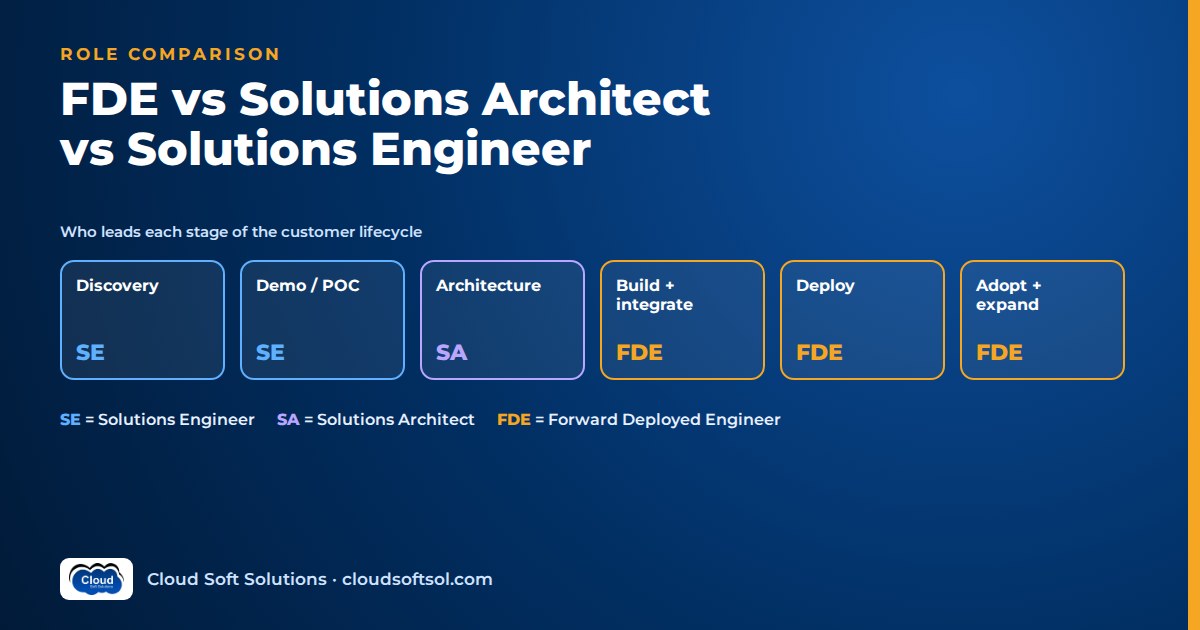
The clearest way to separate the roles is to look at when each one leads. The timeline below is typical for an enterprise software or AI platform sale.
Stage              Leads    Supports
-----------------  -------  ----------------
Lead               Sales    SE
   |
Discovery          SE       SA
   |
Demo / POC         SE       SA, FDE (complex)
   |
Architecture       SA       SE, FDE
   |
Contract           Sales    SE, SA
   |                  ---- handoff risk ----
Build / Integrate  FDE      SA
   |
Deploy             FDE      SA, customer IT
   |
Adopt / Expand     FDE      CSM, SE (upsell)
Two things stand out. First, the SE's centre of gravity is before the contract and the FDE's is after it, which is why the contract line is where most context gets lost. Second, the SA is the role most likely to span both sides, designing during the sale and reviewing during delivery. Companies with FDEs increasingly pull them into complex POCs, because a POC is a promise someone has to keep later.
FDE vs solutions architect vs solutions engineer: detailed comparison
Titles vary between companies; these are typical patterns.
| Dimension | Solutions Engineer | Solutions Architect | Forward Deployed Engineer |
|---|---|---|---|
| Primary goal | Win the technical evaluation | A sound, approved target design | A working system that delivers the business outcome |
| When involved | Lead to contract, again at renewal or upsell | Discovery through design; reviews during delivery | POC (sometimes) and contract through adoption |
| Customer exposure | Many accounts, short and intense cycles | Several accounts or one large programme, at design and review points | Few accounts, deep and continuous, often embedded with the customer team |
| Hands-on code depth | Demo and POC code, scripts, API samples; rarely maintained long term | Reference code, infrastructure templates, proofs of design; varies widely | Production services, integrations, pipelines, infrastructure as code; maintained and on call |
| Typical artefacts | Demo scripts, POC environments, RFP answers, security questionnaire responses | Reference architectures, design documents, architecture decision records, cost models | Deployed services, integration code, runbooks, evaluation reports, dashboards |
| Success metric | Technical win rate, deal progression | Design approved, implemented as intended, meets non-functional requirements | Adoption, accuracy, time saved, incidents avoided: the customer's KPI |
| Reporting line | Usually sales or a pre-sales organisation | Vendor: field technical or customer success; customer side: enterprise architecture or delivery | Engineering, a dedicated deployment organisation, or field engineering |
| Travel / onsite | Frequent short visits for workshops and demos, much of it remote | Moderate; design workshops and review boards | Can be heavy; extended stretches onsite or on the customer's network, depending on employer and security rules |
| Typical background | Developers, support or implementation engineers who enjoy presenting | Senior developers, cloud and infrastructure engineers, often certified | Software, DevOps, data or AI engineers who like ambiguity and ownership |
| Natural next roles | Senior or principal SE, SE manager, product manager, SA | Principal or enterprise architect, CTO-track, field CTO | Senior or lead FDE, engineering manager, product engineer, SA, founder |
Notice the difference in what each role leaves behind. An SE's POC is usually disposable, an SA's design is a document others interpret, and an FDE's code is something the customer runs every day.
One enterprise deal, three roles
Consider an insurer that wants to buy an AI claims-assistant platform. The goal: help claims handlers summarise incoming documents (claim forms, repair estimates, medical reports), check them against policy wording, and draft a next-step recommendation, cutting handling time without increasing wrong payouts. The example is illustrative; the handoff problems are not.
The Solutions Engineer: proving fit
The SE joins the account executive for discovery, learns that claims handlers spend much of their day reading attachments, and builds a demo that ingests a handful of sample claims and produces summaries with citations to policy clauses. The SE completes the insurer's security questionnaire, explains data residency options, and runs a two-week POC on anonymised claims. Technical win achieved.
The Solutions Architect: designing the target
The SA (here, on the vendor side, working with the insurer's own enterprise architect) designs the production shape: documents flow from the claims management system into a private ingestion pipeline, embeddings are stored in a vector store inside the insurer's cloud account, the model is accessed through a managed service such as Amazon Bedrock or Azure OpenAI in the approved region, handlers sign in through the corporate identity provider, and every recommendation is logged for audit. The SA documents and costs the design and gets it through the insurer's architecture review board.
The Forward Deployed Engineer: making it real
After signature, the FDE arrives and finds what the POC never touched. Real claims include scanned handwritten forms. The claims system exposes only a batch export, not the API the design assumed. Policy wording exists in several versions, and the assistant must cite the version in force on the claim date. Handlers in one region must not see claims from another. The FDE builds the ingestion and versioning logic, writes the integration against the batch export, enforces row-level access in retrieval, builds an evaluation set with senior handlers, wires tracing and dashboards, deploys through the insurer's pipeline, then sits with handlers to learn why they ignore some recommendations. Success is not "deployed"; it is handlers using it and handling time going down without quality slipping.
Where the handoffs go wrong
- SE to SA: the demo sets the requirement. The POC ran on clean, typed documents. Nobody wrote down that real claims are messier, so the design inherits an assumption the data will break.
- SA to FDE: the design assumes interfaces that do not exist. The architecture diagram shows an arrow labelled "Claims API". The arrow is a nightly file drop. Designs drawn without someone who has touched the customer's systems are optimistic by default.
- Contract to delivery: success is never defined. The contract lists features, not outcomes. Without an agreed metric (handling time, accuracy on a labelled set, adoption rate), the FDE cannot prove value and the renewal conversation starts on weak ground.
- FDE back to SE: lessons do not flow upstream. The FDE learns which claim types the platform handles badly, but if that never reaches pre-sales, the next insurer is promised the same thing.
The best teams fix this by bringing the FDE into late-stage POCs, having the SA validate interfaces against real systems before signing off a design, and writing measurable success criteria into the deal. We go deeper into the stage gates that prevent these failures in how FDEs take AI from POC to production.
If walking a deal like this from discovery to adoption is the kind of work you want to practise, Cloudsoft's AI Forward Deployed Engineer course includes a weekly Customer Engagement Lab and a simulated customer engagement capstone ("GlobalBank") alongside the engineering sessions.
Overlapping skills vs differentiators
What all three share
- Running discovery: asking about the business problem, current process, constraints and who decides.
- Explaining trade-offs to non-technical stakeholders without hiding risks.
- Cloud fundamentals: networking, identity, storage, managed services, cost.
- Enterprise security basics: SSO, least privilege, data residency, audit logging.
- For AI products, a working understanding of LLMs, retrieval-augmented generation (RAG), agents and why they fail.
What sets each apart
- SE differentiators: storytelling and demo craft, objection handling, reading a buying committee, juggling many accounts, comfort with sales targets.
- SA differentiators: breadth across services and patterns, non-functional requirements (availability, scalability, recovery, cost), formal design documentation, and steering decisions through review boards.
- FDE differentiators: production engineering depth (Python services, APIs, data pipelines, CI/CD, containers, infrastructure as code), debugging inside unfamiliar and locked-down environments, building evaluation and observability, and staying accountable for a number after go-live.
For an AI FDE, the differentiators extend into agent orchestration, tool integration through the Model Context Protocol (MCP), retrieval quality and evaluation tooling. If you want to test yourself on that layer, our agentic AI interview questions are a quick benchmark.
How to move between the roles
Solutions Engineer to FDE
You have the customer instincts. The gap is production engineering: code that runs for months, not a demo that runs for an hour.
- Take one of your best POCs and rebuild it to production standard: tests, error handling, configuration, logging, a container image and a CI pipeline.
- Learn infrastructure as code and deployment properly (Terraform, Docker, Kubernetes, GitHub Actions) so you can ship into a customer's account, not just your demo tenant.
- Add evaluation: build a small labelled test set and measure retrieval and answer quality before and after a change.
- Ask to join post-sale implementations at your current employer, and in interviews tell stories about what broke after the demo.
Solutions Architect to FDE
You bring design breadth, cloud depth and credibility with customer architects. The gap is usually hands-on velocity and comfort owning code in production.
- Pick a reference architecture you have designed and implement it end to end yourself, including the unglamorous parts: identity integration, secrets, monitoring.
- Rebuild daily coding fluency, especially Python and API development; architects often find this rusts faster than expected.
- Learn the AI-specific layer hands-on: RAG pipelines, agents with LangGraph, MCP servers, tracing with tools such as LangSmith or Langfuse.
- Get comfortable being measured on outcomes: on-call, incident reviews, adoption metrics.
FDE to Solutions Architect
A natural step for FDEs who want broader influence and less firefighting; field experience makes your designs realistic.
- Start writing down the patterns you keep rebuilding across customers; those become your reference architectures.
- Broaden beyond your current stack: multi-account design, networking, disaster recovery and cost modelling across services.
- Practise formal documentation: design documents, decision records, and presenting to review boards.
- Consider a cloud architecture certification to signal the breadth; the AWS Solutions Architect course is a structured way to prepare.
For background-specific routes into the FDE role (freshers, developers, DevOps and data engineers), see how to become an AI Forward Deployed Engineer.
Which role suits your personality and background?
Answer these honestly; they matter more than any title trend.
- What does a good week look like? Several customer meetings and a demo that lands (SE)? A design that a review board approves and a team builds (SA)? A service you shipped that users relied on by Friday (FDE)?
- How do you feel about sales targets? If being measured partly on deals closed energises you, SE fits. If it feels like pressure on your judgement, it probably does not.
- Do you want to write code most days? If yes, FDE. If you prefer to design and guide others' code, SA. If you enjoy code mainly as a way to show what is possible, SE.
- How do you handle ambiguity and messy environments? FDEs live with locked-down networks, missing documentation and shifting requirements; SEs see a curated slice; SAs meet ambiguity on paper first.
- Can you live with extended onsite work? Some FDE roles involve long stretches at customer sites; check what each employer expects.
As a rough guide by background: developers who like owning outcomes lean FDE; cloud and infrastructure engineers with strong design instincts lean SA; developers or support engineers who enjoy presenting lean SE. DevOps engineers are well placed for both FDE and SA, because deployment and operations are the parts the other roles most often underestimate.
The Indian context: product companies, GCCs and services firms
In India the same titles mean different things depending on the employer.
- Product and SaaS companies (including Indian-headquartered ones and international firms with Indian engineering teams) use all three titles in their classic sense. FDE roles are appearing as these companies sell AI features to enterprises that need hands-on deployment help.
- Global Capability Centres (GCCs) in Hyderabad, Bengaluru, Chennai and Pune mostly have customer-side SAs who design solutions for the parent organisation. There is rarely an SE, but internal teams increasingly behave like FDEs: embedding with a business unit, building against its data and owning adoption. The title may say "AI engineer" or "platform engineer" while the work is forward deployed.
- IT services and consulting firms have pre-sales solution architects (who blend SE and SA work for bids and proposals) and delivery architects who design for client programmes. Their delivery engineers on AI engagements often do FDE-style work.
The practical takeaway: read the responsibilities, not the title. A "Solutions Architect" posting at a services firm can be mostly pre-sales, while an "AI Engineer" posting at a GCC can be largely forward deployed. Our career roadmaps help map skills to these different paths.
Frequently asked questions
Is a solutions architect higher than an FDE?
Not inherently. They are parallel roles with different focus, not rungs on one ladder. A Solutions Architect designs systems for others to build, while an FDE builds and owns them in production. Both have junior and senior levels, and seniority depends on scope and impact at a given company, not the title itself.
Do solutions engineers write code?
Yes, but usually not production code. Solutions engineers write demo applications, POC integrations, scripts and API samples to show that a product fits the customer's environment. That code is typically short-lived. Some technical SE roles at developer-focused companies involve substantial coding, so check the job description.
Is FDE a pre-sales role?
Mostly no. The FDE's main work happens after the contract: building, integrating, deploying and driving adoption. FDEs are sometimes brought into complex proofs of concept before a deal closes, but they are measured on the deployed outcome, not on winning the sale.
Which pays more: FDE, solutions architect or solutions engineer?
It varies too much to generalise. Pay depends on the company, city, seniority, and how the role is structured; solutions engineer compensation often includes a sales-linked variable component, while FDE and SA pay is usually structured more like engineering pay. Compare actual offers and the scope of responsibility rather than titles.
Can a solutions architect become an FDE?
Yes. Solutions Architects already have design breadth and customer credibility. The usual gaps are daily coding fluency, deployment and operations skills, and the AI-specific layer such as RAG, agents and evaluation. Implementing your own reference designs end to end is the fastest way to close them.
Do I need AWS Solutions Architect certification to become an FDE?
No. FDE hiring focuses on whether you can build and deploy working systems in real environments, which is best shown through projects and a portfolio. A cloud certification can help demonstrate cloud breadth, especially if you come from a non-cloud background, but it does not replace hands-on delivery experience.
What is a customer engineer?
Customer engineer is a title some vendors use for a technical customer-facing role. At some companies it means a pre-sales solutions engineer, at others a post-sales implementation or support engineer. Read the responsibilities to see whether it is closer to SE, SA or FDE work.
Whichever of the three roles you aim for, the engineers who stand out understand the whole journey from first demo to enterprise outcome. If you want to build the hands-on side of that journey with real integrations, deployment and evaluation, explore the Cloudsoft FDE PRO program, available in our Ameerpet classroom or live online. Call +91 96660 19191 to book a free demo session.