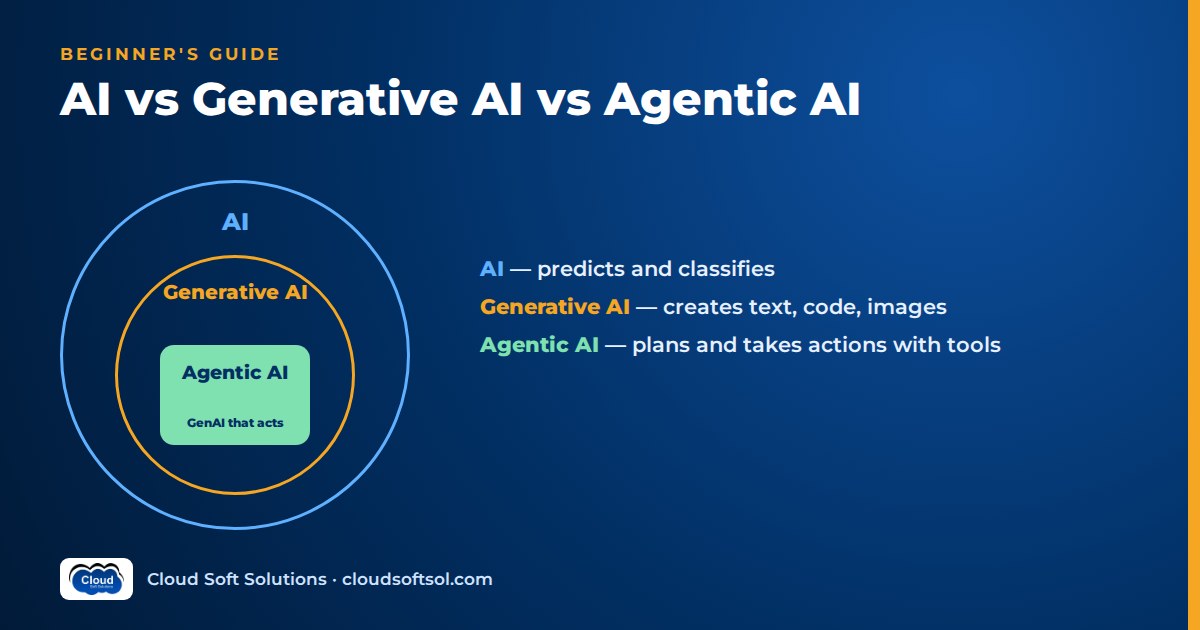
AI, generative AI and agentic AI are not three competing technologies. They are nested ideas. Artificial intelligence is the whole field of making software perform tasks that normally need human judgement; generative AI is the part of it that creates new content such as text, code and images; and agentic AI is a way of using generative models so they plan steps and take actions in real systems to reach a goal. If you remember one line, remember this: classic AI predicts, generative AI creates, agentic AI acts.
The short answer
- AI (artificial intelligence) is the umbrella term. It includes rule-based systems, classic machine learning, computer vision, speech recognition and everything below.
- Machine learning (ML) is the part of AI where systems learn patterns from data instead of following hand-written rules. Most "AI" in business before large language models was ML: fraud scores, churn prediction, demand forecasts.
- Deep learning is ML using large neural networks. It made modern image, speech and language models possible.
- Generative AI is deep learning that produces new content: a large language model (LLM) writing an email, a model generating an image, a coding assistant suggesting a function.
- Agentic AI is not a separate kind of model. It is a system design where a model (usually an LLM) is put in a loop with tools, memory and rules, so it can decide the next step, call an API, check the result and keep going until a task is done.
How they relate: a nested picture
The simplest way to see the relationship is as circles inside circles, with agentic AI sitting across the generative layer rather than inside it.
+--------------------------------------------------+
| ARTIFICIAL INTELLIGENCE                          |
|  rules, search, expert systems, ML ...           |
|  +--------------------------------------------+  |
|  | MACHINE LEARNING                           |  |
|  |  learns patterns from data                 |  |
|  |  +--------------------------------------+  |  |
|  |  | DEEP LEARNING                        |  |  |
|  |  |  large neural networks               |  |  |
|  |  |  +--------------------------------+  |  |  |
|  |  |  | GENERATIVE AI                  |  |  |  |
|  |  |  |  LLMs, image and code models   |  |  |  |
|  |  |  +--------------------------------+  |  |  |
|  |  +--------------------------------------+  |  |
|  +--------------------------------------------+  |
+--------------------------------------------------+

AGENTIC AI = a way of USING models:
  goal -> plan -> call tool -> observe -> repeat
  (model + tools + memory + guardrails + human approval)
Every generative AI system is also an AI system, but most AI in production is not generative; a credit-risk model or spam filter generates nothing. The categories describe roles, not rival products.
What is AI? Prediction and decision support
Before generative models, business "AI" usually meant systems that take structured input and return a prediction, score or label, trained on historical labelled data to answer one narrow question consistently.
Typical examples:
- Classification: is this transaction fraudulent? Is this email spam? Which department should this support ticket go to?
- Regression and forecasting: how many units will this store sell next week? What is the likely claim amount?
Classic ML is measurable and cheap to run: you can compute precision and recall, monitor drift and read the output as a probability. But each model does one job. A fraud model cannot write the email explaining why a card was blocked.
What is generative AI? Creating new content
Generative AI models learn the structure of huge amounts of text, code, images or audio and can then produce new content that follows those patterns. Large language models are the most visible example: you give a prompt and they produce text, which might be a summary, a translation, SQL, Python or a structured JSON object.
Typical examples:
- Drafting customer replies and meeting summaries; coding assistants suggesting functions and tests.
- Extracting fields from messy documents such as invoices, contracts or discharge summaries into a structured format.
- Question-answering over company documents using retrieval-augmented generation, where relevant passages are fetched and given to the model so it answers from your data. We explain this pattern in detail in what is RAG.
The big shift is flexibility: one general model handles many language tasks with only a prompt. The trade-off is that outputs are probabilistic, so a model can produce fluent text that is wrong. That is why business use keeps a human reviewing output and invests in evaluation. If you are deciding how to customise a model for your data, RAG vs fine-tuning covers that choice.
What is agentic AI? Taking action toward a goal
Agentic AI wraps a generative model in a control loop. The system gets a goal and tools such as APIs, database queries and ticketing systems. The model picks a tool, the application executes it, the result goes back to the model, and the loop continues until the goal is met, a limit is hit or a human must decide.
Typical examples:
- An IT operations agent that reads an alert, queries logs, checks the runbook and proposes or applies a fix.
- A coding agent that reads a repository, makes a change, runs tests and opens a pull request for review.
What makes something agentic is not the model but autonomy over multiple steps and the ability to change real systems. A wrong chatbot answer is embarrassing; a wrong agent action can update the wrong record. Production agents therefore need least-privilege tool access, human approval for high-impact steps, step and cost limits, and full tracing. Standards such as MCP (the Model Context Protocol, an open protocol for connecting AI applications to tools and data) make tool connections easier to build; see what is MCP. For the full mechanics of the agent loop, memory and multi-agent design, read our guide on what is agentic AI.
AI vs generative AI vs agentic AI: comparison table
| Aspect | Classic AI / ML | Generative AI | Agentic AI |
|---|---|---|---|
| What it does | Predicts, scores or classifies from patterns in data | Creates new content from a prompt and context | Plans and executes multi-step tasks using tools |
| Typical output | A label, number or ranking | Text, code, images, structured data | Completed actions plus a record of what it did |
| Examples | Fraud detection, demand forecasting, ticket routing | Email drafts, summaries, coding assistants, RAG chat | IT-ops agents, invoice matching, coding agents |
| Human role | Acts on the prediction | Reviews and edits the draft | Sets goals, approves key actions, handles exceptions |
| Risk profile | Bias, drift, wrong predictions at scale | Hallucination, data leakage, inconsistent output | Wrong actions, excess permissions, prompt injection, runaway cost |
| How you test it | Accuracy, precision, recall on a held-out set | Groundedness, relevance, human and LLM-judged evaluation | Task success, tool-call correctness, safety checks, traces |
| Skills to learn | Python, statistics, scikit-learn, feature engineering | Prompting, LLM APIs, embeddings, RAG, evaluation | Tool calling, LangGraph, MCP, APIs, identity, observability |
One business task, three ways: an invoice query
Abstract definitions only go so far. Consider an illustrative example: a retailer's shared-services team in Hyderabad receives thousands of supplier emails every month asking, "Why hasn't invoice INV-4471 been paid?" Here is how each approach handles the same email.
1. Classic ML: a classifier routes the email
A trained classifier reads the email and predicts its category: payment status query, with a confidence score. It also extracts the invoice number with a pattern. The ticket lands in the right queue, which saves triage time. But a human still opens the ERP, finds the invoice, sees it is blocked because the purchase-order quantity does not match the goods receipt, writes the reply and updates the ticket. The AI made one narrow decision, and it is easy to measure how often that decision is right.
2. Generative AI: a model drafts the reply
Now an LLM reads the email, the ticket history and, through retrieval, the accounts-payable policy, and drafts a polite reply explaining the usual reasons invoices are held. The clerk edits and sends it, saving writing time. The catch: the model does not actually know this invoice's status unless someone pastes it in. Without live data, the draft may be generic or, worse, confidently wrong. The human remains the integrator who checks the ERP.
3. Agentic AI: an agent checks the ERP and updates the ticket
An agent is given the goal "resolve this supplier payment query" and a small set of tools: read invoice status from the ERP, read the purchase order and goods receipt, search the supplier master, update the ticket, and send an email only after approval.
Email arrives
  -> classify: payment query (ML tool)
  -> ERP: get invoice INV-4471 -> status BLOCKED
  -> ERP: get PO + goods receipt -> qty mismatch
  -> draft reply with the real reason (LLM)
  -> update ticket: cause, evidence, next step
  -> [HUMAN APPROVAL] send email to supplier
  -> log full trace for audit
The agent does in a minute what took a clerk several screens, and the reply cites the actual mismatch. But look at what had to be engineered around it: read-only ERP access for lookups, a service identity with narrow permissions, an approval step before anything leaves the company, a trace of every tool call for audit, and an evaluation set of past queries to prove it works before it touches real suppliers. Notice also that the classic classifier is still in the picture, as one of the agent's tools. In real enterprises the three approaches are combined, not chosen between.
In short: ML reduces sorting, generative AI reduces writing, agentic AI reduces the clicking between systems, and each step demands more engineering discipline.
If you want to build all three of these in hands-on labs, from a simple classifier to a RAG assistant to a tool-calling agent with approvals, Cloudsoft's AI, GenAI and Agentic AI course is structured around exactly that progression.
Career implications: what to learn first
The nested structure tells you the learning order. You do not need a PhD in deep learning to build useful generative or agentic systems, but you do need the engineering foundations that every layer depends on.
- Python and APIs. Almost every AI tool, SDK and framework assumes Python. Learn JSON, HTTP calls and FastAPI. Python training is the right first step if you are new.
- Core ML concepts. Learn what training, validation, overfitting, precision and recall mean. You will evaluate systems even if you rarely train models.
- Generative AI fundamentals. Prompting, structured outputs, embeddings, vector search and RAG. Build a document Q&A assistant and measure how often it is grounded in the sources.
- Agentic patterns. Tool calling, state and memory, frameworks such as LangGraph, and MCP for connecting tools. Build an agent that reads and writes to a real system like Jira or a database, with an approval step.
- Production skills. Evaluation, observability, security and cloud deployment. This is what separates a demo from a system a bank or hospital will allow near its data. Our guide to LLM evaluation is a good place to start.
Developers move into AI engineering roles building these applications; cloud and DevOps engineers deploy, secure and observe them. Engineers who can take an agentic system into a customer's real environment, integrate it with their systems and prove the business outcome are increasingly hired as Forward Deployed Engineers; if that path interests you, what a Forward Deployed Engineer does explains the role, and Cloudsoft's FDE PRO program trains for it. For a broader view of paths by role, browse our career roadmaps.
For freshers, a practical sequence is one ML project, one RAG project with measured quality and one agent project with tools and approvals. Then test yourself with our agentic AI interview questions.
Frequently asked questions
What is the difference between AI and generative AI?
AI is the broad field of building systems that perform tasks needing human-like judgement, including prediction, classification and recognition. Generative AI is a subset of AI that creates new content such as text, code, images or audio. A fraud detection model is AI but not generative; a model that drafts an email is generative AI.
What is the difference between generative AI and agentic AI?
Generative AI produces content in response to a prompt, and a human decides what to do with it. Agentic AI uses a generative model inside a loop with tools, so it can plan steps, call APIs, check results and take actions toward a goal. Generative AI writes the answer; agentic AI does the work, usually with human approval for important steps.
Is agentic AI a type of generative AI?
Not exactly. Agentic AI is a way of building systems around models, most often large language models, rather than a new type of model. It relies on generative AI for reasoning and language, but adds tools, memory, orchestration and guardrails. An agent can also call classic machine learning models as tools.
What are the main types of AI?
A practical way to group them is by what they do. Rule-based systems follow hand-written logic. Machine learning systems predict or classify from data. Deep learning handles complex inputs such as images, speech and language. Generative AI creates new content. Agentic AI combines models with tools to complete multi-step tasks.
Is ChatGPT generative AI or agentic AI?
A chat assistant answering questions is generative AI. When the same kind of assistant is given tools, such as web search, code execution or access to your files and apps, and works through several steps on its own to complete a task, it is behaving agentically. The label depends on how the model is being used, not just on the product name.
Should I learn machine learning before generative AI?
You do not need deep ML expertise first, but you should understand core concepts such as training data, overfitting and evaluation metrics. Strong Python and API skills matter more for building generative and agentic applications. Learn the basics of ML alongside generative AI rather than spending a long time on ML theory before starting.
Will agentic AI replace jobs?
Agentic AI automates parts of workflows, especially repetitive steps that move information between systems. In practice it changes roles more than it removes them: people shift toward reviewing, approving, handling exceptions and improving the system. It also creates engineering work in building, integrating, securing and evaluating agents.
Which should I learn first: AI, generative AI or agentic AI?
Learn them in order, because each builds on the one before. Start with Python and core AI concepts, then generative AI with RAG and evaluation, then agentic patterns with tool calling and frameworks such as LangGraph. Employers value engineers who understand the whole stack and can explain when each approach is the right one.
Ready to move from definitions to working systems? Cloudsoft's generative AI and agentic AI training in Hyderabad takes you from Python and LLM fundamentals through RAG, evaluation and tool-using agents, in our Ameerpet classroom or live online. Call +91 96660 19191 to book a free demo.