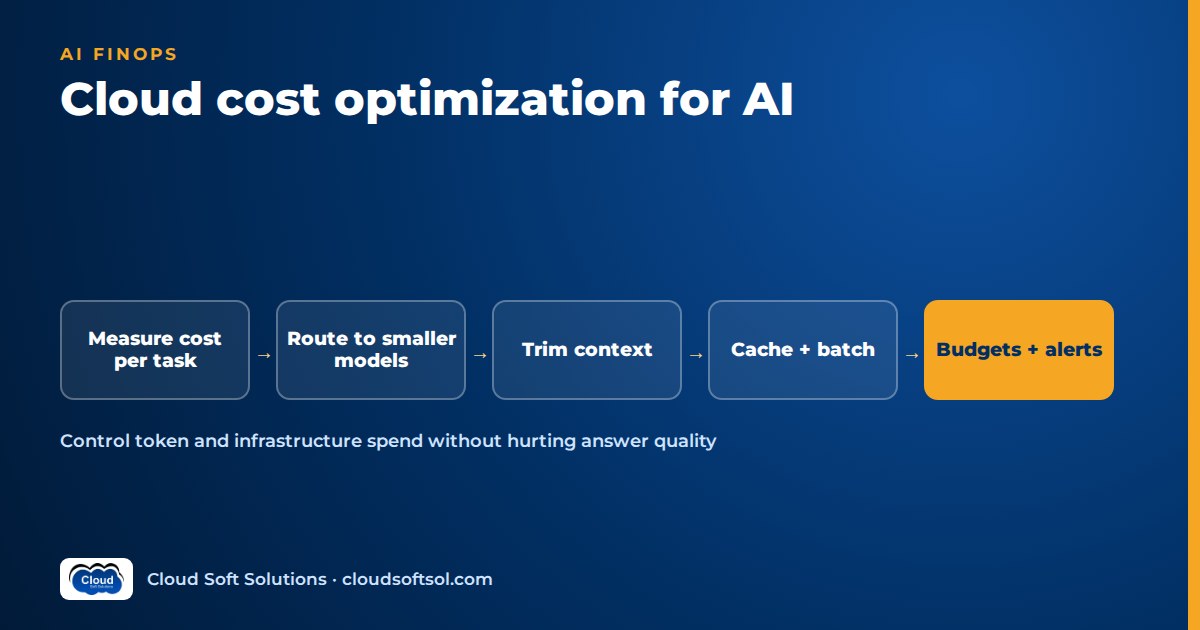
LLM cost optimization means paying only for the tokens, retrieval, compute and storage that actually move a task to a good outcome, and proving it with measurement rather than guesswork. In practice the biggest wins rarely come from haggling over price per token; they come from sending smaller requests to cheaper models, retrieving fewer but better chunks, caching what repeats, moving offline work to batch, capping output and agent steps, and right-sizing the infrastructure around the model. This guide breaks down where AI spend comes from, gives you a cost-per-task model, walks through each lever with its trade-offs, and covers the governance that keeps spend predictable as adoption grows.
It is the cost-engineering companion to our AI observability guide, which explains how to capture tokens and cost on every trace. Prices change often and differ by provider, region and contract, so this article quotes none; any numbers in examples are labelled placeholders.
Where AI cost comes from
Teams new to GenAI FinOps usually look only at the model invoice. In a production RAG assistant or agent, the model is one line among several, and the others grow quietly with data volume and traffic.
| Cost source | What drives it | Typical surprise |
|---|---|---|
| Input tokens | System prompt, history, retrieved chunks, tool definitions and results | Context grows with every feature; agents resend history each step |
| Output tokens | Answer length, reasoning tokens where produced, verbose formats | Usually priced higher than input per token |
| Embeddings | Indexing, re-indexing, embedding each query | Changing embedding model forces a full re-embed |
| Vector storage and search | Vector count, dimensions, replicas, cluster size, queries | Provisioned capacity billed whether or not it is queried |
| GPU / compute | Self-hosted models, rerankers, API containers, ingestion and OCR workers | GPU nodes idling overnight for an office-hours workload |
| Data transfer | Cross-region or cross-cloud model calls, document movement, egress | Model in one region, app and data in another |
| Observability and log retention | Full prompt and answer capture, trace volume, retention period | Long retention of full content grows with every request |
| Evaluation runs | Regression suites per pull request, LLM-as-judge, online evaluators | A judge scoring every trace adds a model call per request |
A cost-per-task model
Cost per API call is the wrong unit. An agent that takes more steps, or a RAG assistant that needs a follow-up question, costs more for the same business outcome. Model cost per completed task (a resolved ticket, an answered policy question, a processed claim) and you can compare designs honestly.
cost_per_task =
    sum over model calls in the task:
        (input_tokens  x input_price)
      + (cached_tokens x cached_price)
      + (output_tokens x output_price)
  + query_embeddings x embed_price
  + vector_queries   x search_price
  + tool / API calls x tool_price
  + share of fixed cost
      (vector DB, GPUs, workers, logs, evals)
      / tasks completed in the period
Illustration with placeholders only: if a task averages S model calls of I input and O output tokens, variable model cost is roughly S x (I x input price + O x output price). Cutting S (fewer agent steps) or I (smaller context) reduces every call, while a cheaper model changes only the price terms. And an always-on vector cluster serving low traffic can dominate cost per task until usage grows.
Track it per feature, tenant and model, next to a quality metric. A cost cut that lowers answer quality is just a cheaper way to fail.
Measure before optimising
Without per-request data, optimisation targets the visible line item rather than the real driver. First make sure each trace records model, prompt version, input, cached and output tokens, retrieval counts, steps and computed cost, tagged with tenant and feature. The AI observability guide covers how to instrument this with OpenTelemetry, LangSmith or Langfuse.
Then answer three questions from the data:
- Which features and tenants drive spend? It is usually concentrated in a few flows.
- Which term dominates in those flows? Input context, output length, step count or fixed infrastructure.
- What is the quality baseline? You need an evaluation set and current scores before any change; see LLM evaluation.
Measure -> Find top driver -> Pick one lever
   ^                               |
   |                               v
Monitor <- Ship behind flag <- Eval vs baseline
Change one lever at a time. Levers interact: editing a prompt can break a cache prefix, and fewer chunks can push more requests to the larger model.
Levers to reduce LLM API costs
Model routing: small model first, escalate when needed
Much production traffic is not hard. Classification, extraction, intent detection, short FAQ answers and query rewriting often work well on a smaller, cheaper model. Common routing patterns:
- Classifier routing. A cheap classifier labels the request simple or complex before the main call.
- Cascade. The small model answers; if a validator or groundedness check fails, the larger model retries.
- Task-split. The small model plans and rewrites; the larger one writes final answers for high-stakes flows.
The risk is silent quality loss. Evaluate each route separately, log which model answered, and watch escalation rates: if most requests escalate, the cascade costs more than calling the large model directly.
Prompt and context trimming
Every system-prompt token is paid for on every call. Remove duplicated instructions, examples that no longer change behaviour, and tool definitions the flow cannot use. Summarise older turns instead of resending full history, pass only the tool results the next step needs, and compare token counts per prompt version in traces.
Retrieval tuning: fewer, better chunks
In a RAG system, retrieved chunks are often the largest share of input tokens. Retrieving many chunks "to be safe" increases cost and frequently lowers quality, because the model must sift through noise. Tune instead:
- Rerank a wider candidate set down to the few most relevant chunks.
- Apply metadata filters (product, region, version) before vector search.
- Right-size chunks, and remove stale and duplicate documents from the index.
- Measure context precision and recall with an evaluation tool such as Ragas as you reduce chunk count, to see where quality starts to drop.
Caching
Response caching (exact match). Store the answer for an identical normalised request and return it without calling the model. Key the cache on prompt version, model, tenant, user permissions and index version, and invalidate when source documents change.
Semantic caching. Embed the request and return a cached answer for a "similar enough" earlier question. It raises hit rates for FAQ-style traffic, but the risks are real:
- Two questions can be similar in embedding space but need different answers ("Can I cancel my policy?" against "Can I cancel my claim?").
- Answers that depend on the user's data or entitlements can leak across users or tenants if the cache is not scoped.
Cached answers also go stale when policies change. Use semantic caching only for non-personalised, tenant-scoped content, with a conservative similarity threshold, expiry and evaluation.
Provider prompt caching. Several model providers can cache a repeated prompt prefix, such as a long system prompt, tool definitions or a shared document, so later calls that reuse the same prefix are processed faster and billed differently for the cached portion. Minimum prefix length, cache lifetime, whether caching is automatic and how cached tokens are priced vary by provider, so check current documentation. The engineering implication is consistent: put stable content first and variable content (user question, retrieved chunks) last, and avoid inserting timestamps or request IDs at the top of the prompt, which break the prefix.
Batch APIs for offline work
Summarising documents, classifying a ticket backlog, embedding a new corpus and nightly evaluation runs do not need answers in seconds; submit them as asynchronous batch jobs. Major providers, including Amazon Bedrock and Azure OpenAI, offer batch modes that are typically priced below synchronous calls in exchange for a longer completion window; confirm the current terms. Separate interactive and offline workloads in your architecture so the offline path can use batch by default.
Output length limits
Set a maximum output token limit per feature, sized to the longest legitimate answer rather than left at a default. Ask for concise formats, prefer structured output for machine-consumed results, and do not ask the model to restate the question. For models that produce reasoning tokens, use the provider's controls for reasoning effort or budget where available, and reserve heavy reasoning for the routes that need it.
Step limits for agents
Agents cause most runaway cost: each step resends growing context, and a confused agent can loop. Enforce a hard cap on steps, tool calls and total tokens per task in the orchestration layer (in LangGraph, for example, through a recursion limit and your own counters in state). When a cap is hit, stop cleanly, return a useful partial result or hand off to a human, and log the event. Alert on rising average steps per task: it often signals a broken tool or a prompt regression before users complain.
Provisioned vs on-demand capacity
On-demand (pay per token) suits variable and early-stage traffic. Provisioned capacity, offered by Amazon Bedrock and Azure OpenAI among others, buys dedicated throughput for a period and is billed whether or not you use it. It fits steady, high traffic, predictable-latency needs or custom models that require it. It is a utilisation question: compare it with on-demand cost at your measured, not forecast, volume, and keep on-demand as overflow.
Provider-specific batch, provisioned throughput and budget mechanics are covered hands-on in our Amazon Bedrock GenAI training and Azure OpenAI training, with foundations in the AWS course and Azure course.
Right-sizing compute and spot for workers
Right-size container requests from observed usage, autoscale API pods on load, scale GPU node pools down outside working hours where possible, and pick the smallest GPU type that meets your latency target. Interruptible capacity (spot instances on AWS, spot VMs on Azure) is a good fit for retry-safe work such as embedding jobs, document ingestion and evaluation runs, provided jobs checkpoint and resume. Keep latency-sensitive serving on on-demand capacity. Codifying node pools, schedules and tags in Terraform for AI infrastructure keeps these settings reviewable and stops one-off console changes from drifting.
Log retention policies
Full prompt and answer text is large and sensitive. Keep metadata (tokens, cost, latency, model, IDs) long term for trends, keep full content briefly or as a sample, and move older data to cheaper storage with lifecycle rules. Shorter raw-content retention also reduces privacy exposure.
To practise these levers on real builds, Cloudsoft's AI Forward Deployed Engineer course includes cost-optimizing AI applications among its skills, alongside LangSmith, Langfuse and OpenTelemetry observability.
Governance and GenAI FinOps
Engineering levers reduce cost per task; governance keeps total spend predictable as more teams build on shared models. In a GCC in Hyderabad or Bengaluru serving several business units, or a services firm running AI for multiple clients, it turns a surprise invoice into a planned budget line.
- Tagging. Tag every resource (vector clusters, GPU node pools, buckets, log groups) with team, application, environment and cost centre, and attach the same identifiers to every model call. Enforce tags in infrastructure as code.
- Per-team budgets and alerts. Set budgets per team and environment in the provider's cost tools, with threshold alerts and anomaly detection. Alert on tokens and steps per task from traces too, because those move before the invoice does.
- Showback (or chargeback). Report spend per team, feature and tenant regularly, with cost per task next to quality. Chargeback adds accountability once the numbers are trusted.
- Quotas per tenant. Route model calls through a central gateway that enforces rate limits and token quotas per tenant, user and feature, and applies routing, caching and logging consistently. Where that gateway sits is covered in our enterprise AI architecture guide.
Budgeting in rupees for services priced in US dollars adds exchange-rate movement to usage growth, another reason to forecast from cost per task multiplied by expected volume rather than last month's invoice.
Illustrative scenario: a support assistant whose costs grew with adoption
Consider an insurer that launched a RAG-based support assistant for contact-centre agents. The pilot bill was small. After rollout to every team and the customer chat channel, spend grew faster than traffic and finance asked why. The team took these steps, in order.
- Instrumented cost per task. Adding tokens, computed cost and tenant and feature tags to existing traces showed customer chat and a "summarise this claim" feature dominated spend.
- Found the drivers. The system prompt had grown with every policy rule, retrieval returned a large fixed number of chunks, full history was resent every turn, and summaries had no output limit.
- Trimmed context and retrieval. They removed duplicated instructions, added a reranker, filtered by product line before search and summarised older turns, confirming evaluation scores held before each change shipped.
- Restructured prompts for caching. Stable instructions and tool definitions moved to the front so provider prompt caching could reuse the prefix.
- Added routing. Intent detection and simple FAQ answers moved to a smaller model, escalating on a failed groundedness check, with escalation rate tracked.
- Moved offline work to batch. Overnight back-office claim summaries moved to batch mode, and re-embedding jobs to spot workers.
- Capped outputs and set governance. Output limits per feature, per-tenant quotas, team budget alerts, monthly showback and shorter retention for raw prompts and answers.
The outcome was not one dramatic saving but a cost per task that stayed controlled as adoption grew, quality tracked alongside it, and a forecast finance could trust. Going from AI demo to enterprise outcome means the economics must scale as well as the code.
LLM cost optimization checklist
- Traces record model, prompt version, tokens, steps and cost; cost per task is tracked next to quality.
- An evaluation baseline exists before any cost change ships.
- Requests are routed to the smallest model that meets the quality bar, with escalation monitored.
- System prompts and tool definitions are audited and versioned; history is summarised or truncated.
- Retrieval uses filters and reranking, with chunk count tuned against context precision and recall.
- Caches are keyed on prompt version, model, tenant and permissions; semantic caching is scoped and expiring; stable prompt content comes first.
- Offline workloads use batch APIs; every feature has a maximum output length.
- Agents have hard caps on steps, tool calls and tokens per task, with alerts on rising step counts.
- Provisioned capacity is justified by measured utilisation; compute is right-sized and retry-safe workers use spot.
- Log retention is tiered, with short retention for raw content.
- Resources and model calls are tagged; budgets, alerts, showback and per-tenant quotas are in place.
Frequently asked questions
What is LLM cost optimization?
It is the practice of reducing the cost of each completed AI task, across tokens, embeddings, vector search, compute, data transfer, logs and evaluation, without lowering quality. It combines measurement, engineering levers such as routing and caching, and governance such as budgets and quotas.
What is the fastest way to reduce LLM API costs?
Measure cost per task to find the dominant driver first. Quick wins are usually trimming prompts and retrieved context, output limits, agent step caps and routing simple requests to a smaller model, each validated against an evaluation set.
Is semantic caching safe for enterprise applications?
With care. Similar questions can need different answers, cached answers can leak across users or tenants, and they go stale. Use it only for non-personalised, tenant-scoped content, with a conservative threshold, expiry and evaluation.
How is provider prompt caching different from response caching?
Response caching returns a stored answer without calling the model. Provider prompt caching still calls the model but reuses the processed prompt prefix, such as a long system prompt or tool definitions, so that portion is processed more cheaply and quickly. Put stable content first.
When should I use provisioned capacity instead of on-demand pricing?
When traffic is steady and high, latency must be predictable, or a custom model requires it. Compare its cost with on-demand at your measured volume, and keep on-demand for overflow.
How do I control the cost of AI agents?
Cap steps, tool calls and tokens per task in the orchestration layer, return a partial result or hand off to a human at the cap, summarise history, and alert when average steps rise.
What is GenAI FinOps?
GenAI FinOps applies cloud financial management practices to AI workloads: tagging resources and model calls, per-team budgets and alerts, showback or chargeback, per-tenant quotas, and forecasting from cost per task multiplied by expected volume.
Ready to engineer AI systems that are reliable, secure and affordable to run? Cloudsoft's Forward Deployed Engineer course in Hyderabad is a 12-week program with live sessions, labs and enterprise projects, in our Ameerpet classroom beside Ameerpet Metro or live online. Call +91 96660 19191 to book a free demo.