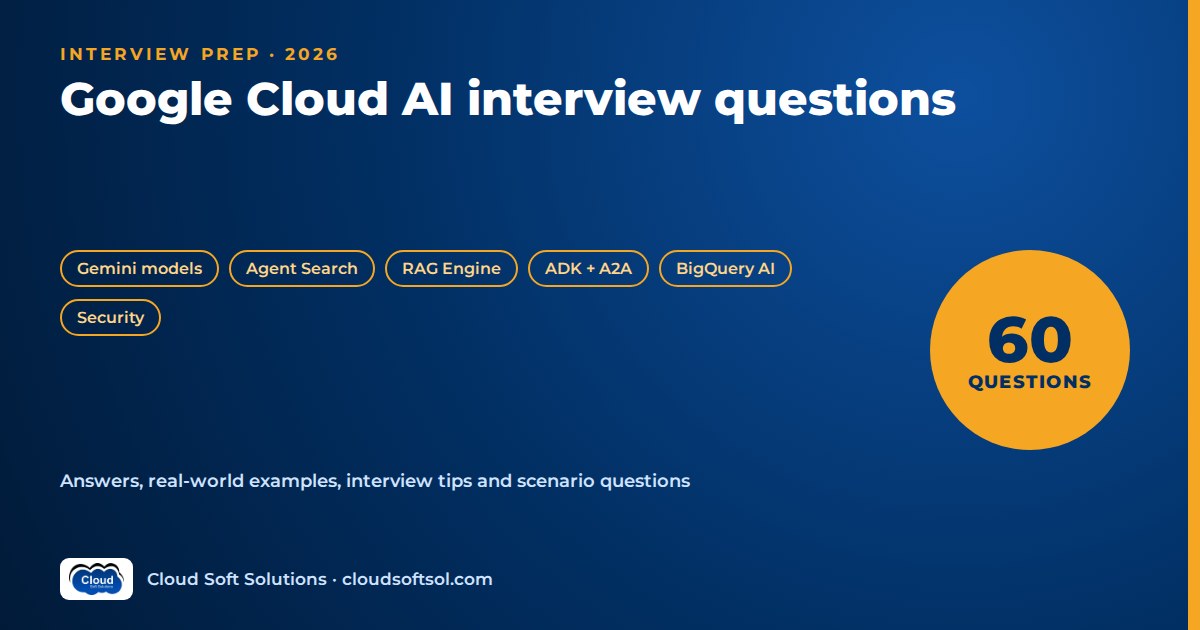
GCP AI interview questions in 2026 test whether you can design, secure and run a generative AI system on Google Cloud, not whether you can list product names. Interviewers for Google Cloud AI engineer, GenAI developer and cloud architect roles expect you to know Gemini Enterprise Agent Platform (previously Vertex AI), retrieval with Agent Search and RAG Engine, agents built with the Agent Development Kit and run on Agent Runtime, data in BigQuery and AlloyDB, and the IAM, VPC Service Controls and cost controls that make it production-grade. This guide works through 60 high-value questions with model answers, from fundamentals to twelve production scenarios.
How to use this guide
- Freshers and career switchers: focus on fundamentals, models and RAG. Interviewers check that you know what each managed service does, when you would pick it, and that you can explain grounding and evaluation in plain words.
- Developers, data engineers and cloud engineers moving into AI: the agents, BigQuery, security and cost sections carry most weight. You are expected to map familiar controls (service accounts, private networking, budgets, logs) onto AI workloads.
- Senior and architect candidates: the architecture and scenario sections matter most. Expect follow-ups such as "what fails first at 10x traffic?" and "how would you prove that answer is grounded?"
Google renamed many AI products in April 2026. Learn the capability first and the current name second, and mention the old name when you answer, because many codebases, API endpoints and job descriptions still use it. Classical ML pipelines are covered in depth in our Vertex AI MLOps interview questions guide; this page touches MLOps only where GenAI changes it.
Contents
- Fundamentals and the 2026 naming (Q1–6)
- Gemini and Model Garden (Q7–11)
- RAG, grounding and search (Q12–17)
- Agents: ADK, Agent Runtime and A2A (Q18–24)
- Data, BigQuery and AlloyDB AI (Q25–29)
- MLOps, evaluation and observability (Q30–34)
- Security and networking (Q35–40)
- Cost and capacity (Q41–44)
- Architecture (Q45–48)
- Real-world scenarios (Q49–60)
- Key takeaways
- Interview preparation checklist
- FAQ
Fundamentals and the 2026 naming
1. What is Gemini Enterprise Agent Platform, and how does it relate to Vertex AI?
Answer: Gemini Enterprise Agent Platform is the 2026 name for Google Cloud's AI developer platform, previously Vertex AI. Google announced it at Google Cloud Next in April 2026 as an evolution of Vertex AI: the model, training, serving and pipeline capabilities of Vertex AI and the agent-building tools of Agent Builder now sit in one platform, with new pieces for agent identity, governance and observability. Existing workloads carried over. What changed for engineers is mostly naming: Vertex AI Studio became Agent Studio, Vertex AI Search became Agent Search, Agent Engine became Agent Runtime, and Vertex AI Pipelines became Agent Platform Pipelines. Documentation URLs, some API endpoints, SDK packages and IAM role names still carry "Vertex AI" or "aiplatform", so you will see both names for a while.
Interview tip: Say both names once ("Agent Platform, previously Vertex AI") and move on. Interviewers care that you are current, not that you can recite the rename table.
2. Which Google Cloud services make up a typical GenAI application stack?
Answer: Think in layers. Models: Gemini and partner or open models through Agent Platform and Model Garden. Retrieval: Agent Search for managed search, RAG Engine for a managed RAG pipeline, or your own vectors in Vector Search, BigQuery or AlloyDB. Agents: the Agent Development Kit (ADK) for code, Agent Runtime for hosting, Sessions and Memory Bank for state. Compute for your own APIs: Cloud Run or GKE. Data: Cloud Storage, BigQuery, AlloyDB or Cloud SQL. Security: IAM and service accounts, VPC Service Controls, Private Service Connect, Secret Manager, Cloud KMS for CMEK, and Model Armor for prompt and response screening. Operations: Cloud Logging, Cloud Monitoring, Cloud Trace, budgets and billing export. Our GCP for AI engineers guide walks through each layer.
3. What is the difference between the Gemini Developer API and Gemini on Agent Platform?
Answer: The Gemini Developer API (used from Google AI Studio with an API key) is the quick path for prototypes and individual developers. Gemini on Agent Platform is the enterprise path: requests are authorised through IAM and service accounts, billed to a Google Cloud project, processed in a region or multi-region you choose, logged in Cloud Audit Logs, and covered by enterprise controls such as VPC Service Controls and CMEK where the feature supports them. The Google Gen AI SDK can target either backend through configuration, so code moves across with little change. For customer or employer work, assume Agent Platform from day one; API keys in a laptop prototype tend to leak into production otherwise.
4. What is Agent Studio used for?
Answer: Agent Studio (previously Vertex AI Studio) is the console workspace for trying models, designing and comparing prompts, testing grounding, tuning models and building agents without writing a full application first. It is not a deployment surface. Once a prompt works, move it into version-controlled code, add an evaluation dataset and deploy through your normal pipeline.
Interview tip: Mention that prompts are code. Saying "I export the prompt to the repo and run it through evaluation in CI" separates you from candidates who only demo in a console.
5. How is the Gemini Enterprise app different from Gemini Enterprise Agent Platform?
Answer: They target different users. The Gemini Enterprise app (the successor to the earlier Agentspace product) is the employee-facing product: staff search across company data, use Google-made agents such as Deep Research, build no-code agents in a workflow builder, and use custom agents that IT has registered and governed. Agent Platform is the developer and platform-engineering layer where you build, deploy, govern and monitor those custom agents, models and pipelines. A common enterprise pattern is to build an agent with ADK, deploy it on Agent Runtime, and then register it so employees reach it from the Gemini Enterprise app. Check edition details in current documentation, because features vary by edition.
6. How do Google Cloud's AI services compare with AWS and Azure equivalents?
Answer: At the capability level they map closely, which is why interviewers ask: they want to know you understand the layer, not one vendor's console.
| Capability | Google Cloud | AWS | Azure |
|---|---|---|---|
| Model platform | Gemini Enterprise Agent Platform (previously Vertex AI) | Amazon Bedrock | Microsoft Foundry |
| Managed search / RAG | Agent Search, RAG Engine | Bedrock Knowledge Bases, Kendra | Azure AI Search |
| Agent hosting | Agent Runtime | Bedrock AgentCore | Foundry Agent Service |
| Warehouse with AI | BigQuery | Redshift | Microsoft Fabric |
| Prompt and response screening | Model Armor | Bedrock Guardrails | Azure AI Content Safety |
Google Cloud's practical difference is data gravity: many enterprises already run analytics in BigQuery, so AI functions and vector search can run next to warehouse data with the same IAM. If you are preparing for more than one cloud, compare this page with our AWS Bedrock interview questions and Azure AI interview questions.
Gemini and Model Garden
7. What is Model Garden, and what kinds of models does it offer?
Answer: Model Garden is the model library in Agent Platform for discovering, testing, customising and deploying models from Google and partners. It groups three families. Google's own models, such as the Gemini family for text, code and multimodal work, Imagen and Veo for media, Gemini embedding models, and the open-weight Gemma family. Partner models offered as managed APIs (models as a service), which on Google Cloud include Anthropic's Claude family and several open-model providers, so you pay per use without managing servers. And open or third-party models you deploy yourself to an Agent Platform endpoint or to GKE, where you pick the machine and accelerator. Model Garden gives one deployment pattern and integrates with tuning, evaluation and serving. Availability differs by region and model, so check the model card before you promise a model to a customer in a specific region.
8. How do you choose between Gemini model tiers for an enterprise use case?
Answer: Start from the task and the budget, not the leaderboard. The Pro tier suits complex reasoning, long documents and difficult code. Flash tiers suit most production chat, extraction and agent tool calls at lower latency and cost. Flash-Lite tiers suit high-volume classification, routing and simple summarisation. Then test on your own evaluation set: run the same 100 to 300 representative prompts through two or three tiers, score with the Gen AI evaluation service, and compare quality, latency and cost per request. Many systems end up with a router: a small model classifies the request, simple ones stay on Flash-Lite, and hard ones escalate. Pin the exact model version you evaluated, because models follow a published retirement lifecycle.
Interview tip: Avoid naming a version number as "the" answer. Say "the current Flash tier, pinned to the version we evaluated". It shows you know versions move.
9. What tuning options exist on Agent Platform, and when would you tune instead of prompting or using RAG?
Answer: Agent Platform supports supervised fine-tuning on supported Gemini models, reinforcement-learning-based tuning on some models (check launch stage), and tuning of open models from Model Garden on your own infrastructure. Tuning changes behaviour, not knowledge. Use it when the model must follow a consistent format, tone or domain style that prompting cannot hold, or to shrink a long prompt into a cheaper model. Use RAG when the problem is missing or changing facts, because a tuned model cannot cite sources or forget a withdrawn policy. Order of escalation: prompt engineering, then RAG, then tuning, and only with a labelled dataset and an evaluation baseline. Tuning is also region-restricted for some models, which matters for data residency.
10. How do you get structured output and tool calls from Gemini reliably?
Answer: Use the API features rather than "please reply in JSON". Gemini supports a response schema (a JSON schema with a JSON response MIME type), so the model is constrained to your structure, and function calling, where you declare tools with typed parameters and the model returns a function call for your code to execute. Then validate anyway: parse with Pydantic or a schema validator, reject and retry on failure, and never execute a tool call without checking arguments against business rules. Keep schemas small and descriptive, since field names and descriptions act as instructions.
11. What are regional, multi-region and global endpoints, and why does the choice matter?
Answer: Google and partner models on Agent Platform are exposed through regional endpoints, multi-region endpoints for some models (for example US and EU), and a global endpoint. The global endpoint gives higher availability because traffic can be served from anywhere, but Google's documentation is explicit that endpoints alone do not ensure data residency or in-region ML processing; residency is a separate set of commitments per feature. So the decision is a trade-off. A consumer app with no residency requirement may prefer global for availability and capacity. An Indian bank or a European client with residency rules should use the regional or multi-region option that the residency documentation covers, accept possible capacity limits, and plan Provisioned Throughput if needed.
RAG, grounding and search
12. What does grounding mean on Google Cloud, and what grounding sources are available?
Answer: Grounding connects model output to verifiable sources so answers come from data rather than the model's memory, which reduces hallucinations and gives citations for audit. On Agent Platform you can ground with Google Search for public, fresh world knowledge; with Google Maps for geospatial context; with Agent Search over your websites and document stores; with RAG Engine over your own corpora; with Elasticsearch indexes; or with your own search API. There is also a Web Grounding for Enterprise option aimed at regulated industries. The design question is which source owns the truth: public facts from Search, policy and product facts from your own data. Never ground internal HR or banking answers on the public web. If you need a refresher on the underlying pattern, read what RAG is.
13. What is Agent Search (previously Vertex AI Search), and when would you use it?
Answer: Agent Search is Google's managed enterprise search and retrieval service. You create data stores from websites, Cloud Storage, BigQuery or connected business applications, and it handles parsing, chunking, embedding, hybrid keyword-plus-semantic retrieval and ranking. You can call it for search results only and pass them to Gemini in your own code, ask it for a generated answer with citations, or use it as a grounding source. It has been renamed several times (Generative AI App Builder, Vertex AI Search and Conversation, Agent Builder, AI Applications, Vertex AI Search), and its API is still the Discovery Engine API at discoveryengine.googleapis.com. Use it when the customer wants search quality fast and is happy to trade some control over chunking and ranking for less engineering.
14. What is RAG Engine, and how is it different from Agent Search?
Answer: RAG Engine (previously Vertex AI RAG Engine) is a managed data framework for building RAG: it ingests from sources such as local files, Cloud Storage and Google Drive, transforms and chunks, embeds, indexes into a vector database, retrieves and passes context to the model. Its value is configurability. You choose the parser (including the Document AI layout parser or an LLM parser), chunking, embedding model and vector store: a RAG-managed database (Spanner-backed, with serverless and Spanner modes), Vector Search, Feature Store, or third-party stores such as Pinecone and Weaviate, plus reranking. Agent Search is more opinionated and search-product-like; RAG Engine is a toolkit for engineers who want control of each stage. On security, its documentation lists VPC Service Controls and CMEK as supported, but not data residency or Access Transparency, which can rule it out for some regulated workloads.
Interview tip: Saying "I would check the security controls page for the exact feature before choosing" is a strong, honest answer for regulated customers.
15. How would you choose between Agent Search, RAG Engine, and building your own RAG on AlloyDB or BigQuery?
Answer: Decide on control, data location and team skill.
| Option | Choose when | Trade-off |
|---|---|---|
| Agent Search | Fast, high-quality search over sites and documents; connectors to business apps | Less control over chunking and scoring |
| RAG Engine | Managed pipeline but you want to choose parser, chunking, embeddings and store | Check per-feature security controls and region support |
| AlloyDB / Cloud SQL with pgvector | Vectors must join operational data and row-level permissions in SQL | You own ingestion, evaluation and tuning |
| BigQuery vector search | Data already in the warehouse; analytical or batch RAG | Not designed for low-latency per-keystroke serving |
Whatever you pick, evaluation and access control remain your job. A hands-on comparison point for the DIY route is our pgvector RAG tutorial.
16. What are Vector Search and Agent Retrieval on Agent Platform?
Answer: Vector Search (previously Vertex AI Vector Search) is Google's managed approximate-nearest-neighbour service, built on the ScaNN algorithm, for low-latency similarity search at large scale with public or private endpoints. Agent Retrieval (previously Vector Search 2.0) is the newer generation, organised around collections and data objects, with options such as autogenerated embeddings and reranking, and a migration path from the first version. Use these when you need dedicated, high-throughput vector retrieval separate from your database, for example product search across a large catalogue. For moderate corpora that need SQL filters and joins, a database with vectors is often simpler to operate.
17. How do you enforce document-level permissions in RAG on Google Cloud?
Answer: Filter at retrieval time using the end user's identity, never by asking the model to hide content. Options: Agent Search supports access control for some connected sources, so results respect the source system's permissions; in a DIY store, attach ACL metadata (groups, department, classification) to every chunk and add a mandatory filter built from the user's verified token, ideally enforced by the database through row-level security in AlloyDB or Cloud SQL. Test it with automated cases: a user in group A must never retrieve a group B chunk. Also handle deletion: when a source document is removed or its permissions change, re-sync quickly, because stale indexes leak. Grounding, safety settings and Model Armor do not decide who may see a document. See hybrid search and reranking for the ranking side of the same pipeline.
Agents: ADK, Agent Runtime and A2A
18. What is the Agent Development Kit (ADK)?
Answer: ADK is Google's open-source, code-first framework for building agents and multi-agent systems. It is model-agnostic (Gemini is the default path, but other models can be used) and deployment-agnostic, with SDKs for Python, TypeScript/JavaScript, Go, Java and Kotlin. Core ideas: LLM agents that reason and call tools; workflow agents (sequential, parallel and loop) for deterministic orchestration; tools as functions, OpenAPI specs or MCP servers; sub-agents and agent-as-tool for delegation; sessions, state and memory services; callbacks for guardrails; and built-in evaluation and a local dev UI. Recent releases add graph-style workflows. You can run ADK agents locally, on Cloud Run or GKE, or on Agent Runtime.
Interview tip: Explain when you would use a workflow agent instead of letting an LLM decide: whenever the order of steps is a business rule, code it.
19. What is Agent Runtime (previously Agent Engine), and what does it give you over Cloud Run?
Answer: Agent Runtime is the fully managed runtime in Agent Platform for deploying, operating and scaling agents. You deploy an agent built with ADK, LangChain, LangGraph, AG2, LlamaIndex or custom code, from the Python SDK, source files or a custom container, and Terraform can provision it. Around it sit managed services: Agent Platform Sessions for conversation state, Agent Platform Memory Bank for long-term memories, Code Execution sandboxes, Example Store, revisions with traffic management, agent identity, and tracing, logging and monitoring through Cloud Trace, Logging and Monitoring. At launch Google also announced long-running operations and faster cold starts. Cloud Run gives you more control and a simpler cost model for a stateless API; Agent Runtime saves you building session storage, memory, sandboxing and agent observability yourself. Pick Agent Runtime when those managed agent services matter; pick Cloud Run or GKE when the platform team wants one container standard.
20. How do Sessions and Memory Bank differ?
Answer: Sessions hold short-term state for one conversation: the ordered events and state variables an agent needs for the next turn. Memory Bank stores long-term memories across sessions, extracted from interactions (for example "user prefers Telugu summaries" or "the customer's open ticket is about card blocking") and retrieved by relevance when a new session starts. Memory generation uses a model, and Memory Bank keeps revision history of memories. The design questions are what you allow it to remember, how a user can delete it, and whether storing it fits privacy rules such as India's DPDP Act. Note one documented limit: CMEK cannot be used for Memory Bank or Sessions on some global or multi-regional endpoints, so check before choosing a location.
21. What is the A2A protocol, and how does it relate to MCP?
Answer: The Agent2Agent (A2A) protocol is an open standard for communication between agents built by different teams, frameworks or vendors. It was originally developed by Google and donated to the Linux Foundation, where a technical steering committee with several large vendors maintains it. An agent publishes an Agent Card describing its skills, endpoint and authentication; a client agent discovers it and sends tasks, which can stream progress and return artifacts, without either side seeing the other's internal prompts or tools. MCP (Model Context Protocol) is complementary: it connects an agent to tools and data. The short version: MCP is agent-to-tool, A2A is agent-to-agent. ADK supports both, and Agent Runtime can host A2A agents. More detail is in A2A protocol explained.
22. How would you connect an ADK agent to enterprise systems such as ServiceNow, Jira or an internal API?
Answer: Prefer narrow, typed tools over broad access. Options in ADK: a Python function tool that calls the API with validated arguments; an OpenAPI toolset generated from the system's spec; or an MCP server for the system, which other agents and clients can reuse. Authenticate with an identity, not a shared key: use the agent's identity or a service account for system-to-system calls, and OAuth on behalf of the user when the action must respect the user's own permissions (Agent Runtime provides an auth manager for three-legged OAuth). Keep secrets in Secret Manager. Separate read tools from write tools, and put any write that changes money, access or customer records behind human approval. Agent Registry, in preview at launch, can catalogue MCP servers and agents for governance.
23. What are Agent Identity, Agent Gateway and Agent Registry?
Answer: These are the governance pieces announced with Agent Platform. Agent Identity gives each agent its own identity so it can authenticate to MCP servers, Google Cloud resources, endpoints and other agents, either as itself or on behalf of an end user; it lets you scope IAM per agent instead of sharing one broad service account. Agent Gateway is the networking component that routes, secures and monitors agent traffic between users, agents and tools. Agent Registry is a central catalogue to store, discover and govern MCP servers, tools and agents. Several of these launched in preview, so check the current launch stage before committing them to a regulated production design. The general principles are in AI agent identity and access.
24. How do you design a multi-agent system on Google Cloud without it becoming unmanageable?
Answer: Start with one agent and add agents only for clear boundaries: different data owners, different security levels, or different teams. Use a coordinator that routes to specialist sub-agents in ADK, and use deterministic workflow agents for fixed sequences. Use A2A only when agents are owned and deployed separately; within one codebase, sub-agents are simpler. Give each agent its own identity and least-privilege tools. Set budgets: maximum turns, tool calls and tokens per request. Trace every hop with OpenTelemetry into Cloud Trace so you can see which agent made which decision. Evaluate the whole trajectory, not just the final answer.
User -> Coordinator agent (ADK, Agent Runtime)
          |-- Policy agent  -> Agent Search
          |-- Account agent -> MCP server -> core API
          |-- Ticket agent  -> A2A -> partner agent
        traces -> Cloud Trace | logs -> Cloud Logging
Data, BigQuery and AlloyDB AI
25. What can you do with generative AI directly inside BigQuery?
Answer: BigQuery provides SQL AI functions that call Gemini models on Agent Platform and built-in models, so analysts can run LLM tasks over tables without moving data. General-purpose functions such as AI.GENERATE and typed variants (for example AI.GENERATE_BOOL and AI.GENERATE_TABLE) give control over model and prompt; managed functions such as AI.CLASSIFY, AI.IF and AI.SCORE handle common patterns; and embedding functions generate vectors for similarity search. Typical uses: classifying support tickets, extracting fields from free-text claims, summarising reviews, and sentiment over call transcripts. The cost lesson is that one SQL statement over millions of rows is millions of model calls, so test on a sample, use the cheapest model that passes evaluation, and watch quotas.
26. How does vector search work in BigQuery?
Answer: You store embeddings in a column (generated with BigQuery embedding functions or brought in), optionally create a vector index with CREATE VECTOR INDEX (IVF or the ScaNN-based TREE_AH index type), and query with the VECTOR_SEARCH function or newer helpers such as AI.SEARCH. You can combine semantic and keyword search for hybrid retrieval. It suits RAG and semantic matching where the data already lives in the warehouse: deduplicating customer records, matching products, finding similar incidents, or batch RAG reports. It is not a low-latency serving store for an interactive chatbot with strict p95 targets; for that, use Vector Search, AlloyDB or a cache in front.
Interview tip: Mention that index creation needs enough rows to be worthwhile and that without an index the search is brute force, which is accurate but slower and more expensive on large tables.
27. What is BigQuery ML, and where does it fit next to GenAI?
Answer: BigQuery ML lets you create and run machine learning models with SQL: regression, classification, boosted trees, k-means clustering, recommendation, time-series forecasting, anomaly detection and more, plus remote models that call Agent Platform endpoints. In a GenAI project it handles the non-LLM parts that LLMs do badly: forecasting call volumes, scoring churn, detecting anomalies in transactions. A strong design often combines both: BigQuery ML flags the risky transactions, and Gemini writes the analyst summary with citations to the rows.
28. What is AlloyDB AI, and when would you use it for RAG?
Answer: AlloyDB AI is the set of AI features in AlloyDB for PostgreSQL. It includes the vector extension (pgvector, customised for AlloyDB, with HNSW and IVF indexes), the alloydb_scann extension for a ScaNN-based nearest-neighbour index, the google_ml_integration extension for generating embeddings and calling models from SQL (including AI filters and ranking), and alloydb_ai_nl for natural-language questions over database data. Use it when vectors must sit next to transactional data and permissions: a customer-service assistant that retrieves policy chunks filtered by the customer's product, branch and entitlement in one SQL query, with row-level security enforcing access.
29. How do you build the ingestion pipeline that keeps a RAG index fresh on Google Cloud?
Answer: Treat it as a data pipeline with change detection. Sources land in Cloud Storage or come through connectors; an event (Eventarc on object finalisation, or a scheduled job) triggers parsing with Document AI or the RAG Engine parser; chunks with metadata (source, version, ACLs, effective date) are embedded in batches; and the store is upserted by a stable document ID so updates replace old chunks and deletions remove them. Run heavy transforms in Dataflow or Cloud Run jobs, orchestrate with Workflows, Cloud Composer or Pipelines. Track index freshness as a metric and alert when it lags.
MLOps, evaluation and observability
30. What does the Gen AI evaluation service do?
Answer: The Gen AI evaluation service on Agent Platform gives data-driven assessment of generative models and prompts for tasks such as model migration, prompt changes and tuning. Its distinctive method is adaptive rubrics: for each prompt it generates tailored pass or fail tests, like unit tests. It also supports static rubrics applied across all prompts, computation-based metrics such as ROUGE or BLEU when you have ground truth, and custom Python functions. You can build datasets by uploading prompts, sampling from production logs, or generating synthetic data. Agent evaluation and predictive-model evaluation are documented separately. Use it in CI so a prompt or model change that lowers scores blocks the release. Our LLM evaluation guide covers metric design.
31. How do you evaluate an agent, not just a model response?
Answer: Score three things. The final response: correct, grounded, policy-compliant. The trajectory: did it call the right tools in a sensible order, with valid arguments, without unnecessary steps. And the side effects: did it create exactly one ticket, not three, and did it stop for approval where required. ADK has built-in evaluation with test cases that check expected tool trajectories and responses, and Agent Platform offers agent evaluation. Add adversarial cases: prompt injection in a retrieved document, a tool that times out, a user asking for someone else's data. Track pass rates per release.
32. How does a GenAI release pipeline on Google Cloud differ from a classical ML pipeline?
Answer: Classical ML pipelines (Agent Platform Pipelines on Kubeflow Pipelines or TFX, Model Registry, Feature Store, Model Monitoring for skew and drift) centre on training data and model artifacts. GenAI pipelines usually do not train; the artifacts are prompts, tool definitions, retrieval configuration, model version pins and evaluation datasets. So the pipeline is closer to application CI/CD: Cloud Build or GitHub Actions runs unit tests, runs the evaluation suite against a staging deployment, compares with the baseline, and deploys a new Agent Runtime revision or Cloud Run revision with gradual traffic shifting. Lineage still matters: record which prompt version, model version and index snapshot produced each answer. For the training-centred side, see our MLOps and LLMOps interview questions.
33. What would you monitor for a GenAI application on Google Cloud, and with which tools?
Answer: Four groups. Reliability: error rates, 429 throttling, timeouts and latency percentiles, including time to first token. Cost: tokens in and out per request, cached tokens, calls per user, spend per feature. Quality: groundedness and answer-quality scores from sampled online evaluation, user feedback, escalation rate to humans. Safety: Model Armor detections, blocked responses, injection attempts. Tooling: Cloud Logging for structured request logs (redact PII before logging), Cloud Monitoring for metrics, dashboards and alerting policies, Cloud Trace with OpenTelemetry for spans across retrieval, model and tool calls, and Agent Observability for deployed agents (preview at launch). Export logs to BigQuery for analysis. The broader practice is covered in AI observability.
34. How do you handle a Gemini model version being retired?
Answer: Plan for it from the start. Pin model versions in configuration, not code. Track the published retirement dates and put them on the team's calendar. When a successor is available, run the full evaluation suite against it, compare quality, latency, cost and safety behaviour, and adjust prompts if needed, since newer models can follow instructions differently. Roll out with a canary: a small share of traffic on the new version, compare live metrics, then shift. Keep the previous version available until the cutover is proven.
Security and networking
35. How do you design IAM for an AI application on Google Cloud?
Answer: One identity per workload, least privilege per identity, no keys. The chat API's service account may call models and query one Agent Search app; the ingestion job's service account may read one bucket and write the index; neither can do both. Use Workload Identity Federation for CI/CD and for workloads outside Google Cloud, and Workload Identity for GKE, so there are no downloaded service account keys. Use predefined roles at the narrowest resource level, and custom roles where predefined ones are too broad. Use Agent Identity for agents so each agent's permissions are visible and revocable. Review with IAM Recommender and audit with Cloud Audit Logs.
36. What are VPC Service Controls, and why do they matter for AI workloads?
Answer: VPC Service Controls create a service perimeter around Google Cloud projects and APIs so data cannot be moved out of the perimeter even by someone with valid credentials. For AI, they stop exfiltration paths such as a stolen token used from outside to call the model API with sensitive prompts, or copying a training bucket to an external project. You place the AI project, data stores and storage inside the perimeter, allow access only from approved networks and identities through access levels, and use ingress and egress rules for controlled exceptions. Check per-feature support: Google publishes which generative AI features support VPC Service Controls, and preview features often do not.
Interview tip: Say that VPC-SC complements IAM, it does not replace it. IAM answers "who"; the perimeter answers "from where and to where".
37. How do you keep model and agent traffic private?
Answer: Use Private Google Access or Private Service Connect so workloads reach Google APIs, including Agent Platform, without traversing the public internet, and combine with VPC Service Controls. For models you deploy yourself, use private endpoints. For Agent Runtime, use the documented private connectivity options, and Agent Gateway where available for governed agent-to-tool traffic. For calls from agents to on-premises systems, route through Cloud Interconnect or Cloud VPN, and restrict egress with firewall policies so an agent cannot call arbitrary internet hosts.
38. What is CMEK, and what should you check before promising it to a customer?
Answer: Customer-managed encryption keys (CMEK) let the customer own the encryption keys in Cloud KMS (or an external key manager) for data at rest, so they can rotate, disable or destroy keys and thereby control access to the data. Before promising it, check the security-controls table for the exact feature and model: support differs between online prediction, batch inference, tuning, context caching, RAG Engine, Agent Search, Sessions and Memory Bank, and between locations. Also confirm the key's location matches the resource's region and that the service agent has the encrypter/decrypter role.
39. What is Model Armor, and where do you place it?
Answer: Model Armor is a Google Cloud service that screens prompts and responses for risks such as prompt injection and jailbreak attempts, harmful content, sensitive data (through Sensitive Data Protection) and malicious URLs. It inspects the incoming prompt before the model, and the model's response before the user, and returns which filters triggered so the application can block, sanitise or log. It works with applications on Google Cloud and other clouds. Place it as one layer among several: it complements Gemini's safety settings, retrieval-time access control, tool permission limits and output validation. It does not replace any of them. See AI guardrails for layering.
40. How do you protect PII and meet Indian data-protection obligations in a GCP AI system?
Answer: Minimise first: send the model only fields it needs. Use Sensitive Data Protection to detect and de-identify PII (masking, tokenisation) in documents before indexing and in prompts before logging. Choose regions and residency options that match the customer's obligations, and document data flows, including any partner model calls. Set retention on logs, sessions and memories, and provide deletion that reaches the vector index and Memory Bank, not only the source database. Record consent and purpose where India's DPDP Act requires it. Keep audit logs of who accessed what.
Cost and capacity
41. What are the main consumption options for Gemini on Agent Platform?
Answer: Pay-as-you-go on shared capacity, billed per token, which can return 429 errors during bursts. Provisioned Throughput, a fixed-cost, fixed-term subscription that reserves throughput for a specific model and location, suited to real-time production workloads that need consistent performance and predictable cost. Batch inference for large offline jobs that do not need immediate answers, typically cheaper per request. Context caching to reduce cost and latency for repeated content. Google lists other consumption options as well, so check the consumption-options page for current choices. A good answer mixes them: Provisioned Throughput for the steady baseline, pay-as-you-go for spikes, batch for nightly enrichment.
42. How does context caching work, and when does it save money?
Answer: Gemini on Agent Platform offers implicit caching, enabled by default, which gives savings automatically when requests share a repeated prefix, and explicit caching, where you declare content to cache and reference it, paying a storage cost based on how long the cache lives. The response metadata reports cached tokens, so you can measure it. It saves money when many requests share a large, stable prefix: a long system prompt, a product manual, or a contract that many questions refer to. It does not help when every request has unique context.
43. A team's GenAI bill on Google Cloud tripled in a month. How do you find and fix the cause?
Answer: Measure before cutting. Export billing to BigQuery and break spend down by SKU, project and label; check token metrics per endpoint in Cloud Monitoring. Common causes: an agent loop calling the model many times per request, retrieval stuffing too many chunks into the prompt, a batch SQL job running AI functions over a full table, a model upgrade to a more expensive tier, or an idle GPU endpoint left running. Fixes: cap agent turns and tokens, retrieve fewer but better chunks with reranking, route simple requests to a smaller model, use context caching and batch inference, and undeploy idle endpoints. Prevent recurrence with budgets and alerts per project, labels on every resource, and quota limits. More tactics are in cloud cost optimisation for AI.
44. When would you self-host an open model on GKE instead of using a managed model API?
Answer: When steady high volume makes dedicated accelerators cheaper than per-token pricing, when the customer needs a specific open or fine-tuned model, when data must not leave a controlled cluster, or when latency demands co-location. On GKE you run a serving engine such as vLLM on GPU or TPU node pools, and GKE Inference Gateway (an extension of the GKE Gateway, powered by llm-d) adds model-aware routing and load balancing for inference traffic at no extra charge beyond the underlying resources. The cost you take on is people: capacity planning, upgrades, autoscaling on queue depth, security patching and model evaluation. If utilisation will be low, managed APIs are usually cheaper overall. See self-hosting LLMs for the trade-offs.
Architecture
45. Design an enterprise knowledge assistant on Google Cloud for 20,000 employees.
Answer: Employees authenticate with the company identity provider; the request reaches a Cloud Run API (or the Gemini Enterprise app if the customer licences it). Documents from Drive, SharePoint and Cloud Storage are ingested into Agent Search or RAG Engine with ACL metadata. The API retrieves with the user's permissions, sends top chunks to a Flash-tier Gemini model with a grounding instruction, screens input and output with Model Armor, and returns an answer with citations. Everything sits inside a VPC Service Controls perimeter with private access. Evaluation runs nightly on a golden set; Cloud Monitoring alerts on latency, errors and spend.
Employee -> IdP -> Cloud Run API
                    |-> Model Armor (in/out)
                    |-> Agent Search (ACL filter)
                    |-> Gemini (Flash tier)
Docs -> ingestion job -> Agent Search data store
Logs/metrics -> Logging, Monitoring, BigQuery
[ all inside VPC Service Controls perimeter ]
Discuss trade-offs: Agent Search for speed of delivery vs RAG Engine for control; Provisioned Throughput if usage is steady during office hours. For a full build of this pattern, see the RAG knowledge assistant project.
46. Design a customer-support agent that can look up orders and raise refunds.
Answer: An ADK coordinator agent on Agent Runtime with three tools: order lookup (read-only API), policy search (Agent Search over refund policies), and refund request (write). The refund tool never executes directly above a threshold; it creates a pending request that a human approves in the existing case system. The agent uses the customer's verified identity, not a free-text claim, to scope order lookups. Sessions hold the conversation; Memory Bank is off or limited to non-sensitive preferences. Model Armor screens inputs, including content pasted from emails. Each tool call is logged with request ID, customer ID, arguments and result. Evaluation covers trajectories: correct tool order, no refund without eligibility check, correct refusal for other customers' orders.
47. Design an analytics assistant that answers business questions over BigQuery.
Answer: This is text-to-SQL with guardrails. Give the agent a curated semantic layer (approved views with clear column descriptions), not raw tables. The agent generates SQL, a validator checks it is read-only, references only allowed datasets and stays under a bytes-scanned limit (dry run first), then runs it with the end user's credentials or a role restricted to the user's data. Return the result with the SQL shown so analysts can verify. Use BigQuery row-level and column-level security for sensitive data. Evaluate against a set of questions with known correct answers, checking result equality, not SQL text.
48. How would you design a multi-region, highly available GenAI service on Google Cloud?
Answer: Start with requirements: residency, availability target and acceptable degraded modes. Run the stateless API in Cloud Run or GKE in two regions behind a global external load balancer. For models, use the global endpoint if residency allows, otherwise regional endpoints in each region with failover logic and Provisioned Throughput sized per region. Replicate retrieval: Agent Search and RAG Engine are regional resources, so plan ingestion into each region or accept a primary-region dependency. Keep session state in a store that survives a regional failure, or accept that conversations restart. Define degraded modes: if the model is throttled, fall back to a smaller model or a "search results only" answer instead of an error.
Real-world scenarios
49. Your Gemini calls start returning HTTP 429 errors during business hours. What do you do?
Answer: 429 means resource exhausted: you exceeded quota or shared capacity was not available. Stabilise first with retries and exponential backoff with jitter, then fix capacity.
What I would check:
- Whether errors are quota-related (project limits) or capacity-related on pay-as-you-go, from error details and Cloud Monitoring.
- Traffic pattern: steady growth or bursts from one client or batch job running in business hours.
- Prompt size, because token-based limits are hit faster by bloated prompts.
- Whether the global endpoint is allowed, since it improves availability.
- Whether steady load justifies Provisioned Throughput.
Production consideration: Move batch work to batch inference outside peak hours, queue non-urgent requests, and add a degraded fallback so users see a slower answer rather than an error.
50. Consider a bank in Hyderabad whose RAG assistant cites an outdated interest-rate policy. How do you fix it?
Answer: This is an ingestion and freshness failure, not a model failure. The old document is still in the index, or the new one is not, or ranking prefers the old one.
What I would check:
- Whether the superseded policy is still in the data store and why the sync did not remove it.
- Whether chunks carry effective-date and version metadata, and whether retrieval filters to the current version.
- Index freshness lag versus the policy publication date.
- Retrieval logs for the failing questions: which chunks came back and in what order.
- Whether the evaluation set includes "latest policy" questions.
Production consideration: Add a freshness SLO and alert, upsert by stable document ID, filter on effective dates, and add regression cases for every policy change. For banking-specific controls, see generative AI in banking.
51. A security review finds that an agent's service account has project Editor. What do you change?
Answer: Replace it with a dedicated identity holding only the roles the agent's tools need, on specific resources.
What I would check:
- Cloud Audit Logs to see which permissions the agent actually used.
- IAM Recommender suggestions for the account.
- Whether any user-facing actions should run on behalf of the user via OAuth instead.
- Whether the account has downloaded keys that must be revoked.
- Whether VPC Service Controls cover the project.
Production consideration: Move to Agent Identity or one service account per agent, grant narrow roles via Terraform, and add a policy check in CI that blocks basic roles such as Editor on workload identities.
52. Consider a hospital group that wants to summarise discharge notes with Gemini. Which controls do you put in place?
Answer: Treat it as a clinical-documentation aid with a clinician in the loop, never an autonomous decision-maker.
What I would check:
- Region and data residency support for the chosen model and features, and CMEK and VPC Service Controls support.
- De-identification needs before logging, using Sensitive Data Protection.
- Output format: structured sections with source references to the original note.
- Evaluation by clinicians on a sample set, including omissions, which matter more than style.
- Retention and access policies for prompts and outputs.
Production consideration: Require clinician review and sign-off, log versions of model and prompt per summary, and monitor omission rates over time.
53. Retrieval quality is poor: answers miss information that is clearly in the documents. How do you debug it?
Answer: Separate retrieval failures from generation failures before changing anything.
What I would check:
- For failing questions, whether the right chunk appears in the top results at all (recall at k).
- Parsing quality: tables, scanned PDFs and headers often parse badly; try the layout parser.
- Chunk size and overlap: answers split across chunks.
- Query mismatch: users use acronyms or Telugu-English mixes that the documents do not; add query rewriting or synonyms.
- Whether hybrid search and reranking are on.
Production consideration: Build a retrieval evaluation set with labelled relevant chunks and track recall and precision per release.
54. An insurer wants to process claim documents at scale overnight. How do you design it?
Answer: Use batch, not online, inference. Claims land in Cloud Storage; Document AI or Gemini extracts fields into a typed schema; Gemini batch inference or BigQuery AI functions classify and summarise; results land in BigQuery with confidence flags for human review.
What I would check:
- Volume and deadline, to size batch jobs and quotas.
- Schema validation and how low-confidence extractions route to adjusters.
- Duplicate and fraud signals, which a BigQuery ML model may handle better than an LLM.
- Cost per claim on a sample before full run.
- Audit trail linking every extracted field to its source page.
Production consideration: Idempotent processing by claim ID so reruns do not duplicate, and a dashboard of extraction accuracy from adjuster corrections.
55. A user pastes an email that contains hidden instructions, and the agent tries to call a tool it should not. What do you do?
Answer: This is indirect prompt injection. The fix is to limit what the agent can do, not to write a stronger system prompt.
What I would check:
- The trace: which content triggered the tool call and what arguments were proposed.
- Whether Model Armor screened the pasted content and what it flagged.
- Whether the tool had authorisation checks outside the model.
- Whether write tools required confirmation.
- Egress rules that limit where the agent can send data.
Production consideration: Mark untrusted content clearly, enforce tool permissions in code, require human approval for sensitive actions, and add this case to the red-team suite.
56. Consider a GCC team in Bengaluru migrating an assistant from another cloud to Google Cloud. How do you plan it?
Answer: Migrate by capability and prove parity with evaluation, not by line-by-line translation.
What I would check:
- The current architecture mapped to Google Cloud equivalents for models, retrieval, agents, identity and observability.
- The existing evaluation set; if none exists, build it on the old system first so you have a baseline.
- Prompt differences between model families; prompts often need rework.
- Data migration and re-embedding, since embeddings from different models are not interchangeable.
- Identity integration with the company IdP and security-control parity.
Production consideration: Run both systems in shadow mode, compare scores and latency, then shift traffic gradually. Keep abstraction thin (an internal model gateway) so future moves are cheaper.
57. Latency is too high: users wait several seconds for the first word. How do you reduce it?
Answer: Measure each span first with Cloud Trace, then attack the largest.
What I would check:
- Time spent in retrieval, reranking, model and tools per request.
- Whether responses are streamed to the client.
- Prompt length and number of retrieved chunks.
- Model tier and thinking or reasoning settings, which add latency.
- Region distance between the app, the data store and the model endpoint, and cold starts on Cloud Run.
Production consideration: Stream tokens, run retrieval and tool calls in parallel where independent, use a faster tier for simple requests, use context caching for long stable prefixes, and set minimum instances for latency-critical services.
58. A retailer wants product Q&A grounded both in its catalogue and in fresh public information. How do you design grounding?
Answer: Use two sources with clear precedence. Catalogue facts (price, stock, specifications) come from the retailer's own data through Agent Search or a database tool, and they always override public information. Public context (reviews summaries, compatibility news) can use grounding with Google Search where policy allows.
What I would check:
- Whether the retailer permits public web content in answers at all, and display requirements for Search grounding.
- That price and stock never come from the web.
- Citation display so users see which source said what.
- Evaluation for conflicts between catalogue and web.
- Cost and latency of calling two sources.
Production consideration: Route by intent: price and stock questions go only to internal tools.
59. After a prompt change, users complain the assistant is "worse", but nothing broke. How do you handle it?
Answer: Treat it as a regression and roll back first, then find out why evaluation missed it.
What I would check:
- Which revision introduced the change and whether a rollback restores satisfaction.
- Feedback and escalation metrics before and after.
- Sampled conversations to name the failure: tone, refusals, missing steps, verbosity.
- Coverage of the evaluation set: whether it contains the kinds of questions users now complain about.
- Whether rubrics measure what users care about.
Production consideration: Add the failing cases to the evaluation set, use adaptive rubrics or targeted static rubrics, and release prompt changes behind canary traffic with online quality metrics. More in LLM evaluation interview questions.
60. A customer asks you to "add AI" to their service desk on Google Cloud, with no further detail. How do you start?
Answer: Start with discovery, not a demo. Find the measurable problem: ticket volume, time to resolve, repeat questions, mis-routed tickets.
What I would check:
- Which ticket categories are frequent and answerable from existing knowledge.
- Data quality of knowledge articles and resolved tickets.
- Systems to integrate (ServiceNow, Jira, identity) and which actions need approval.
- Security, residency and logging requirements.
- A baseline metric and a target agreed with the business.
Production consideration: Pilot one narrow use case, such as triage and suggested answers for agents, with evaluation and a human in the loop, then expand to self-service. Moving a customer from an AI demo to an enterprise outcome is the work Forward Deployed Engineers do; our AI system design interview questions go deeper on this kind of open-ended design.
If you want to practise these designs with guided labs rather than read about them, Cloudsoft's APEX AI, ML, Cloud and Security program covers GenAI, agentic AI and cloud engineering, in classroom in Ameerpet or live online.
Key takeaways
- Vertex AI is now Gemini Enterprise Agent Platform; say "previously Vertex AI" and know the main renames: Agent Studio, Agent Search, RAG Engine, Agent Runtime, Agent Platform Pipelines.
- Choose retrieval by control and data location: Agent Search for speed, RAG Engine for configurability, AlloyDB or BigQuery when vectors must sit with data.
- ADK builds agents, Agent Runtime runs them, MCP connects tools, A2A connects agents.
- Security is IAM per workload, VPC Service Controls, private access, CMEK where supported, and Model Armor as one layer; always check per-feature support.
- Cost is managed with tiered models, caching, batch inference, Provisioned Throughput for steady load, and budgets with labels.
- Evaluation in CI and tracing in production are what make a GCP AI system trustworthy.
Interview preparation checklist
- Call Gemini through Agent Platform with the Gen AI SDK using a service account, not an API key.
- Build one RAG app on Agent Search or RAG Engine with citations, and one on AlloyDB or Cloud SQL with pgvector.
- Build an ADK agent with two tools and one MCP server, and deploy it to Agent Runtime or Cloud Run.
- Run a Gen AI evaluation on 50 or more prompts and explain the scores.
- Write one BigQuery query using an AI function and one using vector search.
- Draw a VPC Service Controls perimeter and an IAM plan for your project.
- Set a budget alert and break down a bill by label in BigQuery billing export.
- Prepare two stories from your own work: one debugging incident and one cost or latency improvement.
FAQ
What skills are required for a Google Cloud AI engineer role?
Python, REST APIs and SQL, plus hands-on use of Gemini on Agent Platform, retrieval with Agent Search or a vector database, an agent framework such as ADK, and core Google Cloud skills: IAM, networking, Cloud Run or GKE, logging and monitoring. Evaluation and cost awareness are increasingly expected.
Is Vertex AI still asked about in interviews after the rename?
Yes. Many job descriptions, codebases and documentation pages still say Vertex AI. Interviewers expect you to know it is now part of Gemini Enterprise Agent Platform and to answer using either name.
Do I need a Google Cloud certification to get a GCP AI job?
A certification can help you get shortlisted, but interviewers focus on what you have built and how you reason about trade-offs. A deployed project with evaluation results often carries more weight than a certificate alone.
How should a fresher prepare for GCP AI interview questions?
Learn the fundamentals and models sections first, then build one small RAG application and one agent on Google Cloud. Be ready to explain grounding, evaluation and IAM in your own words using your project as the example.
Is Python enough, or do I need other languages?
Python is enough for most GCP AI roles. SQL is essential for BigQuery work. ADK also supports TypeScript, Go, Java and Kotlin, which helps if your team builds services in those languages.
How long does it take to prepare for a Google Cloud AI interview?
It depends on your background. Engineers who already know cloud or Python usually need focused weeks of hands-on practice rather than months of theory. Build, break and fix one project rather than reading every product page.
Is GCP AI a good career choice in India?
Google Cloud AI skills are useful in GCCs, services firms and product companies that run analytics on BigQuery or build on Gemini. Pairing them with general AI engineering skills that transfer across clouds makes your profile more resilient.
Should I learn GCP AI, AWS Bedrock or Azure AI first?
Learn the one your target employers use. The concepts of models, retrieval, agents, security and evaluation transfer across clouds, so a second cloud is much faster to learn once you know one well.
Ready to turn these answers into hands-on skill? Explore the Cloudsoft APEX program for GenAI, agentic AI, ML and cloud security, or the Vertex AI training in Hyderabad for a Google Cloud focus. If you want to take enterprise AI to production for customers, the AI Forward Deployed Engineer FDE PRO program adds a simulated customer engagement and placement support until you're placed. Classes run in Ameerpet or live online; call +91 96660 19191 for a free demo.