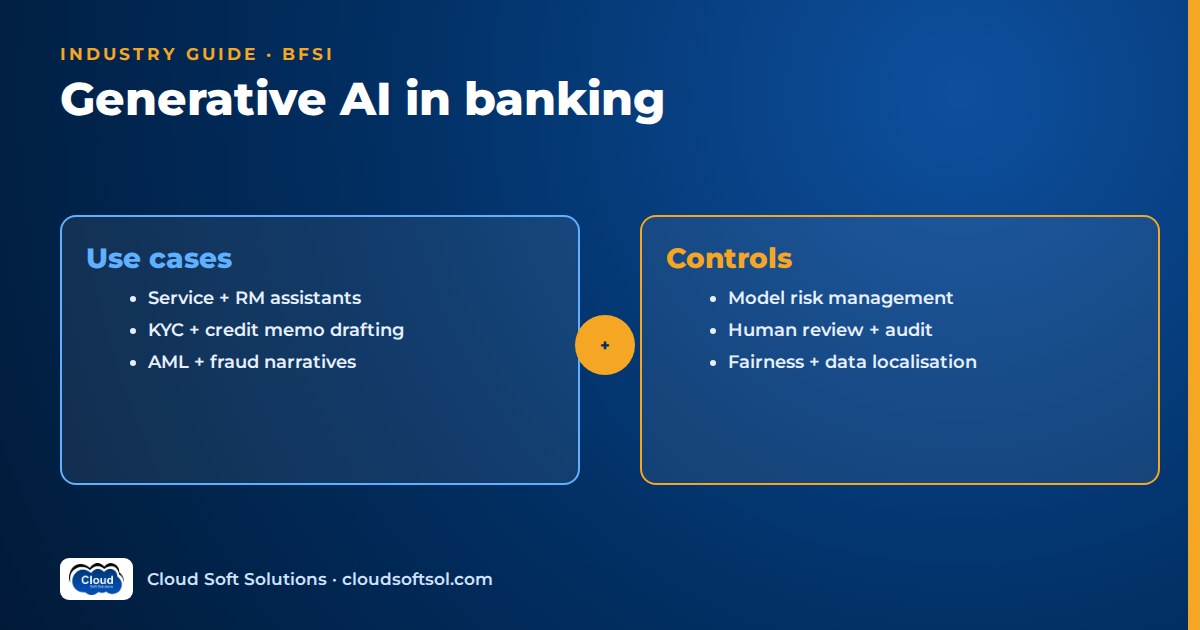
Banks are not short of generative AI ideas. What they lack is a way to tell which ideas are safe to ship, which need heavy controls, and which should wait. Generative AI in banking works when it drafts, summarises and retrieves for a trained employee who stays accountable, and it becomes high risk the moment its output reaches a customer, or shapes a decision about one, without review. This guide maps the main use cases by banking function with a risk level for each, then covers the controls, the Indian regulatory context, a reference architecture and the skills engineers in BFSI GCCs need.
For one project built end to end, see the secure banking AI assistant project walkthrough. This article is the wider view.
How to judge the risk of a banking use case
Four questions settle most of the risk level for a GenAI BFSI use case, before anyone picks a model:
- Who sees the output? An internal analyst, or a customer?
- Does it affect a decision about a customer? Credit, pricing, account restrictions, collections action or a fraud hold all count.
- What data does it touch? Public policy text, internal procedures, or personal and financial data about identifiable customers?
- Can a wrong answer be caught before it does harm? A human reviewer, a downstream check or a deterministic rule.
In the tables below, Low means internal, no customer decision, and errors easy to catch. Medium means it uses customer data or feeds a regulated process, with a human reviewing the output. High means customer-facing, decision-shaping or conduct-sensitive, and needs the full set of controls described later. These are starting points for discussion with your risk function, not formal classifications.
AI use cases in banking, grouped by function
Customer-facing channels
| Use case | What GenAI does | Risk | Key control |
|---|---|---|---|
| Customer service assistant (chat, app, voice) | Answers product and process questions from approved content; triages requests; hands off to agents | High | Answers grounded only in approved content; no advice or account actions without authentication and confirmation; clear handoff to a human |
| Collections communication | Drafts reminder messages and call scripts; summarises a borrower's contact history | High (conduct risk) | Approved templates, tone constraints, contact-time and frequency rules enforced in code, human approval, complaint monitoring |
Collections needs special care. A "firm" generated reminder can read as coercive or misleading to a regulator or ombudsman, and fair-practice expectations on recovery apply whoever wrote it. Deterministic rules decide whom to contact, when and how often; the model only fills approved templates that a person signs off.
Relationship management and sales
| Use case | What GenAI does | Risk | Key control |
|---|---|---|---|
| RM meeting preparation | Summarises products held, recent service requests and notes for customers the RM is entitled to see | Medium | Queries run on behalf of the signed-in RM; masked fields; read-only |
| Draft follow-up emails and checklists | Drafts customer-facing text the RM edits and sends through existing channels | Medium | Draft-only; RM sends; no product recommendation without suitability checks |
Onboarding, KYC and credit
| Use case | What GenAI does | Risk | Key control |
|---|---|---|---|
| KYC / onboarding document handling | Extracts fields from identity, address and business documents; flags missing or inconsistent items | Medium to High | Extraction validated against source systems; mismatches routed to an ops checker; the model never approves KYC |
| Credit memo drafting | Drafts the narrative sections of a credit appraisal from financial statements, bureau summaries and the analyst's notes | Medium to High | Every figure traced to a source; numbers computed in code, not by the model; analyst and credit committee own the decision |
The credit memo shows where to draw the line. A model can draft it; the credit decision stays with the existing scorecards, policy rules and human approvers. If the memo says the debt service coverage is comfortable, a deterministic calculation must have produced that figure, and the memo must cite it. LLMs produce fluent, plausible numbers that can be wrong, which is why hallucinations matter more in credit than almost anywhere else.
Financial crime: fraud and AML
| Use case | What GenAI does | Risk | Key control |
|---|---|---|---|
| Fraud investigation support | Summarises transaction trails, device and login history and prior cases for an investigator | Medium | Detection stays with existing fraud models and rules; GenAI only assembles and explains evidence |
| AML alert narrative drafting | Drafts the case narrative for an alert or a suspicious transaction report from structured case data | High | Investigator owns the conclusion; every statement linked to evidence; strict confidentiality of case data; full audit |
AML narratives are high risk even though a human reviews them. Reviewers anchor on a fluent draft, so a missing fact or invented account link may get signed. Show the evidence beside the draft, highlight uncited claims, and track edit rates: if investigators almost never edit, treat it as a warning sign.
Risk, compliance and regulatory reporting
| Use case | What GenAI does | Risk | Key control |
|---|---|---|---|
| Regulatory reporting assistance | Explains reporting instructions, maps data fields to return line items, drafts commentary and reconciliation notes | Medium to High | The model never produces submitted figures; reporting systems compute them; maker-checker sign-off |
| Internal policy Q&A | Answers staff questions from current policies, procedures and circulars with citations | Low to Medium | Approved corpus only; effective dates and supersession handled; "not found" instead of guessing |
Technology and operations
| Use case | What GenAI does | Risk | Key control |
|---|---|---|---|
| Developer productivity | Code assistance, test generation, legacy code explanation, documentation | Low to Medium | Approved tools only; no production data in prompts; normal code review and security scanning |
| IT operations assistant | Summarises incidents, suggests runbook steps, drafts change records | Low to Medium | Read-only by default; any action through existing change approval |
Many banks start here and with internal policy Q&A: the data is less sensitive, existing reviews catch errors, and teams build the platform and evaluation habits the harder use cases need.
An illustrative scenario: choosing the first three use cases
Consider a mid-sized private bank whose technology centre in Hyderabad has been asked to deliver "GenAI value this year". The business sponsors submit more than twenty ideas, including a customer chatbot that can explain loan rejections.
The team scores each idea on the four questions. The rejection-explaining chatbot is customer-facing, credit-related and uses personal data, so it waits. Three go first: internal policy Q&A for branch staff (low risk, builds the retrieval and citation platform), incident summarisation for IT operations (low risk, proves the observability and audit stack), and fraud case summarisation for investigators (medium risk, internal, with a clear human owner). All three share one gateway, redaction, logging and evaluation stack, so each later use case costs less.
This is the work of a Forward Deployed Engineer: sorting real business demand into what can be delivered safely now, then engineering it from AI demo to enterprise outcome.
The controls that make LLMs acceptable in financial services
Model risk management
A GenAI system enters the same model inventory as a credit scorecard, with an owner, purpose, risk tier, validation evidence and monitoring plan. Validation differs: no single accuracy number, but expert-scored task test sets, faithfulness checks against sources, red-team results, and re-validation whenever the model, prompt, corpus or tools change. Treat a vendor's silent model upgrade as a model change event.
Explainability
An LLM cannot reliably explain its own reasoning. You can provide traceability: sources retrieved, tools called, rules fired and who approved the output. For any decision affecting a customer, the explanation the bank gives should come from the decision system (rules, scorecards, policy) and not from a model's narrative about itself.
Human review for decisions affecting customers
For credit, account restrictions, fraud holds, collections actions and complaint outcomes, the model drafts and a named person decides. Make the review meaningful: show the evidence, require an explicit approve, edit or reject action, and log it. The human-in-the-loop design guide covers approval patterns and how to avoid rubber-stamping.
Fairness
GenAI bias is subtler than scorecard bias: tone that shifts with a customer's name or language, summaries that stress different facts for similar cases, extraction that fails more on some regional scripts. Test with paired cases differing only in a protected or proxy attribute, compare output quality across languages, and monitor overrides and complaints by segment.
Data localisation
Know where every prompt, chunk, embedding, log and cached response is stored and processed. Prefer Indian cloud regions for model endpoints and vector stores where available, avoid global routing by default, and record region in the data map.
Outsourcing and third-party risk
A hosted model API, vector database SaaS or vendor copilot is a third-party service. Vendor-risk review covers data use (no training on bank data), location, sub-processors, audit rights, incident notification, exit, and concentration risk when many use cases depend on one provider. An LLM gateway helps here because it makes switching providers a configuration change rather than a rewrite.
Audit trails
Log enough to reconstruct any output months later: user, redacted prompt, retrieved document versions, tool calls, model and prompt versions, guardrail results, output and the human action. Retain logs under the records policy, protect them as sensitive data, and make them searchable for audit. For the wider control framework, see enterprise AI governance; for threats such as prompt injection and data exfiltration, see AI security for enterprises.
Want to practise these controls on a realistic build instead of reading about them? Cloudsoft's AI Forward Deployed Engineer course includes a Secure Banking AI Assistant project and closes with the GlobalBank capstone, a simulated customer engagement where you take a banking AI requirement through discovery, design, build, security review and delivery.
Regulatory context for AI for banks in India
Not legal or regulatory advice. This section is a general engineering orientation, current as of writing. Regulations and their interpretation change. Always design to the written interpretation of your bank's compliance, legal and risk teams.
RBI's FREE-AI framework
In August 2025 the Reserve Bank of India released the report of its committee on a Framework for Responsible and Ethical Enablement of Artificial Intelligence (FREE-AI) in the financial sector. It sets out seven guiding principles, which the report calls "sutras": trust as the foundation, people first, innovation over restraint, fairness and equity, accountability, understandable by design, and safety, resilience and sustainability. Its recommendations are grouped under six pillars: infrastructure, policy, capacity, governance, protection and assurance.
For engineers, the practical themes are recommendations that regulated entities have a board-approved AI policy, maintain an inventory of AI use cases with risk classification, apply risk-based governance to third-party and generative AI, give customers disclosure and grievance routes when they interact with AI, keep human oversight and ongoing monitoring, and report AI incidents. FREE-AI is a committee framework of recommendations rather than a binding direction by itself. Expect model risk management expectations for AI and machine learning models to keep evolving, so check RBI's current circulars and draft guidance with your compliance team. Check the current status of both with your compliance team, because the specific obligations come from RBI's directions and circulars.
The DPDP Act
The Digital Personal Data Protection Act, 2023, and its Rules notified in November 2025, govern how banks process customers' personal data, with obligations phased in over time. The parts that matter most to AI systems are notice and lawful purpose, purpose limitation (data collected for servicing does not automatically become training data), data minimisation, erasure that must reach embeddings, caches and logs, security safeguards and breach notification, and contracts with processors such as model providers. The DPDP Act guide for AI applications maps each of these to an engineering control.
Payment data storage
RBI's 2018 directive on storage of payment system data requires payment system providers to store data relating to payment systems in India, subject to conditions set out in the directive and RBI's clarifications. In practice, if a use case touches payment transaction data, assume the data and anything derived from it (prompts, embeddings, logs) must stay in India unless compliance confirms otherwise. This can rule out model endpoints hosted abroad for those workloads.
Other expectations
RBI's directions on IT outsourcing, IT governance and cyber security, and fair practices codes for lending and recovery, apply to AI systems like any other technology. Banks with European exposure should also read EU AI Act for Indian IT and GCC teams.
The architecture pattern for GenAI in a bank
Most approved banking deployments converge on a similar shape, whatever the use case:
Employee (SSO) / authenticated customer
        |
   Channel app  --->  AI orchestration service
                         |   identity + entitlements
                         |   PII redaction
                         |   input guardrails
             +-----------+-----------+
             |           |           |
        Retrieval     Tool/API     LLM gateway
       (approved      gateway      (private,
        corpus)    (read-only,     in-region
                   on behalf of    endpoints)
                      user)
             +-----------+-----------+
                         |
          Output checks: citations, policy,
          numbers verified by code
                         |
          Human review (if customer-affecting)
                         |
   Audit log + traces + evaluation dashboard
The principles behind it:
- Inside the bank's network. Private, in-region endpoints.
- No credentials in the model. Tools reach core systems through a gateway with the user's entitlements.
- Read-only by default. Writes need confirmation, and an approver if they affect a customer.
- Deterministic code owns numbers and rules. The model writes the prose around them.
- Shared platform, many use cases. Gateway, redaction, guardrails, logging and evaluation are built once and reused.
Skills for engineers in BFSI GCCs
Global capability centres in Hyderabad and Bengaluru build and run technology for banks and insurers. Engineers there who want to work on generative AI in banking need both engineering and domain skills:
| Skill area | What it means in practice |
|---|---|
| RAG over regulated content | Versioned corpora, effective dates, supersession, citations, "not found" behaviour |
| Identity and entitlements | SSO, on-behalf-of access, row- and field-level security, masking |
| Privacy engineering | PII detection and redaction, data maps, retention, erasure propagation |
| Evaluation | Expert-labelled test sets, faithfulness metrics, regression gates in CI, red-team suites |
| Observability and audit | Tracing every step, tamper-evident logs, dashboards that risk and audit teams can use |
| Cloud and network security | Private endpoints, in-region deployment, Kubernetes, Terraform, secrets management |
| Domain fluency | KYC, credit appraisal, AML case flow, collections conduct, regulatory reporting basics |
| Working with control functions | Writing model documentation, answering validators' questions, presenting to risk committees |
The last two rows are where engineers stand out: explaining to a model validator why a faithfulness threshold sits where it does, with evidence, matters more than wiring up a framework.
Frequently asked questions
What are the safest generative AI use cases for a bank to start with?
Internal, low-risk ones such as policy Q&A with citations, IT incident summarisation and developer productivity. They use less sensitive data, a human reviews every output, and the bank builds shared platform and governance before attempting customer-facing use cases.
Can generative AI make credit decisions?
It should not be the decision-maker. A common pattern is to let GenAI draft the narrative sections of a credit memo while existing scorecards, policy rules and human approvers own the decision, and deterministic code computes every figure the memo cites.
Is RBI's FREE-AI framework mandatory?
FREE-AI is a committee report released by RBI in August 2025 that sets out principles and recommendations for regulated entities. It is not a binding direction in itself, but it signals supervisory expectations. Specific obligations come from RBI directions and circulars, so confirm the current position with your compliance team.
Can a bank in India use a model API hosted outside India?
It depends on the data and the use case. The DPDP Act allows transfers abroad unless the government restricts a country, but sectoral rules can be stricter, and payment system data must be stored in India under RBI's directive. Many banks prefer in-region endpoints for anything involving customer data. Compliance and legal teams make this call.
Why is collections communication considered high risk?
Because of conduct risk. A generated message can sound coercive, misleading or harassing, and fair-practice expectations on recovery apply whoever wrote it. Rules in code should control whom to contact, when and how often, and a person should approve the messages, which are based on approved templates.
How do you explain an LLM's output to an auditor?
Through traceability rather than model introspection: log the user, redacted prompt, retrieved document versions, tool calls, model and prompt versions, output and human approval, so any answer can be reconstructed. Customer-affecting decisions are explained by the decision system, not the model.
What skills do engineers need to work on GenAI in BFSI GCCs?
RAG over versioned regulated content, entitlement design, privacy engineering, evaluation and red-teaming, audit logging, secure cloud deployment, banking domain basics, and the ability to defend a system to model risk and audit teams.
If you want to build these skills on a banking-grade project, the Cloudsoft FDE PRO program runs for 12 weeks, in the classroom beside Ameerpet Metro or live online. Its Secure Banking AI Assistant project and GlobalBank capstone put many of the controls in this guide into practice. Call +91 96660 19191 to book a free demo session.