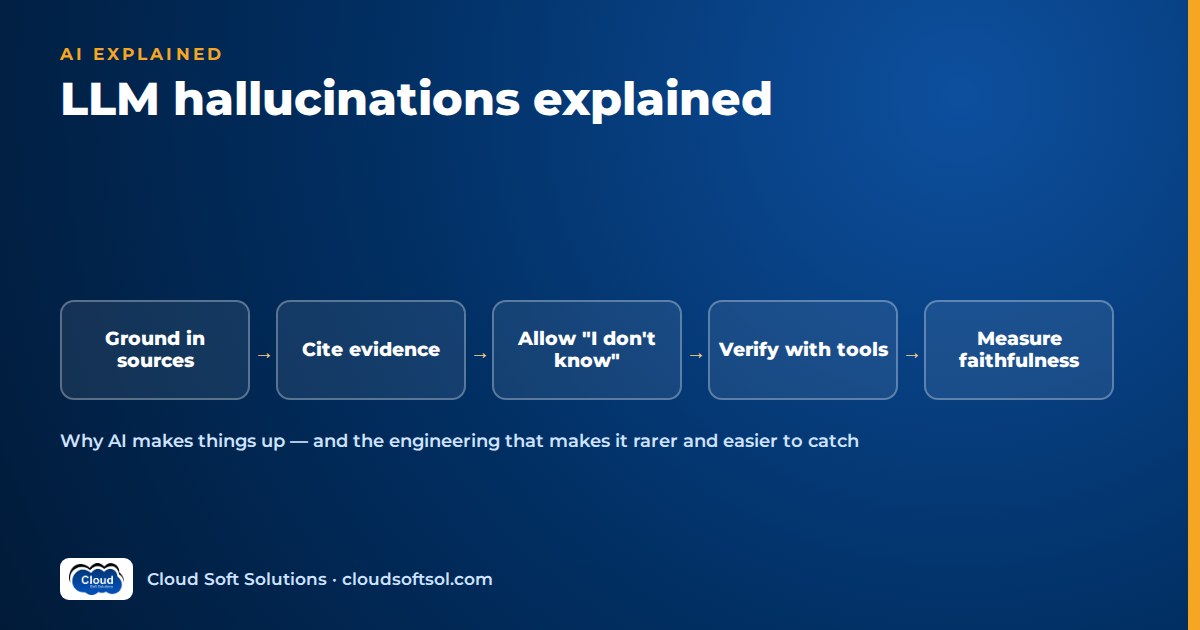
An LLM hallucination is an answer that sounds fluent and confident but is false, invented or not supported by the sources the model was given. LLM hallucinations happen because a language model generates the most plausible next text, not the verified truth, so whenever its training data, its context or the question itself leaves a gap, it fills that gap with something that merely looks right. You cannot switch hallucinations off with a setting. You reduce them with engineering: grounding answers in retrieved sources, letting the model say "I don't know", validating outputs, using tools for facts, and measuring faithfulness in testing and in production.
What an LLM hallucination actually is
The term covers any output that presents something as true when it is not true, or not supported by the evidence available. The important word is presents. A model that says "I'm not sure, but it may be X" and is wrong has made an error. A model that states X as fact, cites a policy section that does not exist and formats it beautifully has hallucinated, and the polish is what makes it dangerous: readers trust fluent text.
Engineers find it useful to separate two questions:
- Is it factually correct? Does the claim match the real world?
- Is it faithful? Does the claim follow from the context the model was given, such as retrieved documents, a database result or a tool response?
In enterprise applications the second question usually matters more. An answer can be true in general and still be unfaithful, for example quoting a common industry rule that this bank does not follow.
Why does AI hallucinate?
If you have read our explainer on what an LLM is, you know the core mechanism: the model predicts the next token from patterns learned in training. Everything below follows from that.
Next-token prediction optimises for plausibility
The model has no internal fact table it looks up. It produces text that is statistically likely given the prompt. For well-covered topics, likely and true usually coincide. For rare facts, specific numbers, names, dates and identifiers, the most likely-looking continuation can be completely wrong.
Gaps in training data
Your internal systems, your product catalogue and your HR policy were never in the training data. When asked about these, the model does not know that it does not know; it pattern-matches from nearby material.
Pressure to answer
Instruction tuning rewards helpful, complete answers. Unless the system prompt and evaluation explicitly reward abstention, a model tends to answer rather than decline.
Ambiguous prompts
"What is the penalty for closing early?" could mean a fixed deposit, a loan or a recurring deposit. The model picks one interpretation silently and answers it confidently.
Stale knowledge
Every model has a training cutoff. Interest rates, product terms, regulations, library versions and org charts change after it.
Retrieval failures
In a RAG system, the model answers from whatever the retriever hands it. If retrieval returns the wrong document, an outdated version, or nothing relevant at all, the model often answers anyway, either from the wrong chunk or from its own memory. Many "model hallucinations" in production are really retrieval bugs.
Types of hallucinations, with examples
Naming the type matters because each one has a different fix. These AI hallucination examples are illustrative.
| Type | Illustrative example | Typical root cause | Main mitigation |
|---|---|---|---|
| Factual error | States the wrong founding year of a company or the wrong limit for a product | Training gaps, stale knowledge | Ground in current sources; use tools for facts |
| Invented citation | Cites a regulation clause, paper or court case that does not exist | Plausible-looking identifiers are easy to generate | Only allow citations to retrieved document IDs; validate them |
| Invented API or package | Suggests a library function or package name that was never published | Pattern-matching on naming conventions | Compile, lint and test generated code; check package registries before install |
| Unfaithful to sources | The retrieved policy says "up to 30 days" and the answer says "within 30 days, always" | Model blends context with prior knowledge or over-generalises | Faithfulness evaluation; quote-and-cite answer style |
| Reasoning error | Retrieves the right fee and the right tenure, then computes the total wrongly | Multi-step arithmetic and logic done "in text" | Calculators and code execution; verification steps |
| Tool-argument error | Calls a lookup tool with an account ID or date it made up | Model fills required parameters it was never given | Schema validation; source-check arguments; ask the user for missing values |
Invented packages are also a security risk: an attacker can publish a malicious package under a name assistants tend to invent. Treat AI dependency suggestions as untrusted input.
Why RAG reduces hallucinations but does not eliminate them
Retrieval-augmented generation (RAG) is the most common way to reduce hallucinations in enterprise AI. Instead of relying on what the model memorised, you retrieve relevant passages from your own documents and instruct the model to answer from them. This fixes stale and missing knowledge directly and makes answers checkable.
But RAG moves the problem rather than removing it. Hallucinations survive in a RAG pipeline in several ways:
- Bad retrieval: the right passage was never retrieved, so the model answers from the closest wrong one.
- Conflicting sources: two versions of a policy are both indexed and the model mixes them.
- Partial context: chunking splits a table or an exception clause, so the model sees the rule but not the exception.
- Ignored context: the model prefers its prior knowledge over the passage, especially when the passage contradicts common practice.
- Over-synthesis: the model combines facts from separate passages into a conclusion none of them supports.
User question
     |
     v
 Retriever --(wrong / stale / no doc)--> risk 1
     |
     v
 Context  --(split table, conflict)----> risk 2
     |
     v
   LLM    --(ignores or over-reads)----> risk 3
     |
     v
 Answer   --(no check before user)-----> risk 4
RAG gives you the raw material for grounded answers. Whether answers are actually grounded depends on retrieval quality, prompt design, validation and evaluation.
How engineers reduce hallucinations
No single technique is enough. Production systems layer several, chosen according to how costly a wrong answer is.
1. Grounding and citations
Grounding LLM responses means instructing the model to answer only from supplied context and to attach a citation to each claim. Give each retrieved chunk a stable ID, ask for answers in the form "claim [doc-id]", and then check in code that every cited ID was actually in the context. Citations make hallucinations visible and give you something mechanical to validate.
2. Allowing "I don't know" and abstention thresholds
Tell the model explicitly that declining is a correct answer when the context does not cover the question, and give it a fixed phrasing to use. Then add an abstention threshold outside the model: if the best retrieval score is below a tuned cut-off, or no chunk passes a relevance check, return a scripted "I couldn't find this in our documents" response and offer a handoff instead of calling the model at all.
3. Retrieval quality
Most of the effort to reduce hallucinations in RAG goes here. Clean and deduplicate source documents, keep only current versions indexed, attach metadata such as product, region and effective date, and filter on it. Use chunking that respects structure so tables and exception clauses stay intact, and combine keyword and vector search with reranking for better recall on exact terms like product codes.
4. Structured output and validation
Free text is hard to check. Where the answer feeds a system or a form, ask for structured output against a JSON schema and validate it in code: required fields present, enums within allowed values, dates parseable, amounts within sane ranges, cited IDs real. Our guide to function calling and structured outputs covers the mechanics.
5. Verification steps
Add a check between generation and the user. Options range from cheap to expensive: rule-based checks (does every number in the answer appear in the context?), a natural language inference or grounding classifier, or a second LLM call that compares each claim against the sources and flags unsupported ones. Several provider guardrail services include contextual grounding checks; see AI guardrails for where these sit in the request path.
6. Tool use for facts
Do not let the model remember or compute what a system can look up or calculate. Account balances, order status, stock levels and today's rates should come from a database or API call. EMI, interest and tax calculations should go to a calculator or code tool. The model chooses the tool and explains the result.
7. Smaller scope
An assistant that answers "anything about our bank" has an unbounded surface for hallucination. One that answers questions about savings accounts and card fees from a defined document set is far easier to ground, test and monitor. Detect out-of-scope questions early and route them elsewhere.
8. Human review for high-stakes content
For legal drafts, medical summaries, credit decisions and anything sent externally under the company's name, a qualified person reviews before it takes effect. Show the sources beside the draft and highlight unsupported claims so review is real, not a rubber stamp. Our sibling article on human-in-the-loop AI design covers approval patterns in detail.
9. Evaluation of faithfulness
Build a test set of realistic questions with expected answers and the documents that support them, including questions the system should decline. Measure faithfulness (are claims supported by the retrieved context?), answer relevance, context precision and recall, and correct abstention. Run the suite in CI on every prompt, model or index change. See LLM evaluation for method and RAG evaluation metrics for what each metric means and how it is computed.
10. Monitoring in production
Offline tests do not cover every real question. Trace each request with the query, retrieved chunk IDs and scores, the prompt version, the answer and any validation results. Sample production traffic for faithfulness scoring, track abstention and thumbs-down rates, and review flagged conversations. Every confirmed hallucination becomes a new test case.
If you want to practise these techniques hands-on, including RAG pipelines, structured outputs, guardrails and faithfulness evaluation with Ragas and LangSmith, Cloudsoft's AI, GenAI and Agentic AI course builds them through labs rather than slides.
How much hallucination risk can you accept? A domain view
The right level of control depends on what a wrong answer costs.
| Use case | Cost of a wrong answer | Minimum controls | Human role |
|---|---|---|---|
| Internal chat helper (drafting emails, summarising meetings) | Low; the user reads and edits the output | Clear disclaimer, scope limits, feedback button | The user is the reviewer |
| Employee policy assistant (HR, IT helpdesk) | Moderate; wrong guidance, wasted time, tickets | RAG with citations, abstention, current-version index, faithfulness evals | Escalation to HR or IT for unclear cases |
| Customer-facing FAQ (banking, insurance, telecom) | High; customer harm, complaints, regulatory exposure | All of the above, plus tools for account facts, verification step, monitoring | Handoff to an agent; regular sampled review |
| Legal (contract review, clause drafting) | Very high; invented clauses or citations can mislead decisions | Quote-level citations, citation validation, narrow scope | A lawyer reviews every output before use |
| Medical (clinical summaries, discharge notes) | Very high; patient safety | Grounding in the patient record only, structured output, strict abstention | A clinician approves; AI drafts, never decides |
| Finance (credit memos, regulatory reporting) | Very high; financial loss, audit findings | Tools for every number, reconciliation checks, audit trail | Analyst sign-off with maker-checker control |
Illustrative example: a bank FAQ assistant
Consider a private bank whose digital team, working out of a GCC in Hyderabad, launches a customer FAQ assistant on its website. The pilot used a strong model with a system prompt and a document folder. In testing, a customer asked, "Can I break my fixed deposit early without any penalty?" The assistant replied that premature withdrawal is free for deposits held more than six months. That rule existed in an older product brochure that was still indexed; the current terms charge a reduced interest rate on premature closure, with exceptions for some schemes.
Retrieval returned the stale brochure, the prompt encouraged complete answers, and nothing checked the answer before it reached the customer. The team fixed it in layers:
- Index hygiene: only current, approved documents with an effective-date field; superseded versions removed automatically when the product team publishes new terms.
- Clarifying questions: when the question could apply to several products, the assistant asks which deposit scheme the customer means.
- Citations: each answer links to the specific terms page it used, and code checks that the cited document was in the context.
- Tools for personal facts: "What penalty will I pay on my deposit?" goes to an authenticated calculation API, not the model.
- Abstention: low retrieval scores trigger a scripted response and an option to talk to a branch or phone banking agent.
- Verification: for deposit, loan and fee intents, a grounding check compares the draft against the retrieved terms and blocks unsupported claims.
- Evaluation and monitoring: a test set of real customer questions, including ones the bot must decline, runs before every release; sampled conversations are reviewed weekly with the product and compliance teams.
The assistant did not become perfect, but wrong answers became rarer, visible and traceable to a fixable cause. That is the realistic goal.
How to explain hallucinations to business stakeholders
Business leaders often hear either "AI makes things up, so it's unusable" or "the new model doesn't hallucinate". Both are wrong.
- Use an analogy: the model is like a very well-read new hire who answers confidently even when unsure. You would not let that person answer customers without approved material, a manager to escalate to and spot checks. The same applies here.
- Talk about risk, not rates: instead of promising a number, agree which use cases tolerate occasional errors and which need human review on every output.
- Show the controls: walk through citations, abstention, tools and review as a visible pipeline, so "trust" becomes a set of checks people can inspect.
- Agree on measurement: define the test set, the acceptance bar and who signs off before launch, and share production quality reports after it.
- Make "I don't know" a feature: a declined question routed to a human is far cheaper than a confident wrong answer.
Translating model behaviour into business risk, and building the controls that make a deployment acceptable to compliance, is a large part of what Forward Deployed Engineers do when they take AI from demo to production inside customer organisations.
FAQ
What are LLM hallucinations?
LLM hallucinations are outputs that sound confident and fluent but are false, invented or not supported by the sources the model was given, such as a made-up policy clause, citation, API method or number.
Why does AI hallucinate?
A language model generates the most plausible next text rather than looking up verified facts. Gaps in training data, stale knowledge, ambiguous prompts, pressure to always answer and poor retrieval all leave room for plausible but wrong content.
Can hallucinations be eliminated completely?
No. They can be reduced substantially and made visible through grounding, citations, abstention, tools, validation and evaluation, but any system that generates text can still produce errors, so high-stakes outputs need human review.
Does RAG stop hallucinations?
RAG reduces them by giving the model current, relevant sources, but it does not stop them. Wrong or stale retrieval, split chunks, conflicting documents and models that ignore or over-read the context can all still produce unsupported answers.
How do you reduce hallucinations in RAG?
Improve retrieval quality with clean, current, well-chunked documents and metadata filters; require citations to retrieved chunks; allow and reward "I don't know"; add a grounding check before the answer is shown; and measure faithfulness on a test set and in production.
How do you measure hallucinations?
Build an evaluation set of realistic questions with supporting documents and expected answers, then score faithfulness, answer relevance, context precision and recall, and correct abstention using tools such as Ragas, LangSmith or Langfuse, combined with human review of samples.
Does a lower temperature prevent hallucinations?
Lower temperature makes outputs more consistent, but a model can be consistently wrong. It helps with predictable formatting, while grounding, tools and validation are what actually reduce false content.
Are newer or larger models hallucination-free?
No model is hallucination-free. Newer models often handle context and abstention better, but they still lack your private data and recent changes, so the same engineering controls are needed whichever model you choose.
Hallucination control is a core engineering skill now, not an optional extra. If you want to build RAG systems, agents and evaluation pipelines that hold up in front of real users, explore Cloudsoft's GenAI and Agentic AI training in Hyderabad, in our Ameerpet classroom or live online. Call +91 96660 19191 for a free demo.