AI guardrails are the checks an LLM application runs on what goes into the model, what comes out of it and what the model is allowed to trigger. Guardrails are an engineering component with inputs, outputs, thresholds, latency and failure modes: you place them deliberately, tune them against test sets and log every decision they make. They reduce how often a system says or does the wrong thing. They do not decide what a user is allowed to see or do; that is the job of permissions.
The threat model and layered security controls are covered in AI security for enterprises. This guide focuses on the guardrail layer itself: what each check looks at, where it sits, how to implement it and how to tune it without making the product useless.
What AI guardrails are, and what they are not
A guardrail is a function that takes a user message, retrieved chunks, a draft answer or a proposed tool call and returns a decision: allow, block, modify (redact or rewrite) or escalate to a human. Most are classifiers, rules or validators; some are small LLM calls.
Three things guardrails are not:
- Not a permission system. If a support bot can call
get_order(order_id)for any order, a guardrail trying to spot "asking about someone else's order" will miss cases. The fix is a tool that only returns the authenticated customer's orders. Guardrails are probabilistic; authorisation must be deterministic. - Not the system prompt. "Never give financial advice" in a prompt is an instruction the model usually follows. A guardrail is a separate check that runs whether or not the model followed it.
- Not a substitute for evaluation. Guardrails act on single requests at runtime; LLM evaluation measures whether the whole system is good enough. You need both, and you evaluate the guardrails too.
Where guardrails sit in the request path
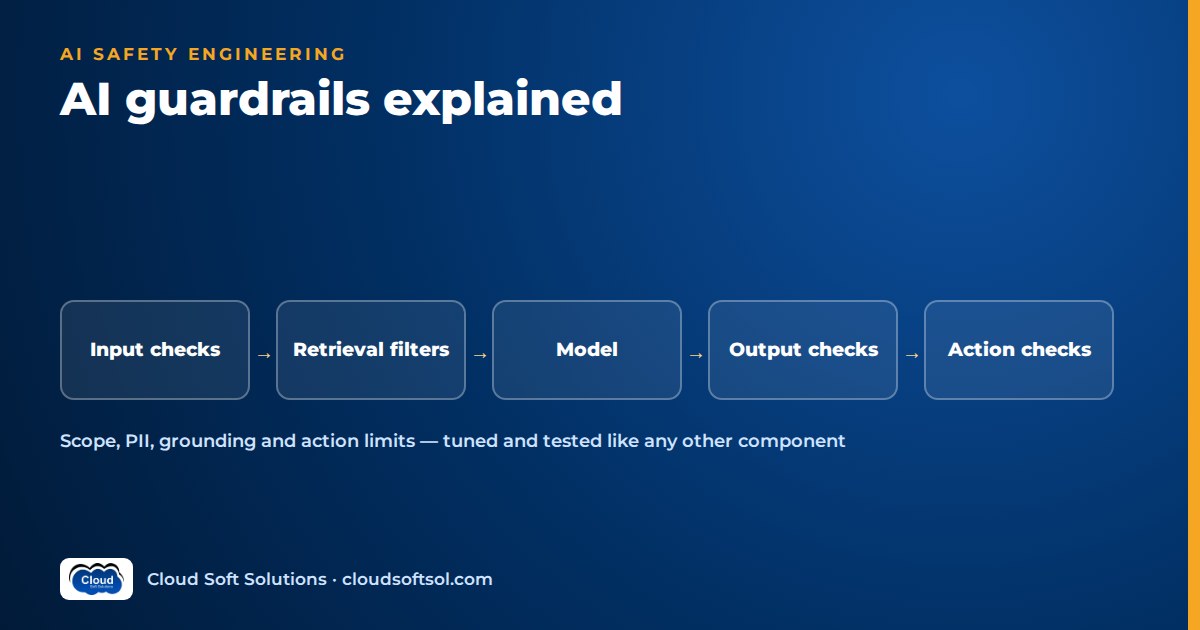
LLM guardrails are not one box in front of the model. Each stage has its own checks, and the cheapest effective check should run earliest.
[ User message ]
      |
      v
+--------------------+  size, topic, PII,
|  1. Input checks   |  toxicity, injection
+--------------------+
      |
      v
+--------------------+  ACL filter, source
| 2. Retrieval filter|  allow-list, chunk scan
+--------------------+
      |
      v
+--------------------+
|     3. Model       |
+--------------------+
      |
      v
+--------------------+  grounding, schema,
|  4. Output checks  |  policy, PII, safety
+--------------------+
      |
      v
+--------------------+  allow-list, params,
| 5. Action checks   |  approval, rate limit
+--------------------+
      |
      v
[ Reply / tool call ]
Each stage answers a different question:
- Input: should this request be processed, and what needs masking first?
- Retrieval: may this content enter this user's context, and does it carry instructions? (New to retrieval? See what RAG is.)
- Output: is the draft safe, grounded, well-formed and within policy?
- Action: is this tool call permitted, are its parameters sane, does it need a human?
Every check also needs a defined failure behaviour: if the PII detector times out, do you block, pass through or fall back to a stricter regex? Decide per check and test it.
Types of guardrails for generative AI
Topic and scope restriction
Keeps the application on its job: an insurer's claims assistant should not write poems or discuss elections. Options range from a denied-topics list described in natural language to a small intent classifier trained on your own in-scope and out-of-scope examples. Run it on input and often on output, because conversations drift. Refuse helpfully, saying what the assistant can do.
PII detection and redaction
Finds personal data and masks it, blocks the request or tags it. Typical entities: names, phone numbers, emails, card and account numbers, and in India, Aadhaar and PAN formats. Combine pattern rules (with checksums where formats have them) and a named-entity model; neither alone is enough. Decide where redaction applies: before the model if the use case does not need the value, before logging almost always, and on output. Reversible tokenisation, swapping a value for a placeholder and restoring it after the response, keeps raw values out of prompts without breaking the workflow.
Toxicity and content safety
Classifies text into harm categories such as hate, harassment, sexual content, violence and self-harm, usually with a severity score. It is the most mature form of content filtering for LLMs and the one provider services cover best. Set thresholds per category and audience: an internal SOC assistant legitimately discusses malicious content; a children's education product does not.
Prompt-injection detection, and its limits
Classifiers that spot text trying to override instructions: "ignore previous instructions", role-play jailbreaks, directives hidden in documents. Run them on user input and on retrieved content and tool results, since indirect injection arrives through data. Treat the score as a signal (route to a no-tools path, add friction, alert), never as a boundary. Attackers rephrase, encode and split instructions across turns, and no detector catches everything. What limits damage is what the model can reach, which is why action guardrails matter more.
Grounding and hallucination checks
Compare the draft answer with the retrieved context and flag unsupported claims, using a natural-language-inference model per sentence, an LLM judge, or simple checks that every answer cites a chunk that was actually retrieved. They catch answers invented from general knowledge when retrieval found nothing useful; they do not catch a wrong source document. The scoring overlaps with offline RAG evaluation metrics such as faithfulness.
Format and schema validation
The most deterministic and most underrated guardrail. Validate structured output against a schema (Pydantic is common in Python), retry with the validation error on failure, and validate values too: enums, ranges, ID formats, URL domains. It is cheap and has no false positives when the schema is right.
Policy rules
Business rules the answer must obey: no unconfirmed refund or delivery promises, no financial, legal or medical advice beyond approved wording, mandatory disclaimers in regulated flows. Some are rules (a pattern for phrases like "assured returns", a check that any refund amount matches the order system); others need a classifier or judge with a rubric. Write each as a testable statement with examples and a business owner.
Action guardrails
Apply to tool calls, and they carry the most weight in agentic systems:
- Allow-lists: which tools this agent, in this state, may call. A triage step may read; only a later step may write.
- Parameter checks: the account ID belongs to the caller, the refund is under a limit, the email recipient is on an approved domain.
- Approvals: consequential actions (send, delete, pay, change a customer record) go to a human with the exact parameters shown.
- Rate and budget limits: calls per minute, actions per conversation, total refund value per day, maximum agent iterations.
Action checks belong in code in the tool layer, so every path to a tool passes through them. AI agent evaluation covers testing tool use.
| Guardrail | Stage | Typical method | Deterministic? |
|---|---|---|---|
| Topic / scope | Input, output | Denied-topic config, intent classifier | No |
| PII detection | Input, output, logs | Patterns plus entity model | Partly |
| Content safety | Input, output | Harm-category classifier | No |
| Injection detection | Input, retrieval | Classifier, heuristics | No |
| Grounding | Output | NLI model, LLM judge, citation check | No |
| Schema validation | Output | Schema validator | Yes |
| Policy rules | Output | Rules plus judge | Partly |
| Action checks | Tool layer | Code: allow-lists, limits, approvals | Yes |
Implementation options
Most production systems combine all three of the options below.
Provider features
Amazon Bedrock Guardrails defines a policy with harm-category content filters (including prompt attacks), denied topics, word filters, sensitive information filters that block or mask PII and custom regex patterns, and contextual grounding checks against a supplied source. Attach it to Bedrock model calls, or call the ApplyGuardrail API to check text from any model. Our Amazon Bedrock GenAI training covers configuring and versioning these policies.
Azure AI Content Safety provides harm-category classification with severity levels, Prompt Shields for detecting user prompt attacks and attacks embedded in documents, groundedness detection and protected-material detection. Azure OpenAI deployments also apply configurable content filtering by default. See Azure AI and OpenAI training for the platform side.
Provider features are quick to adopt and maintained for you, but categories are generic, behaviour can shift when the provider updates, and business-specific policy is hard to encode. Check current documentation for features and regional availability.
Open-source frameworks
NVIDIA NeMo Guardrails is an open-source toolkit for programmable rails (input, output, dialog, retrieval and execution) configured in its Colang language plus Python actions; it suits conversational systems needing explicit control over flows and topics. Guardrails AI is an open-source Python framework built around composable validators (format, PII, toxicity and many community validators) that can fix, re-ask or fail. Both can call provider classifiers or open-weight safety models underneath.
Custom classifiers and rules
For anything specific to your business: policy wording, product scope, ID formats, refund limits. Small fine-tuned classifiers or embedding-similarity checks are fast and cheap; rules and validators handle the deterministic parts; an LLM judge fills nuanced gaps at higher latency and cost.
If you want to build these layers hands-on, wiring provider guardrails, validators and tool-layer checks into a real RAG and agent stack, Cloudsoft's AI, GenAI and Agentic AI course works through them in labs.
Tuning false positives versus false negatives
Every probabilistic guardrail has a threshold, and every threshold trades two errors. A false positive blocks a legitimate request: a customer asking how to dispute a "fraudulent charge" trips a fraud-topic filter, or a nurse's question about medication doses trips a self-harm filter. A false negative lets a bad one through. Over-blocking is not a safe default; users route around a useless assistant, often into less controlled tools.
A practical tuning loop:
- Build a labelled set per guardrail with harmful and legitimate-but-sensitive examples, from redacted real traffic where possible.
- Sweep thresholds; record the block rate on legitimate examples and the miss rate on harmful ones.
- Choose thresholds per category and risk tier with the business owner. Missing a payment-change injection is worse than missing a mild insult.
- Prefer graded responses: allow, allow with a caveat, route to a no-tools path, or hand off to a human.
- Re-run whenever a model, prompt, threshold or provider version changes.
Latency and cost
Rules and schema checks are near-instant, small classifiers are fast, and an LLM judge can take as long as the main generation. To keep latency acceptable:
- Run independent input checks in parallel, and in parallel with retrieval.
- Order checks cheap to expensive and stop early on a confident block.
- Reserve LLM judges for high-risk flows, or run them asynchronously on samples for monitoring.
- Plan for streaming. Either check chunks (and risk retracting shown text) or buffer the full answer; regulated flows usually buffer.
- Measure latency per check to see which one eats your budget.
Testing guardrails with adversarial sets
A guardrail that has not been attacked is a guess. Keep an adversarial set alongside your normal evaluation set:
- Jailbreaks and role-play, including paraphrased, translated and encoded variants; for Indian users, Hinglish and code-mixed phrasing, which generic classifiers often handle less well.
- Instructions planted in documents, emails and tool results.
- PII in odd formats: spaced digits, numbers in words, IDs split across messages.
- Borderline scope cases in both directions, to measure false positives.
- Policy edge cases that invite a promise, forecast or advice, and tool abuse that tries to act for another customer or exceed a limit.
Run it in CI as a regression gate, track block and miss rates per category and add every real incident. Our LLM evaluation guide covers building and gating such suites.
Logging guardrail events
Record every guardrail decision: check name and version, score, threshold, decision, latency and trace ID, with redacted inputs. That tells you which check blocks the most legitimate traffic, whether injection attempts are rising and whether a provider update shifted scores. Attach these events as spans in the same trace as retrieval, generation and tool calls, as described in AI observability, and alert on sudden block-rate changes, which usually mean an attack or a broken check.
Illustrative example: guardrails on a customer-support assistant
Consider a retailer's support assistant that answers order and returns questions and can create return requests and issue small goodwill credits. The overall build is walked through in the enterprise AI customer support agent project; here is just the guardrail layer.
- Input: length cap; card numbers masked; content safety on abuse (offer a human, never block mild frustration); scope classifier; a high injection score runs the turn with read-only tools.
- Retrieval: only published help-centre and policy collections; chunks scanned for injection patterns at indexing time.
- Model: returns structured output with reply text, cited policy chunk IDs and any proposed action.
- Output: schema validation with one retry; grounding check that return-window and fee statements are supported by the cited policy; policy rules forbidding delivery-date promises unless the order system returned one and forbidding any mention of credit amounts not computed by code; PII scan on the reply.
- Actions:
create_return(order_id)only for orders owned by the authenticated customer and within the return window, checked in code;issue_creditcapped per order and per customer per period, above which it goes to a human queue; maximum actions per conversation. - Logging: every decision as a span; weekly review of blocked conversations to tune false positives.
Content checks are probabilistic and tuned; anything moving money or data is deterministic code.
Common mistakes
- Using guardrails as access control. Trying to detect "asking about someone else's data" instead of scoping the tool to the user.
- Only checking the chat box. Retrieved documents and tool results carry injections too.
- Default thresholds forever. Provider defaults are not tuned for your domain; measure on your data.
- No failure mode decided. A guardrail service outage either takes the product down or quietly disables protection.
- Policy only in the prompt. If a rule matters, check it after generation.
- Redacting the model input but logging raw prompts. The PII lands in the tracing tool.
- Never re-testing after a model upgrade changes behaviour and scores.
Designing guardrails that satisfy a customer's risk team, then tuning them on real traffic, is a large part of what Forward Deployed Engineers do; Cloudsoft's FDE PRO program builds this into its Secure Banking AI Assistant project.
FAQ
What are AI guardrails?
AI guardrails are runtime checks that inspect user input, retrieved content, model output and proposed tool calls in an LLM application, then allow, block, modify or escalate them. Common types are topic restriction, PII redaction, content safety, injection detection, grounding, schema validation, policy rules and action limits.
Are guardrails enough to secure an LLM app?
No. Most guardrails are probabilistic and can be bypassed. They sit on top of deterministic controls: authentication, least-privilege tools acting as the user, retrieval access control, human approval for consequential actions and sandboxing.
What is the difference between input and output guardrails?
Input guardrails run before the model and decide whether a request should be processed and what must be masked, for example scope, PII and injection checks. Output guardrails run on the draft response and check that it is safe, grounded in the retrieved context, correctly formatted and within business policy.
What does Amazon Bedrock Guardrails do?
It lets you configure content filters, denied topics, word filters, PII and custom-pattern filters, and contextual grounding checks, applied to Bedrock model calls or independently through the ApplyGuardrail API for text from other models.
Can guardrails stop prompt injection?
They catch many known patterns but not all, because attackers rephrase, encode and hide instructions in documents. Treat detection as a signal; scoped tools, parameter checks and approvals are what contain the damage.
How much latency do guardrails add?
It depends on the check. Rules and schema validation are almost free, small classifiers add a little, and LLM judges can add as much as the main call. Run checks in parallel, order them cheap to expensive and reserve judges for high-risk flows.
Should I use a provider service or an open-source framework?
Usually both, plus custom checks. Provider services cover generic harm categories quickly, frameworks such as NVIDIA NeMo Guardrails and Guardrails AI compose and orchestrate checks, and custom rules encode your own policies and limits.
How do you test AI guardrails?
Build labelled sets per guardrail with harmful and legitimate-but-sensitive examples, including paraphrases, translations, code-mixed language and injections hidden in documents. Measure block and miss rates, run the suite in CI and add every real incident.
Want to move from adding a content filter to engineering a guardrail layer you can tune, test and defend? Cloudsoft's GenAI and Agentic AI training in Hyderabad covers RAG, agents, evaluation and guardrails through hands-on labs, in our Ameerpet classroom or live online. Call +91 96660 19191 for a free demo.