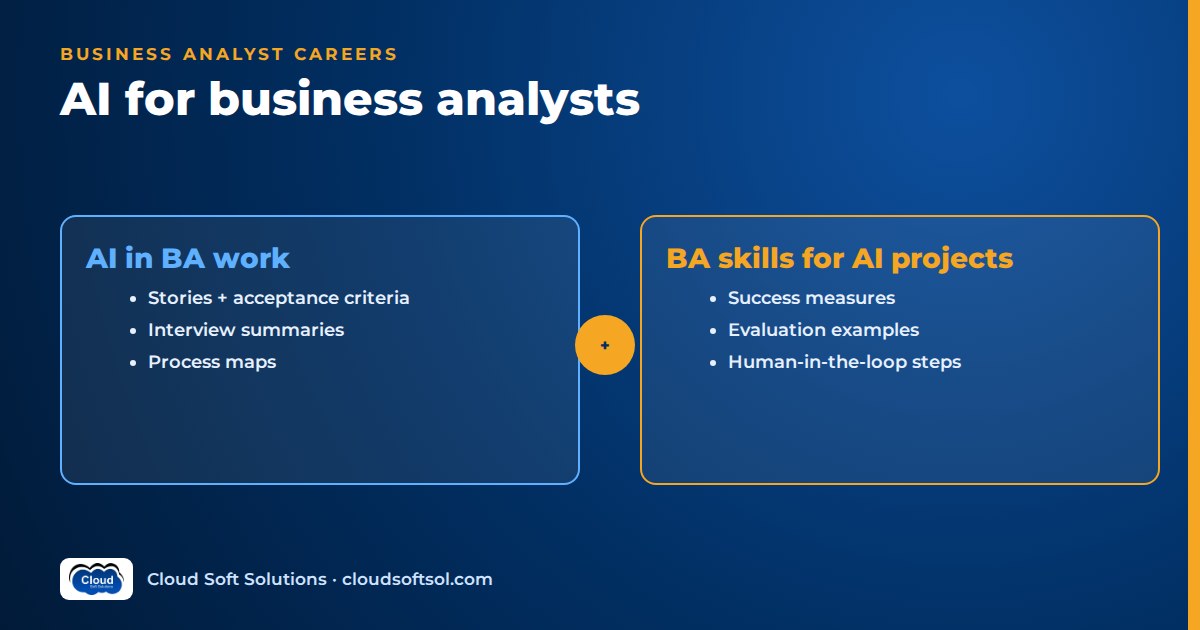
Business analysis is one of the roles generative AI changes most, and in two different ways. AI for business analysts means two things: using GenAI tools to speed up everyday BA work such as user stories, interview summaries, process maps and test scenarios, and bringing BA skills to AI projects themselves, where someone has to define the use case, the success measures, the evaluation examples and the human review steps. The first half makes you faster. The second half makes you the person AI projects can't do without. This guide covers both, with the limits, a skills roadmap and an illustrative insurance GCC example.
It is written for BAs, product analysts and functional consultants in Indian services firms, GCCs and product companies. You don't need to become a machine-learning engineer; you need to know where the tools fail and how to write requirements for output that isn't fully predictable.
Two ways AI changes BA work
Most "AI for BA" content stops at prompt tips. That is the smaller opportunity. The table below separates the two halves.
| Half 1: AI in your BA work | Half 2: BA skills for AI projects | |
|---|---|---|
| What changes | How fast you produce artefacts | What artefacts you produce |
| Typical output | Draft stories, summaries, process maps, test scenarios | Use-case briefs, success measures, evaluation sets, review-step maps, data and risk requirements |
| Main risk | Unverified or confidential content leaking into deliverables | Vague requirements that nobody can test |
| Career effect | Keeps you competitive | Moves you toward AI product analyst and AI project roles |
Half 1: Using generative AI in everyday BA work
Treat a GenAI assistant as a fast junior analyst: good at first drafts, structure and spotting omissions, unreliable on facts it was never given, and unaware of your client's context unless you supply it. The pattern is always the same: you supply the source, the model drafts, you verify and own the result.
Drafting user stories and acceptance criteria
Give the assistant a feature description, the personas and your team's story template, and ask for stories in "As a… I want… so that…" form with Given/When/Then acceptance criteria. Then ask: "What edge cases, error states and non-functional requirements are missing?" Models are good at listing forgotten unhappy paths such as expired sessions, duplicate submissions and accessibility needs.
What you still do: check every criterion against what the stakeholder actually agreed, remove invented business rules. If your team works in Jira, the Jira AI agent project shows how backlog drafting and triage can be automated with an approval step.
Summarising stakeholder interviews (with consent)
A structured summary of a transcribed interview (decisions, open questions, pain points, conflicting statements) saves hours per workshop. Two conditions apply. First, tell participants you are recording and that an approved AI tool will process the transcript, and get their agreement; respect a refusal. Second, check the summary against the transcript. Models sometimes smooth over disagreement or misattribute statements, and disagreement is often the most important finding.
Process mapping from transcripts
Ask the model to extract the as-is process from a walkthrough transcript as a numbered list of steps with actor, system, input, output and decision points. You can also ask for a text diagram notation such as Mermaid or PlantUML. Treat it as a draft for the validation session: practitioners describe the ideal process in interviews and the real one only when shadowed.
Gap analysis
Provide the as-is process, the target process or package capability list, and ask for a gap table: requirement, current state, target state, gap type (process, data, system, policy, skills) and open questions. The model helps with consistency, but it is not a source of truth about what a package can do; confirm capability claims with vendor documentation.
Test scenario drafting
From acceptance criteria, an assistant can draft positive, negative and boundary scenarios, plus test data ideas. Agree with QA who drafts what, so the work isn't duplicated.
Data exploration with natural language
Many BI and spreadsheet tools now let you ask questions of a dataset in plain English, and assistants can write SQL for you to run against an approved, read-only dataset. This is useful for checking a stakeholder's claim before it becomes a requirement. Read the generated query before trusting the number: a wrong join or missing filter gives a confident, wrong answer.
The limits: verify, protect, use approved tools
- Verify everything that goes to a stakeholder. Models produce fluent text that can include rules, numbers or names nobody said. You sign the deliverable, not the tool. Our explainer on why LLMs hallucinate explains why this happens.
- Confidentiality comes first. Requirements documents, transcripts and datasets often contain personal data, pricing, unreleased plans or regulated information.
- Never paste client data into unapproved tools. Use only the AI tools your employer and the client have approved, under their data-handling terms. In services and GCC work, the client contract usually decides this. If no approved tool exists, anonymise properly or don't use AI for that task.
- Personal data has legal weight. In India, the DPDP Act shapes how personal data may be processed; see the DPDP Act for AI applications.
- Keep the thinking yours. Use the model after you have thought, not instead of thinking.
If you want structured practice with these tools and the concepts behind them, Cloudsoft's AI, GenAI and Agentic AI course covers LLMs, prompting, RAG and agents with hands-on labs, in Ameerpet or live online.
Half 2: BA skills that AI projects need
AI projects fail far more often from unclear requirements than from bad models. Often nobody can say whether a capable assistant is good enough to launch, who checks its output, or what data it may see. These are BA questions.
Defining the AI use case and success measures
Your elicitation skills transfer directly. The job is to turn "we want AI for claims" into a task sentence: who does what, how often, what it costs today, and what AI would change. Then capture a baseline (current handling time, backlog, error or rework rate) before anything is built, because without a baseline there is no business case later. Our AI use case discovery playbook covers workshops, shadowing and scoring in depth, and the guide to building an enterprise AI business case and ROI shows how those baselines become a value estimate.
Acceptance criteria for probabilistic systems
Traditional acceptance criteria are binary: given this input, the system does exactly that. A language model can give a slightly different answer to the same question, and will sometimes be wrong. So acceptance criteria shift from "always" to "how often, on what set, and what happens when it's wrong". A good AI acceptance criterion has five parts:
- The evaluation set: which agreed examples the system is measured on.
- The quality measure: for example, "the answer is correct and cites the right policy clause", judged by a named reviewer or an agreed rubric.
- The threshold: a pass level agreed with business stakeholders and risk before testing starts, not chosen after seeing the results.
- Hard rules that allow no exceptions: for example, "never states a claim decision", "never reveals another customer's data", "refuses when the policy is not in the knowledge base".
- The failure behaviour: what the user sees when the system is unsure, and where the case goes next.
Record who agreed the threshold. A drafting aid reviewed by an expert can launch at a lower bar than an answer shown directly to a customer.
Writing evaluation examples with SMEs
An evaluation set is a list of realistic inputs with the expected answer or the criteria a good answer must meet. It is the AI project's test pack, and BAs already know the subject-matter experts. Run sessions where SMEs supply real (redacted) questions, the correct answer, the source it should come from, and why a plausible wrong answer would be harmful. Include easy cases, hard cases, trick questions and "should refuse" cases. Engineers then automate scoring; our guide to LLM evaluation explains how those examples are used in automated and human evaluation.
Mapping human-in-the-loop steps
For each AI output, decide: does a person approve it before it takes effect, review a sample afterwards, or only handle exceptions? Map who that person is, what they see, how long they have, and what happens on rejection. The human-in-the-loop AI design guide gives a risk-tier table you can use as a starting template.
Request
   |
AI drafts answer + sources
   |
Confidence / rule check
   |-- fails --> Human expert queue
   |
Human reviewer approves / edits
   |
Sent to customer, logged
   |
Reviewer edits feed eval set
Change management
A technically good AI tool can still go unused if people don't trust it, if it adds a screen to their day, or if they fear it is measuring them. BAs usually own the stakeholder map and process change, so plan training, champions, feedback channels and updated SOPs. Read AI adoption and change management for the people and workflow side in detail.
Data requirements
AI systems need data requirements beyond the usual field lists:
- Sources: which documents, systems and records the AI may use, and which version is authoritative.
- Freshness: how quickly a changed policy must reach the assistant.
- Access: whether users should see only what they are already entitled to, which is almost always the answer.
- Quality: duplicates, outdated documents, scanned PDFs and tables that need cleaning before use.
- Retention and logging: what prompts and answers are stored, for how long, and who can read them.
Risk and compliance inputs
Bring risk and compliance in early and capture their requirements as testable statements: what the AI must never do, what must be disclosed to users, what must be logged for audit, and which decisions must stay with a human. In regulated sectors such as insurance and banking, these requirements often decide the scope more than the technology does.
A skills roadmap for business analysts
A practical sequence you can follow alongside your current job:
| Stage | Focus | Evidence you can show |
|---|---|---|
| 1. Foundations | How LLMs work, tokens and context, hallucination, RAG and agents at concept level | You can explain to a stakeholder why an assistant gave a wrong answer |
| 2. Daily tool use | Approved assistants for stories, summaries, process maps and test scenarios, with a verification habit | A before-and-after set of your own redacted artefacts |
| 3. Data literacy | Basic SQL, reading generated queries, data quality checks | A small analysis on a public dataset with your queries explained |
| 4. AI requirements | Use-case briefs, probabilistic acceptance criteria, data and risk requirements | A sample brief and requirement set for an invented use case |
| 5. Evaluation and oversight | Evaluation sets with SMEs, review-step maps, feedback loops | A small evaluation set with expected answers and a rubric |
| 6. Delivery and adoption | Change plans, adoption measures, value tracking after launch | A rollout and measurement plan for your sample use case |
Stages 4 to 6 are where the AI product analyst career path opens up. People who can turn business ambition into something an AI team can test are hard to find. Some BAs go further toward the engineering side, where discovery and customer work are combined with building and deploying the system itself; that is the Forward Deployed Engineer path taught in Cloudsoft's FDE PRO program, and it does require real coding.
Illustrative example: a BA at an insurance GCC
Consider a BA in the Hyderabad GCC of a global insurer. The claims operations team wants "an AI assistant for claims handlers". Here is how the BA shapes it. (This is an illustrative scenario, not a customer story.)
Discovery. Shadowing shows handlers spend much of each claim searching long policy wordings and endorsements to check whether a loss is covered. The task sentence becomes: "Claims handlers search policy wordings and endorsements to confirm coverage for a reported loss." Coverage decisions stay with the handler; the assistant only finds and quotes the relevant clauses. The BA baselines handling time and escalations to senior handlers on a sample of claims.
Requirements. The assistant answers only from the policy documents linked to the claim, quotes clause references, and says "not found in the policy documents" rather than guessing. Hard rules: it never states that a claim is approved or declined, and it never shows another policyholder's documents. Data requirements name the policy administration system as the authoritative source, specify that endorsements must be included, and require logging of every question and answer for audit.
Evaluation set. The BA runs three sessions with senior handlers and a coverage specialist. Together they write realistic questions across product lines, each with the correct clause and the answer a good handler would give, plus tricky cases: conflicting endorsements, expired cover and exclusions buried in schedules. The threshold for launch is agreed with the claims head and the risk team, and recorded in the requirements before testing begins.
Human in the loop. Every answer is shown to the handler with its sources; nothing goes to the customer automatically. A senior handler reviews a weekly sample, and handler corrections are added to the evaluation set.
Change and value. Champions in each team, short training on what the assistant can't do, and an updated SOP. After launch, the BA compares handling time and escalations against the baseline and reports the result honestly, including where the assistant didn't help. For the wider industry picture, see generative AI in insurance.
Notice what the BA did not do: choose the model, write prompts or build the retrieval pipeline. The BA made the project testable, safe and adoptable, which is what decides whether it reaches production.
Common mistakes BAs make with AI
- Pasting a client transcript into a personal AI account, or forwarding AI-drafted stories unchecked.
- Writing "the AI shall be accurate" instead of a measurable, agreed threshold on a defined evaluation set.
- Leaving SMEs out of evaluation, then discovering at UAT that "correct" means different things to different people.
- Treating risk and compliance as a sign-off at the end rather than a requirements source at the start.
FAQ
Will AI replace business analysts?
AI is automating parts of BA work such as first drafts of stories, summaries and test scenarios, but not the judgement: understanding stakeholders, resolving conflicts, deciding what is in scope and owning the requirements. BAs who use AI well and can shape AI projects become more valuable, not less.
How can a business analyst use generative AI safely?
Use only tools approved by your employer and the client, get consent before recording or processing interviews, never paste client or personal data into unapproved tools, and verify every AI-drafted artefact against the source before it reaches a stakeholder.
What AI skills should a business analyst learn first?
Start with how LLMs work and why they hallucinate, then daily use of approved assistants with a verification habit, then basic SQL. After that, learn to write AI use-case briefs, acceptance criteria for probabilistic systems and evaluation sets with subject-matter experts.
How do you write acceptance criteria for an AI system?
Define the evaluation set, the quality measure, a pass threshold agreed with stakeholders before testing, hard rules that allow no exceptions, and what the system does when it is unsure. Record who agreed the threshold.
Can AI help with requirements gathering?
Yes. With consent and an approved tool, AI can transcribe and summarise interviews, extract as-is process steps, draft gap tables and list missing edge cases. It cannot replace shadowing real work or resolving disagreement between stakeholders.
What is an AI product analyst?
An AI product analyst is a business or product analyst who specialises in AI features: defining use cases and success measures, writing data and risk requirements, building evaluation sets with experts, mapping human review steps and tracking value after launch.
Do business analysts need to learn coding for AI projects?
Not for most AI BA and product analyst roles. Basic SQL and the ability to read a simple script help. Deep coding is needed only if you want to move into engineering roles such as AI engineer.
Is an AI course useful for a business analyst?
A course is useful if it gives hands-on experience with LLMs, RAG, agents and evaluation, so you can talk credibly with engineering teams and write requirements they can test. Look for labs rather than slides alone.
Ready to understand AI well enough to shape the projects, not just use the tools? Explore Cloudsoft's generative AI and agentic AI training in Hyderabad, with classroom sessions in Ameerpet or live online. Call +91 96660 19191 for a free demo. Teams upskilling a whole BA practice can ask about corporate training.