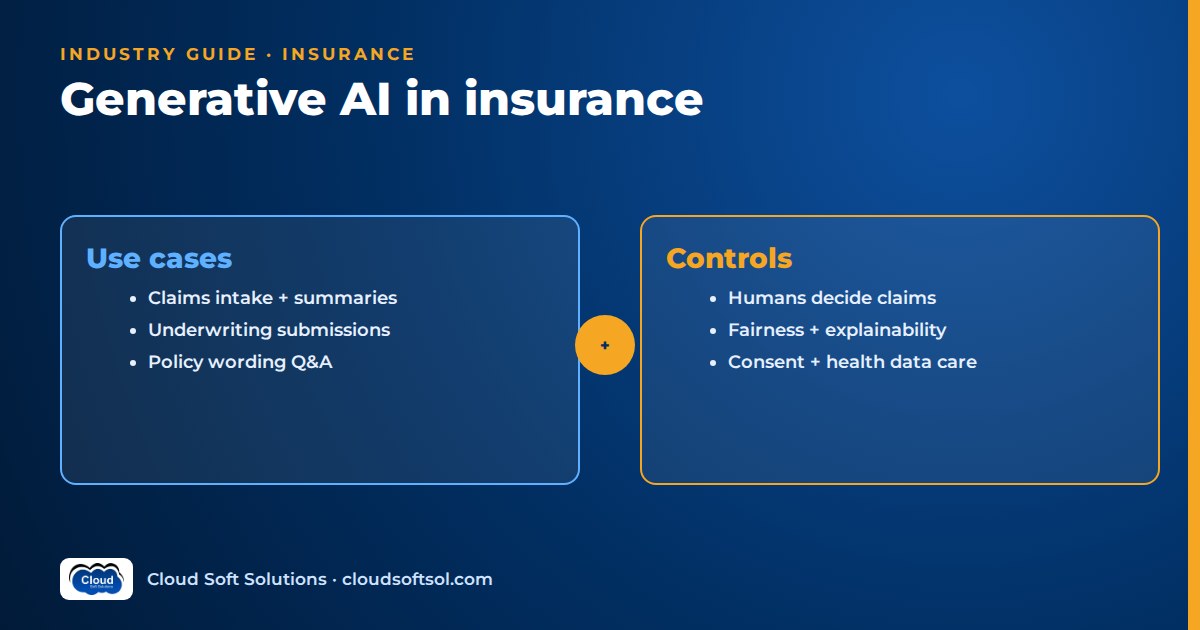
Insurance runs on documents and conversations, which makes it a natural fit for language models, and also a place where one confident wrong sentence can cost a policyholder a valid claim. Generative AI in insurance is safe when it reads, summarises and drafts for a claims handler, underwriter or agent who still makes the decision, and it becomes high risk when its output decides cover, a claim or a price, or reaches a customer without review. This guide rates the main insurtech AI use cases by risk, then covers controls, Indian regulation, architecture, a motor-claims example and engineer skills.
The approach mirrors our guide to generative AI in banking, but insurance has its own pressure points: claims are the customer's moment of truth, health data is common, and photos and scans carry much of the evidence.
How to judge the risk of an insurance use case
Before choosing a model, ask four questions about any proposed use case:
- Does the output influence a claim, cover or price decision? Claim admissibility, repudiation, settlement amount, underwriting acceptance, loadings and exclusions all count.
- Who reads it? An internal handler, an intermediary such as a broker or agent, or the policyholder directly.
- What data does it touch? Public product brochures, internal guidelines, or personal data including health records, accident details and bank accounts.
- Can a person catch a mistake before it does harm? A reviewer, a rules engine, a reconciliation, or nothing.
Internal, assistive and reviewable usually means low or medium risk. Deciding, or speaking to a customer about their claim or cover without review, means high risk.
Generative AI use cases in insurance, with risk levels
Risk levels assume the control in the last column is in place. Remove it and the risk goes up.
| Use case | What GenAI does | Risk | Key control |
|---|---|---|---|
| Claims intake and FNOL summarisation | Turns a first notice of loss call, email or chat into a structured summary: who, what, when, where, policy number, injuries, third parties | Medium | Structured output checked against the policy system; caller confirms key facts; handler reviews before triage |
| Document and photo review assistance | Extracts fields from bills, estimates, FIRs, discharge summaries and surveyor reports; describes visible damage in photos; flags missing documents | Medium to High | Extraction validated against source; low-confidence fields routed to a person; the model never values the loss on its own |
| Claims adjuster assistant | Answers the adjuster's questions about a claim file, drafts reserve notes, correspondence and settlement letters | Medium to High | Read-only access scoped to the adjuster's claims; letters are drafts; the adjuster owns every decision |
| Fraud investigation support | Summarises red flags raised by existing fraud models, links related claims, drafts the investigation narrative | High | Detection stays with established models and rules; the investigator decides; every statement tied to evidence; no automatic repudiation |
| Underwriting submission summarisation | Reads broker submissions, proposal forms, loss runs, risk surveys and medical reports; produces a structured summary for the underwriter | Medium | Figures copied from source with references; no premium or acceptance decision from the model |
| Policy wording Q&A for agents and customers | Answers "Is this covered?" style questions from the exact policy wording, endorsements and schedule | Medium (internal) / High (customer-facing) | Answers grounded in the customer's actual policy version with clause citations; coverage questions on a live claim go to a handler |
| Customer service and renewals | Handles status queries, explains documents needed, drafts renewal reminders and summarises changes in terms | Medium to High | Approved content only; authentication before policy details; no mis-selling; clear human handoff |
| Broker and agent support | Product comparison within the insurer's own range, underwriting guideline lookup, proposal completeness checks | Medium | Guidelines versioned by effective date; suitability remains the intermediary's duty; outputs logged |
| Subrogation | Reads claim files and police or surveyor reports to flag possible recovery from a liable third party; drafts the recovery notice | Medium | A recovery specialist confirms liability and sends; the model only proposes |
| Reinsurance and treaty document analysis | Extracts terms from treaty wordings and slips: limits, retentions, exclusions, reinstatements; compares versions | Medium | Extracted terms reconciled with the reinsurance system; changes flagged for a specialist |
| IT and operations | Incident summaries, runbook suggestions, code assistance for policy admin and claims platforms, test data generation | Low to Medium | No production personal data in prompts; read-only by default; normal change control |
Claims: where most of the value and risk sits
AI claims processing usually starts at intake. FNOL arrives by phone, email, WhatsApp and intermediaries, often in mixed languages, and a model that turns it into a structured record saves re-keying. The model fills in a form; policy lookup, coverage period checks and duplicate detection stay in deterministic code.
Document review is harder than it looks. Bills, estimates and discharge summaries arrive as photographed pages with tables and stamps, so it is a parsing problem before it is an LLM problem; our guide to parsing PDFs, tables and scans covers the techniques. Photos add another layer: a vision model can describe visible damage, but it cannot see internal damage, judge pre-existing wear reliably or confirm that the photo shows the insured vehicle.
Underwriting: summarise, do not decide
An AI underwriting assistant earns its place by reading long submissions and medical reports and producing a referenced summary, so the underwriter spends time on judgement instead of searching. Do not let it suggest acceptance, loadings or exclusions: those are pricing and selection decisions with fairness and regulatory consequences.
Policy wording Q&A
Policy wording is precise legal text, and a near-miss paraphrase can change meaning. Waiting periods, sub-limits and exclusions often live in different clauses and endorsements, so retrieval must pull the right product, the right version and the customer's own endorsements, then quote the clause. This is a classic place for hallucinations: the model fills a gap with a plausible but wrong clause. "I could not find this in your policy wording, a person will confirm" is a better answer than a fluent guess.
The controls insurers need
Human decision on claims and underwriting
Claim admission, repudiation, settlement amounts, underwriting acceptance and pricing stay with accountable people or approved rules-based systems. Enforce this in the architecture, not only in policy: the model has no tool that can approve, reject or pay. Repudiation letters need a named reviewer, because the reasons must match the policy terms and evidence. Our human-in-the-loop design guide covers approval patterns, and how to stop reviewers rubber-stamping.
Explainability
When a customer, ombudsman or auditor asks why a claim was handled a certain way, "the model said so" is not an answer. Log which documents were retrieved, which clause was cited, which prompt and model version ran, and what the human changed. Keep the decision reasons in the claims system, confirmed by the handler, so the explanation never depends on reconstructing an LLM's reasoning.
Fairness
Language models can carry bias into summaries and drafts, such as a different tone for different names, regions or languages. In underwriting and fraud, that can shape a decision even when a human signs off. Test before launch and in production with paired cases that differ only by name, gender, location or language. Our guide on bias and fairness testing for AI walks through the methods. Also keep protected or proxy attributes out of underwriting and fraud prompts unless there is a documented, lawful reason.
Consent and purpose
Insurers collect personal data for specific purposes such as issuing a policy or settling a claim. Using it to fine-tune a model or for marketing is a new purpose that needs its own lawful basis. Record purpose in the data map, carry consent status into the retrieval layer, and keep the evaluation datasets you build from real claims inside the same controls.
Health data sensitivity
Health, life and personal accident claims bring diagnoses, prescriptions and hospital records into scope. Treat them as the most sensitive tier: minimise what reaches the model, redact identifiers where possible, restrict access, keep raw medical text out of general logs, and prefer in-region or self-hosted endpoints.
Supporting controls
Add a full audit trail, input and output guardrails with prompt-injection defences (claim documents come from outside the insurer), evaluation against expert-labelled claim files before every change, and vendor due diligence on where model providers process and retain data.
Regulatory context for AI in insurance in India
Not legal advice. This section is a simplified engineering view of the position at the time of writing. Regulations and circulars change; confirm the current position with your compliance and legal teams and the official texts.
IRDAI
The Insurance Regulatory and Development Authority of India (IRDAI) regulates insurers and intermediaries. At the time of writing, IRDAI has not issued binding AI-specific regulations for insurers. In June 2026 it constituted a Working Group on Artificial Intelligence, with members from academia, industry and cyber security bodies, to recommend governance frameworks, safeguards and an AI audit approach for regulated entities. The group was given three months to report. Watch for any guidance that follows.
Meanwhile, AI systems fall under the rules that already govern the processes they touch, including IRDAI's regulations on protecting policyholders' interests (claim handling, disclosure, grievances), its information and cyber security guidelines, and its outsourcing rules. An AI-drafted repudiation letter must meet the same standard as a human-written one. A chatbot that explains a product is part of the sales and servicing process and must not mis-sell.
The DPDP Act
The Digital Personal Data Protection Act, 2023, with its Rules notified in November 2025 and obligations phasing in, applies to the personal data in prompts, retrieved documents, embeddings and logs. The practical points are purpose-specific notice and consent, minimisation, security safeguards, breach handling, erasure and cross-border transfer. The Act does not create a separate category for health data, but its sensitivity still matters for security, for whether an insurer is designated a Significant Data Fiduciary, and for sectoral expectations. Our DPDP Act guide for AI applications maps the Act to engineering controls in detail.
The architecture pattern for GenAI in an insurer
Most insurance use cases fit one shape, with core systems remaining the system of record:
Handler / agent (SSO)   Customer (authenticated)
            \               /
          Channel app or claims UI
                    |
          AI orchestration service
          identity, entitlements,
          PII + health redaction,
          input guardrails
                    |
     +--------------+--------------+
     |              |              |
 Document       Retrieval       Tool gateway
 parsing +      (wordings,      (policy, claims,
 vision         guidelines;     read-only, on
 extraction     versioned)      behalf of user)
     +--------------+--------------+
                    |
          LLM gateway (in-region)
                    |
   Output checks: citations, schema,
   amounts verified by code
                    |
   Human decision (claims, underwriting)
                    |
   Audit log, traces, evaluation
The principles:
- Systems of record stay authoritative. Policy status, sums insured and payments come from core systems through tools, never from the model.
- Read-only by default. Writes need confirmation; decisions need an approver.
- Code owns arithmetic. Deductibles, depreciation and sub-limits are calculated deterministically; the model explains the result.
- One platform, many use cases. Redaction, an LLM gateway, guardrails, logging and evaluation are built once and shared.
An illustrative motor-claims example
Consider a general insurer that wants to speed up own-damage motor claims without weakening control. This is a hypothetical walk-through, not a description of any real insurer.
- FNOL. A policyholder reports a collision in the app and uploads photos, licence and registration certificate. The intake assistant produces a structured summary, which the policyholder confirms. Code checks the policy is active for that vehicle and date.
- Document check. Parsed licence and registration details are compared to the policy record by a rule. A mismatch goes to a handler; the model does not decide whether it is a typo.
- Photo assistance. A vision model describes visible damage, "front bumper cracked, left headlamp broken", and flags photos that are blurred or show a different colour of vehicle. It does not estimate the repair cost.
- Surveyor and estimate. The adjuster assistant lines up garage estimate items against the surveyor's assessment and highlights differences, citing page and line.
- Calculation. The claims system applies the policy's deductible, depreciation rules and any add-on covers. The model writes a plain-language explanation of the calculation it was given.
- Decision. The adjuster reviews the file, edits the draft settlement letter and approves. If the fraud model has raised a flag, the case goes to investigation with a drafted evidence summary, and nothing is repudiated automatically.
- Learning loop. Adjuster edits and overrides feed the evaluation set for the next prompt change.
The gain is less reading, re-keying and chasing, while every judgement stays with a person or a rule. Watch for automation creep, where approving the draft becomes a habit; track override rates and review time.
Want to practise this kind of engineering on realistic projects? Cloudsoft's AI Forward Deployed Engineer course includes an Enterprise Knowledge Assistant and a Secure Banking AI Assistant project, where you build cited retrieval, entitlement-aware tools, human approval steps and audit logging. These are the same patterns an insurance deployment needs.
Skills engineers need for insurance AI
BFSI GCCs and IT services teams in Hyderabad and Bengaluru build platforms for insurers. Engineers who want to work on AI in insurance in India need:
| Skill area | What it means in practice |
|---|---|
| Document AI | OCR, table extraction, layout parsing for bills, estimates and medical records; confidence scoring and fallbacks |
| Multimodal models | Using vision models for photo description and quality checks, and knowing their limits. See multimodal AI in the enterprise |
| RAG over policy wordings | Product and version-aware retrieval, endorsements, clause-level citations, "not found" behaviour |
| Structured outputs and tools | Schemas for FNOL and submissions; read-only tools into policy admin and claims systems |
| Privacy engineering | Health data redaction, purpose tagging, retention and erasure across logs and vector stores |
| Evaluation and fairness testing | Expert-labelled claim files, faithfulness checks, paired fairness tests, regression gates in CI |
| Observability and audit | Tracing each step, linking human edits to outputs, dashboards for claims and compliance leaders |
| Insurance domain fluency | FNOL, reserving, surveyors, subrogation, underwriting guidelines, treaty basics, claim grievance flow |
Domain fluency often separates engineers: knowing why a waiting-period clause trips up a health claim lets you design the right checks. Sitting with claims teams and turning their workflow into a controlled system is what a Forward Deployed Engineer does.
Frequently asked questions
What are the safest generative AI use cases for an insurer to start with?
Internal, assistive use cases such as underwriting submission summarisation, policy wording Q&A for staff with citations, treaty document extraction and IT operations support. They help trained employees, keep decisions with people and are easy to review.
Can generative AI approve or reject insurance claims?
It should not. Claim admission, repudiation and settlement amounts should stay with accountable handlers or approved rules-based systems. GenAI can summarise the file, extract documents and draft letters, but a person must review and own the decision.
Has IRDAI issued rules on AI in insurance?
At the time of writing, IRDAI has not issued binding AI-specific regulations. In June 2026 it set up a Working Group on Artificial Intelligence to recommend governance frameworks and an AI audit approach. Existing rules on policyholder protection, claims, cyber security and outsourcing already apply to AI systems. Check the current position with your compliance team.
How does the DPDP Act affect AI claims processing?
Personal data in prompts, documents, embeddings and logs is covered. Insurers need clear notices and consent for each purpose, data minimisation, security safeguards, breach handling and erasure. Reusing claims data to train models or for a new purpose needs its own lawful basis.
Can AI assess vehicle damage from photos?
A vision model can describe visible damage and flag poor or inconsistent photos, which helps adjusters triage. It cannot see hidden damage or verify the vehicle reliably, so repair estimates and settlement amounts should come from surveyors, garages and the claims system.
How do you test an AI underwriting assistant for fairness?
Run paired test cases that differ only in attributes such as name, gender, location or language and compare the summaries and flags. Keep protected and proxy attributes out of prompts unless there is a documented reason, and repeat the tests after every prompt or model change.
What skills do engineers need to work on insurtech AI?
Document AI and parsing, multimodal models, RAG over versioned policy wordings, structured outputs and tool integration, privacy engineering for health data, evaluation and fairness testing, observability, and enough insurance domain knowledge to work closely with claims and underwriting teams.
If you want to build these skills with an engineer who has delivered cloud and AI systems, look at the Cloudsoft FDE PRO program. It runs for 12 weeks with five live sessions a week, in the classroom beside Ameerpet Metro or live online, and ends with the GlobalBank capstone, a simulated customer engagement in a regulated financial setting. Call +91 96660 19191 to book a free demo session.