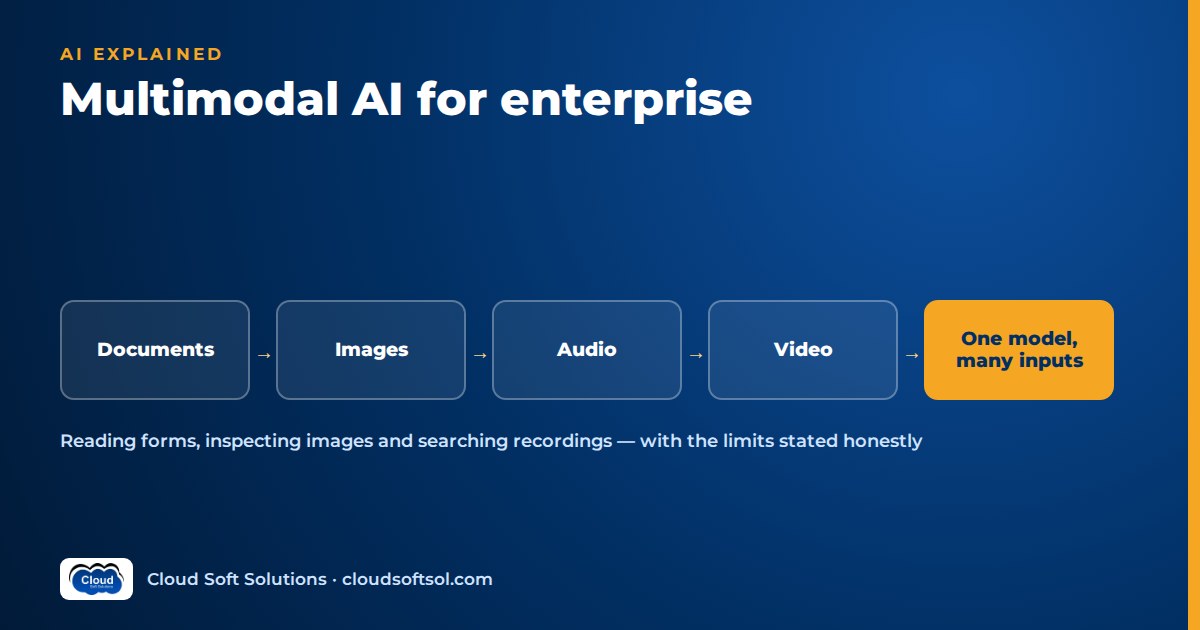
Multimodal AI means models that can take in, and sometimes produce, more than text: scanned documents, photos, charts, screenshots, audio and video. One model can read a claim form, assess a photo of a damaged car and summarise a recorded call, work that once needed a separate system per input. The catch is that multimodal models misread numbers and small text, cost more per request than text, and touch sensitive data such as faces and ID cards. They earn their place only with careful architecture and evaluation against labelled examples.
What is multimodal AI?
A "modality" is a type of data: text, images, audio, video. A classic large language model works on one modality. A multimodal model accepts several modalities in the same request, so you can send a photo and the question "What is the policy number on this form?" together.
How a vision language model "sees"
The most common enterprise multimodal model is a vision language model (VLM), an LLM that also accepts images. A simplified picture of how it works:
- An image encoder cuts the image into small patches and turns each into a vector describing what it contains.
- A projection layer maps those vectors into the same space the language model uses for text tokens. In effect the image becomes a sequence of "visual tokens".
- The language model attends over the visual tokens and your text tokens together, then generates text as usual.
Two consequences matter in production. First, images cost tokens, and more pixels usually mean more tokens, so high-resolution pages are expensive. Second, many services resize large images to a maximum size before encoding. Fine print that was readable in the original can blur into a few patches, which is the root of many "the model misread the number" incidents.
Other modalities
- Audio: either a speech-to-text model produces a transcript that a text LLM then processes, or a natively audio-capable model takes the sound directly and can pick up tone, pauses and multiple speakers.
- Video: usually handled as frames sampled at intervals plus the audio track. The model never "watches" every frame; it reasons over a sample, so short events between samples can be missed.
- Output modalities: some models also generate images or speech, but in most enterprise systems the useful output is structured JSON.
Enterprise use cases by modality
Documents and forms: vision models vs OCR pipelines
Documents are where most enterprises start, and the first design question is whether to send page images to a vision language model or run a traditional OCR and layout pipeline first and give the extracted text to an LLM.
An OCR pipeline (a managed document service or an open-source engine) returns words, tables, key-value pairs, word confidences and bounding boxes, which are gold for audit and human review. Its weakness is understanding: it does not know that "Amt. payable (incl. GST)" and "Net due" are the same field on two hospital layouts.
A vision language model reads the page as a whole. It copes with odd layouts, stamps, checkboxes and unseen documents, and maps content straight into your schema. Its weaknesses mirror OCR's strengths: no reliable word-level confidence, approximate coordinates at best, and a tendency to produce a plausible value when the real one is unreadable.
Many production systems combine both: OCR for text and evidence, a model to interpret layout and fill the schema, with the page image attached when layout matters.
Images: inspection, damage assessment and shelf audits
These are illustrative patterns, not claims about any specific deployment:
- Visual inspection. Consider a manufacturer whose line technicians photograph components. A VLM can describe visible defects in plain language and classify them against a defect taxonomy. For high-volume, fixed-camera lines a purpose-trained computer vision model is usually cheaper and more consistent; the VLM suits varied, low-volume cases.
- Damage assessment. An insurer or a fleet operator receives photos of damaged vehicles or property. The model can list damaged parts, flag unusable photos and draft assessor notes. It should not decide payouts.
- Retail shelf audits. Consider a retailer whose field staff photograph shelves. A model can check whether a planned product is present, spot empty facings and read shelf-edge price labels. Small, angled price text is exactly where models misread, so prices need validation against the price master.
Charts and screenshots
Vision models can describe a chart's trend and explain an error dialog or dashboard screenshot attached to a support ticket. For a GCC IT operations team in Hyderabad or Bengaluru, letting the ticket triage step "look at" the user's screenshot is a quick win. Be careful with chart values: a model estimating a bar's height is guessing. If the underlying data exists, fetch the data instead of reading the picture.
Audio
Call-centre transcription and summarisation, meeting minutes, compliance review of recorded advice calls, and voice notes from field staff are the common cases. Indian deployments add code-mixed speech (Hindi-English, Telugu-English) and noisy environments, so test on your own recordings, not demo clips. Real-time conversation is a separate problem; our guide to voice AI agents covers it in depth, so this article keeps audio brief.
Video: summarisation and search
Enterprise video is mostly training recordings, town halls, demos and inspection footage. Two patterns dominate:
- Summarisation: combine the transcript with descriptions of sampled frames (slides, on-screen text, scene changes) and produce chapters, key points and action items.
- Search: index each segment with its transcript, frame captions and timestamps so a user can ask "where does the trainer configure the VPN?" and jump straight to that moment.
Video is expensive, so sample adaptively (more frames at scene changes, fewer for a static speaker) and cache results.
OCR pipeline vs vision language model
| Dimension | OCR + layout pipeline | Vision language model |
|---|---|---|
| Core strength | Accurate character reading on clean scans | Understanding layout and meaning across varied documents |
| Evidence | Bounding boxes and word confidences per value | Approximate or no coordinates; confidence not calibrated |
| New layouts | Templates or rules often need updating | Usually handled without new templates |
| Failure mode | Garbled characters, broken tables, visible as low confidence | Fluent but wrong values that look plausible |
| Handwriting, stamps, checkboxes | Varies by engine; often weak | Often better, still needs verification |
| Cost profile | Predictable per page | Per image token; rises with resolution and page count |
| Best fit | High-volume, stable forms; audit-heavy fields | Diverse, messy or unseen documents; layout reasoning |
Use OCR where you need evidence and numbers, a model where you need understanding, and validation code over both.
Multimodal RAG: indexing images and tables
Standard retrieval-augmented generation indexes text chunks, but enterprise knowledge also lives in diagrams, scanned SOPs, slide decks and tables inside PDFs. Multimodal RAG keeps that retrievable, in two main ways.
1. Caption, then index text
At ingestion, a vision model writes a description of every image, diagram and chart, and tables are converted to Markdown or HTML. Those descriptions are embedded and stored like any other chunk, with a pointer back to the original image. At answer time you can pass the original image to a VLM along with the text.
- Pros: works with your existing text embeddings and vector store; captions are human-readable and debuggable.
- Cons: retrieval is only as good as the caption. If the caption missed the detail a user later asks about, the image is never found.
2. Multimodal embeddings
A multimodal embedding model maps images and text into a shared vector space, so a text query can be compared directly with image vectors. A newer variant embeds whole page images, which avoids the parsing step for visually rich documents such as slides.
- Pros: no captioning step; keeps visual detail a caption might drop.
- Cons: harder to debug (you cannot read a vector), weaker on exact identifiers like part numbers, and page-image indexes can be much larger than text indexes.
Tables deserve their own handling
Tables break naive chunking because a row means nothing without its header. Extract tables to a structured form, keep the header with every chunk, For numeric questions, consider loading tables into a database and querying them rather than asking a model to read figures off an image. A practical default is hybrid: captions and table text for search, page images for the answer step, and page metadata for citations. See data pipelines for RAG for ingestion.
A reference architecture
Docs / photos / audio / video
            |
            v
 [Ingest] store original, hash, dedupe
            |
            v
 [Route by modality]
   |         |          |          |
 pages    images     audio      video
   |         |          |          |
 OCR +    resize,    speech-    frames +
 layout   quality    to-text    transcript
   |      checks       |          |
   +---------+----------+----------+
            |
            v
 [PII redaction: faces, IDs, numbers]
            |
            v
 [VLM / LLM -> JSON schema or caption]
            |
            v
 [Validation rules + confidence]
        |                |
     pass             fail
        v                v
 [Systems / index]  [Human review]
            |
            v
 [Logs, cost, evaluation sets]
A few decisions do most of the work:
- Route by modality early and take the cheapest path: a clean digital PDF needs text extraction, not a vision call.
- Ask for structured output. Constrain the model to a JSON schema so downstream code can validate it; see function calling and structured outputs.
- Keep deterministic checks outside the model. Totals that must add up, dates that must fall in a range and IDs with check digits are verified in code, never trusted to the model.
Illustrative example: an insurer's claims intake
Illustrative scenario. Consider a motor and health insurer whose claim packs contain a claim form, hospital bills, an identity document, photos of a damaged car and sometimes a customer voice note:
- Forms and bills go through OCR and layout parsing first, so amounts and policy numbers carry coordinates and word confidences. A model maps the result to the claim schema, with the page image attached for messy layouts.
- Car photos go to a VLM that lists visibly damaged parts, flags unusable photos (blurred, too dark, wrong vehicle angle) and notes whether visible damage matches the described incident, for the assessor, not as a decision.
- The voice note is transcribed and summarised into the claim's description field, with the original audio retained.
- The ID document gets stricter controls: only required fields are extracted, the image is encrypted with restricted access and never indexed.
- Validation checks bill totals against line items, dates against the policy period, and the vehicle number on the form against the policy record. Anything failing goes to a human review queue with the reason shown.
The full build of the document side, including schemas, confidence routing and straight-through measurement, is in our enterprise document intelligence project. Want to build pipelines like this with hands-on labs? Cloudsoft's AI, GenAI and Agentic AI course covers LLMs, RAG, structured outputs, evaluation and agents end to end.
Limitations to design around
- Hallucinated reading of numbers. The most dangerous failure. A model can return a confident, correctly formatted amount or policy number that is not on the page, especially when the true value is partly obscured. Mitigate with OCR cross-checks, check digits, totals reconciliation and lookups against master data.
- Small and dense text. Downscaling destroys fine print, footnotes and dense tables. Crop regions of interest and send tiles at higher resolution rather than sending a whole page at low resolution.
- Cost per image. Image tokens add up across multi-page packs, retries and video frames. Track cost per document, skip vision calls when text extraction suffices, and cache results. See cloud cost optimisation for AI.
- Counting and spatial reasoning are weak spots; use dedicated vision models where precision matters.
- Prompt injection through images. Text hidden in an image ("ignore previous instructions") can steer a model. Treat everything extracted from user-supplied media as untrusted data.
- Model differences. Capabilities vary widely by provider and change between releases, so compare candidates on your own data; our guide on how to choose an LLM for enterprise sets out a method.
Privacy: faces, IDs and sensitive media
Images and recordings carry more personal data than people expect: faces in the background of a damage photo, an Aadhaar or PAN card in a claim pack, a vehicle number plate, a customer's voice, a patient's name on a hospital wristband. India's Digital Personal Data Protection Act makes purpose limitation and data minimisation central obligations, so design for them from day one:
- Minimise: extract only the fields the process needs, and do not keep full ID images where the business only needs a verified number.
- Redact before the model where possible: blur faces and mask ID numbers that the task does not need, before images reach a model or an index.
- Keep data in approved regions and accounts: use enterprise model endpoints in your cloud account with logging and data-retention settings you control.
- Separate indexes: keep ID and medical images out of general knowledge-base indexes.
- Avoid biometric use by accident: describing a photo is different from identifying a person. Do not build face recognition into a workflow without explicit legal review and consent.
The wider threat model, covering access control, injection and data leakage, is in AI security for enterprises.
Evaluation with labelled sets
Multimodal demos shine on clean examples; production performance is set by blurry, rotated and unusual inputs, which only a labelled evaluation set reveals.
- Collect representative samples from real traffic (with consent and redaction): bad scans, phone photos, handwriting, languages, noisy audio.
- Label ground truth with domain experts: the correct value for each field, the correct damage category, the reference summary points.
- Measure per field and per segment: precision, recall and exact match for IDs and amounts, sliced by document type and image quality. An overall average hides the failing segment.
- Track the dangerous errors separately: a wrong amount that passed straight through costs more than a field sent to review. Measure the error escape rate, not just accuracy.
- Re-run on every change of model, prompt, image resolution or preprocessing, and add every production failure a reviewer catches to the set.
Our LLM evaluation guide covers the general method; for multimodal systems the key addition is slicing results by input quality. Taking pipelines like this into production for enterprise customers, from discovery to evaluation and measured business outcome, is the core work of a Forward Deployed Engineer, and the Cloudsoft FDE PRO program is built around that journey.
Frequently asked questions
What is multimodal AI in simple terms?
Multimodal AI refers to models that can understand, and sometimes generate, more than one type of data, such as text, images, audio and video, in a single request. For example, you can send a photo of a form with a question and get a structured answer.
What is a multimodal LLM?
A multimodal LLM is a large language model extended to accept inputs other than text. An encoder converts images or audio into vectors that the language model can attend to alongside text tokens and reason over both.
Should I use OCR or a vision language model for documents?
Use OCR when you need accurate characters, word-level confidence and coordinates for audit, especially on high-volume, stable forms. Use a vision language model when layouts vary widely or understanding matters more than exact characters. Many production systems combine both and add validation rules in code.
What is multimodal RAG?
Multimodal RAG extends retrieval-augmented generation to images, diagrams, tables and other media. Content is made searchable either by captioning images and indexing the text, or by using multimodal embeddings that place images and text in a shared vector space.
Why do multimodal models misread numbers?
Images are often resized before encoding, so small digits become blurred, and the model generates the most plausible value rather than admitting it cannot read it. Cropping regions at higher resolution, cross-checking with OCR and validating against business rules and master data reduce the risk.
Is multimodal AI expensive to run?
It costs more per request than text because images, audio and video frames consume many tokens. Route clean text documents away from vision models, cache results, sample video frames adaptively and track cost per document.
How do you keep faces and ID documents private?
Extract only the fields the process needs, redact faces and unneeded ID numbers before images reach a model or index, use enterprise endpoints in approved regions, keep sensitive documents in restricted stores and avoid identifying people without legal review and consent.
How do you evaluate a multimodal AI system?
Build a labelled test set from representative real inputs, including poor-quality ones, and measure per field and per segment, such as document type and image quality. Track errors that pass straight through separately and re-run the set on every change.
Ready to go from reading about multimodal AI to building it? Cloudsoft's AI, GenAI and Agentic AI training in Hyderabad covers LLMs, RAG, evaluation and agents with hands-on labs, in our Ameerpet classroom beside Ameerpet Metro or live online. Call +91 96660 19191 to book a free demo.