Choosing a model is a decision you make for a set of tasks, not a ranking you look up. To choose an LLM for enterprise use, shortlist a few candidates that pass your data-handling and deployment constraints, run them all against an evaluation set built from your own tasks, score them on quality, latency, cost per task and reliability, and pilot the winner with real users before committing. Expect to end up with more than one model behind a gateway, and expect to repeat the exercise whenever the models change, because they will.
Why public leaderboards aren't enough
Search for "best LLM for business" and you will find leaderboards, benchmark tables and vendor comparisons. They are useful for one thing: deciding which models are worth testing. They are a poor basis for the final decision, for several reasons.
- Benchmarks measure someone else's task. A general reasoning benchmark says little about whether a model can extract fields from your claim forms or call your ticketing API correctly.
- Contamination and tuning. Popular benchmark questions leak into training data, and models are sometimes tuned to do well on them. A strong score can reflect familiarity rather than capability.
- Your prompts, retrieval and tools change the result. In a RAG or agent system, the model is one component. A model that wins in isolation can lose inside your pipeline.
- Leaderboards ignore enterprise constraints. Region availability, data terms, throughput and version lifetime are not on the table, and rankings shift with every release.
The fix is the same discipline described in our guide to LLM evaluation: measure on your own test set, with metrics that reflect what your users and risk owners care about.
LLM selection criteria: what actually matters
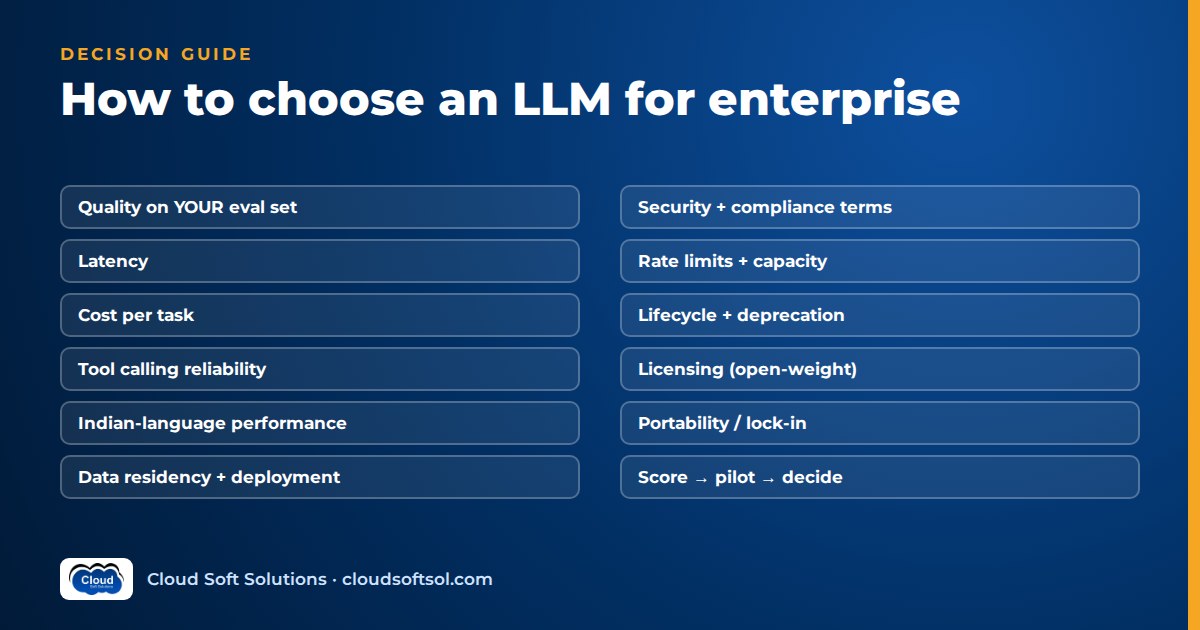
The table below lists the LLM selection criteria that tend to decide enterprise choices. Some criteria are gates (a model that fails them is out, whatever its quality) and others are scored trade-offs.
| Criterion | What to check | How to measure | Gate or scored |
|---|---|---|---|
| Task quality on your eval set | Correctness, faithfulness to sources, adherence to instructions and tone on your real tasks | Automated checks, calibrated LLM-as-judge and expert review on a versioned test set | Scored (with a minimum bar) |
| Latency | Time to first token and total response time at your typical input and output lengths | Measure percentiles from your own region under realistic load, not single calls | Scored; gate for real-time use cases |
| Cost per task | Total cost to complete one business task, including retries, retrieval context and tool-call rounds | Tokens per task from eval runs multiplied by current pricing or your hosting cost | Scored |
| Context window needs | Whether your longest realistic input fits, and whether quality holds as context grows | Test with your longest documents and conversations, not just the advertised limit | Gate, then scored |
| Tool calling and structured output reliability | Valid JSON against your schema, correct tool choice and arguments, sensible behaviour when a tool errors | Schema-validation pass rate and tool-call accuracy across many runs | Scored; often decisive for agents |
| Multilingual / Indian-language performance | Hindi, Telugu, Tamil and other languages your users write in, plus code-mixed text such as Hinglish and transliterated input | Native-speaker review of a language-specific slice of the eval set | Scored; gate if users need it |
| Data handling, residency and deployment options | Retention and training-use terms, region availability, and whether you can use a direct API, a cloud platform (such as Amazon Bedrock, Azure OpenAI or Vertex AI) or self-host | Read the data processing terms; confirm region and deployment mode with the provider or platform | Gate |
| Security and compliance terms | Contractual commitments, audit reports, access controls, logging, and fit with your sector's regulators | Security questionnaire and review by your security and legal teams | Gate |
| Rate limits and capacity | Requests and tokens per minute available to you, burst handling, provisioned or reserved capacity options | Load test at expected peak plus headroom; confirm quota in writing | Gate at your peak volume |
| Model lifecycle and deprecation risk | How long versions stay available, how much notice is given before retirement, whether versions can be pinned | Review the provider's published lifecycle policy and past behaviour | Scored |
| Licensing for open-weight models | Commercial-use terms, usage thresholds, acceptable-use rules, attribution, rights over fine-tuned derivatives | Legal review of the specific licence for the specific model revision | Gate |
| Vendor lock-in and portability | Dependence on provider-specific APIs, features or prompt formats; cost of switching | Estimate the effort to move the workload to your second-choice model | Scored |
A few criteria deserve extra attention
Cost per task, not price per token. A cheaper model that needs longer prompts, more retries or extra agent turns can cost more per resolved ticket than a pricier one that gets it right first time. Measure tokens per task during your evaluation runs and multiply. Our cloud cost optimization for AI guide sets out the cost-per-task model in detail.
Structured output reliability. For agents, a model that occasionally invents a field name or skips a required argument is a production incident waiting to happen. Run each tool-calling case many times; rare failures only show up at volume.
Indian-language performance. Quality in English does not predict quality in Telugu or Tamil, and it says even less about the code-mixed, transliterated text that real Indian users type. Token usage also varies by language, which affects cost. Give that slice of the eval set its own score and have native speakers review it.
Deployment options. The same model family may be reachable through its provider's API, one or more cloud platforms, or as open weights, each with different data terms, regions, quotas and pricing. If self-hosting is on the table, read our guide to self-hosting LLMs before you score it.
A step-by-step selection process
The process is designed to be repeatable: the second run reuses most of the first.
 Use case + constraints
          |
          v
 [1] Shortlist  -- gates: data, region, licence
          |
          v
 [2] Build eval set (your tasks, your data)
          |
          v
 [3] Run candidates (same data, same tools)
          |
          v
 [4] Score on weighted scorecard
          |
          v
 [5] Pilot with real users + monitoring
          |
          v
 Decision record --> re-evaluate on change
Step 1: Shortlist
Write down the use case and its constraints: users, data, regions, regulators, volume and response time. Apply the gate criteria first; any model that fails data residency, approved deployment paths or licensing is removed before testing. Then pick a small, deliberately varied shortlist: typically a large frontier-class model, a mid-tier or smaller hosted model, and, where self-hosting is viable, an open-weight option. Our article on small language models for enterprise explains why the small option is often worth including.
Step 2: Build the eval set
Collect real examples: tickets, documents, questions, expected tool calls. Include common cases, edge cases, adversarial inputs and every language your users write in. For each case, record what a good answer looks like, agreed by domain experts. Version the set, and keep a held-out slice you never tune prompts against.
Step 3: Run the candidates
Run every shortlisted model through the same pipeline: same retrieval, same tools, same test cases. Allow a bounded amount of prompt tuning per model rather than reusing a prompt tuned for one vendor. Run cases more than once to see variance, and log tokens, latency and errors; LangSmith, Langfuse or Ragas keep runs comparable.
Step 4: Score
Score each model on the weighted scorecard below, combining deterministic checks, a calibrated LLM judge and expert review of a sample. Look at the failures, not just the totals: a model that fails rarely but dangerously may be worse than one that fails more often in harmless ways.
Step 5: Pilot
Put the leading candidate, and ideally the runner-up, in front of a limited group of real users with tracing and feedback capture. Pilots reveal how people actually phrase requests and how latency feels in the real interface. Close the pilot with a short decision record: what was chosen, for which tasks, on what evidence, and what would trigger a re-evaluation.
If you want to practise this end to end, building RAG pipelines and agents on Amazon Bedrock, Azure OpenAI and Gemini and then comparing models with real evaluation data, Cloudsoft's AI, GenAI and Agentic AI course treats model selection as an engineering exercise, not a guess.
Multi-model strategy with a gateway or router
Mature enterprise AI platforms rarely run on one model. They route tasks to different models through an LLM gateway, so the choice can change without rewriting applications.
 Apps / agents
      |
      v
 +-----------------------------+
 | LLM gateway / router        |
 | auth, quotas, logging,      |
 | routing rules, fallbacks    |
 +-----------------------------+
   |            |            |
   v            v            v
 Small model  Large model  Self-hosted
 (classify,   (reasoning,  (sensitive
  extract)     drafting)    data)
A gateway gives you:
- Task routing. Send classification and extraction to a small model and reserve the large one for reasoning, one of the strongest levers in our guide to cutting LLM costs.
- Fallbacks. If one provider is rate-limited or down, route to an approved alternative that has already passed your evaluation.
- Data-based routing. Sensitive requests go only to a self-hosted or in-region model.
- Central controls. Authentication, budgets, quotas, logging and guardrails live in one place instead of in every application.
- Portability. Applications call one interface, so swapping a model is a configuration change plus an evaluation run.
Keep routing rules simple, and evaluate the router itself: one that misclassifies hard requests as easy silently degrades quality.
Re-evaluating when models change
Providers release new models, retire old versions, change pricing and adjust behaviour, sometimes under the same name. Revisit the decision on defined triggers:
- A deprecation or retirement notice for a model you depend on.
- A new model or tier from a shortlisted provider that looks relevant.
- A pricing, quota or data-terms change.
- Drift in production quality signals: lower user ratings, more escalations, more schema failures.
- A change in your own system: new data sources, new tools, new languages or a new regulator requirement.
With the eval set, scorecard and gateway in place, re-evaluation is a routine run. Pin versions where possible, compare the new candidate against the current model, and promote it through the gateway behind a regression gate in CI. Record each change in the model inventory that your enterprise AI governance process keeps, so risk owners can see which model serves which use case and why.
Compare LLMs for enterprise: a scorecard template
Use a scorecard like this to compare LLMs for an enterprise use case. Agree weights with the business owner before seeing results, so nobody tunes them to favour a favourite. Gates are pass or fail; scored criteria use a simple scale, for example 1 to 5, multiplied by the weight.
| Criterion | Type | Weight (agree up front) | Model A | Model B | Model C | Evidence / notes |
|---|---|---|---|---|---|---|
| Data handling and residency | Gate | Pass / fail | Link to data terms, region confirmed | |||
| Security and compliance terms | Gate | Pass / fail | Security review ticket | |||
| Licence (open-weight only) | Gate | Pass / fail | Legal review, model revision | |||
| Rate limits and capacity at peak | Gate | Pass / fail | Load test result, quota confirmation | |||
| Task quality on eval set | Scored | [weight] | Eval run ID, failure review | |||
| Tool calling / structured output | Scored | [weight] | Schema pass rate across repeated runs | |||
| Indian-language performance | Scored | [weight] | Native-speaker review notes | |||
| Latency | Scored | [weight] | Percentiles from your region | |||
| Cost per task | Scored | [weight] | Tokens per task x current pricing | |||
| Context window fit | Scored | [weight] | Longest realistic input tested | |||
| Lifecycle and deprecation risk | Scored | [weight] | Provider lifecycle policy | |||
| Portability / lock-in | Scored | [weight] | Effort to switch to runner-up | |||
| Weighted total | Decision and re-evaluation triggers |
Keep the evidence column honest. A score with no linked eval run or review is an opinion, and the scorecard is only useful during LLM vendor evaluation if someone else can check how each number was reached.
Illustrative example: an insurer's claims assistant
Consider an insurer in India that wants an assistant to help claims handlers. It must extract fields from claim documents into the claims system, answer questions grounded in policy wordings, and draft customer messages in English, Hindi and Telugu. Customer data must stay in an Indian cloud region.
Shortlist. The team applies the gates first. One candidate is not offered in an Indian region on any approved platform, so it is dropped. Three remain: a large and a smaller hosted model on the insurer's existing cloud platform, and an open-weight model it could self-host, whose licence legal has cleared.
Eval set. Claims experts assemble cases from anonymised past claims: clean forms, poor scans, ambiguous policy questions, cases where the right answer is "escalate to a senior handler", and Hindi and Telugu messages, including code-mixed ones.
Results, qualitatively. The large model gives the strongest answers on policy questions and the most natural Telugu drafts, but its cost per task is high for the extraction work. The smaller hosted model matches it on field extraction and produces valid JSON just as reliably, at a much lower cost and latency, but it struggles with ambiguous policy questions. The self-hosted model performs acceptably on extraction, falls behind on regional-language drafting, and would need GPU capacity and an operations team the insurer does not yet have.
Decision. The scorecard points to a split: the smaller model handles extraction, the large model handles policy Q&A and customer drafts, and both sit behind a gateway with logging and quotas. The self-hosted option is recorded as a future fallback for the most sensitive documents. A pilot with one claims team confirms the routing and adds new edge cases to the eval set.
Running this kind of selection inside a customer's environment, with their data, security reviewers and claims experts at the table, is what Forward Deployed Engineers do; Cloudsoft's FDE PRO program practises it through enterprise projects and a simulated customer engagement.
Frequently asked questions
What is the best LLM for business?
There is no single answer that holds across use cases or over time. The right model depends on your tasks, data rules, languages, volume and budget, and the options change frequently. Shortlist candidates that pass your constraints, test them on your own evaluation set and choose per task.
How many models should we shortlist?
Usually three to four. Include a large model, a smaller or cheaper hosted model and, where self-hosting is viable, an open-weight option.
How big does the evaluation set need to be?
Big enough to cover your common cases, your important edge cases, adversarial inputs and every language your users write in, with expert-agreed expected outcomes. Start modest and grow it from pilot and production failures.
Should we choose an API model or self-host an open-weight model?
Choose an API or cloud platform when you want speed, managed scaling and a large model, and the data terms are acceptable. Consider self-hosting when data cannot leave your environment, volume is steady and high, or you need full control of versions, and you have the GPU and operations capability to run it.
Is it a good idea to use multiple LLMs?
Often, yes. Routing simple tasks to smaller models and complex tasks to larger ones lowers cost and latency, and approved fallbacks improve resilience. Put a gateway in front of the models so routing, logging, quotas and guardrails are managed in one place.
How often should we re-evaluate our LLM choice?
Re-evaluate on triggers rather than a fixed calendar: a deprecation notice, a relevant new model, a pricing or terms change, a drop in production quality signals, or a change in your own system. With an existing eval set and scorecard, each re-evaluation is a routine run.
How do we test Indian-language performance?
Add a language-specific slice to your eval set with real user-style text, including code-mixed and transliterated input, and have native speakers review the outputs. Score it separately, because English quality does not predict regional-language quality, and check token usage per language since it affects cost.
How do we avoid vendor lock-in?
Call models through a gateway with a common interface, keep prompts and tool schemas in your own repository, avoid depending on provider-specific features unless they are worth it, and keep an evaluated runner-up model for each important task so switching is a tested option.
Choosing the right model is where AI architecture meets business constraints, and it is a skill you only build by doing it with real data. Cloudsoft's AI, GenAI and Agentic AI training in Hyderabad covers LLM fundamentals, RAG, agents, evaluation and cost-aware deployment with hands-on labs, in our Ameerpet classroom beside Ameerpet Metro or live online. Call +91 96660 19191 to book a free demo.