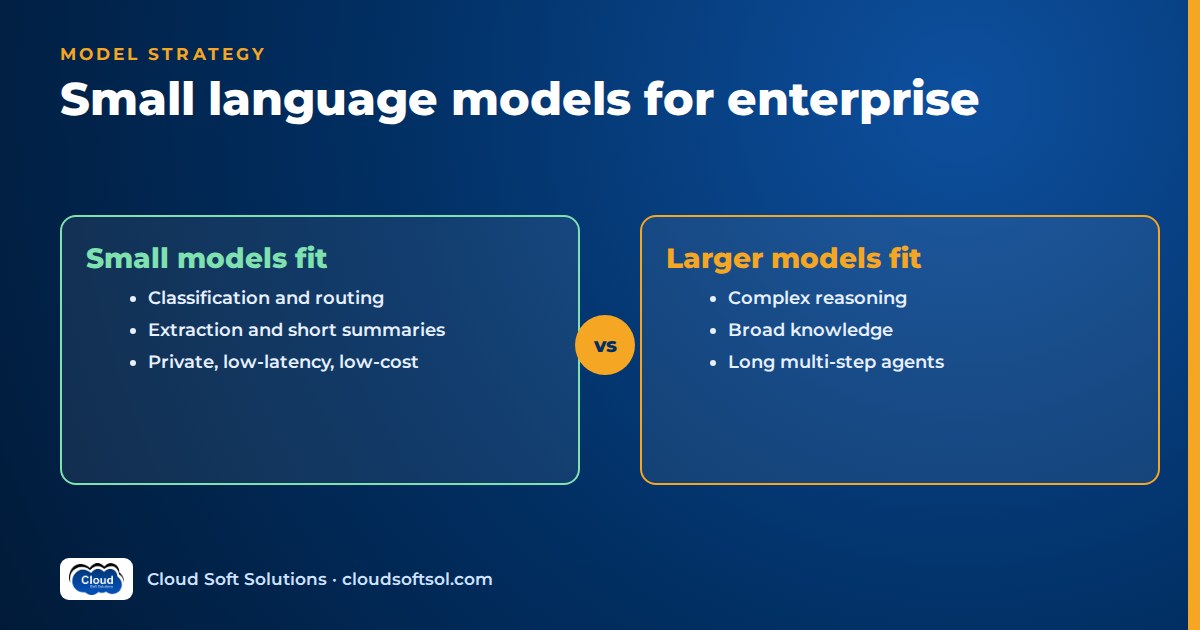
Not every enterprise AI task needs the largest model you can call. Small language models (SLMs) are compact language models that, for narrow and well-defined tasks such as classification, extraction and routing, can match a much larger model's quality at a fraction of the cost and latency, and can run on your own servers or devices. They are the wrong choice for open-ended reasoning, broad world knowledge and long multi-step agent work. The practical question is never "SLM or LLM?" in the abstract; it is "which model is good enough for this specific task, proven on my own test set?"
What is a small language model?
A small language model is a language model built on the same transformer ideas as a large language model, but with far fewer parameters, so it needs less memory and compute to run. Our explainer on what an LLM is covers the fundamentals, which apply equally here.
There is no official parameter cut-off that separates "small" from "large". The label is relative and it moves: what counted as a large model a few years ago is now often described as small, and vendors use the word loosely. A more useful definition is operational:
- It runs on a single modest GPU, a CPU server, a laptop or a phone, not a multi-GPU cluster.
- It is fast enough to sit inline in a request path.
- It is practical to fine-tune with ordinary engineering resources.
Most small models you will meet are open-weight: the trained weights are published so you can download and run them yourself. Several well-known families, including Llama, Mistral, Gemma, Phi and Qwen, ship smaller variants alongside their larger ones. Hosted providers also offer smaller, cheaper tiers through their APIs.
Why enterprises care about SLMs
Five practical pressures drive the interest.
Cost
A smaller model needs less compute per token, so it costs less to call through an API or to host. On high-volume tasks such as tagging every ticket, the saving multiplies with every request. Our guide to cloud cost optimization for AI treats model right-sizing as one of the biggest cost levers, and SLMs are how you pull it.
Latency
Fewer parameters means faster generation. That matters when the model sits in front of a user (autocomplete, live chat triage) or when it is one step in a chain where delays add up.
Privacy, data residency and on-prem
Banks, hospitals, insurers and government bodies often cannot send certain data to an external API, or must keep it in a specific region. A small model can run inside the organisation's own network or private cloud, which shortens security and compliance reviews considerably.
Edge and on-device AI models
On-device AI models run on laptops, phones, factory gateways or retail terminals, where connectivity is unreliable or cloud round-trips are too slow. Only small models fit the memory and power budget of these devices, usually after quantisation (storing weights at lower numeric precision to shrink them).
Fine-tunability
Fine-tuning a small model on a few thousand good examples is a realistic project for a normal engineering team. The result is a specialist that knows your labels, formats and vocabulary; doing the same with a very large model is costlier and sometimes not offered.
SLM vs LLM: which tasks suit which
The pattern is consistent: small models do well when the task is narrow, the input is short, the output format is constrained and success is easy to check. Large models earn their cost when the task needs broad knowledge, long context or many reasoning steps.
Tasks small models handle well
- Classification: intent detection, ticket category, sentiment, priority, language detection, spam and toxicity flags.
- Extraction: pulling fields such as policy number, invoice date or product code from short text into a fixed JSON schema.
- Routing: deciding which queue, tool, workflow or larger model a request should go to.
- Short-text summarisation: condensing a single email, chat transcript or call note into a few lines.
- Domain-tuned tasks: house-style rewriting or mapping free text to internal codes, once fine-tuned.
Tasks that usually need a larger model
- Complex reasoning: multi-step analysis, weighing conflicting evidence, non-trivial maths or code generation across a codebase.
- Broad knowledge: open-domain questions where the model must already know a lot about the world; small models have less room to store facts and hallucinate more on them.
- Long, messy context: reading many documents at once and synthesising them faithfully.
- Long multi-step agents: planning, choosing among many tools, recovering from tool errors and staying on track across many steps. Small models tend to lose the thread or produce malformed tool calls sooner. Our guide to agentic AI design patterns covers where those agent loops get hard.
These are tendencies, not laws: a well-tuned small model can beat a general large model on its one narrow task, which is why the decision must come from evaluation.
Architecture patterns that use small models
In production, small and large models are rarely rivals; good designs use each where it fits.
Routing and cascades: small model first, escalate when needed
A router uses a small model (or a plain classifier) to decide where a request should go: a simple FAQ answer, a specific workflow, or a large model for hard cases. A cascade goes a step further: the small model attempts the task first, and the system escalates to a larger model only when the small model's answer fails a check, such as low confidence, an invalid JSON schema or a validator rule.
Request
   |
   v
[ Small model ] -- attempt task
   |
   v
[ Check ] confidence, schema, rules
   |               |
  pass            fail
   |               |
   v               v
 Return    [ Larger model ]
                   |
                   v
                 Return
This pays off when most traffic is routine. The risk is a check that passes wrong answers, so validate the escalation signal on real data and log which path each request took.
Small models as guardrail classifiers
Guardrails such as prompt-injection detection, PII detection, toxicity filters and topic restriction run on every request and every response. Running a large model for each check multiplies cost and latency; small classifier models fit because the output is just a label or score. Our sibling article on AI guardrails covers the guardrail layers themselves; the point here is that many of them are small models under the hood.
A fine-tuned small model for one narrow task
When prompting a general model still produces inconsistent labels or formats, fine-tuning a small model on labelled examples often gives a cheaper, more consistent specialist. Fine-tuning teaches behaviour and format; it is not a good way to inject frequently changing facts, which belong in retrieval. Our guide to RAG vs fine-tuning explains that line in detail. Parameter-efficient methods such as LoRA, which train a small set of extra weights instead of the whole model, keep this affordable.
Distillation, explained plainly
Distillation means using a large "teacher" model to train a small "student" model. In the simplest enterprise version, you run the large model over many real, unlabelled inputs to produce high-quality outputs, have humans review a sample, and fine-tune the small model on those input-output pairs. The student learns to imitate the teacher on your task, then serves production traffic at small-model cost. Two cautions: the student inherits the teacher's mistakes, so review the data; and provider terms may restrict training other models on a hosted model's outputs.
To practise these patterns hands-on on Amazon Bedrock, Azure OpenAI and Gemini, Cloudsoft's AI, GenAI and Agentic AI course is built around labs rather than slides.
How to evaluate: deciding with data
Public benchmarks measure general ability; your task is specific. A decision process that holds up in review:
- Build one test set from real data: representative, anonymised examples with agreed correct answers, including edge cases and the categories that matter most.
- Run every candidate on that same set: a large model as the quality reference, prompted small models, and a fine-tuned small model if you have data.
- Measure quality with task metrics: per-class precision and recall for classification (overall accuracy hides failures on rare, expensive classes), field-level match and schema validity for extraction, a rubric for summaries.
- Measure cost per task and latency, including tail latency, at expected volume.
- Decide against a threshold agreed in advance, then pick the cheapest, fastest option that clears it.
- Keep the test set as a regression suite for every model, prompt or fine-tune change.
For the mechanics of building test sets, judges and regression suites, see our guide to LLM evaluation.
Deployment options: hosted vs self-hosted
You can use a small model in two broad ways.
Hosted small models are smaller tiers offered through a managed API, either a provider's own or open-weight models served by a cloud platform such as Amazon Bedrock, Azure AI or Vertex AI. No infrastructure to run, pay per use, and the platform's security controls apply. This is usually the right starting point.
Self-hosted small models run on your own GPUs or CPUs, in your cloud account, data centre or on devices. You gain control over data, lower cost at steady high volume and freedom to deploy custom fine-tunes, and you take on serving, scaling, patching and monitoring. Small models make this far more approachable, often fitting on a single modest GPU node, but it is still real operations work. Our sibling guide to self-hosting LLMs with vLLM, GPUs and Kubernetes covers the serving stack, GPU sizing and autoscaling in depth.
A common path: prototype on a hosted model, prove the task, then move high-volume or sensitive workloads to a self-hosted small model when the numbers justify it.
Licensing considerations for open-weight small models
"Open-weight" does not mean "free to use for anything". Read the licence before production, and involve legal for anything customer-facing. Check:
- Licence type and commercial limits: permissive open-source licences versus custom licences that add conditions on commercial use or scale.
- Acceptable-use policies that forbid specific use cases.
- Derivatives and fine-tunes: whether your fine-tuned version inherits the licence, and any naming or attribution requirements.
- Using outputs to train other models: some licences and hosted terms restrict this, which matters for distillation.
- Provenance and documentation: what is disclosed about training data, which your governance team may need. See enterprise AI governance for how this fits a model approval process.
Record the licence and version of every model you deploy in your model inventory, alongside the evaluation results that justified it.
Illustrative example: ticket classification at an IT services GCC
Consider a global capability centre in Hyderabad that runs IT support for its parent company's employees worldwide. Every ticket must be tagged with a category, priority and assignment group. Today a large hosted model does this through a long prompt. It works, but cost grows with volume, latency slows the portal, and security is uneasy that ticket text containing names and internal hostnames leaves the network.
The team runs the decision the way this guide describes:
- They export resolved tickets, whose final category and group are already known, and build an anonymised test set and a larger training set.
- On the same test set, the fine-tuned small model matches the large model on common categories but is weaker on rare, ambiguous tickets; the prompted small model falls short of the threshold.
- They ship a cascade: the fine-tuned small model, self-hosted inside the GCC's private cloud, tags every ticket; tickets where its confidence is low, or where the predicted group is a high-risk one such as security incidents, escalate to the large model.
- Service desk agents correct wrong tags; corrections feed retraining, and the regression suite gates every new fine-tune.
They track business metrics, not "we use an SLM": correct first assignment, time to first response, cost per ticket and escalation share. That shift, from model choice to measured outcome, is the core of moving from AI demo to enterprise outcome.
Doing this inside a customer's environment, negotiating data access, security review and the service desk integration, is what Forward Deployed Engineers do; Cloudsoft's FDE PRO program trains for exactly that kind of engagement.
Small vs large language models: comparison table
| Factor | Small language model | Large language model |
|---|---|---|
| Cost per request | Low; scales well with high volume | Higher; adds up quickly at volume |
| Latency | Fast; suits inline checks and real-time UI | Slower, especially for long outputs |
| Hardware to self-host | Single modest GPU, CPU or device | Multi-GPU servers or a hosted API |
| Privacy and on-prem | Easy to run inside your network or on device | Usually a hosted API; self-hosting is heavy |
| Broad knowledge | Limited; more prone to factual gaps | Strong general knowledge |
| Complex reasoning and long agents | Weaker; loses track over many steps | Stronger planning and tool use |
| Narrow, well-defined tasks | Strong, especially when fine-tuned | Strong, but often more than needed |
| Fine-tuning effort | Practical for most teams | Costly or not offered |
| Typical role | Classifier, extractor, router, guardrail, edge assistant | Reasoner, generalist assistant, agent planner, escalation path |
Frequently asked questions
What counts as a small language model?
There is no official parameter threshold. A model is called small relative to the largest models of its time, and in practice it means a model that runs on a single modest GPU, a CPU server or a device, responds quickly, and is practical to fine-tune. The label shifts as models improve.
Are small language models less accurate than LLMs?
On broad knowledge and complex reasoning, usually yes. On a narrow, well-defined task such as classifying tickets or extracting fields, a small model, especially a fine-tuned one, can match a much larger model. The only reliable way to know is to compare both on the same test set built from your own data.
When should an enterprise choose an SLM over an LLM?
Choose a small model when the task is narrow and repetitive, volume is high, latency matters, data must stay on-prem or on device, or you want a fine-tuned specialist. Stay with a large model for open-ended questions, long documents, complex reasoning and long multi-step agents, or combine both with a routing or cascade pattern.
What is the difference between distillation and fine-tuning?
Fine-tuning trains a model further on labelled examples. Distillation is one way of producing those examples: a large teacher model generates outputs on real inputs, ideally reviewed by humans, and a small student model is fine-tuned to imitate them.
Can small language models run on a laptop or phone?
Yes. Many small open-weight models, usually after quantisation, run on laptops, phones and edge devices, enabling offline use, low latency and privacy, though quality on hard tasks stays below large hosted models.
Are open-weight small models free for commercial use?
Not always. Some use permissive open-source licences, while others use custom licences with commercial conditions, acceptable-use restrictions or rules about fine-tuned derivatives and training other models on their outputs. Read the licence for the exact model and version, and involve legal before customer-facing use.
Should I host a small model myself or use an API?
Start with a hosted API to prove the task with evaluation. Move to self-hosting when data residency, steady high volume or custom fine-tunes justify the operational work.
Want to build AI systems that use the right-sized model for each job? Cloudsoft's AI, GenAI and Agentic AI training in Hyderabad covers model fundamentals, fine-tuning, RAG, evaluation and agents with hands-on labs, in our Ameerpet classroom beside Ameerpet Metro or live online. Call +91 96660 19191 to book a free demo.