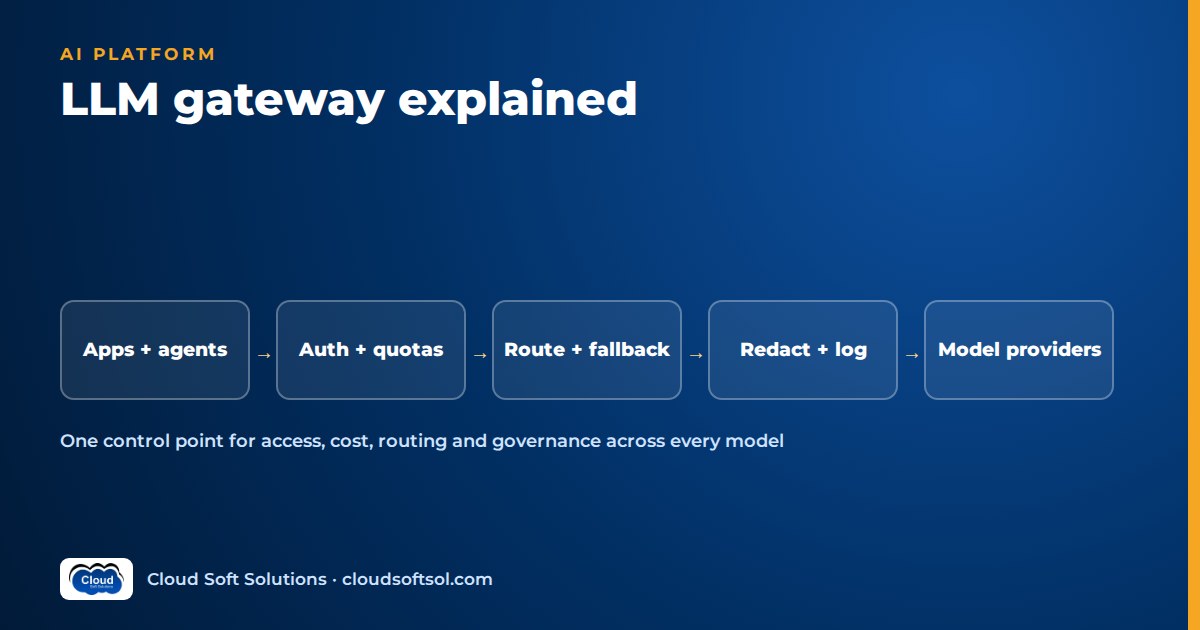
An LLM gateway is a single entry point that sits between your applications and every model provider you use, so that authentication, quotas, cost tracking, routing, logging and policy are enforced once, in one place, instead of being re-implemented inside every app. Once several teams build with LLMs, it becomes the control point that makes enterprise AI governable.
This guide explains what an AI gateway does, function by function, when to build or buy one, the risks it introduces, a reference architecture and a phased rollout. It is vendor-neutral and quotes no prices or latency figures. For where the gateway fits in the full stack, see our enterprise AI architecture reference.
What is an LLM gateway?
Without a gateway, every app holds its own provider keys, retry logic and logging. Finance sees one invoice per provider and cannot say which team spent what, and security cannot say which applications send customer data to which models.
An LLM gateway (also called an AI gateway or LLM proxy) puts one centrally operated service in that path. Apps authenticate to it with an internal credential; it holds the real provider credentials, forwards the request, streams the response back and records metadata. To apps it looks like one model API; behind it may sit several hosted providers, cloud model services and self-hosted open-weight models.
It is worth separating it from two neighbours:
- A general API gateway handles HTTP routing, authentication and request-count rate limits. An LLM gateway also understands tokens, models, prompts, streaming and model-specific errors.
- An orchestration framework (LangChain, LangGraph and similar) lives inside an application and decides what to call. The gateway lives outside every application and governs how calls reach models.
The core functions of an AI gateway
Not every gateway needs every function on day one; this is roughly the order teams add them.
Authentication and per-team keys
The gateway issues its own virtual keys or accepts the organisation's identity tokens (for example OAuth tokens from the corporate identity provider), and maps each to a team, application and environment. Provider keys never leave the gateway, so rotating them is one change rather than a hunt through every repository. Revoking a leaked app key affects one app, not the company. Where it matters, apps also pass the end-user identity so logs and quotas reach a person, not just a service account.
Quotas and rate limits
Providers enforce their own limits, usually per account and per model. One team's batch job can exhaust them for everyone. The gateway lets you split that capacity: limits by requests and by tokens, per team and per model, with separate budgets for production and non-production. Token-based limits matter more than request counts, because one long-context request can cost as much as many small ones.
Cost attribution and chargeback
Because every call passes through it, the gateway can record input and output tokens, model, team, application and use case for each request, and multiply by the price list you maintain. That turns one opaque bill into a per-team view for showback or chargeback, and lets engineers spot a runaway agent loop the day it starts. Budget alerts, and hard stops for non-production keys, follow naturally. Cloud cost optimization for AI covers what to do with that data.
Model routing and fallback
Model routing means choosing the deployment that serves a request based on rules: the requested model alias, the team, the data classification, the region, or a canary percentage for a new model version. Fallback means that when the primary deployment returns throttling or server errors, or times out, the gateway retries against a configured alternative, such as the same model in another region or an approved substitute model. Two cautions: a different model behaves differently, so only fall back to models that passed the same evaluation suite; and retries must respect a total time budget, or a fallback chain turns one slow request into a very slow one.
Provider abstraction with an OpenAI-compatible interface
Many gateways expose a single request format to applications and translate it to each provider's native API. A common choice is an OpenAI-compatible chat interface, because many SDKs already speak it, so adopting the gateway is often just a new base URL and key. Apps then refer to models by internal aliases such as chat-default or chat-large, and the platform team decides which real model sits behind each alias.
Abstraction has limits. Providers differ in tool calling, structured outputs, multimodal inputs, caching controls and safety settings. Translation covers the common subset; provider-specific features may need a pass-through mode. And prompts tuned on one model often behave differently on another, so do not promise perfect interchangeability.
Caching
Exact-match caching returns a stored response when an identical request repeats. Semantic caching returns a stored answer for a similar question, which saves more but risks wrong, stale or leaked answers. Provider-side prompt caching of repeated prefixes is different again; the gateway should pass those controls through. Scope any gateway cache by tenant, team and data version, and never cache answers built from one user's private data. The trade-offs are covered in depth in LLM latency optimization.
Logging and tracing with PII redaction
The gateway is the natural place to emit a record for every model call: who called, which model, tokens, latency, status, cost, and a trace ID that links the call to the application's wider trace. Propagating the caller's trace context (for example with OpenTelemetry) means a gateway span appears inside the same trace as retrieval and tool calls. Whether to log the prompt and response content is a separate decision. If you do, detect and mask personal data such as names, phone numbers, Aadhaar or PAN numbers, account numbers and email addresses before storage, restrict access to content logs, and set short retention. See AI observability for the tracing side.
Guardrail hooks
A gateway can call guardrail checks before the request goes to the model and after the response comes back: prompt-injection detection, PII detection, topic or content filters, output format validation. This gives every app a baseline but does not replace application-level guardrails, because only the app knows which documents a user may see or which actions need approval. Treat gateway checks as a floor, built as pluggable hooks so security can update a policy without redeploying every app. Our AI guardrails guide explains the input, output and action layers.
Model allow-lists and governance
The gateway enforces which models are approved, for which data classifications and for which teams. A new model becomes available only after it passes the organisation's review: security, legal terms, data handling, evaluation results. Sandboxes may get a broader list than production. Deprecating a model becomes a controlled change: move the alias, notify remaining callers, remove it. The gateway's records also feed the AI inventory that governance and audit teams ask for (see enterprise AI governance).
Data residency routing
Some data must be processed in a particular country or region because of regulation, contract or internal policy. The gateway can route by data classification or tenant: requests tagged as restricted go only to model deployments in an approved region, or to a self-hosted model inside the organisation's network, and are refused rather than silently sent elsewhere if that deployment is unavailable. Fallback rules must respect the same boundary. For Indian teams, this is one practical control when mapping obligations under the DPDP Act and customer contracts, though the legal analysis belongs with your compliance team.
Reference architecture
The diagram shows a centralised LLM access layer for an organisation with several product teams, two hosted providers and a self-hosted model.
  Apps / agents (team A, B, C)
       | virtual key + user + trace ID
       v
  +-------------- LLM GATEWAY --------------+
  | authN -> quota -> policy/allow-list     |
  | -> pre-guardrail -> cache lookup        |
  | -> router (alias, region, class)        |
  | -> post-guardrail -> meter + log        |
  +-----+--------------+--------------+-----+
        |              |              |
   Provider X     Cloud model    Self-hosted
   (region 1)     service (r2)   model (VPC)

  Side channels:
  config store (aliases, limits, prices)
  secrets vault (provider keys)
  telemetry -> traces, cost, audit logs
A few design points the diagram hides:
- Stateless data plane, separate control plane. Configuration (aliases, quotas, allow-lists, prices) lives in a store that replicas read and cache, so you can scale horizontally and change policy without a redeploy.
- Streaming end to end. A proxy that buffers the full response destroys the perceived speed of every chat app behind it.
- Metering off the critical path. Write usage and log records asynchronously to a queue or collector, so a slow log backend never slows a user's request.
- Deployment. Containers on Kubernetes or a managed container service, defined in Terraform, with tier-one change control.
Build vs buy
There are broadly four options, and many organisations combine two of them.
| Option | Strengths | Weaknesses |
|---|---|---|
| Open-source LLM proxy, self-hosted | Fast start, broad provider support, you own the data path | You operate, patch and scale it; check the project's maturity and licence |
| API-management product with AI features | Reuses an existing platform, policies and team skills | LLM-specific features vary; may lag new provider capabilities |
| Cloud-provider gateway or model service | Native identity, networking and billing in that cloud | Strongest for that cloud's models; weaker as a multi-cloud layer |
| Build your own thin gateway | Exactly your policies, simple to reason about | Every provider change and feature becomes your backlog |
Deciding questions: how many providers and clouds you genuinely need now; whether you already run an API-management platform with an owning team; whether prompts must stay inside your network; and who is on call. Test candidates with your real traffic shapes: streaming, tool calling, long contexts and failover.
A pragmatic pattern is to adopt an existing proxy or API-management product for the data plane and write your own thin layer only where policy is specific to you: the alias catalogue, the chargeback export, the residency rules. Verify any product's features hands-on; this space changes quickly.
To practise building pieces of this, such as a FastAPI proxy with per-team keys, token metering and OpenTelemetry traces in front of Bedrock, Azure OpenAI or Gemini, Cloudsoft's AI, GenAI and Agentic AI course covers the underlying patterns hands-on.
Risks a gateway introduces
Single point of failure
If every AI call goes through one service, its outage is everybody's outage. Run replicas across availability zones, fall back to the last known good config if the config store is down, and load-test at peak concurrency with streaming. Decide in advance how its dependencies fail: a brief fail-open on quotas is often acceptable, but allow-lists and residency rules should fail closed.
Added latency
Every hop adds time, and every synchronous check (guardrail model, PII scanner, cache lookup) adds more. Keep the gateway close to apps and providers, reuse connections, run pre-checks in parallel, make logging asynchronous, and trace the gateway's overhead as its own span.
Logging privacy risk
A gateway that logs full prompts and responses quietly becomes the largest store of sensitive data in the company: customer conversations, internal documents pulled in by RAG, credentials pasted by users. Default to metadata only; enable content logging per use case with redaction, encryption, tight access, short retention and an audit trail, in the same approved region as the data.
There is also an organisational risk: if the gateway becomes a slow approval queue, teams route around it with personal keys. Make onboarding self-service.
A phased rollout plan
- Inventory. Find every application calling a model directly, its provider keys, models, owners and data types.
- Pass-through first. Stand up the gateway with authentication, virtual keys, metadata logging and cost metering only. Migrate one or two willing teams by changing base URL and key. Change no behaviour yet.
- Visibility. Publish per-team usage and cost dashboards. Adoption is faster when teams get something they lacked.
- Controls. Add quotas based on observed traffic, model aliases and the allow-list. Introduce fallback for the most critical use cases, tested against your evaluation suite.
- Policy. Add guardrail hooks, PII redaction for content logs, and residency routing for classified data.
- Mandate. Once the path is proven, make the gateway the only route: rotate old provider keys, block direct egress to provider endpoints from application networks, and treat exceptions as tracked risks.
- Operate. Assign an owning team, an SLO, on-call, runbooks and a regular review of models, prices and limits.
Illustrative example: a GCC platform team
Consider a global capability centre in Hyderabad that builds internal software for its parent insurer. Five teams have shipped AI features, from a claims-summary assistant to an IT service-desk agent, each integrated directly with one of two hosted providers. The parent's security office asks three questions: which apps send policyholder data to which models, what each business line spends, and how quickly a model can be withdrawn if a provider's terms change.
The GCC's platform team, which already runs the shared Kubernetes clusters, takes ownership of an LLM gateway. They start with pass-through: each app gets a virtual key tagged with team, cost centre and data classification, and migrates by changing its base URL. The cost dashboard soon shows a nightly batch job dominating token usage and a test environment calling the most expensive model for trivial tasks, both fixed with aliases and quotas.
Next, apps tagged as handling personal data, such as claims, are routed only to approved-region deployments, with metadata-only logs and PII checks on outputs. Fallback is enabled only for the service-desk agent, to a second region of the same model, after its regression suite passes there. Finally, direct egress to provider endpoints is blocked. The security office's questions now have answers from data, not from asking each team.
Taking a platform like this into a customer's environment, with their identity provider, network rules and approval processes, is the kind of end-to-end work a Forward Deployed Engineer does; Cloudsoft's FDE PRO program trains for that role. For a product serving many customers, see multi-tenant AI SaaS architecture, where per-tenant isolation and metering raise similar questions.
FAQ
What is an LLM gateway?
An LLM gateway is a central service that sits between applications and model providers. Applications call it instead of calling providers directly, and it handles authentication, quotas, cost tracking, model routing, logging and policy in one place.
Is an AI gateway the same as an API gateway?
Not quite. An API gateway handles general HTTP routing, authentication and request limits. An AI gateway adds LLM-specific capabilities such as token-based quotas, cost metering per model, model aliases and fallback, streaming support, prompt and response logging with redaction, and guardrail hooks.
When does a team need an LLM gateway?
Usually once several applications or teams use models, when finance asks who is spending what, when security asks which data goes to which provider, or when a provider outage or throttling takes down more than one app. A single prototype rarely needs one.
What is model routing?
Model routing is choosing which model deployment serves a request based on rules such as the requested alias, the team, the data classification, the region or a canary percentage. It is often combined with fallback to an approved alternative when the primary deployment fails or is throttled.
Does an LLM gateway add latency?
Yes, every extra hop and synchronous check adds some time. Keep it small by deploying the gateway near applications and providers, reusing connections, running checks in parallel, streaming responses without buffering and writing logs asynchronously.
Should the gateway log full prompts and responses?
Default to metadata only, such as caller, model, tokens, latency, status and cost. Enable content logging only for use cases that need it, with PII redaction, encryption, restricted access, short retention and storage in the same approved region as the data.
What does an OpenAI-compatible interface mean in a gateway?
It means the gateway accepts requests in the widely used OpenAI-style chat format and translates them to each provider's native API. Many SDKs and frameworks can then use the gateway by changing only a base URL and key, though provider-specific features may still need special handling.
Should we build or buy an LLM gateway?
Most organisations start from an open-source proxy, an existing API-management platform with AI features, or a cloud-provider service, and build only a thin layer for policies unique to them. Decide based on providers needed, existing platform skills, data-path requirements and who will operate it.
Want to go beyond calling a model API and learn how enterprise AI platforms are actually engineered, governed and run? Explore Cloudsoft's AI, GenAI and Agentic AI training in Hyderabad, in our Ameerpet classroom beside Ameerpet Metro or live online. Call +91 96660 19191 for a free demo session.