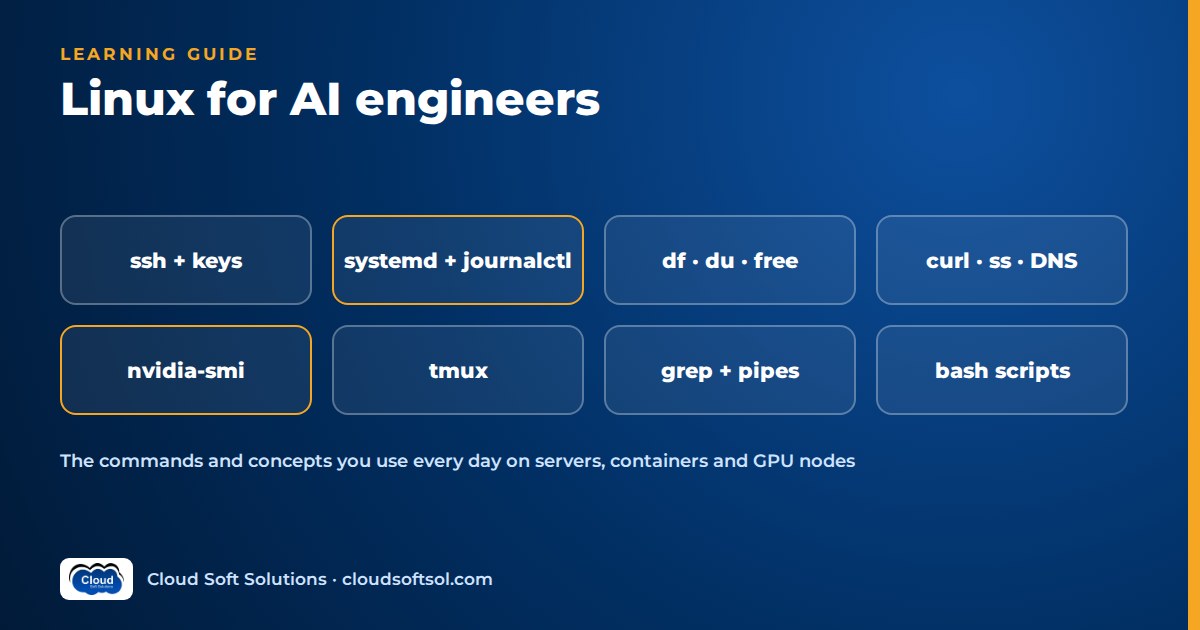
Linux for AI engineers means being comfortable on the machines where AI systems actually run: reading logs, checking memory, disk and GPUs, managing services, moving around over SSH and handling secrets safely. You don't need to be a kernel expert. You need a working set of commands that answers "why is this slow?", "why did it crash?" and "why is the disk full?" without guessing. The same set applies to Linux for machine learning engineers and platform teams. This guide lists those skills by area, then walks through a troubleshooting session on an LLM inference server.
Why Linux matters for AI work
Almost everything an AI application touches after your laptop runs Linux, which is why Linux for DevOps AI work is not optional:
- Servers and VMs. The VM hosting your API on AWS, Azure or Google Cloud usually runs Ubuntu, Amazon Linux, RHEL or a similar distribution.
- Containers. Linux containers share the host's kernel, and you debug them with Linux tools inside and outside.
- GPU nodes. Self-hosted models run on Linux machines with NVIDIA drivers, and driver mismatches or GPU memory exhaustion are diagnosed from a shell.
- CI runners. Most pipelines run on Linux runners, and a failing step is often a shell or environment problem rather than a code problem.
- Kubernetes nodes. Pods are Linux processes in cgroups; "OOMKilled" is the kernel's out-of-memory killer at work.
Consider a bank's GCC team in Hyderabad running an internal document assistant. It works on every laptop, but in production it runs in a container on a Linux VM behind a corporate proxy. The first month's incidents are all Linux questions: a full disk, a certificate error, a missing environment variable, a process killed for memory. The engineer who answers those quickly is the one the team relies on.
Linux skills for AI, by area
"Good enough" means you can do it from memory under mild pressure, not that you know every flag.
| Area | Key commands and concepts | What "good enough" looks like |
|---|---|---|
| Shell and files | cd, ls -la, chmod, chown, find, grep -r, pipes, redirection | Read permissions, find files by name, size or age, grep logs and chain commands with pipes. |
| Processes and services | ps, top/htop, systemctl, journalctl, kill, signals | Find what is using CPU or memory, manage a systemd service, know SIGTERM from SIGKILL. |
| Resources | free -h, vmstat, df -h, du -sh, lsof | Tell RAM from swap pressure and find what is filling a disk. |
| Networking | curl, ss -tlnp, dig, getent hosts, openssl s_client | Check that a port listens, a name resolves and a certificate is valid; time a request. |
| SSH and keys | ssh-keygen, ~/.ssh/config, scp/rsync, port forwarding | Key-based login, host aliases, jump hosts and local tunnels. |
| Environment and secrets | export, env, .env files, file permissions | Know where a process gets its variables; keep secrets out of history, arguments and Git. |
| Package managers | apt/dnf, Python virtual environments, pip or uv | System packages via the distro tool, Python packages only in a virtual environment or image. |
| GPU basics | nvidia-smi, driver vs CUDA vs container toolkit | See GPU memory and processes; tell which layer a version error comes from. |
| Long jobs | tmux or screen, nohup | An indexing job survives a dropped SSH session and you can reattach. |
| Scheduling | cron, systemd timers | Schedule a nightly re-index and know why it fails under cron but not in your shell. |
| Log reading | journalctl -u, tail -f, less, grep -C | Filter by service, time and severity; read the lines around an error. |
| Bash scripting | set -euo pipefail, quoting, exit codes, loops | Write a short, safe script and know when to switch to Python. |
The concepts behind the commands
Files, permissions and pipes
Most "works for me" bugs on servers are permission bugs: a service user cannot read a model directory owned by your login, or cannot write to a log directory created by root. Learn to read -rw-r-----, fix ownership with chown, and never reach for chmod 777. Pipes make the shell an analysis tool: grep ERROR app.log | sort | uniq -c | sort -rn ranks error lines.
Services and signals
A production API on a VM should run under systemd, not in a terminal you forgot to close. The unit file sets the command, user, environment file, restart policy and limits such as MemoryMax=. SIGTERM asks a process to shut down cleanly and finish in-flight requests; SIGKILL (kill -9) cannot be caught. Container platforms send SIGTERM, then SIGKILL after a grace period, so a model server that ignores SIGTERM drops requests on every deployment.
Memory and disk, and why AI fills disks
Linux uses spare RAM as file cache, so read the available column in free -h, not "free". Real pressure shows up as swap activity (si/so in vmstat 1) or the out-of-memory killer. AI workloads fill disks fast: model weights land in caches such as ~/.cache/huggingface, old model versions and large ML container images accumulate, and logging full prompts and responses grows quickly. df -h shows which filesystem is full, du -sh /path/* | sort -h shows what is using it, and lsof +L1 finds deleted files still held open by a process, which is why df and du sometimes disagree.
Networking, TLS and SSH
curl -v shows DNS, connection, TLS and HTTP in one go. ss -tlnp shows what is listening and on which address; a service bound to 127.0.0.1 is unreachable from outside its host or container. In many Indian enterprises outbound traffic passes through a TLS-inspecting proxy, so Python clients fail with certificate errors until the corporate CA bundle is configured; openssl s_client -connect host:443 -servername host shows which certificate you are really getting. For SSH, use ed25519 keys with 600 permissions, host aliases in ~/.ssh/config, -J for jump hosts and -L 8000:localhost:8000 to tunnel to a port that is deliberately not public.
Environment variables, secrets and packages
Configuration and API keys usually reach a process as environment variables. Don't pass secrets as command-line arguments, because other users can see them in ps and they land in shell history. Keep .env files out of Git and readable only by the service user; in production, prefer a secrets manager. For packages, use apt or dnf for the system and a virtual environment or container for Python; never sudo pip install on a shared server. The Python side of this is in Python for AI engineers.
GPU basics: driver, CUDA and the container toolkit
- The NVIDIA driver lives on the host, including the kernel module.
nvidia-smiships with it and shows GPUs, memory, utilisation and processes. The "CUDA Version" in its header is the highest CUDA version the driver supports, not proof that a CUDA toolkit is installed. - CUDA libraries are what frameworks such as PyTorch use, and they often ship inside the Python wheel or container image. The rule: the host driver must be new enough for the CUDA version the framework or image was built with.
- The NVIDIA Container Toolkit lets the container runtime expose the host's GPUs and driver libraries to containers.
So: no output from nvidia-smi on the host is a driver problem; GPUs visible on the host but not in the container is a toolkit or run-flag problem; a CUDA version error from the framework is an image-versus-driver mismatch. The container side is in Docker for AI applications, and hardware and serving choices in self-hosting LLMs.
tmux, cron, timers and Bash
Long jobs such as embedding a corpus should survive a dropped SSH session: tmux new -s ingest, detach with Ctrl-b d, return with tmux attach -t ingest. Cron runs with a minimal environment, so scripts relying on your shell's PATH or virtual environment fail silently; systemd timers log to the journal and are easier to debug. Keep Bash for glue: start with set -euo pipefail, quote every variable and run shellcheck. Once a script needs JSON, retries or real error handling, switch to Python.
To build these skills through guided labs on real cloud VMs, Cloudsoft's Multi-cloud DevOps with Linux and Python course covers Linux administration and automation across AWS, Azure and Google Cloud.
Troubleshooting walkthrough: a slow or OOM-killed inference service
Consider a hospital's IT team that self-hosts an open-weight model on one GPU VM to draft discharge summaries, running under systemd as llm-api. Responses have become very slow and the service restarted twice this morning. The sequence below is illustrative; the order matters more than the flags.
symptom: slow / restarting
   |
   v
service state + logs  --> crash reason?
   |
   v
kernel OOM? --> host RAM / cgroup limit
   |
   v
GPU memory + utilisation --> on GPU at all?
   |
   v
disk, network, latency breakdown
1. What does the service manager say?
systemctl status llm-api
journalctl -u llm-api --since "2 hours ago" -p warning
Status shows uptime since the last restart and the last exit reason; oom-kill or a KILL signal points to memory. The priority filter shows warnings and errors without noise.
2. Did the kernel kill it?
journalctl -k --since "2 hours ago" | grep -iE "out of memory|oom"
systemctl show llm-api -p MemoryMax
Kernel messages naming the process confirm an out-of-memory kill. If MemoryMax is set, the service may have hit its own cgroup limit rather than the machine running out. In Docker, docker inspect -f '{{.State.OOMKilled}}' <container> answers the same question.
3. Is host memory under pressure right now?
free -h
vmstat 1 5
ps aux --sort=-rss | head
Low available memory plus steady swap-in and swap-out means thrashing, which alone explains slow responses. ps sorted by resident memory shows the culprit, for example a stray test process holding a second copy of the model.
4. What is the GPU doing? These are the GPU server Linux commands you will use most.
nvidia-smi
nvidia-smi --query-gpu=utilization.gpu,memory.used \
  --format=csv -l 5
If the service's process is not listed, the model may be running on the CPU, a classic cause of slow inference after an upgrade pulled in a CPU-only framework build. Many serving engines reserve most GPU memory up front, so a full bar alone is normal; a CUDA out-of-memory error in the application log is the real signal that long prompts or high concurrency exhausted the KV cache. Unlike the kernel kill in step 2, it is fixed in server settings.
5. Disk and network.
df -h
du -sh /var/log/* ~/.cache/huggingface \
  2>/dev/null | sort -h
ss -tlnp | grep 8000
curl -s -o /dev/null \
  -w "connect=%{time_connect} ttfb=%{time_starttransfer}\n" \
  http://localhost:8000/health
A full disk silently breaks logging and temporary files. ss confirms the server is listening, and the curl timing separates connection time from time to first byte. A fast health check but slow real requests points at generation, not the network.
Here the answer is two problems: request logging was writing full prompts to disk, and a config change had raised concurrency beyond what GPU memory could hold. For tuning the generation side once the system is healthy, see LLM latency optimization; on Kubernetes the same reasoning applies to pod limits and node pools, covered in the Kubernetes guide for AI workloads.
What to skip early
- Kernel compilation and tuning. Specialist work; defaults are fine for application engineers.
- Every distribution's quirks. Learn one Debian-family and one RHEL-family system; the rest follows.
- Advanced text tools. Basic
grep,sortanduniqgo far; deepawkandsedcan wait. - Manual driver installs. Understand the layers, but use GPU-ready machine images or managed node groups.
- Memorising flags. Know what a command is for and use
manor--helpfor details.
A four-week practice plan
- Week 1: shell and files. Use a cheap cloud VM as your daily terminal. Practise permissions,
find,grepand pipes on real logs; set up SSH keys and~/.ssh/config. - Week 2: services and logs. Run a small FastAPI app as a systemd service under its own user with an environment file. Break it deliberately (wrong path, missing variable, bad permission) and diagnose each failure from the journal.
- Week 3: resources and networking. Fill a disk with dummy files and find them with
du. Run a memory-hungry script underMemoryMaxand watch it get killed. Time the app withcurland reach it through an SSH tunnel. - Week 4: jobs, scheduling and scripts. Write a safe Bash backup script, schedule it with a systemd timer and run a long job inside tmux. If you can rent a GPU instance briefly, start a small model in a container and watch
nvidia-smias you raise concurrency.
For interview preparation alongside this plan, use the Linux commands interview questions and the Linux interview questions for cloud and DevOps engineers.
Common mistakes
- Running production services in a terminal. A model server started by hand dies with the SSH session and has no restart policy or central logs.
- Fixing permissions with
chmod 777or running as root. It hides the problem and widens the blast radius of a compromise. - Treating every OOM as one problem. Check whether it was a kernel kill or a CUDA error before changing anything.
- Reading only the last error line. The cause is often a few lines earlier; use
grep -C 20orless. - Secrets in arguments, history and Git. Use tightly permissioned environment files or a secrets manager.
- Ignoring disk growth. Model caches, old images and logs need retention rules.
- Cron jobs that rely on your interactive shell. Use absolute paths, set the environment explicitly and log output.
Where Linux fits in an AI career
Linux is shared ground between AI engineering, DevOps and SRE. Services firms and product companies increasingly expect AI engineers to own their services after deployment, which means logging into a machine and working out what is wrong. Engineers who take AI systems into customer environments end to end do this daily, and Cloudsoft's Forward Deployed Engineer program builds on exactly this foundation.
FAQ
How much Linux do AI engineers need?
Enough to run and debug your own services on a server: files and permissions, systemd, logs, memory, disk and GPU checks, network tests and SSH. Deep system administration is optional for most AI application roles.
Which Linux distribution should I learn first?
Ubuntu is a practical first choice because it is common on cloud VMs and GPU images. Spend some time on a RHEL-family distribution too, since many enterprises standardise on it. The skills transfer.
Do I need Linux if I only call managed model APIs?
Yes, minus most of the GPU material. Your API still runs in a Linux container or VM, and full disks, certificate errors and memory limits still need Linux skills to diagnose.
Can I learn Linux for AI on Windows?
Start with WSL, which gives you a real Linux environment for shell, packages and scripting. Also practise on a cloud VM, where services, SSH and GPU drivers behave as they do in production.
What does nvidia-smi actually tell me?
It shows the installed driver version, each GPU's memory use and utilisation, and the processes using each GPU. The CUDA version in its header is the highest version the driver supports, not necessarily the CUDA version your framework uses.
What is the difference between an OOM kill and a CUDA out-of-memory error?
An OOM kill is the kernel ending a process because host or cgroup RAM ran out; it shows in kernel logs and service status. A CUDA out-of-memory error is raised by the framework when GPU memory is exhausted; it appears in the application log and is fixed by reducing model size, context length, batch size or concurrency.
Should I learn Bash scripting or just use Python?
Learn enough Bash to write short glue scripts and read the ones in CI pipelines and Dockerfiles. Use Python once a script needs JSON, retries or real error handling.
Are Linux certifications useful for AI roles?
They can structure your learning, but AI-role interviewers usually probe practical troubleshooting. Walking through how you diagnosed a slow or crashing service carries more weight than a certificate alone.
Want hands-on practice with Linux, shell scripting and Python automation on real AWS, Azure and Google Cloud environments? Explore Cloudsoft's multi-cloud DevOps training with Linux and Python, in the classroom beside Ameerpet Metro or live online. Call +91 96660 19191 to book a free demo session.