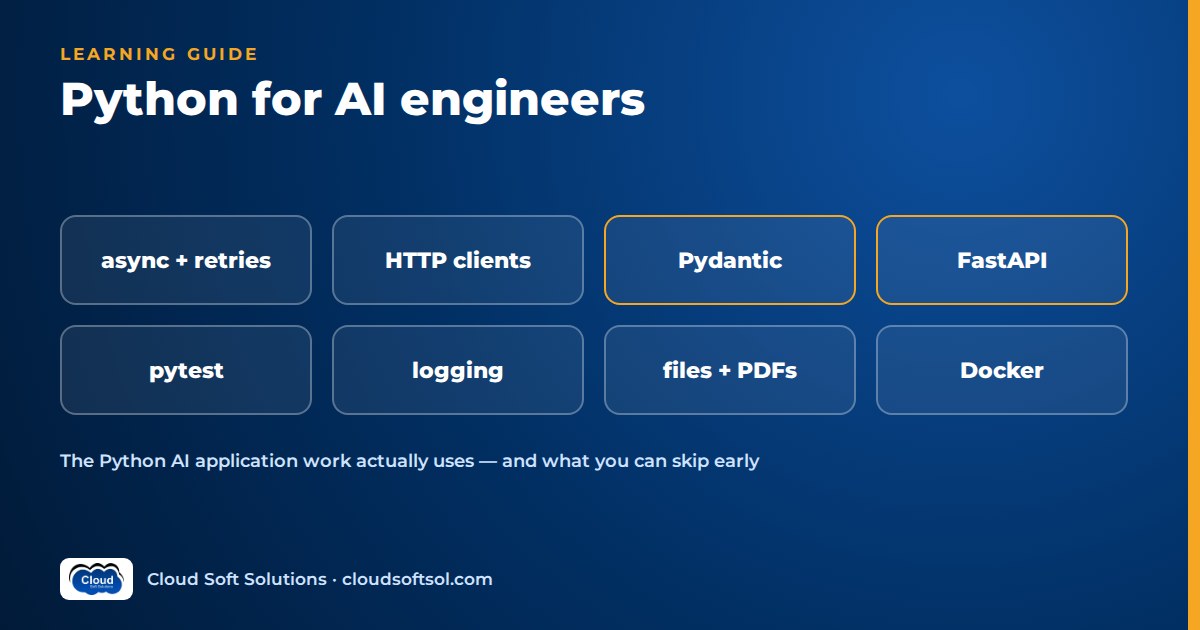
Python for AI engineers means backend Python: async HTTP calls to model APIs, Pydantic validation, FastAPI services, tests, logging and packaging, not linear algebra or training loops. If you build applications on top of large language models, most of your code will look like a careful web service that happens to call a model. This guide lists the specific Python skills that work needs, level by level, what you can safely postpone, and a practice plan with three small projects to prove the skills to yourself and to an interviewer.
If you want the bigger picture first, the AI engineering roadmap puts Python in stage 1 alongside Git, Linux, SQL and HTTP. This article is the detailed version of that one line: which Python, specifically.
What AI application engineers actually use Python for
A typical enterprise LLM repository contains very little "AI code". It contains:
- API services. A FastAPI or similar service that receives a request from a web app, a Teams bot or another backend, does some work, and returns a response.
- Calling model APIs. HTTP or SDK calls to a hosted model on Amazon Bedrock, Azure OpenAI, Gemini or a self-hosted endpoint, with timeouts, retries and cost-aware limits.
- Data handling. Reading PDFs, Word files, CSV exports and JSON from other systems, cleaning text, chunking it and writing it to a database or vector store.
- Orchestration. Glue code that decides which tool to call, in what order, and what to do when a step fails, whether hand-written or built on a framework such as LangGraph.
- Evaluation scripts. Small programs that run a set of test questions through the system, score the answers and write a report, so you know whether a prompt change helped or hurt.
- Automation. CLI tools and scheduled jobs: re-index documents nightly, export a usage report, migrate a prompt version.
ML research Python is a different world: NumPy, PyTorch, CUDA, training loops, gradient maths and experiment notebooks. That work matters, but an application engineer can ship a reliable document assistant without writing a single tensor operation, so don't spend months on the wrong half.
Consider an insurer's IT team at a GCC in Hyderabad that wants to triage claim emails. Their Python reads the email and PDF attachments, asks a model for a structured summary (policy number, claim type, urgency), validates it, calls the claims system's REST API, logs every step and exposes the flow as an internal service. Every step is ordinary Python; the model call is a dozen lines.
Python skills for AI, by level
Level 1 is what you need before touching an LLM API, level 2 makes a prototype reliable, and level 3 makes it deployable by a team.
| Level | Skill | What "good enough" looks like |
|---|---|---|
| 1 – Core | Core language: types, dataclasses, exceptions, context managers | You write functions with type hints, model simple records as dataclasses, raise and catch specific exceptions, and use with for files, connections and clients. |
| 1 – Core | JSON handling | You load, transform and dump nested JSON confidently and know the difference between a dict, a string and bytes. |
| 1 – Core | Environment and dependency management | Every project has its own virtual environment and a pinned dependency file. |
| 1 – Core | Working with files and PDFs | You walk directories with pathlib, read text and CSV files, and extract text from PDFs with a library, knowing scanned PDFs need OCR. |
| 2 – Reliable | HTTP clients, retries and timeouts | Every outbound call has a timeout; you retry only on retryable errors (rate limits, transient server errors) with backoff. |
| 2 – Reliable | async/await for concurrent API calls | You can fan out many model or API calls concurrently with a limit, and you know not to block the event loop. |
| 2 – Reliable | Pydantic validation | You define request, response and model-output schemas, and treat a validation error as a normal, handled outcome. |
| 2 – Reliable | Testing with pytest | You write unit tests with fixtures, mock external calls, and keep a small regression set for prompts and parsers. |
| 2 – Reliable | Logging | You use the logging module (or a structured logger) with levels and request IDs, never print, and never log secrets or raw personal data. |
| 3 – Deployable | FastAPI services | Routes, Pydantic models, dependency injection, background tasks, error handlers and the generated OpenAPI docs. |
| 3 – Deployable | Basic pandas | You load a CSV, filter, group and join, and turn evaluation results into a summary table. No more than that at first. |
| 3 – Deployable | CLI tools | You turn a script into a command with arguments and help text using argparse or a CLI library. |
| 3 – Deployable | Packaging and Docker | Your project has a pyproject.toml, an importable package layout and a Dockerfile that builds a slim, reproducible image. |
A note on dependency tools
The built-in venv module plus pip is always available. Tools such as uv, Poetry and pip-tools add a lock file that pins every transitive dependency, and some also manage Python versions. The tool matters less than the habit: one isolated environment per project, a committed lock file, and the same lock file in CI and in your Docker build. Learn whichever your team has standardised on.
Calling model APIs: async, retries and timeouts
Model APIs are slow, rate-limited and occasionally fail. Three habits cover most of the damage: a timeout on every call, retries only for retryable errors, and concurrency for independent calls.
The snippet below is illustrative, not production code: an httpx async call with a timeout and exponential backoff. A real service would usually use the provider's SDK, add jitter and honour retry-after hints.
# Illustrative only: async call with timeout and retry
import asyncio
import httpx

RETRYABLE = {429, 500, 502, 503, 504}

async def call_model(client, payload, attempts=4):
    for attempt in range(attempts):
        try:
            r = await client.post(
                "/v1/generate", json=payload, timeout=30.0)
            if r.status_code not in RETRYABLE:
                r.raise_for_status()
                return r.json()
        except httpx.TransportError:
            pass  # timeout or network: back off, retry
        await asyncio.sleep(2 ** attempt)
    raise RuntimeError("model call failed after retries")

async def main(prompts):
    limit = asyncio.Semaphore(5)  # cap concurrency
    base = "https://llm.internal"
    async with httpx.AsyncClient(base_url=base) as c:
        async def one(p):
            async with limit:
                return await call_model(c, {"prompt": p})
        tasks = [one(p) for p in prompts]
        return await asyncio.gather(*tasks)
The work is done by a context-managed client, an explicit set of retryable status codes, a semaphore that caps concurrency, and a clear exception when retries run out. None of it is AI-specific, and all of it shows up in interviews.
JSON, Pydantic and structured output
Most useful LLM features end with "return it as JSON for the next system". Models sometimes return almost-valid JSON, a missing field or a category you never defined. Pydantic turns that uncertainty into a schema and a clean, handleable error.
This is again illustrative. It defines the claim-triage output from the insurer example and validates a model response.
# Illustrative only: validating structured model output
from enum import Enum
from pydantic import BaseModel, Field, ValidationError

class Urgency(str, Enum):
    low = "low"
    medium = "medium"
    high = "high"

class ClaimSummary(BaseModel):
    policy_number: str = Field(
        pattern=r"^[A-Z]{2}\d{6,10}$")
    claim_type: str
    urgency: Urgency
    summary: str = Field(max_length=600)

def parse_summary(raw_json: str) -> ClaimSummary | None:
    try:
        return ClaimSummary.model_validate_json(raw_json)
    except ValidationError as err:
        # log err, then re-ask the model or route to a human
        return None
The same class can generate the JSON Schema for a provider's structured-output feature, serve as the FastAPI response model and drive your tests. That single source of truth is why Pydantic is close to non-negotiable in Python for LLM apps. For how providers enforce schemas and how tool calls are shaped, see function calling and structured outputs.
FastAPI for AI services
FastAPI is a common choice for AI backends: async-native, built around Pydantic, with interactive OpenAPI docs that help other teams integrate. Learn, in order:
- Routes with typed request and response models, and why a bad request returns 422 rather than 500.
- Dependency injection for shared clients, configuration, database sessions and authentication.
- Startup and shutdown handling (lifespan) so the HTTP client and connection pool are created once, not per request.
- Streaming responses, since users expect model output to appear token by token.
- Exception handlers that return consistent error bodies without leaking stack traces.
If this is the gap in your skills, Cloudsoft's Python training in Hyderabad covers the core language through to building and testing API services, in the classroom at Ameerpet or live online.
Testing, logging, files and the rest of the toolkit
pytest
Test the deterministic parts thoroughly: parsers, chunkers, prompt builders, validators and routes. Mock the model call in unit tests so they run fast and free. Keep a separate evaluation script that hits the real model with a fixed question set; that is where you measure quality, as described in our guide to LLM evaluation.
Logging
Log one structured line per significant step with a request ID: request received, retrieval done, model called (with latency and token counts), validation result, response returned. In a bank or hospital, decide early what must never be logged, such as account numbers or patient details, and enforce it in code.
Files and PDFs
Enterprise knowledge lives in PDFs, Word files and spreadsheets. Learn pathlib, text encodings and a PDF extraction library, and expect tables and scanned pages to need extra handling. The ingestion side of this is covered in depth in data pipelines for RAG.
pandas, CLIs and packaging
Basic pandas covers most application work: load evaluation results, group by category, compute pass rates. Wrap repeated scripts as CLI commands so a colleague can run reindex --source exports/ without reading your code. Finally, give the project a pyproject.toml and a Dockerfile; Docker for AI applications covers lean images, secrets and why model weights usually stay out of the image.
What you can skip early
Postpone these until a real project needs them:
- Deep NumPy and the maths behind it. You need to know an embedding is a list of numbers and what cosine similarity means. You don't need matrix calculus to build retrieval.
- PyTorch, TensorFlow and training loops. Only relevant if you fine-tune or self-host models, and even then you start from existing recipes.
- Every framework at once. Learn one orchestration framework well after you can call a model API by hand. Frameworks change; HTTP, schemas and retries don't.
- Jupyter-only workflows. Notebooks are fine for exploration, but don't let them become the place your code lives.
- Micro-optimisation. Latency is dominated by the model and network, not loop speed.
A 6–8 week practice plan
This is a sequence, not a promise; pace depends on your starting point and available hours.
Weeks 1-2  Core language, JSON, files, venv
    |
    v
Weeks 3-4  HTTP, retries, async, Pydantic, pytest
    |
    v
Weeks 5-6  FastAPI service + logging + model API
    |
    v
Weeks 7-8  pandas evals, CLI, packaging, Docker
- Weeks 1–2: the language itself. Write small scripts daily: parse JSON files, summarise a CSV, extract text from PDFs. Use type hints, dataclasses and proper exceptions from day one, each in its own environment.
- Weeks 3–4: talking to other systems. Call a public REST API, then a model API. Add timeouts, retries and concurrency limits. Define Pydantic models for everything that crosses a boundary, and write pytest tests that mock the HTTP layer.
- Weeks 5–6: build a service. Wrap your work in FastAPI with dependency-injected clients, structured logging, consistent error responses and a streaming endpoint. This is mini-project 1 or 2 below.
- Weeks 7–8: make it shippable. Write an evaluation script with a pandas summary, add CLI commands, package and containerise the project, and ask someone else to run it from your README.
If the plan slips, cut breadth, not depth.
Three mini-projects
1. Document Q&A command-line tool
A CLI that ingests a folder of PDFs and text files, splits them into chunks, stores them (a local file or SQLite is fine at first), and answers a question by retrieving the most relevant chunks and calling a model. Practises files, PDFs, HTTP calls, CLI design and chunker tests.
2. Structured extraction API
A FastAPI service with one endpoint: post an email or document text, get back a validated JSON object like the ClaimSummary above. Add retries, a re-ask when validation fails, structured logging, pytest coverage for good and bad model outputs, and a Dockerfile. This is the most interview-relevant of the three because it combines Pydantic, async, error handling and packaging in one small codebase.
3. Evaluation harness
A script that reads a CSV of test questions and expected facts, runs them concurrently through project 1 or 2, scores each answer with simple checks, and writes a pandas summary by category. Run it before and after a prompt change. This habit separates demos from production systems.
When you want to go beyond these, the enterprise AI projects list describes larger builds that integrate with ticketing systems, cloud services and real approval flows.
Common mistakes
- No timeouts. One hung model call ties up a worker indefinitely. Every outbound call needs a timeout.
- Retrying everything. Retrying a 400 bad request or a validation error just repeats the failure and the cost. Retry transient errors only.
- Trusting model output. Parsing JSON with string slicing or
eval, or passing unvalidated output straight to another system's API. - Blocking the event loop. Synchronous database drivers, file reads or sleeps inside async routes.
- Secrets in code. Hard-coded API keys or a committed
.envfile; use environment config or a secret manager. - Testing only the happy path. Incidents come from empty documents, rate limits and half-valid JSON.
- Logging sensitive data. Dumping full prompts and responses into logs that many people can read.
Where this fits in an AI career
Solid application Python is the base layer for AI engineering, platform and integration roles alike. Engineers who go on to take these systems into customer environments, handling discovery, integration, security and deployment end to end, work as Forward Deployed Engineers; Cloudsoft's FDE PRO program builds on exactly this Python and FastAPI foundation. If your goal is GenAI application development more broadly, the AI, GenAI and Agentic AI course is the natural next step after Python.
FAQ
How much Python do I need before learning generative AI?
Enough to write a small, tested program that reads files, handles JSON, calls an HTTP API with error handling and runs in its own virtual environment. You can learn async, Pydantic and FastAPI in parallel with your first LLM experiments, but skipping the basics makes every later bug harder to diagnose.
Do AI engineers need to know machine learning maths?
Application engineers need concepts rather than derivations: what tokens, embeddings, similarity and temperature mean and how they affect behaviour. Linear algebra and calculus become important if you move into model training, fine-tuning research or model optimisation.
Is FastAPI necessary for AI applications?
It isn't mandatory, but it is a strong default for Python LLM services because it is async-native, uses Pydantic and generates API docs automatically. Flask and Django work too, and the skills transfer.
Should I learn LangChain before plain Python API calls?
No. Call a model API directly first, with your own retries, validation and logging. Once you understand what a framework is doing for you, it becomes much easier to use it well and to debug it when something goes wrong.
Which Python version should I use?
Use a currently supported Python 3 release that your main libraries and your deployment platform support, and pin it in your project and Dockerfile. Avoid very old versions, and wait for your dependencies to support a brand-new release before adopting it.
Is pandas required for AI engineering?
Basic pandas is useful for evaluation results, data exploration and reports, so learn to load, filter, group and join. Deep pandas expertise is more important in data engineering and analytics roles than in LLM application work.
Can a Java or .NET developer switch to Python for AI quickly?
Usually, because the hard parts are the same: HTTP, error handling, testing and deployment. The adjustments are dynamic typing, Python's packaging and async model, and idioms such as context managers.
What Python project should I show in an interview?
A small, complete service beats a large unfinished one. A FastAPI endpoint that calls a model, validates output with Pydantic, handles failures, has pytest coverage and runs in Docker shows most of what interviewers look for.
Ready to build these skills with guided labs and code review? Explore Cloudsoft's Python course for AI and backend development, in the classroom beside Ameerpet Metro or live online. Call +91 96660 19191 to book a free demo session.