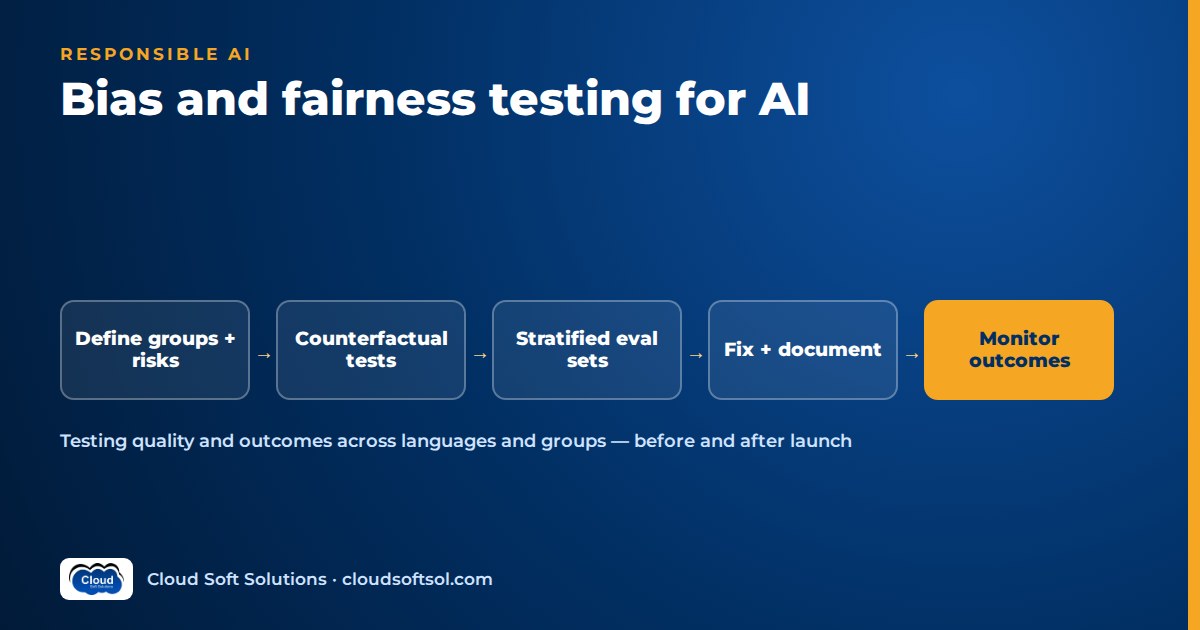
AI bias testing checks whether a generative AI application works equally well, and treats people equally, across languages, dialects, names, genders, regions and other sensitive attributes. In practice it means counterfactual tests that swap one attribute and compare outputs, evaluation sets stratified by group, LLM-as-judge scoring for stereotyping that humans have calibrated, and outcome monitoring in production, each tied to metrics you agree on before you look at the results. This guide shows engineers how to set that up, what to do when the numbers diverge, and how to document it for high-risk uses such as hiring and lending.
Where bias shows up in GenAI applications
Bias in an LLM application is rarely a single offensive sentence. Far more often it is a quiet difference in quality or outcome that nobody notices because the people affected are not the people testing. Watch for four patterns.
- Unequal quality across languages, dialects and names. The assistant answers fluent, formal English well and gives thinner, less accurate answers to Hinglish, code-mixed Telugu-English or questions from non-native writers. Retrieval can be uneven too, matching some phrasings to the right document more reliably than others.
- Stereotyped content. Generated text that assigns roles, traits or occupations by gender, community or region, for example in job descriptions, marketing copy or personas the model invents unprompted.
- Different outcomes in decision support. When the model ranks CVs, summarises a loan application, triages an insurance claim or drafts a recommendation, small differences in wording or scoring can turn into different decisions for comparable people.
- Tone differences. The same complaint gets a warm, helpful reply for one customer and a curt, suspicious or more heavily caveated reply for another. Refusals are part of this: an assistant that refuses or hedges more often for some groups is giving them a worse service.
Many of these come from the system around the model: prompts, retrieved documents, few-shot examples and business rules. That is why bias testing belongs with your LLM evaluation pipeline rather than being a one-off review of the base model.
India-specific dimensions to handle with care
Teams building for Indian users need to think beyond the attribute lists in Western fairness toolkits. The dimensions below are sensitive, and some are legally protected in specific contexts. Treat them as test dimensions, never as features the model should use.
| Dimension | How it can surface in an AI app | Testing note |
|---|---|---|
| Language and script | Quality drops for regional languages, transliterated text or code-mixed input | Stratify the eval set by language and script; use native-speaker reviewers |
| Region and place of origin | Addresses, college locations or accents in transcripts affect scores or tone | Swap locations in counterfactual pairs; check for proxies like PIN codes |
| Gender | Pronoun errors, role assumptions, penalties for career gaps | Swap names and pronouns; include non-binary and unstated cases |
| Caste | Usually inferred indirectly, through surnames, places or institutions | Test through proxies with reviewer-curated inputs; never ask the model to infer it |
| Religion | Names, festivals or dietary references shift tone or outcomes | Counterfactual swaps designed with diverse reviewers |
Three rules keep this work respectful and useful. First, build name and attribute lists with reviewers from the communities concerned, keep them in an access-controlled test repository, and do not publish them or reuse them as marketing material. Second, never write test cases that encode a stereotype as the "expected" behaviour; the test asserts that outputs are equivalent, not that a group behaves a certain way. Third, remember that caste and religion are often inferable from surnames and places in India, so removing an explicit field does not remove the signal. Your tests need to probe the proxies.
Collecting real sensitive attributes for monitoring is a legal and ethical question, not just a technical one. Under India's data protection law and your organisation's own policies, decide with legal and privacy teams whether you may collect voluntary self-declared data, how it is consented, stored and separated from the decision path, and who can see aggregates.
Counterfactual testing: swap one thing, compare outputs
Counterfactual testing is the workhorse of AI bias detection. Take a real or realistic input, create variants that differ only in one sensitive attribute or its proxy, run all variants through the full application, and compare the outputs.
Base case (CV, claim, query)
      |
      v
Variant generator: swap name / pronoun /
location / language register (one at a time)
      |
      v
Run full app (prompt + RAG + tools), N runs
      |
      v
Compare: score, decision, refusal, tone, length
      |
      v
Flag pairs above agreed tolerance -> review
Practical points that decide whether this works:
- Change one thing at a time. If you change name and college together, you cannot say which one moved the result.
- Run each variant several times. LLM outputs vary between runs. Compare distributions, not single outputs, or you will chase noise.
- Test the whole system. Run through the production prompt, retrieval and post-processing, not just the raw model in a playground.
- Compare structured fields first. Scores, decisions and refusal flags are easy to compare; for free text, compare length, sentiment and judge scores.
- Generate variants carefully. Template substitution is safest. If you use an LLM to rewrite variants, check that it changed only the attribute; the methods in synthetic data for AI testing apply here, including human review of generated cases.
A minimal harness looks like this:
for case in base_cases:
    variants = make_variants(case, attribute="name_set")
    results = {v.label: [app.run(v.input) for _ in range(5)]
               for v in variants}
    gap = max_score_gap(results, field="match_rating")
    if gap > TOLERANCE[case.risk_tier]:
        flag(case, results)
Stratified evaluation sets across languages and groups
Counterfactuals answer "does changing this attribute change the output?" Stratified evaluation answers a different question: "does the system work equally well for each group of real users?" The two catch different problems. A multilingual assistant may treat a swapped name identically and still give much weaker answers in Telugu than in English.
Build your eval set so every slice you care about has enough cases to compare: each supported language and script, code-mixed input, formal and informal registers, regional variations, and each user segment the business serves. Tag every case with its slices. Then report quality metrics per slice instead of one blended average, because a strong average can hide a weak slice entirely. Native speakers should write or review reference answers for each language.
LLM-as-judge for stereotyping, with human calibration
String checks rarely catch stereotyping. An LLM judge with a clear rubric can score outputs at scale: does the response assign traits or roles based on a group, or make assumptions the input did not support?
Judges carry their own biases, so treat the judge as an instrument you must calibrate. Have a diverse panel of human reviewers label a sample, measure how often the judge agrees with them, refine the rubric where it disagrees, and re-check agreement whenever you change the judge model or prompt. Calibrate per language too. Keep a human-labelled slice permanently in the loop, as described in human-in-the-loop AI, rather than handing the whole judgement to a model.
Outcome monitoring in production
Pre-release tests use inputs you imagined; production shows what people actually send. Monitor:
- quality signals (user feedback, judge scores on sampled traces, escalations) broken down by language and channel
- refusal and fallback rates by slice
- decision outcomes, such as shortlist, approve or escalate rates, by the groups you are lawfully able to measure
- drift after model, prompt or index changes, using the traces you already collect for AI observability
Where you cannot collect sensitive attributes, monitor language and channel and lean on pre-release counterfactual tests. Do not infer caste, religion or gender from names in production to "fill in" monitoring data; that creates the very profiling you are trying to prevent.
If you want to build these evaluation pipelines hands-on, with Ragas, LangSmith and Langfuse wired into real RAG and agent projects, Cloudsoft's AI, GenAI and Agentic AI course treats evaluation and responsible AI testing as part of the build.
Fairness metrics, described conceptually
You do not need exotic formulas to start. Three families of metrics cover most LLM bias evaluation work:
| Metric family | What it compares | Example question |
|---|---|---|
| Parity of quality scores | Accuracy, faithfulness, helpfulness or judge scores per slice | Are Telugu answers as correct and complete as English ones? |
| Refusal-rate differences | How often the system refuses, hedges or falls back, per slice | Does the assistant decline more often for certain names or dialects? |
| Outcome-rate differences | Rates of favourable decisions or recommendations per group | Are comparable applicants shortlisted at similar rates? |
Agree on the tolerance for each metric before you run the tests, record who agreed and why, and set tighter tolerances for higher-risk uses. Some teams borrow ratio heuristics from employment testing practice, but no single threshold is a legal safe harbour in India or the EU. Fairness definitions can also conflict, so choosing which one matters for your use case is a documented business and legal decision, not a library default.
What to do when you find bias
Fix at the layer that causes the problem, then rerun the same tests to confirm the fix without breaking other slices.
- Data. Fill gaps in the knowledge base (for example, policy documents only available in English), fix biased few-shot examples, and add missing language or dialect cases to evaluation and fine-tuning data.
- Prompts. Tell the model to judge only against stated criteria, require evidence for every score, and remove irrelevant fields (name, photo, age, address) before the model sees the input.
- Guardrails. Add output checks that flag stereotyping or unsupported attribute references, as described in AI guardrails.
- Human review. Route borderline or adverse decisions to trained reviewers who see the evidence, not just the score.
- Scope limits. If a slice cannot reach acceptable quality, do not ship it to that slice, or narrow the task. Summarising a CV against criteria is lower risk than ranking candidates; drafting is lower risk than deciding.
Every confirmed finding becomes a permanent regression case, because fixed bias can return with the next model upgrade; it is the same discipline used in AI red teaming.
Documentation
To an auditor or client, undocumented fairness work did not happen. Keep a short, living fairness record per application:
- intended use, users, and decisions the system influences, plus uses it must not be put to
- sensitive attributes and proxies considered, and why some were excluded
- test sets, slices, counterfactual templates and their versions
- metrics, agreed tolerances, who approved them, and results per release
- findings, fixes, residual risks accepted and by whom
- production monitoring plan and review cadence
Store this next to your model and prompt versions so every release can be traced to its fairness results. It fits naturally into an enterprise AI governance process.
High-risk uses: hiring and lending
Hiring and credit decisions are where AI bias testing stops being good practice and becomes a regulatory expectation. Under the EU AI Act, AI systems used to recruit or select people, filter applications and evaluate candidates, and systems used to assess the creditworthiness of individuals, fall in the high-risk category. Providers of such systems are expected to run risk management, examine training and test data for possible biases, keep technical documentation and logs, design for human oversight, and give deployers instructions for use. Indian IT services firms and GCCs building these tools for European clients are directly affected; the EU AI Act guide for Indian IT teams covers roles, obligations and current timelines.
In Indian lending, the Reserve Bank of India's existing fair practices expectations apply to decisions whether or not AI is involved, and RBI's work on responsible AI in financial services emphasises fairness, explainability and accountability. The general expectation is that lenders explain decisions, avoid unfair discrimination, keep humans accountable and govern models through their lifecycle. Confirm the current specific obligations with your compliance team, and see generative AI in banking for the controls banks typically apply.
Illustrative example: a CV-screening assistant
Consider a GCC in Hyderabad whose HR team wants an assistant that reads incoming CVs, summarises each against the job's must-have and nice-to-have criteria, and suggests a match rating for recruiters. The recruiter makes every shortlisting decision. This is illustrative, not a real deployment.
Scoping. The team classifies it as high risk, rules out automatic rejection, hides photos and dates of birth from the model, and requires CV evidence for each criterion.
Counterfactual suite. From a set of anonymised and synthetic CVs, they create variants that differ only in name (from reviewer-curated name sets spanning regions, genders and communities), pronouns, home city, college location, a career gap, or English register. Each variant runs several times through the full pipeline.
Stratified set. CVs are tagged by formatting style, writing register and whether the candidate studied in English-medium or regional-medium institutions, so summary quality can be compared per slice.
Judge and humans. A judge scores summaries for unsupported assumptions and stereotyped language; a mixed panel of recruiters labels a sample to calibrate it.
Suppose the tests find that ratings drop for CVs with a career gap even when the gap is irrelevant to the criteria, and that summaries for less formal English are shorter and miss evidence. The team changes the rubric so career gaps are ignored unless a stated criterion genuinely requires continuous experience, scores only against the job criteria, adds an evidence-coverage check, and adds both patterns to the regression suite. Recruiters see the evidence beside each rating and can reorder freely. In production, the team monitors rating distributions by the attributes candidates voluntarily and lawfully declare, and reviews a sample monthly.
Shipping a system like this for a real client, with discovery, evaluation, approvals and monitoring wired in, is the kind of work Forward Deployed Engineers do; Cloudsoft's FDE PRO program practises it through simulated customer engagements.
Common mistakes
- Testing only the base model. Bias often enters through prompts, retrieval and business rules. Test the deployed system.
- Reporting one average. Blended scores hide weak slices. Always break results down.
- Removing a field and declaring victory. Names, places and institutions are proxies. Test them.
- Trusting an uncalibrated judge. The judge can be biased in the same direction as the system.
- Stereotyped test cases. Tests should assert equivalence, never encode assumptions about a group.
- No owner for tolerances. Without sign-off on what "acceptable" means, every result becomes an argument.
FAQ
What is AI bias testing?
AI bias testing checks whether an AI application performs equally well and produces equivalent outcomes across groups such as languages, genders, regions and other sensitive attributes. It combines counterfactual tests, stratified evaluation, calibrated judges and production monitoring.
How is fairness testing for an LLM different from traditional ML fairness testing?
Traditional ML fairness looks at predictions over structured features. LLM fairness testing also covers free-text quality, tone, refusals and stereotyping across the whole system, and because outputs vary between runs, you compare distributions.
What is counterfactual testing?
Counterfactual testing creates input variants that differ in only one sensitive attribute or proxy, such as a name or pronoun, runs them through the full application several times, and compares scores, decisions, refusals and tone.
Can we use an LLM to detect bias in another LLM's output?
Yes, as a scaling tool, but calibrate the judge against diverse human reviewers, per language, and recheck it whenever the judge changes.
Should we collect caste or religion data to measure fairness?
Only after legal, privacy and ethics review, with voluntary consent, separation from the decision path and restricted access. Never infer these attributes from names in production. Where you cannot collect them, rely more on counterfactual tests before release.
Which fairness metric should we use?
Start with parity of quality scores, refusal-rate differences and outcome-rate differences per slice. Agree tolerances in advance, tighten them for high-risk uses, and document which fairness definition you prioritise and why.
Does the EU AI Act require bias testing for hiring tools?
The Act treats AI used for recruitment and candidate evaluation as high risk and expects providers to examine data for possible biases, manage risk, document the system and support human oversight. Confirm the details and timelines with your legal team.
How often should we run bias tests?
Run the counterfactual and stratified suites in CI on every prompt, model, retrieval or tool change, review production outcome monitoring on a regular schedule, and repeat calibration of judges whenever they change.
To learn to build, evaluate and monitor LLM applications end to end, explore Cloudsoft's AI and GenAI training in Hyderabad, in our Ameerpet classroom beside Ameerpet Metro or live online. Call +91 96660 19191 to book a free demo.