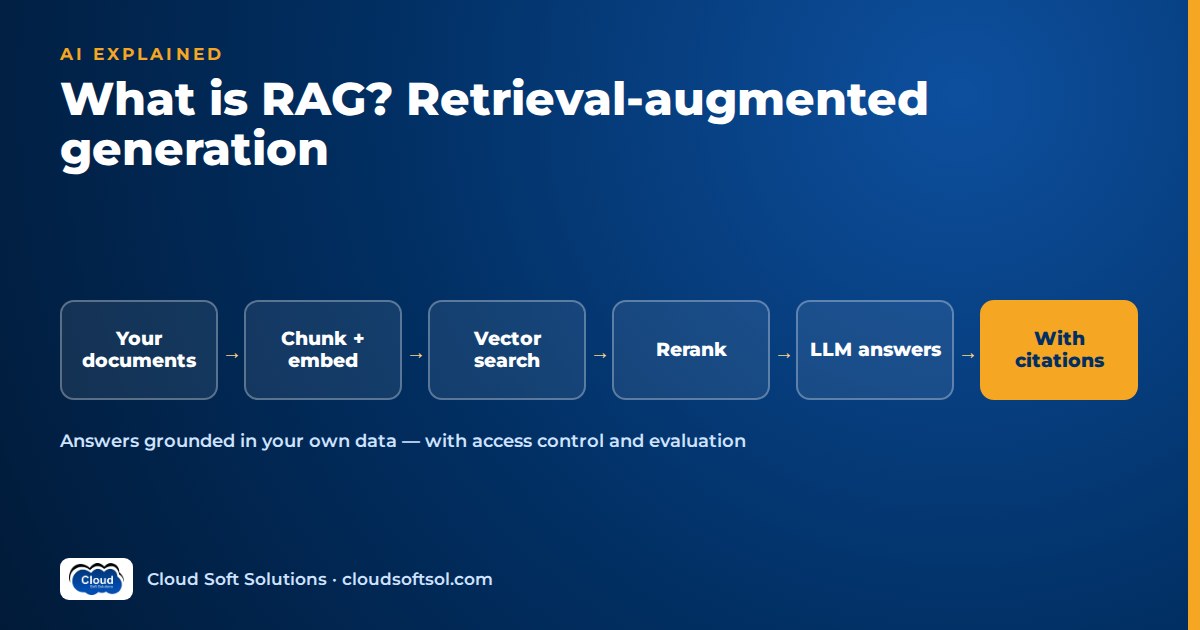
RAG for policy documents is retrieval-augmented generation built so that every answer about a policy is grounded in the current, approved text, cites the exact clause it came from, respects who is allowed to see that clause, and leaves an audit trail a regulator could follow. In a regulated enterprise the model is the easy part. The hard parts are document versioning, access control, citation enforcement, evaluation and the evidence pack that lets compliance sign off. This playbook lays out how a Forward Deployed Engineer (FDE) runs that engagement end to end in roughly 12–16 weeks: principles, phases, deliverables, a reference architecture, a recommended stack, risks and the metrics to agree at kickoff.
If RAG itself is new to you, start with what RAG is and how it works; for the role, see what a Forward Deployed Engineer does. This article assumes both and focuses on delivery.
Who this playbook is for
The client profile is a North American regulated enterprise: a bank or financial-services firm, a healthcare provider or payer, an insurer, a law firm or legal department, or a government contractor. The use cases look similar across all of them:
- Policy Q&A for employees ("Can I approve this expense?", "What is the retention period for claim files?").
- Compliance assistants that help risk, audit and legal teams find and compare obligations across policies, procedures and standards.
- Audit-ready, cited answers, where every response links to a specific policy, section and version and can be reproduced later.
- Controlled access, so a contractor, a branch employee and a compliance officer see different sources for the same question.
Consider an illustrative case: an insurer with several thousand policy and procedure documents spread across SharePoint, Confluence and a document management system, many with overlapping versions and regional variants. Staff ask the compliance desk the same questions every week, and the answers are inconsistent. The goal is not "a chatbot". The goal is fewer escalations, consistent answers and an evidence trail, which is why the engagement is run by an FDE rather than handed to a model vendor.
Six FDE principles for compliance RAG
- Outcome over output. Success is measured in business terms agreed up front (fewer compliance escalations, faster answers, consistent interpretations), not in "we shipped a chat UI".
- Security and compliance first. SOC 2 controls, HIPAA (with a BAA where protected health information is in scope), GDPR and CCPA obligations, data residency, least-privilege access, audit logging and PII redaction are designed in from week one, not bolted on before go-live.
- Customer co-ownership. A named business owner, a compliance reviewer and the customer's platform team sit inside the engagement. They own the golden questions, the acceptance criteria and, eventually, the system.
- MVP in 4–6 weeks. A thin end-to-end slice on real documents, real users and real permissions within the first four to six weeks beats a polished demo on sample PDFs.
- Observability and evaluation are first-class. Tracing, cost and latency metrics and an automated evaluation suite exist before the first user sees an answer.
- Handover means enablement. The engagement ends when the customer's team can run, evaluate and change the system without you, not when the code is pushed.
Engagement timeline: 12–16 weeks, phase by phase
The clock usually starts at contract signature. Pre-sales happens before it, and data preparation runs in parallel with architecture and the start of the MVP build, which is how the phases below fit into 12–16 weeks.
| Phase | Duration | Outcome |
|---|---|---|
| 0. Pre-sales | 1–2 weeks | Scoped problem, signed SOW, risk register, data-processing terms (DPA/BAA) agreed |
| 1. Discovery | 2 weeks | Stakeholders mapped, document estate inventoried, golden questions and baseline metrics captured, threat model drafted |
| 2. Architecture | 1.5 weeks | Approved architecture, security design, residency decision and cost model |
| 3. Data preparation | 2–3 weeks | Clean, versioned, permission-aware index of the in-scope policy corpus |
| 4. MVP build | 3–4 weeks | Working assistant with grounded, cited answers for a pilot user group |
| 5. Evaluation and hardening | 2 weeks | Measured quality against agreed targets, red-team findings fixed, compliance evidence mapped |
| 6. Production | 1.5–2 weeks | Infrastructure as code, monitored production deployment with audit trail and DR |
| 7. Handover and hypercare | 2 weeks + 30-day hypercare | Customer team trained and running the system; acceptance report signed |
How a pilot becomes a production system more generally is covered in how FDEs take AI from POC to production. The rest of this article is specific to policy and compliance RAG.
Reference architecture for enterprise RAG over policies
The flow below shows the two paths that matter: ingestion (keeping the index current and permission-aware) and query (retrieving only what the user may see, then forcing citations).
INGESTION
SharePoint / Confluence / Drive / DMS
        |
  parse + OCR (layout-aware)
        |
  section/clause chunking
  + metadata: policy_id, version,
    effective_date, owner, ACL
        |
  embed + BM25 index  -->  vector store
        |
  change detection (re-index on
  new version, retire old one)

QUERY
user (SSO: Okta / Entra ID)
        |
  input guardrails + PII redaction
        |
  query rewrite -> hybrid search
  (filtered by user ACL + "current")
        |
  re-rank -> top clauses
        |
  LLM: grounded answer, cite or
  refuse
        |
  citation check -> output guardrails
        |
  answer + citations + audit log
Two design choices carry most of the compliance weight. First, permission filtering happens at retrieval time, using the user's identity and the document's ACL metadata, so the model never sees text the user could not open themselves. Second, only the current effective version is retrievable by default; superseded versions stay in the index for audit questions ("what did the policy say on 1 March?") but are filtered out of normal answers.
Deliverables checklist for phases 0–7
Use this as the engagement checklist. Each item is a concrete artefact the customer can review, not an activity.
Phase 0: Pre-sales
- Statement of work (SOW) with scope, out-of-scope items and acceptance criteria
- Risk register (data, security, regulatory, adoption, delivery)
- RACI covering the FDE team, business owner, compliance, security, IT and data owners
- Data processing agreement (DPA) and, where PHI is involved, a business associate agreement (BAA)
Phase 1: Discovery
- Stakeholder map (sponsor, policy owners, compliance, legal, security, end-user groups)
- Document inventory: sources, formats, owners, volumes, update frequency, sensitivity
- 20–30 golden questions with expected answers and source clauses, written by policy owners
- Baseline metrics: how questions are answered today, how long it takes, how often answers conflict
- Threat model (prompt injection, data leakage across roles, stale answers, abuse)
Running these sessions well is its own skill; see the FDE customer workshop playbook.
Phase 2: Architecture
- Architecture decision records (ADRs) for model, vector store, framework and hosting
- Component diagram
- Security architecture: identity, network boundaries, encryption, key management, logging
- Data residency decision (region, cross-border transfers, model endpoint location)
- Cost model (ingestion, embedding, storage, per-query inference, re-ranking, monitoring)
Phase 3: Data preparation
- Ingestion connectors for PDF, DOCX, SharePoint, Confluence and Google Drive
- OCR for scanned policies, with layout-aware parsing for tables and numbered clauses
- Metadata extraction (policy ID, title, owner, version, effective date, jurisdiction, business unit)
- Versioning and change detection, so new versions replace old ones in normal retrieval
- Policy-section-aware chunking (example below)
- Embedding model evaluation on the customer's own golden questions
- Hybrid search index: BM25 keyword plus dense vectors
- ACL mapping from source systems to retrieval-time filters
Parsing and chunking choices are covered in more depth in document parsing for RAG and RAG chunking strategies. Most of the effort here is the customer's knowledge hygiene, which getting enterprise knowledge ready for AI addresses directly.
Phase 4: MVP build
- Retrieval: hybrid search, re-ranking, query rewriting and multi-hop retrieval for questions that span policies
- Grounded generation with citation enforcement
- Input and output guardrails
- API layer for downstream systems
- Admin UI (sources, sync status, evaluation results, feedback review)
- Chat UI with clickable citations
- Feedback loop (thumbs up/down, "wrong source", free-text) routed to policy owners
Retrieval mechanics are explained in hybrid search and re-ranking for RAG; when questions need several retrieval steps, see agentic RAG.
Phase 5: Evaluation and hardening
- Golden set expanded to 50–200 questions, including "no answer exists" and access-restricted cases
- Automated evaluation: faithfulness, answer relevance, context precision and recall, citation accuracy
- Red-team exercise (prompt injection, role escalation, data exfiltration, jailbreaks)
- Latency, throughput and cost benchmarks
- SOC 2 control mapping for the new system
- System card: purpose, data, limits, known failure modes, evaluation results
Phase 6: Production
- Infrastructure as code for every environment
- CI/CD with evaluation gates (a prompt or retrieval change that lowers scores does not ship)
- Monitoring: quality, latency, cost, errors, guardrail triggers
- Audit trail: user, question, retrieved chunks, versions, answer, citations, timestamp
- Disaster recovery plan and tested restore of the index
- Runbooks (re-index, revoke access, roll back a prompt, respond to an incident)
Phase 7: Handover and hypercare
- Complete documentation package (structure below)
- Training for admins, policy owners and support teams
- Knowledge-transfer sessions, with the customer team making real changes while you watch
- 30-day hypercare with agreed response times
- Acceptance report against the success metrics agreed at kickoff
Want to practise this kind of engagement end to end, from discovery workshop to production deployment? Cloudsoft's AI Forward Deployed Engineer course (FDE PRO) includes an Enterprise Knowledge Assistant project and a simulated "GlobalBank" customer engagement as the capstone.
Policy-aware chunking: a worked example
Fixed-size chunking is the most common reason policy RAG gives vague or wrong answers: a 500-token window can cut a clause in half or glue the end of one section to an unrelated exception. For policies, chunk by section and clause, keep the heading path, and carry the version metadata on every chunk.
Take an illustrative clause from a travel and expense policy:
FIN-POL-014  Travel and Expense Policy  v3.2
Effective: 2026-07-01
4. Approvals
4.3 International travel
4.3.1 International travel requires prior written
      approval from the employee's VP.
4.3.2 Exceptions for client emergencies may be
      approved retrospectively within 5 business days.
Stored as two chunks, each clause becomes independently retrievable and citable:
{
  "chunk_id": "FIN-POL-014:v3.2:4.3.1",
  "text": "4.3.1 International travel requires prior
           written approval from the employee's VP.",
  "heading_path": "4. Approvals > 4.3 International travel",
  "policy_id": "FIN-POL-014",
  "policy_title": "Travel and Expense Policy",
  "version": "3.2",
  "effective_date": "2026-07-01",
  "superseded": false,
  "owner": "Finance Policy Office",
  "jurisdiction": "US, CA",
  "acl_groups": ["all-employees"],
  "source_url": "https://.../FIN-POL-014.pdf#page=6"
}
Rules of thumb: keep a clause and its numbered sub-clauses together when they are short; prepend the heading path to the text before embedding so "4.3.2" still means something on its own; keep definitions sections as separate chunks that retrieval can pull in when a defined term appears; and when a new version arrives, mark the old chunks superseded: true rather than deleting them, so audit questions about past wording still work.
Citation enforcement: a prompt sketch
A prompt alone does not enforce citations, but it sets the contract that the code then checks. A sketch of the system prompt:
You answer questions about company policy using ONLY
the numbered SOURCES below.

Rules:
1. Every factual sentence must end with one or more
   citations like [FIN-POL-014 v3.2 s4.3.1].
2. Cite only chunk IDs that appear in SOURCES.
3. If the SOURCES do not answer the question, reply:
   "I can't find this in the current policies you
   have access to." and suggest the policy owner.
4. If sources conflict, quote both, cite both, and
   say which has the later effective date.
5. Do not give legal advice or interpret beyond the
   text. Do not use outside knowledge.

SOURCES:
[1] FIN-POL-014 v3.2 s4.3.1 (effective 2026-07-01)
    "International travel requires prior written..."
[2] ...
Then enforce it in code after generation: parse every citation, reject any that does not match a retrieved chunk ID, check that each cited chunk actually supports its sentence (a lightweight entailment or LLM-judge check), and if the answer fails, either regenerate once or return the refusal message. Log the outcome either way. This is what turns "the model usually cites" into "uncited answers do not reach users". For the broader picture of why models invent content, see LLM hallucinations explained, and for layered controls see the AI guardrails guide.
Evaluation rubric for compliance RAG
Agree this rubric with the compliance reviewer during discovery, then automate it. The metric definitions are explained in RAG evaluation metrics.
| Dimension | Question it answers | How to measure | Fail condition |
|---|---|---|---|
| Faithfulness | Is every claim supported by the retrieved text? | LLM judge plus human spot checks on a sample | Any unsupported claim about an obligation or limit |
| Citation accuracy | Does each citation point to the clause that supports the sentence? | Automated ID match plus support check | Citation to wrong clause, wrong version or a non-retrieved chunk |
| Answer relevance | Does the answer address the question asked? | LLM judge against golden answers | Correct text, wrong question |
| Context precision | Are the retrieved chunks mostly relevant? | Labelled relevant chunks in golden set | Relevant clause buried below noise |
| Context recall | Was the needed clause retrieved at all? | Golden set source clauses | Required clause missing from top results |
| Version correctness | Is the answer based on the current effective version? | Golden questions with recently changed policies | Superseded text used for a current question |
| Access correctness | Did the user only receive content they may see? | Same questions run as different test personas | Any restricted content in the answer or citations |
| Correct refusal | Does it decline when no policy covers the question? | "No answer" questions in golden set | Confident answer with no supporting source |
Recommended stack
There is no single correct stack; the customer's cloud, identity provider and residency requirements usually decide most of it. A typical shortlist:
| Layer | Options |
|---|---|
| Orchestration | LangGraph or LlamaIndex |
| LLM | Claude models (as of late 2026: Claude Opus 5.5, Sonnet 5.5 and Haiku 4.5) via the Anthropic API, Amazon Bedrock or Google Cloud's Vertex AI (now part of the Gemini Enterprise Agent Platform); GPT-class models via Azure OpenAI in Microsoft Foundry where Azure residency is required |
| Embeddings | Voyage, Cohere or OpenAI text-embedding-3-large, chosen by evaluation on the customer's golden questions |
| Vector / search store | Pinecone, Weaviate, Azure AI Search or OpenSearch (hybrid BM25 + dense) |
| Re-ranking | Cohere Rerank or an open bge-reranker model |
| Parsing | Unstructured or LlamaParse, plus OCR for scanned documents |
| Identity | Okta, Microsoft Entra ID (formerly Azure AD) or Amazon Cognito |
| Observability and evaluation | LangSmith, Arize Phoenix or OpenTelemetry-based tracing |
| Networking | AWS or Azure private networking (private endpoints, no public model egress) |
| Security | DLP, Llama Guard or equivalent safety classifier, SIEM integration, customer-managed KMS keys |
A practical pattern is to route most questions to a fast, cheaper model and reserve the largest model for multi-hop or conflicting-policy questions, with the routing rule itself covered by evaluation. Identity design for AI systems is covered in AI agent identity and access.
The documentation package (12 folders)
Hand over a predictable structure so auditors and the customer's team can find things without asking you:
policy-rag-engagement/
  01-commercial/        SOW, DPA/BAA, change requests
  02-governance/        RACI, risk register, decisions log
  03-discovery/         stakeholder map, doc inventory,
                        golden questions, baseline
  04-architecture/      ADRs, component + data-flow
                        diagrams, cost model
  05-security/          threat model, security design,
                        residency, SOC 2 control mapping
  06-data/              source connectors, chunking
                        spec, metadata schema, ACL map
  07-application/       API spec, prompts, guardrails,
                        UI guides
  08-evaluation/        golden set, eval reports,
                        red-team findings, system card
  09-infrastructure/    IaC, CI/CD, environments, DR
  10-operations/        runbooks, monitoring, on-call,
                        incident response
  11-training/          admin, policy-owner and user
                        training material, recordings
  12-acceptance/        acceptance report, hypercare
                        log, sign-offs
Day-to-day engagement rhythm
- Daily: 15-minute stand-up with the customer's technical counterparts; review overnight evaluation runs and any feedback flagged by pilot users.
- Twice weekly: working session with policy owners on golden questions, wrong answers and source conflicts. Most quality gains come from here, not from prompt tweaks.
- Weekly: demo to the business owner on real documents, an updated metrics dashboard, and a risk-register review with security and compliance.
- Every phase gate: written sign-off on the deliverables for that phase before moving on.
- Always: decisions written down as ADRs or in the decisions log the same day, so nobody relies on memory of a meeting.
What this looks like from the FDE's side in a new engagement is described in an FDE's first 90 days.
Risks and mitigations
| Risk | Mitigation |
|---|---|
| Hallucinated or unsupported answers about obligations | Citation enforcement in code, refusal when unsupported, faithfulness gate in CI/CD |
| Users see content outside their permissions | ACL filtering at retrieval, persona-based access tests, audit of every retrieved chunk |
| Answers based on superseded policy versions | Version and effective-date metadata, change detection, "current only" default filter |
| Poor source quality (duplicates, conflicts, scans) | Document inventory, owner-led clean-up list, OCR quality checks, conflict reporting to policy owners |
| Prompt injection through documents or user input | Input/output guardrails, treating retrieved text as data, red-team testing |
| PII or PHI leaking into logs or model calls | Redaction before logging and inference, DLP, private endpoints, BAA where required |
| Data residency breach | Region-pinned model endpoints and storage, residency documented as an ADR |
| Cost overruns at scale | Cost model in phase 2, model routing, caching, per-query cost monitoring |
| Low adoption | Pilot group from day one, feedback loop, training, champions in each business unit |
| Dependence on the FDE team after go-live | Knowledge transfer with hands-on changes, runbooks, 30-day hypercare with a defined exit |
For structured adversarial testing, see AI red teaming; for organisational controls, see enterprise AI governance.
Success metrics to agree at kickoff
These are typical targets for a compliance RAG engagement. Treat them as a starting point to negotiate with the customer in discovery and write into the SOW, not as promised results; the right numbers depend on the corpus, the users and the risk appetite.
| Metric | Typical target |
|---|---|
| Faithfulness on the golden set | ≥90% |
| Citation accuracy | ≥95% |
| p95 end-to-end latency | under 4 seconds |
| Adoption among the target user group | ≥60% within 60 days of launch |
| Penetration test | zero critical findings open at go-live |
| Audit trail | every answer reproducible: user, question, sources, versions, response |
Pair these with the business baseline from discovery (for example, how many policy questions reach the compliance desk each week) so the acceptance report shows an outcome, not just model scores. Tracing and dashboards for this are covered in AI observability.
FAQ
What is RAG for policy documents?
RAG for policy documents is a retrieval-augmented generation system that answers questions using an organisation's approved policies and procedures. It retrieves the relevant clauses, generates an answer grounded only in them, cites the policy, section and version, and respects each user's access rights.
How long does an enterprise RAG engagement for policies take?
A typical engagement runs about 12 to 16 weeks from contract to production, plus a 30-day hypercare period. A first working slice on real documents should be in front of pilot users within roughly four to six weeks.
How do you stop a compliance RAG system from hallucinating?
Combine policy-aware chunking and good retrieval with a prompt that requires citations, then enforce citations in code: reject citations that do not match retrieved chunks, check that each cited clause supports its sentence, and refuse when no source supports the answer. Gate releases on faithfulness scores.
How is access control handled in RAG for regulated enterprises?
Map each document's permissions from the source system into chunk metadata, then filter retrieval by the signed-in user's identity and groups from the identity provider. The model only sees text the user could open themselves, and persona-based tests prove it.
Which vector database is best for compliance RAG?
There is no single best option. Pinecone, Weaviate, Azure AI Search and OpenSearch can all support hybrid keyword and vector search with metadata filtering. The choice usually follows the customer's cloud, residency rules, existing contracts and operational skills.
What does an FDE hand over at the end of a policy RAG engagement?
A documentation package covering commercial, governance, discovery, architecture, security, data, application, evaluation, infrastructure, operations, training and acceptance, plus training, hands-on knowledge transfer, 30 days of hypercare and a signed acceptance report.
Building systems like this is what Forward Deployed Engineers do every day: turning a document estate, a compliance requirement and a business problem into a measured, audited production system. If you want to learn that end to end, the Cloudsoft FDE PRO program covers RAG, agents, MCP, evaluation, security and cloud deployment over 12 weeks, in the Ameerpet classroom beside Ameerpet Metro or live online, with placement support until you're placed. Earlier in your career? The APEX AI, ML, Cloud and Security program builds the foundations first. Call +91 96660 19191 for a free demo session.