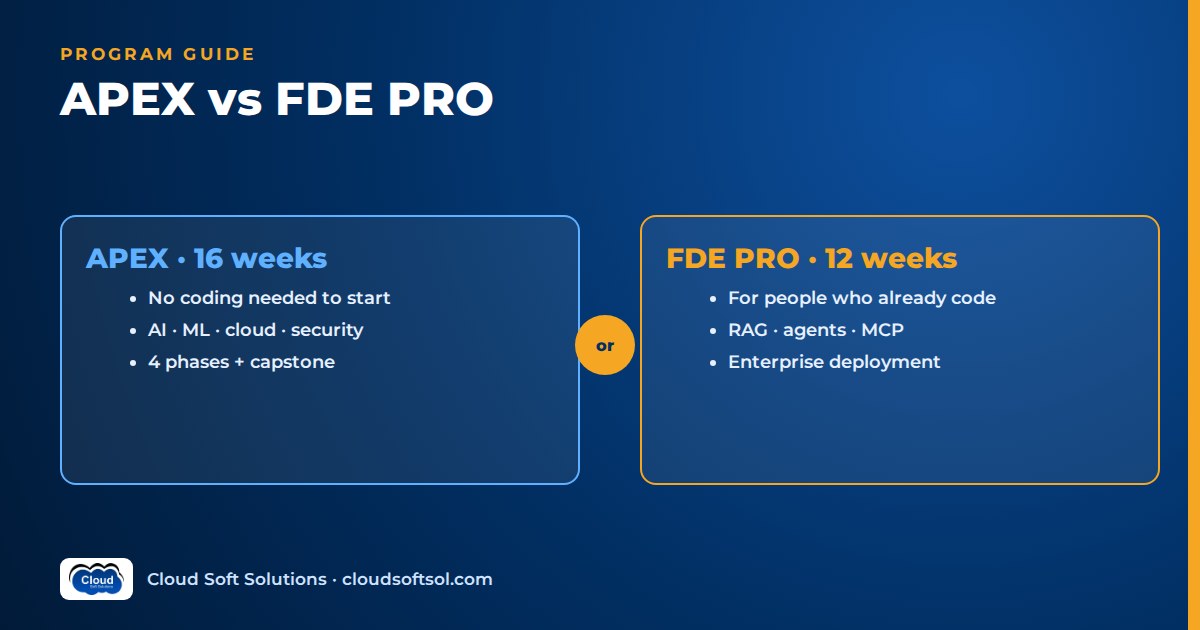
APEX and FDE PRO are built for different starting points: APEX is a 16-week, broad foundation program that assumes no prior coding, while FDE PRO is a 12-week specialist fast track for people who can already program and want to take AI from a customer's problem to production. Neither is the "better" program. APEX gives you breadth across Python, data, machine learning, generative and agentic AI, AWS, DevOps and cyber security. FDE PRO gives you depth in one job: the Forward Deployed Engineer who runs discovery, builds RAG and agent systems, integrates them with enterprise tools and proves the business result.
This guide compares the two using only what each program publishes, then gives you a decision guide by profile, a sequencing option and the questions worth asking at your demo.
The short version
- Choose APEX if you are a fresh graduate or early-career professional who has not written much code yet, and you want one structured path into AI, ML, cloud, DevOps or security roles.
- Choose FDE PRO if you can already write basic programs and want to specialise in enterprise AI delivery: RAG, agents, MCP, identity, deployment, evaluation and customer-facing engineering.
- Do both, in that order, if you are starting from zero but your target role is specifically Forward Deployed Engineer.
The deciding question is simple: can you write a small program today without a tutorial open? If not, the foundation comes first. If yes, the question becomes whether you want breadth or a specific role.
Who each program is for
APEX: one structured path from fundamentals
APEX describes itself as a program for fresh graduates (BE, B.Tech, MCA, B.Sc, M.Sc, BCA or any degree) and early-career professionals who want "a single, structured path into AI, cloud and DevOps roles". It assumes no prior coding experience. Week 1 starts with setting up Python, variables, loops and data structures, and by the end of week 4 you have deployed an app to AWS and built your first GenAI app and a simple tool-using agent.
The design philosophy is breadth with a connecting thread. Eight domains (Python, machine learning, generative AI, agentic AI, data science, AWS multi-cloud, DevOps and cyber security) are taught in one track, and the target roles span AI/ML engineer, GenAI engineer, data scientist or analyst, cloud engineer, DevOps engineer, cloud security or DevSecOps engineer, Python developer and MLOps or SRE. You come out able to choose a direction rather than having chosen one on day one.
FDE PRO: one role, done properly
FDE PRO is built around a single job. A Forward Deployed Engineer works directly with customers to turn their problems into production systems; if the role is new to you, start with what a Forward Deployed Engineer does. The program lists its audience as freshers with programming basics, software developers moving into applied AI, DevOps, cloud and SRE engineers adding GenAI and agent skills, support and implementation engineers stepping up to customer engineering, data engineers and analysts, and pre-sales engineers who want hands-on build depth.
The backbone is the customer engagement lifecycle, expressed as eight stations: Understand, Design, Build, Integrate, Deploy, Observe, Improve and Deliver value. Every week has four engineering sessions plus one Customer Engagement Lab, where you apply that week's technology to a simulated customer: a discovery call, a design document, a security questionnaire, an RCA, an SOW or an executive demo. The recurring idea is moving from AI demo to enterprise outcome.
Prerequisites: the honest filter
Prerequisites decide more of this choice than any curriculum line.
| Requirement | APEX | FDE PRO |
|---|---|---|
| Coding | None assumed; starts from Python fundamentals | Can write basic programs in any language (variables, loops, functions) |
| Education | Graduation in any stream | Freshers (B.Tech, MCA, M.Sc., BCA) with programming basics, or working engineers |
| Other | Basic computer literacy and logical aptitude | Comfort on the command line (or willingness to practise it in week 1); a laptop that runs Docker smoothly (16 GB RAM recommended, 8 GB works for most labs) |
| Accounts | AWS Free Tier account is created in week 1 | GitHub, AWS free tier, an Azure or Google Cloud trial and a ServiceNow developer instance |
| Time outside class | Guided practice, project sprints and weekend doubt-clearing are built into the format | 8 to 10 hours a week of practice, because it is a fast-track program |
FDE PRO is explicit that it is demanding as a first step. Its own advice to freshers is that the projects matter more than the certificate. If you would be learning what a loop is in the same week the class is writing a resilient, rate-limit-aware API client with retries and tests, you will spend the twelve weeks catching up instead of building.
What you build in each program
APEX: four projects that stack into one platform
- InsightHub (Phase 1, data and ML): a data pipeline, a Streamlit analytics dashboard, a churn-prediction model and a GenAI assistant that answers questions about the data.
- AskCloud (Phase 2, GenAI and agents): a RAG pipeline with a vector store, a multi-tool agent, a FastAPI backend with a chat interface, plus guardrails and evaluation.
- DeployX (Phase 3, cloud and DevOps): Docker, a CI/CD pipeline pushing to ECR, deployment to Amazon EKS, Terraform-provisioned infrastructure and Prometheus with Grafana.
- SecureAI capstone (Phase 4): the first three projects integrated into one secure AI cloud platform with a DevSecOps pipeline (image scanning, SAST/DAST, secrets scanning), IAM least privilege, KMS, WAF, LLM guardrails and an incident-response plan.
Each week also ships a lab and a real-time scenario, such as a fraud-detection model served as a FastAPI endpoint or a vulnerability assessment of a sample web application.
FDE PRO: five enterprise projects and a simulated engagement
- Customer Integration Service: pull CRM and support data from different APIs, clean it and serve it through one reliable API on ECS Fargate.
- Enterprise Knowledge Assistant: permission-aware RAG with citations, scored with Ragas.
- ServiceNow AI Agent via MCP: an MCP server that searches knowledge and creates and updates incidents with SSO-aware permissions.
- IT-Ops Multi-Agent Platform: a LangGraph supervisor routing to CloudWatch, Kubernetes and Jira agents, waiting for human approval, deployed to EKS with Terraform, Helm and GitHub Actions.
- Secure Banking AI Assistant: PII masking, RBAC-filtered retrieval, audit trail, approvals and a red-team report.
Then comes the GlobalBank capstone: squads of three or four work as an FDE pod while trainers play the customer's IT head, security lead, service-desk manager and CFO. You hand over discovery notes, HLD and LLD, a deployed system, an evaluation report, a security review, a runbook, an SOW, an ROI model and an executive deck. Alongside the projects, every lab adds a component to your own FDE Accelerator repository.
How they differ: breadth versus depth
Both programs touch AI, cloud, DevOps and security, so a tool-by-tool comparison makes them look more alike than they are. The real differences are in what each one optimises for.
Foundation versus forward-deployed customer work
APEX asks: can you build, deploy and secure an intelligent application end to end? FDE PRO asks a different question: can you make an AI system work inside a specific customer's environment, under their identity, security and approval rules, and prove it was worth it? That second question is why FDE PRO spends a session every week on discovery, design documents, security reviews, SOWs and executive communication, and why its capstone is a role-played engagement rather than a product build.
Where each goes deeper
- Only APEX teaches classical machine learning (regression, classification, ensembles, clustering, SHAP), deep learning (TensorFlow, Keras, PyTorch, CNNs), data science and EDA with Pandas and Streamlit, and general cyber security (network security, cryptography, OWASP Top 10, Nmap, Wireshark, Burp Suite). It also includes DSA, aptitude and group-discussion practice.
- Only FDE PRO teaches MCP server building, enterprise integrations (ServiceNow, Jira, GitHub, Slack, Microsoft Teams, Salesforce, SharePoint), identity for AI (OAuth 2.0, OIDC, SAML, SSO, Microsoft Entra ID), systematic evaluation with Ragas, AI observability with LangSmith- and Langfuse-style tracing and OpenTelemetry, LLM-specific security (OWASP Top 10 for LLM Applications, red teaming), enterprise networking, and customer engineering (SOWs, ROI, executive demos).
- Both cover RAG, tool-calling and multi-agent systems with LangGraph, FastAPI, Docker, Kubernetes on EKS, Terraform, GitHub Actions, Argo CD and Amazon Bedrock, but at different depths and with different end goals.
An illustrative example
Consider a private bank's IT team in a Hyderabad GCC with two open needs. The first is a model that flags customers likely to close their accounts, built from transaction history, with a dashboard for the retail team. The second is an assistant that lets service-desk staff search policy documents and raise ServiceNow incidents, but only with the access rights of the person using it, and only after the CISO's team has signed off. The first need draws on APEX-style skills: data wrangling, supervised ML, evaluation and a deployed service. The second is a forward-deployed problem: discovery with stakeholders, permission-aware retrieval, MCP tools, SSO, approval gates, a security review and an ROI case. Both are real AI work, and the people who are good at each have usually trained differently.
Side-by-side comparison
Every entry below comes from the two program pages. Where a program does not publish something, the table says so rather than guessing.
| Area | APEX | FDE PRO |
|---|---|---|
| Positioning | Broad AI, ML, cloud and cyber security engineering program | Focused fast track for the AI Forward Deployed Engineer role |
| Duration | 16 weeks (4 months), 4 phases | 12 weeks (3 months), 3 phases, 120+ hours live |
| Schedule | Daily sessions, guided practice, project sprints, weekend doubt-clearing | Five 2-hour sessions a week: 4 engineering + 1 Customer Engagement Lab |
| Starting point | No prior coding; any-stream graduates | Basic programming in any language |
| Phases | Foundation, Intelligence, Production, Mastery | Build, Integrate, Deploy and deliver |
| Projects | InsightHub, AskCloud, DeployX, SecureAI capstone | 5 enterprise projects + GlobalBank capstone; 60+ labs |
| ML and deep learning | Yes: scikit-learn, XGBoost, LightGBM, TensorFlow, Keras, PyTorch | Not a core topic; focus is applied LLM engineering |
| GenAI and agents | RAG, LangChain, LlamaIndex, LangGraph, CrewAI | RAG with Ragas evaluation, LangGraph, MCP, Bedrock AgentCore, Microsoft Foundry Agent Service, Google ADK |
| Cloud | AWS hands-on, Azure and GCP service mapping | AWS primary, plus hands-on Azure and Google Cloud |
| Security | Cyber security foundations, cloud security, DevSecOps (Trivy, Snyk, SonarQube) | AI security, red teaming, governance, enterprise networking, identity |
| Customer-facing skills | Communication and group-discussion practice for interviews | Weekly Customer Engagement Lab: discovery, design docs, security reviews, SOWs, executive demos |
| Certification angle | Cloud and DevOps phases map to AWS Cloud Practitioner and Solutions Architect Associate preparation; course completion certificate | Portfolio-led: FDE Accelerator repository, five projects and capstone deliverables |
| Career support | Resume, LinkedIn, mock interviews, DSA and aptitude practice, placement drives | Placement support until you're placed: resume, portfolio review, mock interviews |
| Fee | Not published on the page; ask at the demo | ₹30,000 |
| Format | Classroom in Ameerpet or live online | Classroom beside Ameerpet Metro or live online |
If the breadth column reads like what you need, the full week-by-week curriculum is on the APEX AI, ML, Cloud and Cyber Security program page. If the depth column does, the twelve-week route, projects and fee are on the AI Forward Deployed Engineer course page. A free demo for either can be booked on +91 96660 19191.
Decision guide by profile
Fresher (any stream, little or no coding)
Start with APEX. It was designed for you: Python from zero, a first cloud deploy in month one, then ML, GenAI, cloud, DevOps and security in a sequence that builds on itself. The 16-week plan is laid out in our fresher to AI engineer 16-week plan.
Fresher who already codes well
If you have built real projects in Python, Java or another language and you are drawn to customer-facing work, FDE PRO is open to you. Be honest about the pace: it is a fast track with 8 to 10 hours of practice a week. If you are unsure whether you want AI, ML, cloud or security, APEX lets you find out before you specialise.
Career switcher from a non-IT role
APEX, in most cases. Switchers usually underestimate how much time the fundamentals take: Python, Git, Linux, SQL and one cloud account you are comfortable in. APEX teaches these before it asks you to build on them. Ask at the demo whether the batch pace suits your situation, since APEX is pitched at graduates and early-career professionals.
Working engineer with 3+ years (developer, QA automation, support or implementation)
FDE PRO is usually the better use of your time. Your coding, APIs, debugging and experience with real users transfer directly; what you add is LLM, RAG and agent engineering, cloud deployment and structured customer work. Sitting through four weeks of Python basics in APEX would mostly repeat what you know. The exception is if your goal is ML or data science specifically, which APEX covers and FDE PRO does not.
DevOps or cloud engineer
FDE PRO. Kubernetes, Terraform, CI/CD, IAM and observability are already FDE skills, so you start ahead in the Deploy and Observe stations and spend your effort on production Python, RAG, agents, MCP and evaluation. See how a DevOps engineer becomes an FDE for the gap analysis. Choose APEX only if you want to add machine learning or broad cyber security alongside your cloud work.
EUC admin (Citrix, VMware, AVD, Intune)
It depends on your scripting. If you regularly write PowerShell or other scripts with variables, loops and functions, you meet FDE PRO's readiness bar, and your experience with identity, networking, change control and enterprise users is exactly what makes AI projects pass security review. If you mostly work through consoles and have not scripted, start with APEX or a focused Python course first. Our guide on moving from Citrix or VMware admin to AI and cloud covers the transition in detail, and AI for EUC engineers shows where AI already touches your current job.
Can you write a small program today?
 |
 +-- No  --> APEX (16 weeks, from Python basics)
 |             |
 |             +-- want the FDE role? --> FDE PRO next
 |
 +-- Yes --> Want ML, data or broad security?
               |
               +-- Yes --> APEX
               +-- No, enterprise AI delivery --> FDE PRO
Can you do both? APEX then FDE PRO
Yes, and for a fresher who is set on the Forward Deployed Engineer role it is a sensible sequence. APEX's final phase leaves you with a working, secured AI cloud platform and the fundamentals FDE PRO assumes. FDE PRO then adds the layers APEX does not publish: MCP, enterprise integrations, identity, systematic evaluation, AI-specific security and the weekly practice of working with a "customer".
Expect overlap. Docker, Kubernetes on EKS, Terraform, GitHub Actions, RAG and LangGraph appear in both. The second time round, the emphasis shifts from "make it run" to "make it run inside someone else's environment, under their rules, and prove the result", so treat the overlap as depth rather than repetition. Doing the order the other way round makes less sense: FDE PRO assumes programming ability that APEX is designed to build.
A gap between the two can help. Building one or two projects of your own on what APEX taught, for example extending AskCloud with better evaluation, will make FDE PRO's pace far more manageable. When you get to the role itself, an FDE's first 90 days shows what the job looks like after training.
Questions to ask at the demo
A demo is your chance to check fit, not just to hear a pitch. Useful questions:
- Given my background, which program would you put me in, and why?
- What are the next batch dates, timings and, for APEX, the fee?
- How much practice outside class do learners in my situation actually need?
- Can I see a sample lab and a finished project repository from a past batch?
- For FDE PRO: what does a Customer Engagement Lab session look like in practice?
- For APEX: how are the phase assessments and project reviews run?
- If I join one program and realise the other suits me better, what are my options?
- What does career support include, and what do you expect from me in return?
- Which cloud and AI API accounts will I need, and how do I keep usage costs low?
For broader context on how the role-specific paths compare across Cloudsoft, the AI, ML, cloud and security engineer roadmap is a useful companion read before the demo.
Frequently asked questions
Is APEX or FDE PRO better?
Neither is better in general. APEX is the better fit if you are starting from zero and want a broad, structured foundation across AI, ML, data, cloud, DevOps and security. FDE PRO is the better fit if you can already program and want to specialise in taking AI solutions from a customer's problem to production. The right choice depends on your starting point, not on which program is bigger.
Can I join FDE PRO without knowing Python?
FDE PRO expects you to write basic programs in some language: variables, loops and functions. Python itself is taught from fundamentals to production standard in the first weeks, so a Java, .NET, Node.js or PowerShell scripter can join. If you have never written a program in any language, APEX, which starts from Python fundamentals and assumes no prior coding, is the safer starting point.
Do I need a computer science degree for APEX?
No. APEX is designed for graduates of any stream, including BE, B.Tech, MCA, B.Sc, M.Sc, BCA and other degrees. The stated prerequisites are basic computer literacy and logical aptitude.
How long does each program take?
APEX runs for 16 weeks (four months) in four phases: Foundation, Intelligence, Production and Mastery. FDE PRO runs for 12 weeks (three months) with five 2-hour live sessions a week, 120+ hours in total, plus 8 to 10 hours a week of practice outside class.
Which program covers machine learning and deep learning?
APEX. Its Intelligence phase covers classical machine learning with scikit-learn, ensembles such as XGBoost and LightGBM, and deep learning with TensorFlow, Keras and PyTorch. FDE PRO focuses on applied LLM engineering, RAG, agents, MCP, integration and production delivery, and does not teach model training as a core topic.
Does either program cover MCP and enterprise integrations like ServiceNow?
FDE PRO does. You build MCP servers for a database, GitHub and ServiceNow, integrate with tools such as Jira and Microsoft Teams, and implement SSO, OAuth and OIDC with Microsoft Entra ID. APEX covers RAG, tool-calling agents and multi-agent orchestration with LangGraph and CrewAI, but MCP and enterprise identity integration are not part of its published curriculum.
Can I do APEX first and then FDE PRO?
Yes, and for a fresher who wants to become a Forward Deployed Engineer it is a sensible sequence. APEX builds the broad foundation; FDE PRO then adds MCP, enterprise integration, identity, evaluation and the weekly Customer Engagement Lab. Expect some overlap in Docker, Kubernetes, Terraform and RAG, and treat the second pass as going deeper rather than repeating.
Are both programs available online?
Yes. Both run as classroom batches at the Cloud Soft Solutions campus in Ameerpet, Hyderabad and as live, instructor-led online batches. Call or WhatsApp +91 96660 19191 for batch dates, timings and a free demo for either program.
Not sure which side of the table you are on? Book a free demo on +91 96660 19191 and talk through your background. Start broad with APEX if you are building your foundation, or go straight to the Cloudsoft FDE PRO program if you already code and want to deliver AI inside real enterprises. Both run in the classroom in Ameerpet and live online.