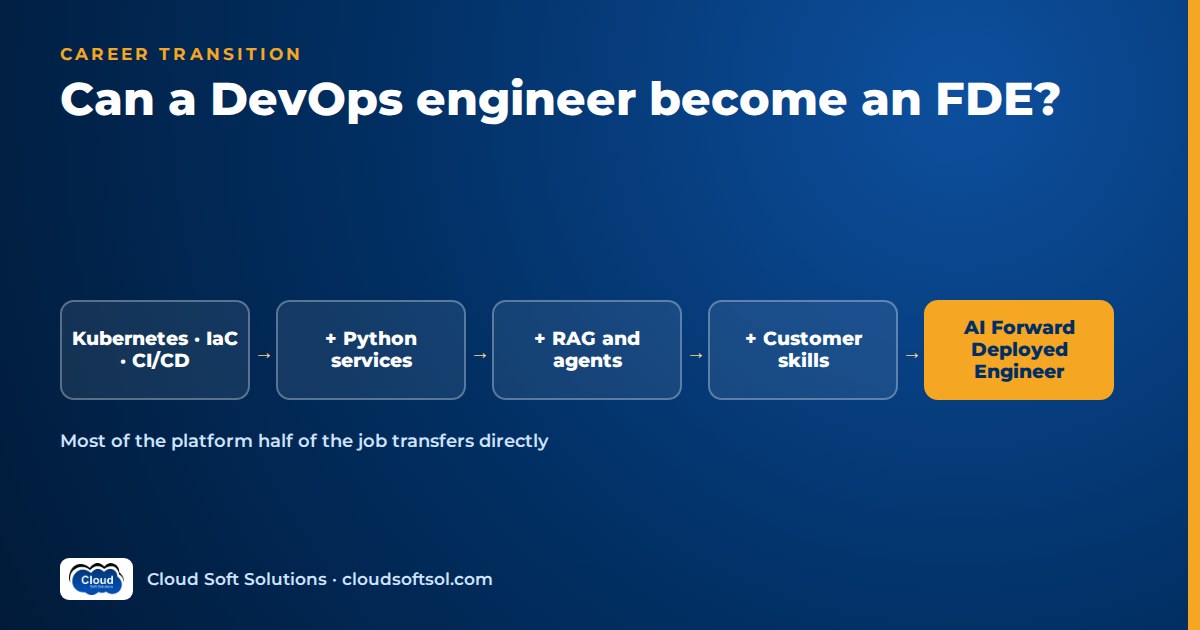
Yes, a DevOps engineer can become a Forward Deployed Engineer, and it is one of the strongest starting points for the role. FDE work is about taking AI from demo to enterprise outcome, and the hardest part of that journey is usually the part DevOps engineers already own: deploying, securing, observing and operating systems in real customer environments. What you need to add is application-level Python, a working understanding of LLMs, RAG and agents, evaluation as an engineering discipline, and the confidence to sit in front of a customer and own the problem, not just the platform.
This article is specific to the DevOps path. If you want the overview of every starting point (fresher, developer, cloud, AI/ML, support), read how to become an AI Forward Deployed Engineer first. If you are still unsure what the role involves day to day, the complete guide to the Forward Deployed Engineer role covers it in one place.
The short answer: why DevOps maps well to FDE
An FDE embeds with a customer, understands their problem, and ships a working AI system inside their environment. Cloudsoft describes the flow like this:
Customer problem -> Discovery -> Requirement
  -> Data -> AI architecture -> RAG / Agent
  -> Tools / MCP -> APIs -> Security -> Cloud
  -> Deployment -> Observability -> Evaluation
  -> Optimization -> Business outcome
Look at the second half of that chain: security, cloud, deployment, observability, optimization. That is DevOps territory. Many enterprise AI projects do not fail because the model is weak; they fail because nobody could get the system through the customer's network rules, identity setup, change process and production readiness review. We cover those failure modes in why AI demos fail in enterprise production, and a large share of them are operational.
The honest caveat: the first half of the chain (discovery, data, AI architecture, RAG and agents) is where DevOps engineers are usually thinnest. FDE hiring managers want someone who can write the application, not only the pipeline that ships it. Closing that gap is the real work of this transition.
DevOps skills that transfer directly
The table below maps what you already do to how it shows up in FDE work. Use it when you rewrite your resume later; each row is a story you can tell.
| DevOps skill | How it is used in FDE work |
|---|---|
| Kubernetes | Running the AI API, retrieval workers and agent services on EKS or the customer's cluster; autoscaling for spiky inference traffic; isolating tenants; running ingestion jobs as CronJobs. |
| Terraform / IaC | Standing up a repeatable AI stack (VPC endpoints for Amazon Bedrock or Azure OpenAI, PostgreSQL with pgvector, secrets, queues) so the same deployment can be reproduced in the customer's dev, UAT and prod accounts. |
| CI/CD (GitHub Actions, Argo CD) | Shipping prompt and retrieval changes like code; adding an evaluation stage that blocks a release if answer quality drops; GitOps promotion across environments. |
| Observability | Tracing every LLM call, tool call and retrieval step with OpenTelemetry, LangSmith or Langfuse; tracking latency, token usage, error rates and failed tool calls. |
| Incident response | Handling "the assistant gave a wrong answer to a branch manager" as an incident: reproduce from traces, find whether retrieval, prompt or data caused it, fix, add a regression test. |
| IAM and identity | Making sure the assistant only retrieves documents the user is allowed to see; least-privilege roles for agents that call ServiceNow, Jira or internal APIs; integrating with Microsoft Entra ID. |
| Cost management | Model choice, caching, prompt size and retrieval depth all drive spend. FDEs are often asked "what will this cost per month at our volume?" and DevOps engineers are used to answering that kind of question. |
Softer skills transfer too: you already work with change advisory boards, security reviews and on-call rotas, which is the enterprise reality an FDE walks into.
The gaps to close, and how to close them
These four gaps are what interviewers probe, and each needs evidence, not just a certificate.
1. Production Python services
Many DevOps engineers write Python for scripts and automation, but FDE work needs you to build and own a service: a FastAPI application with typed request models, async calls to an LLM provider, retries and timeouts, structured logging, database access and tests.
- Build a small FastAPI service that talks to PostgreSQL, with Pydantic models, pytest tests and a Dockerfile you would be happy to put in production.
- Learn async properly, because most LLM and tool calls are I/O-bound.
If your Python is mostly scripting, a structured Python course is a reasonable first step before the AI layer.
2. LLMs, RAG and agents
You do not need to train models. You do need to understand how an LLM application behaves: tokens and context windows, embeddings, chunking, retrieval, re-ranking, tool calling, and how agents loop and fail.
- Build a RAG pipeline end to end: ingest documents, chunk, embed, store in pgvector, retrieve, generate with citations. Our explainer on what RAG is covers the concepts.
- Build one agent with LangGraph that calls two or three tools, with a human approval step before any write action.
- Learn MCP (Model Context Protocol), the open protocol for connecting AI applications to tools and data. It is quickly becoming the standard way to expose enterprise systems to agents.
3. Evaluation
This is the gap DevOps people underestimate most, and also the one they can learn fastest because it resembles testing and SLOs. An AI system needs a test set of realistic questions, expected answers or grading criteria, and automated metrics such as faithfulness and answer relevance (tools like Ragas help here). Then you track those metrics release by release, just as you track error budgets. Our guide to LLM evaluation goes deeper.
4. Customer-facing skills
FDEs run discovery calls, write design documents customers sign off on, and demo to people who do not care about pods. Practise:
- Writing a one-page problem statement from a messy request ("we want AI for our IT helpdesk").
- Writing a short high-level design with architecture, data flow, security controls and open risks.
- Explaining a trade-off (latency vs answer quality, cost vs model size) to a non-technical stakeholder in two minutes.
A three-phase transition plan
We are deliberately not attaching weeks to these phases. How long each takes depends on how much Python you already write, how many hours you can give it alongside a job, and whether your current employer has AI work you can volunteer for. For the full stage-by-stage curriculum, use the FDE engineer roadmap; the plan below is the DevOps-specific shortcut through it.
Phase 1: Become an application engineer who happens to know infrastructure
Focus on Python services and AI fundamentals. Build a FastAPI service, then a basic RAG application, and deploy both with the tooling you already know. You are ready to move on when you can explain every line of your RAG service and fix a bad answer by changing retrieval rather than guessing at the prompt.
Phase 2: Production-grade AI systems
Now combine your strengths with the new skills. Add evaluation to CI, add tracing, add document-level access control, add an agent with tools and approvals, and run it all on Kubernetes provisioned by Terraform. This is where your two portfolio projects (below) get built. You are ready to move on when someone else can clone your repo, run Terraform, and get a working, evaluated system.
Phase 3: Customer engineering and the job search
Practise discovery and design documents on your own projects, rewrite your resume around outcomes, and prepare for FDE interview loops. If possible, find AI work inside your current company; many GCC and services teams in Hyderabad and Bengaluru have internal AI pilots that need someone who can deploy them properly. Volunteering to productionise one of those is often the most credible bridge into an FDE-style role.
If you would rather do these phases with structure, labs and a simulated customer engagement, the AI Forward Deployed Engineer course (FDE PRO) is built around exactly this sequence: Understand, Design, Build, Integrate, Deploy, Observe, Improve and Deliver value.
Two portfolio projects built for DevOps engineers
Generic chatbot demos will not set you apart. These two projects lean on what you already know, so they show depth where other candidates are shallow and prove you have closed the application gap. For a wider list, see 10 projects every AI FDE engineer should build.
Project 1: Internal RAG assistant on EKS with IaC and evaluation in CI
Consider a mid-sized insurer whose operations team keeps asking the same questions about runbooks, policies and change procedures. Build an assistant that answers them with citations.
- App: FastAPI service, PostgreSQL with pgvector, an ingestion job for Markdown and PDF runbooks, Amazon Bedrock (or Azure OpenAI) for embeddings and generation.
- Infra: Terraform for VPC, EKS, RDS and secrets; Helm or Kustomize manifests; Argo CD for deployment.
- Security: documents tagged by team; retrieval filters by the caller's group so a user never sees content they are not entitled to.
- Evaluation: a test set of realistic questions; a GitHub Actions stage that runs Ragas metrics and fails the pipeline if faithfulness drops below a threshold you choose and justify.
- Observability: traces for retrieval and generation in Langfuse or LangSmith, plus OpenTelemetry metrics for latency and token usage.
The README should include an architecture diagram, a cost estimate method, a list of known limitations, and a short "how to deploy into a new AWS account" section.
Project 2: AIOps incident-summary agent with approvals
Consider a bank's GCC IT team that gets paged at night and loses valuable time at the start of every incident collecting context. Build an agent that does that collection and drafts the summary.
Alert -> Agent gathers context
  (logs, metrics, recent deploys, runbook)
  -> Draft summary + suggested action
  -> Human approves / edits
  -> Ticket updated, Slack/Teams posted
- Agent: LangGraph workflow with read-only tools (query logs, fetch recent deployments from GitHub, search runbooks) and one write tool (update a ticket in ServiceNow or Jira) that only runs after explicit human approval.
- Integration: expose the tools through an MCP server so the same tools can be reused by other agents.
- Safety: least-privilege credentials per tool, an audit log of every action, and a hard rule that the agent never restarts or scales anything on its own.
- Evaluation: replay a set of past (or synthetic) incidents and score whether the summary identified the right cause and the right runbook.
You already understand the incident domain, so you can design realistic tools and failure cases. Pair it with our AI DevOps and AIOps interview questions guide to prepare for scenario questions around it.
Reframing your resume and interview stories
A DevOps resume usually lists tools. An FDE resume needs to show problems solved for someone. Rewrite each role and project around three things: the stakeholder, the problem, and the outcome.
- Before: "Managed EKS clusters and Terraform modules for the company's microservices."
- After: "Worked with the payments team to move their services to EKS; designed Terraform modules that let them provision new environments themselves, removing the dependency on the platform team for routine requests."
Then add an "AI projects" section above older experience, with your two portfolio projects, each with a one-line problem, the stack, and how you evaluated it.
For interviews, prepare four stories using the situation, action, result shape:
- A production incident where you found the root cause under pressure with stakeholders watching. It mirrors an AI system misbehaving at a customer site.
- A time you pushed back on a requirement (a risky deployment, an insecure shortcut) and offered a better alternative.
- A time you translated something technical for a business or security audience.
- Your AI project, walked through as an engagement: what problem, what design, what went wrong, how you measured quality, what you would do next.
For the full question bank, see our FDE engineer interview questions.
DevOps vs MLOps vs FDE
DevOps engineers often ask whether they should go into MLOps instead. They are different jobs, and the right choice depends on whether you want to stay platform-focused or move toward customers and applications.
| Dimension | DevOps engineer | MLOps engineer | Forward Deployed Engineer |
|---|---|---|---|
| Main goal | Reliable, fast delivery of software | Reliable training, deployment and monitoring of ML models | A working AI system that delivers a business outcome for a specific customer |
| Typical users | Internal development teams | Data scientists and ML engineers | Customer stakeholders, business users and their IT teams |
| Core work | CI/CD, IaC, containers, reliability | Feature pipelines, model registries, training jobs, drift monitoring | Discovery, building RAG and agent applications, integration, deployment, evaluation |
| Code you write | Pipelines, IaC, automation scripts | Pipelines plus ML infrastructure code | Application code plus enough infrastructure to ship it |
| Customer contact | Low to moderate | Low | High, often daily |
| Quality signal | Uptime, deployment frequency, failure rate | Model metrics, drift, pipeline reliability | Evaluation scores, adoption and the customer's business result |
MLOps suits you if you enjoy platforms and data science teams; FDE suits you if you want to own the application and work directly with the people who use it.
Frequently asked questions
Can a DevOps engineer become an AI engineer or FDE without a data science background?
Yes. Most FDE work uses existing foundation models through APIs such as Amazon Bedrock, Azure OpenAI or Gemini, so you do not need to train models. You need to understand how LLM applications behave, how retrieval and agents work, and how to evaluate them.
How much coding does a DevOps engineer need to learn for FDE roles?
Enough to build and own a production Python service: a FastAPI application with tests, database access, async calls to LLM providers, error handling and structured logging. Scripting experience is a good start, but interviewers will expect application-level code.
Is MLOps a better move than FDE for DevOps engineers?
Neither is better in general. MLOps keeps you platform-focused and close to data science teams. FDE moves you toward customers and application building. Choose based on whether you want to build the product and work with customers, or build the platform for ML teams.
Will my Kubernetes and Terraform experience actually matter in FDE interviews?
Yes, especially in system design and deployment rounds. Many AI candidates struggle to explain how they would deploy securely into a customer's cloud account. Being able to describe the network, identity, IaC and rollout plan is a genuine differentiator, as long as you can also build the application layer.
How long does the DevOps to FDE transition take?
It depends on your current Python level, the time you can commit and whether you can get AI work in your current job. There is no honest fixed timeline. Treat it as three phases, application engineering, production AI systems and customer engineering, and move on when you meet each phase's readiness check.
Which cloud should a DevOps engineer focus on for AI work?
Go deeper on the cloud you already know. AWS with Amazon Bedrock is a common enterprise choice, and Azure with Azure OpenAI is common in Microsoft-heavy organisations. The design patterns transfer across clouds, so depth in one beats shallow knowledge of three.
What AI skills should a DevOps engineer learn first?
Start with building a RAG application end to end, then add evaluation, then build one agent with tool calling and human approval. Evaluation is the skill most DevOps engineers underestimate, and it maps naturally to testing and SLO thinking.
Your next step
You already know how to get systems into production. The move to FDE is about building the AI application yourself and owning the customer outcome. If you want a guided route with 60+ labs, five enterprise projects (including an IT-Ops Multi-Agent Platform and a ServiceNow AI Agent via MCP) and the GlobalBank capstone engagement, explore the Forward Deployed Engineer course in Hyderabad. FDE PRO runs for 12 weeks in our Ameerpet classroom beside Ameerpet Metro or live online, with placement support until you're placed. Call +91 96660 19191 for a free demo session.