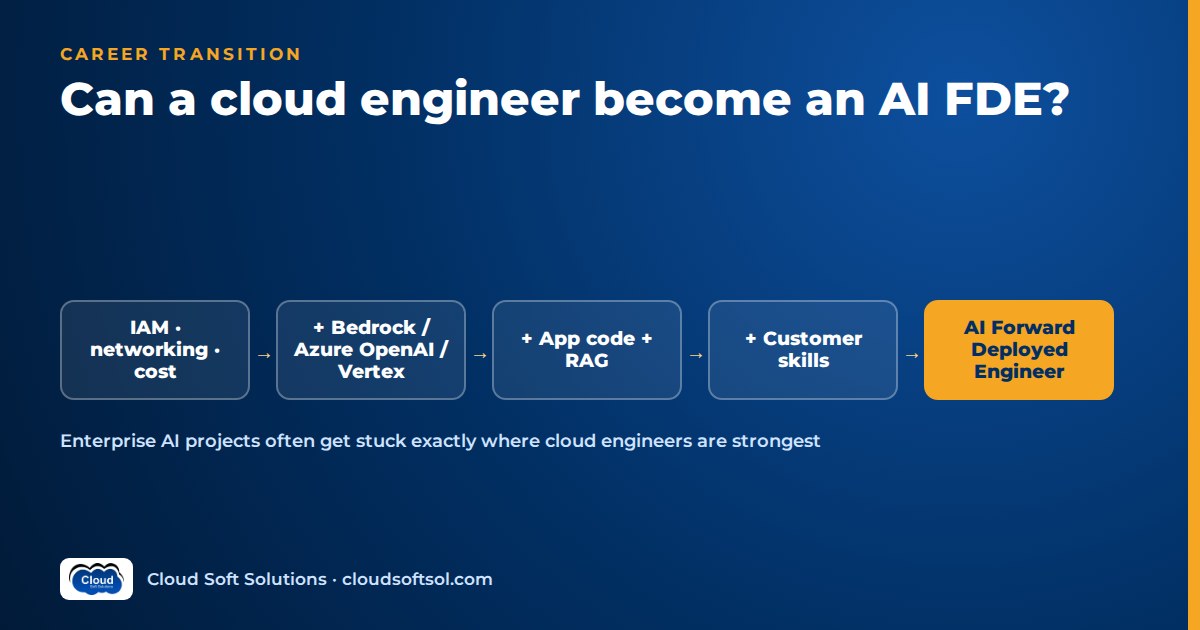
Yes, a cloud engineer can become an AI Forward Deployed Engineer, and the cloud layer is exactly where many enterprise AI projects get stuck. Identity, private networking, data residency, managed AI service quotas and cost are the questions that stall a promising pilot in a bank or hospital, and they are questions you already answer every week. What you need to add is the application on top: production Python, RAG and agents, evaluation, and the confidence to own a customer's problem rather than a ticket in their landing zone.
This article is written for cloud platform engineers and administrators working on AWS, Azure or Google Cloud. If your background is CI/CD, Kubernetes and release engineering, the sibling article on moving from DevOps engineer to FDE fits you better. For a one-line definition: an FDE embeds with a customer and ships a working AI system inside their environment; the complete guide to the Forward Deployed Engineer role covers the rest, and how to become an AI Forward Deployed Engineer compares every starting point.
The short answer: why cloud engineers have a head start
Cloudsoft describes FDE work as a chain from customer problem to business outcome:
Customer problem -> Discovery -> Requirement
  -> Data -> AI architecture -> RAG / Agent
  -> Tools / MCP -> APIs -> Security -> Cloud
  -> Deployment -> Observability -> Evaluation
  -> Optimization -> Business outcome
A cloud engineer already owns "Security", "Cloud" and much of "Deployment" and "Optimization". Those links are not glamorous, but they are where the chain breaks. A demo built in a public playground with a personal API key tells you nothing about whether the same assistant can run inside a regulated customer's network. Closing that gap is the theme of this career: from AI demo to enterprise outcome.
The caveat is equally direct. Provisioning a model endpoint is not building an AI system. Hiring managers for FDE roles want someone who can write the retrieval pipeline, design the agent, prove answer quality and explain trade-offs to a business owner. If your work today is mostly console clicks, landing zone policies and ticket queues, the application half is real work, not a weekend course.
Why cloud skills are where enterprise AI projects get stuck
Consider an insurer whose claims team has a working proof of concept: an assistant that reads policy documents and drafts answers for claims handlers. The data science team built it in a sandbox. Then it meets the enterprise, and five questions arrive in the same week.
1. Identity and access
Who is allowed to call the model, and as whom? The production version cannot use a shared API key in an environment variable. It needs workload identity (an IAM role, an Azure managed identity or a Google Cloud service account), least-privilege permissions scoped to specific models, and user sign-on through the customer's identity provider, often Microsoft Entra ID. Harder still: the assistant must only retrieve documents the signed-in user is allowed to see. That is an identity design problem before it is an AI problem.
2. Networking and private endpoints
The security team's first question is usually "does any traffic leave our private network?" Every major cloud lets you reach its managed AI services privately: AWS PrivateLink interface endpoints for Amazon Bedrock, private endpoints for Azure OpenAI and Azure AI Search, and Private Service Connect plus VPC Service Controls on Google Cloud. Getting DNS resolution, egress rules and proxy settings right across hub-and-spoke networks is familiar cloud work, and it is often the blocker that holds a pilot for weeks.
3. Data residency and data handling
Which region processes the prompts? Does a cross-region inference feature move requests outside an approved geography? Are prompts and responses logged, and where? Indian banks, insurers and hospitals, and the GCCs in Hyderabad and Bengaluru serving regulated global clients, will ask these questions in writing. A cloud engineer who can answer them precisely, using the provider's own documentation, earns trust quickly.
4. Managed AI service mechanics
Model access has to be enabled per account and region, quotas and throttling limits apply, some models are only available in certain regions, and capacity options differ (pay-per-token on-demand versus reserved or provisioned throughput). These details decide whether a pilot survives its first busy Monday.
5. Cost
"What will this cost per month at our volume?" Token usage, model choice, retrieval depth, caching, vector index sizing and reserved capacity all feed the answer. Cloud engineers who already run FinOps reviews can turn that into a credible estimate and a set of budget alarms.
We list more of these failure modes in why AI demos fail in enterprise production. A noticeable share of them are cloud problems wearing an AI label.
Cloud skills that transfer directly
| Cloud skill you have | How it shows up in FDE work |
|---|---|
| IAM policies, roles, managed identities | Scoping which workloads may invoke which models; least-privilege roles for agents that call ServiceNow, Jira or internal APIs; per-tenant isolation. |
| VPC / VNet design, private endpoints, DNS | Keeping model calls, vector search and document storage on private paths that the customer's security team will sign off. |
| Landing zones, policies, guardrails | Deploying the AI stack into a customer's account structure without breaking their organisation-level controls. |
| Infrastructure as code (Terraform, CloudFormation, Bicep) | Reproducing the same AI environment across dev, UAT and prod, and handing it over cleanly. |
| Key management and secrets | Customer-managed keys for document stores and vector databases; no credentials in code or prompts. |
| Monitoring and logging | Capturing latency, token usage, throttling and errors, while making sure sensitive prompt content is not written to logs carelessly. |
| Cost management and tagging | Per-team or per-tenant cost attribution, budgets and alarms for AI usage. |
| Compliance and audit evidence | Producing the architecture diagrams, data-flow descriptions and access reviews that risk teams require before go-live. |
The gaps to close
Application code
Most cloud engineers script; FDEs build services. You need to be comfortable writing a FastAPI application with tests, async calls to a model provider, retries and timeouts, PostgreSQL access, structured logging and clean error handling. If your Python stops at boto3 scripts, start here.
RAG and agents
You need to understand how documents are chunked, embedded and retrieved, why hybrid search and reranking matter, and how retrieval quality limits answer quality. The primer on what RAG is is a good starting point. After RAG, learn agents: a model that decides which tool to call, with state, limits and human approval for risky actions. LangGraph is one common framework for this, and MCP (Model Context Protocol, the open protocol introduced by Anthropic in late 2024 for connecting AI applications to tools and data) is increasingly how those tools are exposed.
Evaluation
Cloud engineers are used to binary health: the endpoint is up or it is down. AI systems fail quietly, with fluent wrong answers. You need test sets, retrieval metrics, faithfulness checks and regression gates in CI. Our guide to LLM evaluation explains the methods; tools like Ragas, LangSmith and Langfuse help you run them.
Customer skills
Discovery calls, writing a one-page design, demoing to a non-technical sponsor, and managing scope when the customer asks for "just one more feature". Many cloud engineers work behind a ticketing system; an FDE works in front of the customer.
The managed AI services to learn on each cloud
Go deep on the cloud you already know, then learn enough of the others to map concepts. Service names and model line-ups change often, so learn the building blocks rather than memorising model versions, and always check the current provider documentation.
| Building block | AWS | Azure | Google Cloud |
|---|---|---|---|
| Managed access to foundation models | Amazon Bedrock (models from several providers through one API) | Azure OpenAI, within Azure AI Foundry (which also offers models from other providers) | Vertex AI (Gemini models plus Model Garden for other models) |
| Managed retrieval / RAG | Knowledge Bases for Amazon Bedrock | Azure AI Search (vector, keyword and hybrid search, with optional semantic ranking) | Vertex AI Search and the Vertex AI RAG Engine |
| Agents and tool use | Bedrock agent capabilities | Agent capabilities in Azure AI Foundry | Agent tooling on Vertex AI |
| Safety controls | Amazon Bedrock Guardrails | Azure AI content filtering and safety services | Gemini safety settings and filters on Vertex AI |
| Private connectivity | VPC interface endpoints (PrivateLink) | Private endpoints | Private Service Connect, VPC Service Controls |
| Workload identity | IAM roles | Managed identities with Entra ID role assignments | Service accounts |
Two practical notes. First, the managed RAG and agent features are useful, but an FDE must also be able to build the same pattern directly (for example PostgreSQL with pgvector, your own retrieval code and LangGraph), because customers sometimes need control the managed option does not give. Second, learn each provider's data-handling and logging settings for its AI services; that is what security reviewers will ask about.
Cloudsoft runs focused courses for each platform: AWS Bedrock GenAI training, Azure AI and Azure OpenAI training, Vertex AI training, and Microsoft Entra ID training for the identity layer that almost every enterprise assistant depends on.
A three-phase transition plan
There is no honest fixed timeline; it depends on your Python level and the hours you can commit. Move to the next phase when you pass its readiness check, not when a calendar says so.
Phase 1: Build an application, not just an environment
- Write a small FastAPI service that calls your cloud's managed model service, with tests, retries and structured logs.
- Add PostgreSQL with pgvector and build a basic RAG flow yourself before using the managed version.
- Readiness check: you can explain every line of the application and debug a bad answer back to the retrieved chunks.
Phase 2: Make it enterprise-grade
- Put it behind SSO with Entra ID or another identity provider, enforce document-level permissions, and move all model and search traffic onto private endpoints.
- Add an evaluation set and a CI gate, tracing with OpenTelemetry or Langfuse, and cost dashboards.
- Build one agent with two or three tools and a human approval step for any write action.
- Readiness check: you can present the architecture to a sceptical security reviewer and answer their data-flow questions.
Phase 3: Customer engineering and the job search
- Practise mock discovery calls and write a one-page design for each project.
- Rewrite your resume around outcomes (see below) and prepare with FDE engineer interview questions.
- Readiness check: you can demo your project to a non-technical listener in ten minutes and handle "what happens if it is wrong?"
If you would rather do this with structure, labs and a simulated customer, the Cloudsoft FDE PRO program follows the same arc through its eight stations (Understand, Design, Build, Integrate, Deploy, Observe, Improve, Deliver value), with AWS as the primary cloud alongside Azure and Google Cloud, and projects such as the Secure Banking AI Assistant and Enterprise Knowledge Assistant.
Two portfolio projects built for cloud engineers
These two play to your strengths while forcing you to close the gaps. For more ideas, see projects every AI FDE engineer should build.
Project 1: Private-network RAG assistant behind SSO
Consider a hospital IT team that wants an assistant over internal policies and SOPs, with the rule that no traffic leaves the private network. Build it on Amazon Bedrock or Azure OpenAI:
User -> SSO (Entra ID) -> Private app
  -> Retrieval (pgvector or AI Search)
     filtered by user's groups
  -> Model via private endpoint
  -> Answer + citations -> Audit log
- Terraform for the whole stack: network, private endpoints, private DNS, database, key management, workload identity.
- Group-based document filtering at retrieval time, not after generation.
- An evaluation set of real-looking questions, including ones the user should not be able to answer.
- A short security note: data flows, what is logged, which region processes prompts.
Project 2: Cost-controlled multi-tenant AI API
Consider a GCC IT team offering one internal AI API to several business units, each with its own budget. Build a gateway in front of your managed model service:
- Per-tenant API keys or identities, rate limits and monthly token budgets enforced in the gateway.
- Model routing: a cheaper model for simple tasks, a stronger one for complex ones, with the choice logged.
- Response caching where safe, prompt size limits, and per-tenant cost attribution using tags and usage records.
- Dashboards and alarms for spend, throttling and error rates, plus a written runbook for "tenant hit their budget".
Reframing your resume and interview stories
Cloud resumes tend to list services. FDE resumes should describe problems solved and outcomes delivered. Compare:
| Cloud-style bullet | FDE-style bullet |
|---|---|
| Configured private endpoints and IAM roles for Bedrock. | Designed private, least-privilege access to a managed model service so a regulated team could approve an internal assistant for production. |
| Managed AWS cost optimisation. | Built per-tenant cost attribution and budget controls for a shared AI API, giving business owners a predictable monthly bill. |
| Deployed Azure landing zone with Terraform. | Delivered a reproducible AI environment across dev, UAT and prod, cutting handover friction with the customer's platform team. |
Only claim what you did. In interviews, expect a system design round where you design an enterprise assistant end to end. Lead with the customer problem, then data and retrieval, then the security and cloud design where you are strongest. Be ready to write code; interviewers will test whether you can build the application, not just host it.
Frequently asked questions
Can a cloud engineer become an AI engineer without a data science background?
Yes. FDE and applied AI engineering roles use pretrained models through APIs, so you rarely train models from scratch. You need solid Python, RAG, agents and evaluation, not deep machine learning math.
Is AWS, Azure or Google Cloud better for an AI career?
Go deeper on the cloud you already know. Amazon Bedrock, Azure OpenAI and Vertex AI cover similar building blocks, and the design patterns transfer. Depth in one cloud plus a working map of the other two is more useful than shallow knowledge of all three.
Are cloud certifications enough to get an FDE role?
No. Certifications show platform knowledge, but FDE interviews test whether you can build and evaluate an AI application and work with customers. A deployed portfolio project with an evaluation report carries more weight.
How much coding does a cloud engineer need for FDE work?
Enough to build and own a production Python service: a FastAPI application with tests, database access, calls to a model provider, error handling and logging. Infrastructure scripting is a start, not the finish line.
What is the difference between the cloud engineer and DevOps engineer paths to FDE?
Both share the application and AI gaps. Cloud engineers usually bring stronger identity, networking, data residency and cost skills, while DevOps engineers bring stronger CI/CD and Kubernetes skills. Each should build portfolio projects that showcase their own strengths.
Should I use managed RAG services or build RAG myself?
Learn both. Managed options such as Knowledge Bases for Amazon Bedrock or Azure AI Search speed up delivery, but building retrieval yourself teaches you how to debug it, and some customers need control the managed option does not provide.
Can I make this transition while working full time?
Yes, many engineers do. Work in phases, build projects in evenings and weekends, and look for chances to support AI pilots in your current job, since the security and network work on those pilots is often already yours.
Your next step
You already know how to make cloud environments safe for production. The move to FDE is about building the AI system that runs in them and owning the customer outcome. To learn Forward Deployed Engineering with 60+ labs, five enterprise projects and the GlobalBank capstone, a simulated customer engagement, explore the AI Forward Deployed Engineer course. FDE PRO runs for 12 weeks in our Ameerpet classroom beside Ameerpet Metro or live online, with placement support until you're placed. Call +91 96660 19191 for a free demo session.