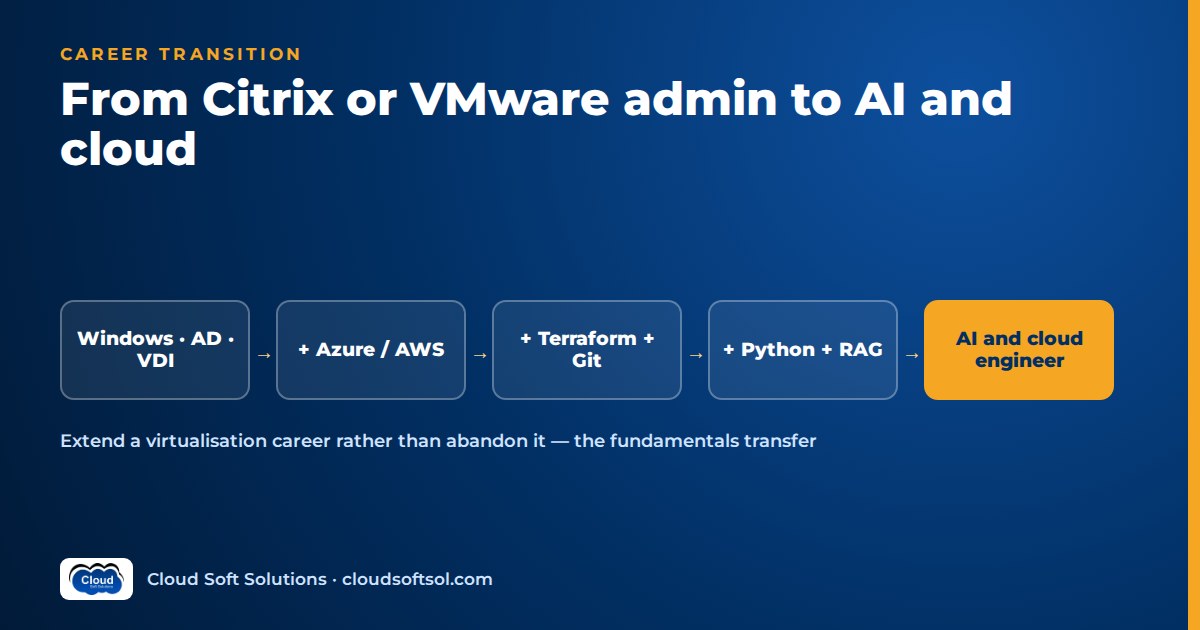
If you run Citrix, Horizon (now Omnissa Horizon, formerly VMware Horizon) or vSphere today, the practical career move is to extend into cloud, not to walk away from virtualisation. VDI and virtualisation skills are still needed in banks, hospitals, insurers and GCC IT teams, and many of those estates are now being rebuilt on Azure and AWS rather than switched off. This guide maps what you already know to cloud, Azure Virtual Desktop and AI work, then lays out three paths, each with its gaps, first three actions and a portfolio project, plus a six-month plan you can start next week.
If you want a longer view of the Citrix career ladder itself, from L1 support to architect, read the Citrix career roadmap from beginner to architect.
Why this is an extension, not a career change
A Citrix admin career change is often framed as an escape from a "dying" technology. That framing is wrong, and it leads people to throw away their strongest assets. Published desktops and apps remain the way regulated organisations give contractors, offshore teams and clinicians controlled access to sensitive systems. What has changed is where those desktops run and how they are managed.
- Control planes moved to the cloud. Citrix DaaS, Azure Virtual Desktop and Windows 365 put the brokering layer in a cloud service, so the admin's job shifts from patching Delivery Controllers to designing networks, identity and images in Azure.
- Device management moved to Intune and Entra ID. Group Policy and on-premises Active Directory still exist, but new builds increasingly assume Entra ID join, Conditional Access and Intune policies.
- Virtualisation estates are being re-evaluated. Broadcom's acquisition of VMware, and the licensing changes that followed, pushed many organisations to review their vSphere footprint. Whether they migrate to Azure or AWS, move to managed VMware in the cloud or stay put, they need people who understand the existing estate.
- AI is arriving in the service desk. Knowledge assistants, ticket triage and troubleshooting agents for end-user computing are now real projects, and they need people who know what a broken logon looks like.
Your transferable skills, mapped
Before learning anything new, take stock. The table shows where each core EUC and virtualisation skill applies in cloud, AVD and AI work.
| Skill you have | Where it applies in cloud and AVD | Where it applies in AI work |
|---|---|---|
| Windows Server, Active Directory, Group Policy | Hybrid identity with Entra ID, AD DS or Entra Domain Services for session hosts, migrating GPOs to Intune settings catalog policies | Mapping user groups to document permissions so an assistant only retrieves what each user is allowed to see |
| Networking (VLANs, firewalls, DNS, load balancers, NetScaler) | VNet and VPC design, hub-and-spoke, private endpoints, DNS forwarding, RDP Shortpath, ExpressRoute or VPN to the data centre | Keeping model and vector search traffic on private paths that security teams will approve |
| Storage (SAN, NAS, datastores, profile shares) | Azure Files or Azure NetApp Files for FSLogix profile containers, managed disks, storage tiers and backup | Designing where source documents, embeddings and logs live, and how long they are retained |
| Image management (MCS, PVS, golden images, App Layering) | Azure Compute Gallery, Azure VM Image Builder, Packer, versioned images promoted through environments | The same discipline applied to prompts, indexes and model configuration: versioned, tested, promoted |
| Troubleshooting under pressure (slow logons, black screens, printing) | Reading Azure Monitor and Log Analytics, tracing a failure across identity, network and host | Debugging an AI answer from traces: was it retrieval, the prompt, the data or the tool call? |
| Enterprise change control (CAB, maintenance windows, rollback plans) | Infrastructure as code reviews, staged rollouts, policy-as-code | Release gates for AI changes, approval steps for agents that take actions, audit evidence |
The cloud and AI columns are mostly the same skills with different tools, which is why this path is realistic for an experienced admin.
Three paths from EUC and virtualisation
Pick one path based on what you enjoy and what your current employer is moving toward. The third builds on the second.
Citrix / VMware admin
  |
  +-- Path 1: EUC on Azure
  |     AVD, Intune, Entra ID
  |
  +-- Path 2: Cloud / platform
  |     AWS or Azure, Terraform, K8s
  |       |
  |       +-- Path 3: AI / FDE
  |             Python, RAG, agents
Path 1: EUC to Azure (AVD, Intune, Entra ID)
This is the shortest jump and usually the most natural for Citrix admins. You stay in end-user computing but move to the cloud-native version of it. Citrix often runs on top of Azure, so knowing both is a strength.
Gaps to close:
- Azure fundamentals: subscriptions, resource groups, role-based access control, VNets, Azure Monitor.
- AVD architecture: host pools, application groups, workspaces, Windows multi-session, scaling plans, FSLogix on Azure storage.
- Cloud-native identity and endpoint management: Entra ID join versus hybrid join, Conditional Access, Intune compliance and configuration policies, app deployment through Intune.
- Cost thinking: in the data centre, idle hosts cost nothing extra; in Azure, they are on the bill every hour.
First three actions:
- Build an Azure subscription with a budget alert, then deploy a single AVD host pool by hand through the portal so you understand every moving part.
- Enrol a few test devices and session hosts into Intune, and move three of your familiar GPO settings into Intune policies.
- Write a one-page comparison of your current Citrix or Horizon design against the equivalent AVD design: brokering, profiles, images, printing, monitoring.
Portfolio project: an AVD environment for a fictional hospital's offshore billing team. Pooled host pool with a custom image from Azure Compute Gallery, FSLogix profiles on Azure Files, Entra ID sign-in with Conditional Access requiring MFA, Intune-managed session hosts, a scaling plan that shuts hosts down out of hours, and a short runbook for the three most common user complaints. Document each design decision.
The Azure Virtual Desktop training and Microsoft Intune training cover this path end to end, and existing Citrix engineers can keep their DaaS skills current through the Citrix training track.
Path 2: Virtualisation to cloud and platform engineering
This path suits VMware and vSphere admins who enjoy infrastructure more than desktops. The move from VMware admin to cloud engineer is about translating concepts you know well (clusters, resource pools, port groups, datastores, templates, vMotion) into cloud equivalents, then learning to describe everything as code.
Gaps to close:
- One cloud in depth, AWS or Azure: compute, networking, storage, identity and monitoring, and how they map to your vSphere estate.
- Migration patterns: rehost, replatform and refactor, plus the tools that discover and move workloads (Azure Migrate, AWS Application Migration Service) and the managed VMware options in each cloud.
- Terraform: modules, state, plans in pull requests, environments.
- Containers and Kubernetes: the platform many applications land on after migration.
First three actions:
- Draw your current vSphere environment and annotate each component with its AWS and Azure equivalent. Where there is no clean equivalent (for example DRS or shared datastores), write down what changes.
- Rebuild a small three-tier lab in the cloud with Terraform only, no console clicks, and destroy and recreate it until it is reliable.
- Containerise one simple application and run it on a managed Kubernetes service, so you can talk about what happens after the VM migration.
Portfolio project: a migration runbook for a fictional retailer moving a dozen VMs from vSphere to AWS or Azure. Include the discovery inventory, a wave plan, Terraform for the landing network and target compute, a rollback plan for each wave, and a short cost comparison method (with clearly labelled hypothetical inputs).
Useful courses for this path are VMware training for the estate you are migrating from, AWS training or Azure training for the target, and Terraform training for infrastructure as code.
Path 3: Toward AI and Forward Deployed Engineering
This path builds on Path 2. A Forward Deployed Engineer embeds with a customer and ships a working AI system inside their environment, taking it from AI demo to enterprise outcome. EUC and infrastructure people bring something rare to that work: they know how enterprise networks, identity and change control actually behave. The sibling article on moving from cloud engineer to FDE covers the cloud-to-AI step in detail; here we focus on what is specific to your background.
Gaps to close:
- Python as an application language, not just a scripting language: APIs, tests, error handling.
- Retrieval-augmented generation: how documents are chunked, embedded, retrieved and cited.
- Agents and tools: letting a model call APIs, with limits and human approval for risky actions.
- Evaluation: proving answer quality with test sets rather than impressions.
- Customer-facing work: discovery, scoping and demos to non-technical sponsors.
First three actions:
- Finish the cloud fundamentals from Path 2 first. AI systems that cannot pass a security review do not ship.
- Learn enough Python to build a small API that calls a managed model service on Azure or AWS.
- Read AI for end-user computing engineers to see where AI already fits into Citrix, AVD and VDI operations, and pick one use case from your own job.
Portfolio project: an EUC troubleshooting assistant. Index a set of anonymised runbooks and knowledge articles about slow logons, profile corruption and printing issues. Build a RAG service that answers with citations, restrict results by user group, and add one read-only tool, for example looking up session host health. Write a test set of real-world questions and report how often the answers are correct and grounded.
Consider a GCC IT team in Hyderabad supporting a global bank's virtual desktops across several time zones. Night-shift engineers spend much of their time searching old tickets for the fix to a known issue. An assistant that searches approved runbooks, shows the source and refuses to guess is a modest project, and an EUC engineer understands it better than a generic developer: who can see which runbook, which actions need a change ticket, and what "fixed" means to the user.
Planning a move into cloud-hosted desktops first? The AVD course is the most direct next step for most Citrix and Horizon admins, and it works as a foundation for the other two paths.
From PowerShell to Python, plus Git
Most EUC admins already write PowerShell, and that is a real head start. The concepts carry over; the habits need to change. PowerShell remains essential for Windows, AVD and Intune automation, so you add Python rather than replace PowerShell.
| PowerShell habit | Python equivalent to learn |
|---|---|
Pipeline of objects (Get-* | Where-Object) | Lists, dictionaries and comprehensions |
Invoke-RestMethod against an API | The requests or httpx library, with timeouts and retries |
ConvertFrom-Json and CSV exports | The json and csv modules, then data validation with typed models |
| Modules in a shared folder | Virtual environments, packages and a dependencies file |
| Try/Catch and transcript logs | Exceptions, structured logging and unit tests |
| Scheduled task running a script | A small web service (for example FastAPI) or a containerised job |
A good first exercise: rewrite a PowerShell script you already trust, such as a session host health report, in Python against the same REST API.
Git is the other non-negotiable. Store every script, Terraform file and runbook in a repository, make small commits with clear messages, work on branches and open pull requests even when you are the only reviewer. A pull request is the CAB process you already know: proposed change, review, approval, record. The Python training course is a structured option if you prefer guided practice.
Positioning your resume
Admins often list products rather than outcomes, and "Citrix, VMware, NetScaler, PVS" tells a cloud hiring manager very little. Rewrite each line as a problem, an action and a result described without inflated numbers.
- Weak: "Managed Citrix Virtual Apps and Desktops environment."
- Stronger: "Owned the published desktop platform for a hospital's clinical and billing users; redesigned profile management to remove recurring slow-logon incidents; led monthly image updates through change control with documented rollback."
Then add a section for your new work: the portfolio projects, each with a repository link, a short architecture description and what you would do differently. For a fuller treatment of portfolio structure and how reviewers read it, see the guide to building an FDE resume and portfolio, which applies just as well to cloud and AVD roles.
A six-month plan
This plan assumes you work full time and give the learning steady weekly effort. Consistency matters more than speed.
Months one and two: foundations
Choose your path. Learn the fundamentals of one cloud (Azure for Path 1, AWS or Azure for Path 2). Start using Git for everything you write at work and at home. Begin the PowerShell-to-Python rewrite exercise. By the end, deploy a small cloud environment and explain its networking and identity.
Months three and four: depth
Path 1: build the AVD and Intune portfolio project end to end. Path 2: learn Terraform properly and complete the migration runbook. Path 3 learners do the Path 2 work and add a first Python API calling a managed model. Volunteer for one small piece of cloud or automation work in your current job.
Months five and six: proof and positioning
Polish one portfolio project until a stranger could deploy it from the README. Path 3 learners build the EUC troubleshooting assistant and its evaluation report. Rewrite your resume, and start applying for roles that combine your existing depth with the new skill: AVD engineer, cloud EUC engineer, cloud infrastructure engineer, or platform engineer with a Windows focus.
For those aiming beyond cloud toward enterprise AI delivery, Cloudsoft's FDE PRO program is a 12-week next step after the cloud foundation, covering RAG, agents, MCP, evaluation and deployment through five enterprise projects and a simulated customer engagement.
Frequently asked questions
Is Citrix still a good career in 2026?
Citrix and VDI skills remain in demand in regulated industries and GCCs, but the work increasingly runs on cloud platforms. The safest position is Citrix depth combined with Azure, AVD and automation skills.
Should a VMware admin learn AWS or Azure first?
Learn the cloud your current employer or target employers use most. If you work in a Microsoft-heavy environment with Citrix or AVD nearby, Azure is usually the natural choice. The core concepts transfer between clouds once you know one well.
Do I need to learn coding to move from VDI to cloud?
Yes, but not at a software developer level for Paths 1 and 2. You need confident PowerShell or Python scripting, Terraform and Git. Path 3 toward AI requires stronger Python, because you will build and maintain application services.
What is the difference between AVD and Windows 365?
Azure Virtual Desktop gives you control over host pools, images, scaling and multi-session hosts in your own Azure subscription. Windows 365 provides managed Cloud PCs with a simpler, per-user model and less infrastructure to run. Many organisations use both for different user groups.
Can a Citrix admin move into AI engineering?
Yes, through cloud first. Build cloud and Python foundations, then learn RAG, agents and evaluation. EUC knowledge of identity, networking and troubleshooting is genuinely useful in enterprise AI projects, especially service desk and IT operations assistants.
Will my VMware or Citrix certifications still count?
They show depth in enterprise infrastructure and remain relevant for hybrid roles. Pair them with a cloud certification and, more importantly, a portfolio project that shows you can build in the cloud.
How do I get cloud experience if my current job is purely on-premises?
Volunteer for any cloud-adjacent task at work, such as an AVD pilot, an Intune rollout or a migration assessment, and build portfolio projects in your own subscription with budget alerts. Documented lab work with clear design decisions is taken seriously in interviews.
Your next step
You do not need to abandon the platform you know; you need to carry it into the cloud. For most Citrix and Horizon admins, the clearest first move is the Azure Virtual Desktop course in Hyderabad, followed by broader Azure training if you are heading toward platform work. Classes run in our Ameerpet classroom beside Ameerpet Metro or live online. Call +91 96660 19191 for a free demo session.