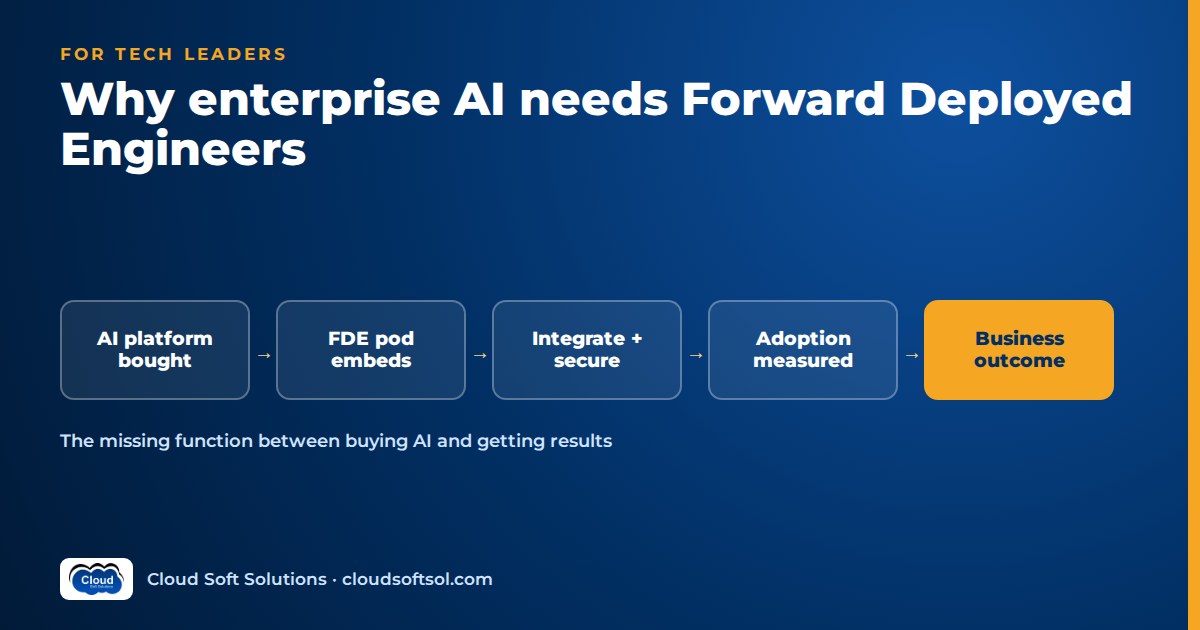
Most enterprises no longer struggle to buy AI. Model access, cloud AI services and copilots are now a procurement exercise. The hard part is turning those purchases into systems people use every day and that move a business number. Enterprise AI adoption stalls in the integration gap between a platform and an outcome, and Forward Deployed Engineers (FDEs) are the function built to close it: small teams that sit with the business, work inside your security and data constraints, and own a use case from discovery to measured result. This guide is for CIOs, CTOs, heads of AI or platform and GCC leaders; for the role definition, see what a Forward Deployed Engineer is.
The gap between buying AI and getting outcomes
The pattern is familiar: a licence is signed, a demo impresses, a programme is announced, and months later the demo is still a demo. The causes are rarely the model:
- Data is not ready. The knowledge lives in document stores, ticketing systems and spreadsheets with unclear owners and mixed classifications.
- Integration is unowned. The vendor stops at the API, application teams are busy with their own roadmaps, and nobody is accountable for wiring AI into the system of record.
- Security sees it late. Questions on data residency, prompt logging, access control and agent permissions arrive at the end, when they are expensive to answer.
- Quality is judged by impression. Without an agreed evaluation set, every stakeholder has an anecdote and nobody has evidence.
- Nobody owns the business result. Projects are measured on "delivered", not on a change in handling time, error rates or customer experience.
Our engineering articles go deeper: why AI demos fail in enterprise production catalogues the failure modes, and why the future of AI engineering is forward deployed engineering explains why the bottleneck moved from the model to integration. Platforms give you capability; outcomes need a function that converts it into adopted, governed, measured systems.
What an FDE function does for an enterprise
Traditional delivery assumes a clean handoff: requirement, code, deploy. An FDE function starts earlier and ends later:
Customer problem -> Discovery -> Requirement
  -> Data -> AI architecture -> RAG / Agent
  -> Tools / MCP -> APIs -> Security -> Cloud
  -> Deployment -> Observability -> Evaluation
  -> Optimization -> Business outcome
Internal or vendor-provided, it does five things a licence or a typical project team does not:
- Discovery with the business. Finds the task where AI changes cost, time or risk, agrees a metric with the sponsor and records a baseline before building.
- Engineering inside your constraints. Builds on your approved cloud accounts, identity provider, data classification and change process, not around them.
- Integration with systems of record. Connects AI to CRM, ticketing, core banking or claims systems through tested services with narrow tool permissions and audit trails. The Model Context Protocol (MCP) helps standardise this, but someone still has to decide what the AI may do.
- Evidence of quality. Builds evaluation sets with subject-matter experts, runs them on every change and traces production behaviour so bad answers can be explained.
- Handover and adoption. Trains users, hands the system to an owning team and stays accountable until the business metric moves.
The stage-by-stage mechanics are in our playbook on how FDEs take AI from POC to production. Your job is to make sure someone is accountable for each.
Operating models: vendor, internal, partner or hybrid
Most enterprises end up with a mix, but the choice for the first use cases matters because it decides who learns.
| Model | Pros | Cons | When it fits |
|---|---|---|---|
| Vendor FDEs | Deep product knowledge; fast start; direct line to the vendor's engineering team | Optimise for their product; knowledge leaves with them; shallow in your legacy systems | Early adoption of a specific platform, or a use case that sits mostly inside that product |
| Internal FDE pod | Lasting capability; knows your data, people and politics; aligned to your outcomes | Slower to stand up; needs scarce mixed skills and executive cover to work across silos | AI is strategic, you expect a pipeline of use cases, and a sponsor and budget are committed |
| Partner or SI | Capacity on demand; delivery discipline; strong on large integration work | Fixed scope can fight discovery; risk of "delivered but not adopted"; dependence on the partner's bench | Well-defined, integration-heavy work, or a bridge while an internal team forms |
| Hybrid | Internal pod owns outcomes and architecture; vendors and partners add depth and capacity | Needs clear decision rights and one owner per use case; coordination overhead | Most mid-to-large enterprises and GCCs once the first use case is proven |
Whichever model you choose, keep ownership of the business metric, the evaluation set and the architecture decisions inside the enterprise. Those assets compound; if outsiders hold them, you rebuy that knowledge at every renewal.
How to structure an internal FDE pod
An FDE pod is small, cross-skilled and attached to a business problem rather than a technology. A typical first pod:
| Role | Focus | Typical background |
|---|---|---|
| Pod lead / lead FDE | Owns the use case end to end; runs discovery; makes architecture calls; faces the sponsor | Senior developer, solutions architect or cloud engineer with stakeholder experience |
| FDE, application and AI | RAG pipelines, agents, tool integration, prompts, evaluation harness | Python or backend developer |
| FDE, platform and delivery | Infrastructure as code, CI/CD, Kubernetes, observability, cost controls | DevOps, SRE or cloud engineer |
| Business product owner | Defines the task, accepts the metric, champions adoption | Operations or process lead in the target function |
| Subject-matter experts (part-time) | Write and grade evaluation cases; review failure categories | Senior practitioners in the process |
Two or three engineers plus an embedded business owner is enough to start. The mix matters more than headcount: someone fluent in LLM application patterns, someone fluent in cloud delivery, and a lead who can sit with a sponsor and push back on a vague requirement.
Interfaces the pod must have
- Security and risk. Engage at discovery, not go-live, with a lightweight review path covering data classification, model provider and region, logging, prompt-injection controls and agent permissions. Our view of AI security in the enterprise is a useful shared reference.
- Data owners. A named owner for every source, a realistic access path and agreement on what may reach a model.
- Platform engineering. Build on the paved road of approved accounts, identity, pipelines and observability. Where it does not yet support AI workloads, the pod's work is the first input to extending it.
- Business owners. The sponsor owns the metric and the adoption decision; the pod owns the evidence.
- Governance. Use-case intake, risk tiering and model approval should be fast and predictable. See our sibling article on enterprise AI governance.
How to measure an FDE team
Measure outcomes and the health of the delivery system, not activity. Counting demos rewards the behaviour that creates the adoption gap. Set targets against your own baseline; external benchmarks rarely transfer between organisations.
- Adoption. Are the intended users using the system for the intended task, and returning without being chased? Track active users, repeat usage and the share of eligible tasks handled through the AI path.
- Time to production. Elapsed time from approved use case to real users on real data, and from pilot to general availability. It exposes friction in security review, data access and provisioning, where leaders can help most.
- Evaluation quality. Scores on a fixed, versioned evaluation set agreed with experts: groundedness, correctness, appropriate refusals, tool-call accuracy. Watch the trend and whether evals act as a release gate. Our guide to LLM evaluation explains the methods.
- Incidents. Production incidents by severity, including quality incidents such as a wrong or harmful answer, time to detect and resolve, and whether each produced a new eval case.
- Business KPIs. The metric the sponsor signed up for, such as handling time, first-contact resolution, rework or backlog age, measured the same way before and after and set against full running cost.
Read them together: high adoption with falling eval scores is a risk, not a success.
Hiring vs upskilling your developers and DevOps engineers
Engineers who have already shipped FDE-style AI work are scarce everywhere, including India's GCC hubs in Hyderabad and Bengaluru. Waiting to hire a full pod usually delays the first use case. The faster path combines a few experienced hires or partner engineers with deliberate upskilling of people you already employ.
Existing engineers know your systems, security process and stakeholders. They usually lack LLM application patterns (RAG, agents, tool calling, MCP), evaluation practice and the habit of running discovery.
- Backend and Python developers fit the application and AI seat once they learn RAG and agent design, evaluation and AI-specific security.
- DevOps, SRE and cloud engineers fit the platform and delivery seat; they already own CI/CD, infrastructure as code and observability and need to learn how AI workloads change them. Our DevOps engineer to FDE article shows that transition from the engineer's side.
- Solutions architects and senior engineers with customer exposure often make the strongest pod leads once they have hands-on AI build experience.
Upskilling works when it is project-based and tied to a real use case. If you are planning this for a team, Cloudsoft's corporate training for engineering teams can be shaped around your stack and a use case close to your own, from RAG and LangGraph agents to MCP integrations, evaluation, tracing and delivery on AWS, Azure or Google Cloud.
A 90-day plan for your first FDE pod
The goal of the first 90 days is not a platform or a strategy deck. It is one use case in front of real users, with evidence, and a pod that can do the next one faster.
Days 1 to 30: choose, staff and discover
- Pick one use case with a committed sponsor, a measurable task, reachable data and moderate risk, even if it is not the most visible idea.
- Staff the pod, name the business owner and line up experts for evaluation work.
- Shadow the workflow, map data sources and owners, record a baseline and log constraints such as provider, region and identity.
- Open conversations with security, data and platform teams and agree the evidence each needs. Start upskilling, using the real use case as the lab.
Days 31 to 60: build the thin slice and prove quality
- Build the thinnest end-to-end path in the approved environment, with single sign-on and permission-aware retrieval from the start.
- Build the evaluation set before tuning and agree the quality bar with the sponsor.
- Add tracing and cost capture so every answer and every rupee is explainable.
- Hold a gate review: proceed, loop back or stop. Stopping here is a cheap, legitimate result.
Days 61 to 90: pilot with real users
- Put the system in front of a named user group doing real work, integrated with at least one real system of record.
- Turn weekly feedback and failures into new eval cases, and measure the metric against the baseline.
- Produce a pilot report, a hardening plan for production and a note on what slowed the pod down, especially approvals and access.
An illustrative GCC example
Consider a global insurer's capability centre in Hyderabad that runs IT operations for the group. It has an AI platform licence and a runbook chatbot that impressed in demos but was rarely used: engineers did not trust it and it could not see live tickets.
The GCC head forms a pod of three: a senior integration engineer as lead, a Python developer from an internal tools team and an SRE from the platform group, with an incident manager as business owner. Two are upskilled in the first month, using their own runbooks and anonymised tickets as lab material.
Discovery changes the use case. The pain is not finding runbooks; it is triaging repetitive tickets and gathering diagnostics before a human can act. The pod builds an assistant that reads a new ticket in the ITSM tool, retrieves relevant runbook sections, collects read-only diagnostics through a few approved tools and drafts a triage note. Anything that changes a system stays with a human, and identity flows through the group directory so the assistant sees only what the engineer could.
Past tickets graded by senior support engineers become the evaluation set. Security approves quickly because tool permissions were narrow from the start. The pilot runs with one support tower against the triage-time baseline agreed in discovery. What the GCC presents to the group is not "we built a chatbot" but a measured change in triage effort, a reusable pattern for the next tower, and an internal team that can repeat it without a vendor in the room.
Risks and anti-patterns
- The innovation-lab trap: demos for executives, no ownership of production. Make the pod accountable for a business metric.
- Platform first, use case later: months building an internal AI platform before serving a user. Let early use cases shape the paved road.
- Late security engagement: treating review as a final form rather than a design input.
- Over-autonomous agents: broad write access to systems of record before evaluation and audit exist. Start read-only; add actions behind approvals.
- The hero engineer: one person who understands the prompts and evals. Pair and document from week one.
- Ignoring running cost: usage that looked cheap in a pilot becomes a budget line at enterprise volume. Track cost per task from the start.
Frequently asked questions
What is a Forward Deployed Engineer in an enterprise context?
An engineer who works directly with a business function to turn an AI capability into a production system people use. The FDE runs discovery, builds and integrates inside the enterprise's security and data constraints, proves quality with evaluation and stays accountable until the agreed business metric moves.
Do we need our own FDEs if our AI vendor provides them?
Vendor FDEs help you start on their platform, but they optimise for their product and their knowledge leaves with them. Most enterprises benefit from a small internal pod that owns the business metric, evaluation sets and architecture decisions, with vendor engineers alongside.
How big should a first FDE pod be?
Usually two or three engineers plus an embedded business owner and part-time subject-matter experts. The mix matters more than size: LLM application skills, cloud delivery skills and a lead who can run discovery with a sponsor.
Should we hire FDEs or upskill existing engineers?
Most enterprises do both. A few experienced hires or partner engineers seed the pod while existing developers and DevOps engineers are upskilled. Existing staff already know your systems and stakeholders, which shortens time to production.
How do we measure whether an FDE team is working?
Track adoption by intended users, time from approved use case to production, quality on a fixed evaluation set, production incidents including quality incidents, and the business KPI the sponsor agreed to. Set targets against your own baseline.
How is an FDE pod different from a traditional project team?
A project team usually receives a requirement and delivers to it. An FDE pod starts before the requirement exists, defining the problem with the business, and finishes only when the system is adopted and the result measured.
What makes a good first FDE use case?
A committed sponsor, a measurable task, data you can actually access and moderate risk. Internal assistants that support staff in a defined workflow, such as triage, policy lookup or case summarisation, are strong candidates because a human stays in the loop.
Where do FDEs fit alongside solutions architects and platform teams?
Solutions architects shape designs and platform teams provide shared accounts, identity, pipelines and observability. FDEs build on that foundation for a specific business problem and carry it through to production and adoption.
If you are standing up a first pod or reskilling an existing team, talk to Cloudsoft about corporate AI engineering training built around project work, delivered in Ameerpet or live online. For individual engineers who want the full end-to-end path, Cloudsoft's FDE PRO program runs for 12 weeks with five live sessions a week, including a weekly Customer Engagement Lab and the GlobalBank capstone engagement. Call +91 96660 19191 to arrange a free demo.