A strong FDE resume reads like a short record of customer problems you solved with deployed software, and every claim on it points to evidence a hiring manager can open: a repository, a design note, an eval report or a demo. This guide is the application kit: how to structure the resume, how to rewrite weak bullets, what the portfolio repo should contain, how to write your LinkedIn headline and about section, which writing samples to attach, and a short cover note you can adapt. It assumes you already know what to learn and build. For that, see the paths into an AI FDE role, the skills employers screen for and ten projects worth building.
New to the role? A Forward Deployed Engineer embeds with a customer and takes an AI system from vague request to production outcome; the complete guide to the Forward Deployed Engineer role covers the rest.
What FDE hiring managers scan for
A first pass is fast. The reviewer is usually answering three questions before deciding to read properly.
- Has this person shipped and deployed something? Words like "built", "deployed", "migrated", "on-call" and "in production" carry weight. "Explored", "learned" and "worked on" do not. A link to a running system or a recorded walkthrough beats a paragraph of description.
- Is there customer-facing evidence? Requirement gathering, demos to business users, handling a stakeholder's escalation, writing a handover document, supporting a go-live. Support and services engineers often have plenty and bury it.
- Can this person write clearly? The resume is itself the first writing sample. Tight bullets, consistent tense, no buzzword stacks. If the resume is hard to read, the reviewer assumes your customer emails will be too.
Resume structure for FDE roles
One page under five years of experience, two at most otherwise. Single column, standard headings, evidence near the top.
NAME | City | Phone | Email
LinkedIn | GitHub | Portfolio link

SUMMARY        2-3 lines: role, domain, proof
EXPERIENCE     impact bullets, newest first
PROJECTS       2-3 flagship repos, one line each
SKILLS         grouped, only what you can defend
EDUCATION      degree, college, year
CERTIFICATIONS optional, short
Summary
Two or three lines: what you are, what problems you solve, where the proof is. Example shape: "Backend engineer with [N] years building integrations for banking clients at an IT services firm. Recently built and deployed a permission-aware RAG assistant and an MCP-based ticket agent with human approval; eval reports and demos linked below."
Impact bullets: problem, what you built, result
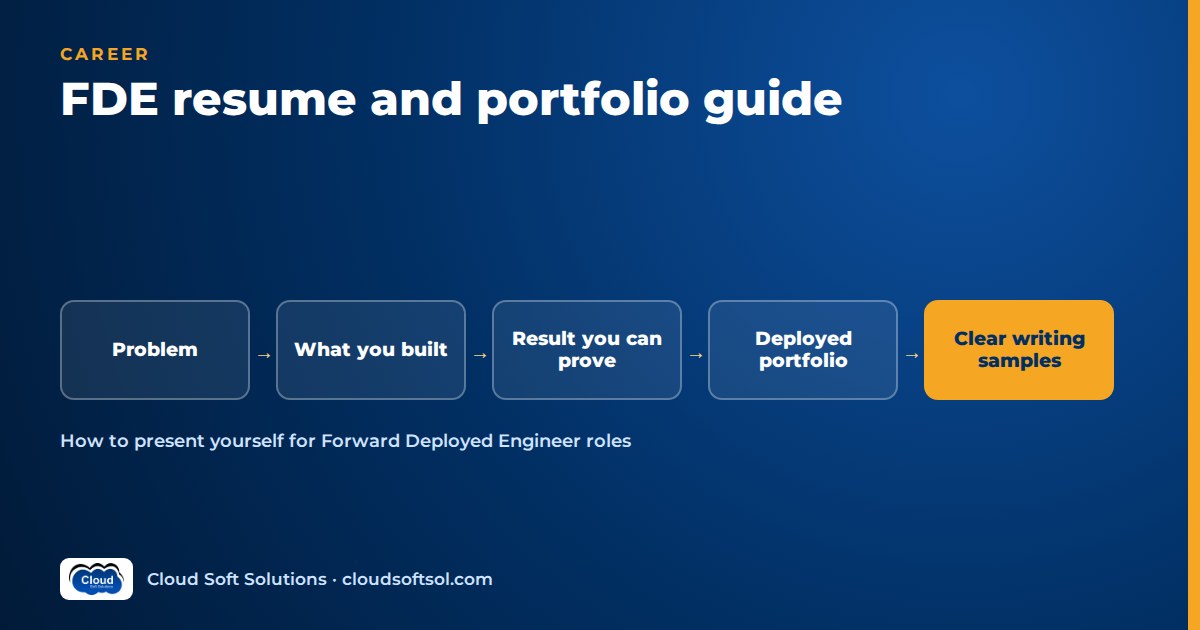
Every bullet in Experience and Projects should follow one pattern: problem → what you built → result. The problem gives context a non-specialist understands. What you built shows engineering judgement. The result shows that it mattered, measured in something the customer or team cared about: time saved, errors avoided, tickets deflected, latency, cost, adoption, or simply "went live and is used by [team]".
Results do not always need a number. "Adopted by the operations team as the default triage tool" is a real result.
Skills, grouped
A flat list of thirty tools is unreadable. Group them so the reviewer can map them to the job description in seconds:
- Languages and backend: Python, FastAPI, SQL, PostgreSQL
- AI engineering: RAG, pgvector, LangChain, LangGraph, MCP, Ragas, Langfuse
- Cloud and platform: AWS (Bedrock, ECS/EKS, IAM), Docker, Terraform, GitHub Actions
- Enterprise integration: REST APIs, ServiceNow, Jira, Microsoft Entra ID
- Customer engineering: requirement workshops, design documents, demos, RCAs
The test for every item: could you whiteboard it for ten minutes if asked? If not, remove it.
Projects section
Give each project a name that describes the business problem, one or two impact bullets and a direct link. "Claims Policy Assistant (permission-aware RAG)" tells the reader more than "GenAI Chatbot".
Rewriting weak bullets into strong ones
The examples below are illustrative. Square brackets mark where your real numbers or names belong. If you did not measure something, either measure it now on your project, describe the result qualitatively, or drop the claim. Do not fill the brackets with guesses.
| Weak | Stronger |
|---|---|
| Worked on a GenAI chatbot using LangChain. | Built a RAG assistant over [N] policy documents for an insurer's claims team, with group-based access filtering before retrieval and cited answers; deployed on AWS behind Entra ID sign-in. |
| Responsible for API integrations. | Replaced a failing nightly batch sync with an idempotent REST integration (retries with backoff, dead-letter table) between the client's CRM and order system, ending duplicate records that support had been fixing by hand. |
| Used Ragas for evaluation. | Created a [N]-question eval set with the business team and wired Ragas into CI, so retrieval or prompt changes that dropped faithfulness below [threshold] failed the build. |
| Handled production support. | Led triage on [N] production incidents for a banking client; wrote RCAs that identified a connection-pool leak and an expired certificate, and added alerts so both are now caught before users notice. |
| Knowledge of Docker and Kubernetes. | Containerised a FastAPI inference service and deployed it to EKS with Terraform and Argo CD; cut environment setup for new developers from [X] days to [Y] hours. |
| Built an AI agent for ServiceNow. | Built a ticket-triage agent that exposes ServiceNow search and update as MCP tools, pauses for human approval before any write and logs every action with its approver; tested on [N] historical tickets. |
| Interacted with clients to gather requirements. | Ran [N] requirement workshops with a hospital's operations team, turned a vague "AI for discharge summaries" request into a scoped two-week pilot with agreed success criteria, and wrote the design note they signed off. |
| Improved the performance of the application. | Reduced p95 response time of a document Q&A API from [X] s to [Y] s by caching embeddings and moving re-ranking to a smaller model, keeping faithfulness flat on the eval set. |
The strong versions name a context (claims team, banking client, hospital) and a production concern (access control, idempotency, approval, alerts, evals): the FDE chain from customer problem to outcome, in miniature.
Fresher vs experienced versions
| Section | Fresher | Experienced (3+ years) |
|---|---|---|
| Summary | What you build and the two projects that prove it | Years, domain, customer exposure, one AI system you shipped |
| Order | Projects above education; internships under experience | Experience first; projects only if they add AI or customer evidence your jobs lack |
| Bullets | Project bullets with eval results and deployment detail | Work bullets reframed as problem → build → result, with stakeholders named by role |
| Customer evidence | Mock discovery notes, a demo to non-technical users, hackathon or college-client work | Workshops, go-lives, escalations, handovers, on-call |
| Length | One page | One to two pages |
Freshers: an internship fix for a real user, or a project built for a college department, counts if you say what they needed and whether they used it. Engineers from Indian IT services firms: your client-facing work is your advantage. "Worked on a project for a US bank" hides it; "Integrated the bank's KYC service with [system] and supported go-live with the client's operations team" shows it.
ATS basics, described honestly
An applicant tracking system (ATS) is the software many employers use to collect applications and let recruiters search and filter them. How much any particular system parses, ranks or filters depends on the vendor and how the employer configured it, so treat confident claims about "beating the ATS" with caution. What you can control is simple:
- Make the file easy to parse. A text-based PDF or DOCX, single column, standard headings (Experience, Projects, Skills, Education). Avoid tables, text boxes, icons and skill-rating bars for core content; parsers can scramble them.
- Use the job description's words where they are true. If the posting says "Forward Deployed Engineer", "RAG" and "Azure OpenAI" and you have done those things, use those exact terms. Recruiters search for them. Never paste keywords you cannot back up, and never hide them in white text.
- Tailor per role. Reorder bullets and adjust the summary for each application.
A human still reads it, so bullets matter more than keyword density. Browse current FDE openings to see which terms real postings use, and mirror the ones you can honestly claim.
If you want a structured route to this evidence, Cloudsoft's FDE PRO program builds five enterprise projects and a simulated "GlobalBank" customer engagement over 12 weeks, and its placement support includes an ATS-friendly resume, LinkedIn and portfolio review, and mock interviews, until you're placed.
The portfolio repo
The projects guide covers what goes into each artefact. Here is a layout a reviewer can navigate in a minute.
claims-policy-assistant/
  README.md          problem, demo link, setup
  docs/
    architecture.png trust boundaries marked
    design-note.md   options, trade-offs
    eval-report.md   test set, metrics, failures
    security.md      auth, PII, injection
    business-summary.md  one page, no jargon
  infra/             Terraform
  app/               FastAPI service
  evals/             test set + runner
  .github/workflows/ CI with eval gate
- README a customer could follow. Top three lines: the business problem, a link to the demo video, and a link to the business summary. A reviewer who never runs the code should understand it from the first screen.
- Eval report. Include the failures. A report that shows only wins looks untested. The LLM evaluation guide explains which metrics to report.
- One-page business summary. Written for a manager at the customer: the problem, who uses it, what changes for them, the known limits, and what the next phase would cost in effort. This is the artefact most candidates skip, and the one closest to what an FDE actually hands over.
Pin two or three repos like this on your GitHub profile and add a short profile README that lists each one as "problem → what it does → link to demo". Unpin tutorial clones.
LinkedIn headline and about section
Recruiters often search LinkedIn first, so the headline carries role and proof.
- Weak: "Aspiring AI Enthusiast | Learner | Open to Work"
- Better: "Backend and AI Engineer | RAG, agents and MCP integrations deployed on AWS | Building toward Forward Deployed Engineering"
- Experienced: "Forward Deployed / Integration Engineer | Banking and insurance clients | Python, Azure OpenAI, LangGraph, Kubernetes"
For the about section, use three short paragraphs. First, what you do and for whom. Second, two pieces of evidence with links (a repo, a demo, a write-up). Third, what you are looking for. Keep it short and in the first person. Add your flagship projects to the Featured section.
Writing samples as differentiators
FDEs write constantly, yet few candidates show any writing, so two short samples stand out. Link them from your resume, README and LinkedIn Featured section.
A short design doc (one to two pages)
Context and problem, requirements and constraints, the options you considered (for example RAG vs fine-tuning, a single agent vs a fixed workflow), the decision and why, security and data handling, risks and open questions. End with a clear recommendation.
An RCA (one page)
Pick something that genuinely broke in one of your projects: a retrieval bug, a rate-limit cascade, a prompt change that dropped your eval score. Write it as you would for a customer: what happened and who was affected, timeline, root cause, fix, the new test or alert that prevents a repeat. Blameless, factual, short.
Consider a retailer's GCC team in Hyderabad hiring an FDE to support store-operations AI tools. Two candidates have similar repos. One also links a one-page RCA explaining how a stale product index caused wrong answers and how a nightly freshness check fixed it. That candidate has already shown the customer conversation they would have.
A short tailored cover note
Most portals have a cover note field or a recruiter message box. Keep it to five or six sentences and make it specific to the posting.
Hi [Name], I'm applying for the Forward Deployed Engineer role on [team]. The posting mentions integrating AI assistants with customers' ticketing and identity systems. That is close to what I built in [project]: a ServiceNow triage agent using MCP tools, with human approval before writes and an audit log, deployed on AWS. The repo includes a design note, eval report and a short demo: [link]. In my current role at [company] I [one line of customer-facing evidence]. I'd welcome a conversation about how I could help your customers get from pilot to production.
One posting detail, one matching piece of evidence, one link. Nothing generic.
Common mistakes
- Invented or unverifiable metrics. Interviewers ask "how did you measure that?" A made-up number damages everything else on the page.
- Tool soup. Forty technologies, none with context. Group them and cut what you cannot defend.
- Notebook-only projects. No deployment, no auth, no evals. They read as tutorials.
- Hiding customer work. Services and support engineers describing client-facing work as "maintained application".
- Dead links. Private repos and expired demo URLs. Test every link.
FDE resume and portfolio checklist
- Summary names your role, domain and two pieces of evidence.
- Every bullet follows problem → what you built → result.
- Every number is real and you can explain how it was measured.
- Skills are grouped, and each one survives a ten-minute whiteboard question.
- Single column, standard headings, text-based PDF or DOCX.
- Two or three pinned repos, each with README, diagram, eval report, security note, demo video and business summary.
- One design doc and one RCA linked as writing samples.
- LinkedIn headline carries role and proof; Featured section shows your flagship projects.
- All links tested in a private browser window.
Once the application is out, prepare for the loop with the FDE engineer interview questions; interviewers will pick bullets from your resume and ask you to go deeper on each.
Frequently asked questions
How long should an FDE resume be?
One page if you have under about five years of experience, and no more than two pages otherwise. Reviewers skim, so put your strongest evidence, deployed projects and customer-facing work, in the top half of the first page.
Should I put "Forward Deployed Engineer" in my headline if I have never held the title?
Do not claim a title you have not held. You can say you are building toward the role, or use an accurate title such as integration engineer or AI engineer alongside the FDE-relevant skills and projects that recruiters search for.
What if I do not have real metrics for my bullets?
Measure what you can on your own projects, such as eval scores, latency and test pass rates, and describe other results qualitatively, for example adoption by a team or a process that stopped needing manual fixes. Never guess a number to fill a placeholder.
How many projects should an AI engineer portfolio have?
Two or three deep, deployed projects are enough. Each should have a README, an architecture diagram, an eval report, a security note, a demo video and a one-page business summary. More shallow projects usually weaken the signal.
Do ATS systems reject resumes automatically?
It depends on the system and how the employer configured it. Some use knockout questions or filters; many mainly help recruiters search. A single-column, text-based resume with standard headings and honest use of the job description's terms is the practical approach.
Is a GitHub portfolio necessary for AI jobs in India?
It is not always required, but for FDE and AI engineering roles it is one of the clearest ways to show deployed, evaluated work. Recruiters at product companies and GCCs frequently open GitHub links, so pin only your strongest repos.
Should freshers include college projects?
Yes, if they are rebuilt to production standard: deployed, with authentication, evaluation and documentation. A college project that solved a real problem for a real user, described with problem, build and result, is stronger than a generic tutorial clone.
Do I need a cover letter for FDE roles?
A long letter is rarely needed, but a short tailored note helps. Five or six sentences linking one requirement from the posting to one piece of your evidence, with a link, is enough.
Want feedback on all of this from engineers who deploy enterprise AI? FDE PRO, the AI Forward Deployed Engineer course in Hyderabad, runs in a classroom in Ameerpet beside Ameerpet Metro or live online, and includes resume, LinkedIn and portfolio review with placement support until you're placed. Call +91 96660 19191 for a free demo.