LLMOps is the set of practices, tools and team habits for building, releasing, operating and improving applications that run on large language models, so that their quality, safety and cost stay under control after launch. It takes DevOps discipline (version everything, automate releases, monitor production, learn from incidents) and extends it to the parts of an LLM application that DevOps never had to manage: prompts, model and provider choices, retrieval configuration, tool definitions and evaluation sets. This overview ties the lifecycle together; pipelines, evaluation and observability each have their own deep-dive guide, linked below.
What is LLMOps?
Most enterprise LLM applications do not train a model. They call a foundation model through Amazon Bedrock, Azure OpenAI or Google's Gemini API, and wrap it in prompts, retrieval-augmented generation (RAG), tools and business logic.
That changes what "operations" means. A conventional service changes behaviour when someone merges code. An LLM application changes behaviour when a prompt is reworded, when the provider updates a model, when documents are re-indexed, or when a tool description is edited. None of these raise an error; the response is healthy, the answer inside it is wrong.
LLMOps closes that gap: treat every behaviour-defining artefact as a versioned release, decide "good enough" with evidence before you ship, see what the system actually did in production, and feed what you learn back into the next release.
The LLMOps lifecycle
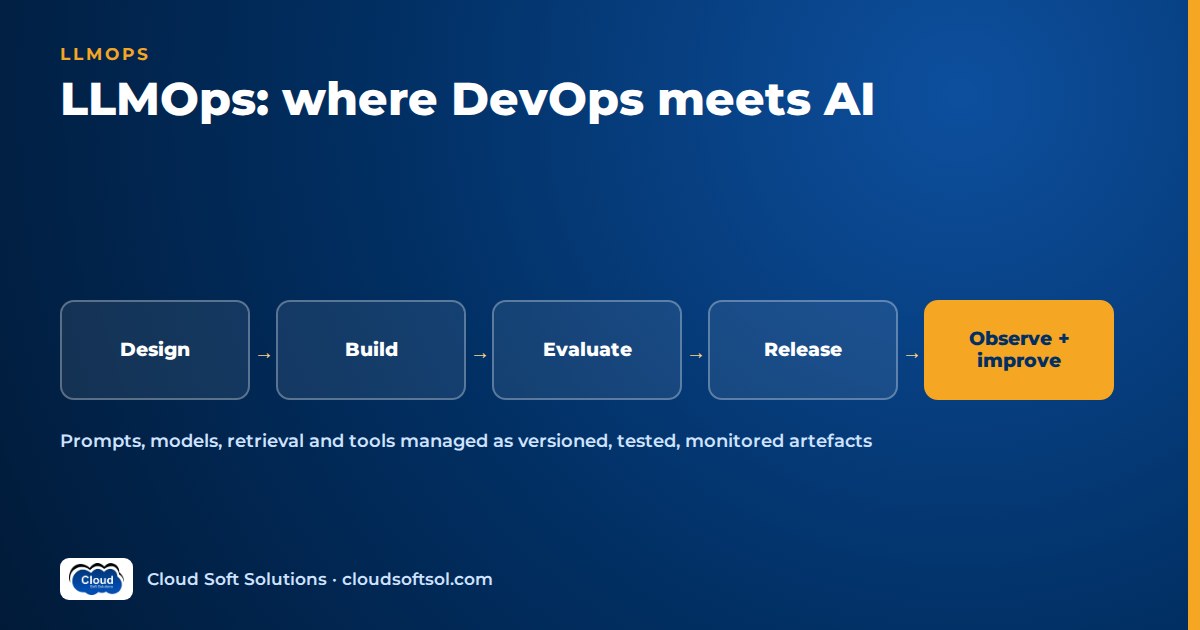
The lifecycle is a loop: production teaches you what users actually ask, so the last stage feeds the first.
  design
  (use case, risk, success criteria)
     |
     v
  build
  (prompts, retrieval, tools)
     |
     v
  evaluate --fail--> back to build
     |
     v
  release
  (versioned config, gated, canary)
     |
     v
  observe
  (traces, cost, feedback, drift)
     |
     v
  improve
  (new test cases, fixes, tuning)
     |
+-----> back to design / build- Design. Agree the use case, the risk level, who owns the outcome and what "correct" looks like.
- Build. Write prompts, set up retrieval (chunking, embeddings, filters, re-ranking), and define the tools an agent can call, increasingly exposed through MCP, the Model Context Protocol.
- Evaluate. Score the system on a versioned test set with deterministic checks, reference comparisons, LLM-as-judge scoring and human review. Our guide to LLM evaluation covers the methods and metrics.
- Release. Promote a pinned, reviewed configuration through environments with eval gates, canaries and fast rollback. The pipeline is covered in CI/CD for AI applications.
- Observe. Trace every request: prompt version, model, retrieved chunks, tool calls, tokens, latency, cost, guardrail events and feedback. See AI observability for what to capture and how.
- Improve. Turn bad answers and thumbs-down feedback into test cases, fix the cause, and release again through the same gates.
What gets versioned in LLMOps
The single most useful LLMOps habit is being able to answer "what changed?" for any behaviour shift. That requires versioning more than code.
| Artefact | What it includes | Why it needs a version |
|---|---|---|
| Prompts | System prompts, templates, few-shot examples, output format instructions | A one-line wording change can shift tone, refusals or format everywhere |
| Models and providers | Provider, model identifier, temperature, maximum tokens, fallback model | The largest behavioural change you can make, often arriving as a one-line diff |
| Retrieval config | Chunk size and overlap, embedding model, top-k, filters, re-ranker, index version | Re-indexing changes answers even when no code changed |
| Tools | Tool names, descriptions, input schemas, permissions, MCP server versions, agent graph | The model reads tool descriptions, so editing one is a behaviour change |
| Eval sets | Test cases, reference answers, judge prompts and rubrics, baseline scores | Every score is only meaningful against a known dataset and judge version |
How to store and gate these in a pipeline is covered in the CI/CD guide; the principle is that production reads a pinned, reviewed version of each, never "latest".
LLMOps vs MLOps vs DevOps vs AIOps
These four terms get used interchangeably in job descriptions, which causes real confusion. Three of them are about operating a kind of software. The fourth, AIOps, is about using AI to operate IT, which is a different thing entirely.
| Dimension | DevOps | MLOps | LLMOps | AIOps |
|---|---|---|---|---|
| Core question | How do we ship and run software reliably? | How do we train, deploy and maintain our own ML models? | How do we ship and run applications built on foundation models? | How do we use AI and analytics to run IT operations? |
| Main artefacts | Code, containers, infrastructure as code | Training data, features, model weights, training pipelines | Prompts, model config, retrieval config, tools, eval sets | Monitoring events, logs, metrics, tickets, topology |
| Who builds the model? | No model involved | Your team trains it | Usually a provider; you configure and consume it | Usually a vendor platform or your own ML models |
| How "passing" is decided | Deterministic tests pass or fail | Offline metrics on held-out data (accuracy, precision, recall) | Statistical evaluation of open-ended outputs plus deterministic checks | Whether alerts are reduced, correlated and actionable |
| Typical drift | Config and dependency drift | Data drift degrading a trained model | Prompt, provider, index and user-question drift | Changing infrastructure and alert patterns |
| Cost driver | Compute and infrastructure | Training and serving compute | Tokens per request, agent steps, context length | Platform licensing and data volume |
| Example outcome | A payments API deployed safely and often | A fraud model retrained when data shifts | An HR policy assistant that stays grounded after every prompt change | Many related alerts grouped into one probable incident |
Two clarifications. LLMOps is often called a subset of MLOps, which is fair when you fine-tune or host your own models; for the common case of calling a hosted model, the daily work looks more like DevOps plus evaluation. And AIOps meets LLMOps: an LLM-based agent that summarises incidents for on-call engineers is an AIOps use case, and that agent itself needs LLMOps to be run safely. Cloudsoft's AI DevOps interview questions and AIOps guide covers the operations side in scenario form.
The LLMOps toolchain by stage
There is no single LLMOps product. Teams assemble a toolchain, mostly from components they already know. The table uses the stack Cloudsoft teaches; equivalents exist on every cloud.
| Stage | Tools | What they do in LLMOps |
|---|---|---|
| Models | Amazon Bedrock, Azure OpenAI, Gemini | Managed access to foundation models through cloud APIs, with IAM, quotas and logging |
| Build | Python, FastAPI, LangChain, LangGraph, MCP | FastAPI serves the app; LangChain provides building blocks for prompts, retrieval and model calls; LangGraph models agents as stateful graphs; MCP standardises connections to tools and data |
| Retrieval | PostgreSQL with pgvector | Stores embeddings beside relational data, so similarity search and metadata filters share one database |
| Evaluate | Ragas, LangSmith, Langfuse | Ragas is an open-source library for RAG metrics such as faithfulness and context recall; LangSmith and Langfuse manage datasets, run evaluations and record scores against versions |
| Release | GitHub, GitHub Actions, Argo CD, Docker | GitHub Actions runs tests and eval gates on pull requests; Docker packages the service once; Argo CD syncs the approved version to Kubernetes from Git |
| Infrastructure | Terraform, Kubernetes (EKS), AWS, Azure, Google Cloud | Terraform defines model access, networking and IAM as code; EKS runs the services |
| Observe | OpenTelemetry, LangSmith, Langfuse | OpenTelemetry carries traces across the whole request; LangSmith and Langfuse show LLM trace trees, token cost and feedback (Langfuse can be self-hosted) |
| Identity and process | Microsoft Entra ID, ServiceNow, Jira | Entra ID controls who can use the assistant and what it may retrieve for them; ServiceNow and Jira hold changes, incidents and fixes |
Most of this is ordinary DevOps tooling. The genuinely new pieces are evaluation and LLM-aware tracing, plus token spend as an operational metric; see cloud cost optimisation for AI goes deeper.
Who does what: LLMOps team roles
Titles vary between a Hyderabad GCC, a services firm and a product company; the responsibilities do not.
- Business or product owner. Owns the use case and the risk. Signs off on what "good enough" means and on the thresholds the eval gate enforces.
- Domain experts. Write and approve reference answers, label samples for judge calibration and review high-risk outputs. Without them, an eval set is guesswork.
- AI engineer. Builds prompts, retrieval and agent logic, runs experiments and reads eval reports.
- Platform, DevOps or LLMOps engineer. Owns pipelines, environments, secrets, infrastructure as code, tracing and cost controls.
- SRE or on-call. Defines SLOs, handles incidents, and decides when a quality drop is an incident rather than a ticket.
- Security, risk and compliance. Review data flows, PII handling, tool permissions and audit trails. The policy layer is covered in enterprise AI governance.
On customer engagements, a Forward Deployed Engineer often covers several of these roles at once, working with the customer's domain experts while also owning the pipeline and the traces.
LLMOps maturity levels
Do not start with the full toolchain. Ask which level you are at and what moves you up.
1. Ad hoc
Prompts live in a notebook or a vendor dashboard. Quality is judged by someone trying a few questions. Deployments are manual, model versions float, and when a user complains nobody can reconstruct what the system saw. Most demos sit here, which explains many of the problems in why AI demos fail in enterprise production.
2. Repeatable
Prompts and configuration are in Git and reviewed through pull requests. A small test set exists. Releases go through a pipeline, the model version is pinned, and basic request logging is in place. Releases are reproducible, but quality is still judged by eye.
3. Measured
Evaluation runs automatically as a gate, with must-pass safety cases and category-level scores compared against a baseline. Every request produces a trace with prompt version, retrieval and tool spans, tokens and cost. Dashboards show quality signals beside latency and errors, and alerts fire on drift.
4. Optimised
The loop runs continuously. Production failures become test cases within days, judges are calibrated against human labels and re-checked, model and provider changes are compared on quality, cost and latency together, and canary or shadow releases are routine.
What DevOps engineers already know
If you come from DevOps, most of LLMOps will feel familiar. Git-based change control, pipelines, containers, Kubernetes, Terraform, secrets management, canary releases, SLOs, incident response and blameless postmortems all carry straight over. The habits matter more than the tools.
What is new is smaller than it looks:
- Statistical tests. "Did faithfulness on policy questions drop against baseline?" replaces "did it pass?"
- New release artefacts. Prompts, retrieval settings and tool descriptions need the same rigour you give to Helm values.
- Semantic monitoring. A 200 OK says nothing about correctness, so traces capture what the model saw and did.
- AI fluency to discuss chunking, embeddings, agents and judge bias.
The fuller career path, including portfolio projects, is in DevOps engineer to FDE. If you are earlier in the journey, Cloudsoft's DevOps training in Hyderabad builds the pipeline, container and infrastructure foundation LLMOps sits on, and the SRE course covers the SLO and incident practice. For the AI side, the AI, GenAI and Agentic AI course covers RAG, agents and evaluation hands-on.
An illustrative example: an insurer's claims assistant
Consider an insurer whose Bengaluru GCC builds an assistant that answers claims handlers' policy-coverage questions from policy wordings and guidelines, with a tool to look up claim status. The pilot impresses everyone. Then the guidelines are re-indexed, answers start mixing old and new rules, and nobody can tell whether the cause was the documents, a prompt edit that week or a provider-side model update.
The lifecycle fixes this in steps. In design, claims operations and compliance agree that answers must cite the guideline section and never state a coverage decision. In build, prompts move into the repository and the index is versioned. In evaluate, claims experts write reference answers plus must-pass cases such as "refuse to confirm coverage" and an injection attempt planted in a document; Ragas checks faithfulness and context recall. In release, GitHub Actions blocks any change that fails a must-pass case, and Argo CD rolls the approved version to a canary group of handlers first. In observe, Langfuse traces show the index version and chunk IDs behind every answer. In improve, flagged answers become candidate test cases, reviewed by an expert.
The result is not a perfect assistant, but one the next re-index cannot silently break, where a complaint traces to a cause quickly. That is the shift from AI demo to enterprise outcome.
To practise this lifecycle on enterprise projects, from customer discovery to observability, explore Cloudsoft's FDE PRO program: 12 weeks of live sessions, in our Ameerpet classroom beside Ameerpet Metro or live online.
Frequently asked questions
What is LLMOps in simple terms?
LLMOps is the practice of building, releasing, monitoring and improving applications that use large language models, so they stay accurate, safe and affordable after launch. It applies DevOps discipline to prompts, model choices, retrieval settings, tools and evaluation sets.
What is the difference between LLMOps and MLOps?
MLOps focuses on training, deploying and retraining your own machine learning models, with data pipelines, feature stores and model registries. LLMOps focuses on applications built on foundation models, which you usually consume from a provider, so the main artefacts are prompts, retrieval and tools, and quality is judged by evaluating open-ended outputs. When you fine-tune or host your own LLM, MLOps practices come back into scope.
How is LLMOps different from DevOps?
DevOps covers how software is built, released and run. LLMOps keeps all of that and adds versioning for prompts, model configuration, retrieval settings and tools, statistical evaluation gates in place of pass-or-fail tests alone, and tracing that records what the model saw and did, because a wrong answer usually looks like a successful request.
Is AIOps the same as LLMOps?
No. AIOps means using AI and analytics to run IT operations, for example correlating alerts or detecting anomalies in monitoring data. LLMOps means operating applications that are built on large language models. An LLM-based incident assistant is an AIOps use case that itself needs LLMOps to run safely.
What tools are used for LLMOps?
A typical toolchain combines model platforms such as Amazon Bedrock, Azure OpenAI or Gemini; LangChain, LangGraph and MCP for building; pgvector for retrieval; Ragas, LangSmith or Langfuse for evaluation; GitHub Actions, Docker, Argo CD, Terraform and Kubernetes for release and infrastructure; and OpenTelemetry with LangSmith or Langfuse for tracing.
Do I need to know machine learning to work in LLMOps?
You do not need to train models for most LLMOps work. You do need to understand how LLMs, embeddings, RAG and agents behave, how evaluation metrics and LLM judges work, and where they fail, so you can design sensible tests and read traces.
Can a DevOps engineer move into LLMOps?
Yes. Pipelines, containers, Kubernetes, infrastructure as code, secrets management, SLOs and incident response all transfer directly. The main additions are evaluation, LLM-aware tracing, cost per token and enough AI fluency to work with prompts, retrieval and agents.
Where should a team start with LLMOps?
Start by moving prompts and model configuration into Git and pinning model versions, then build a small expert-approved test set with must-pass safety cases, add it as a gate in your pipeline, and trace every production request. Grow the test set from real failures.
LLMOps is where operations experience becomes directly valuable in AI work. Cloudsoft's Forward Deployed Engineer course in Hyderabad brings the pieces together across five enterprise projects and the GlobalBank capstone, with placement support until you're placed. Join in Ameerpet or live online; call +91 96660 19191 for a free demo.