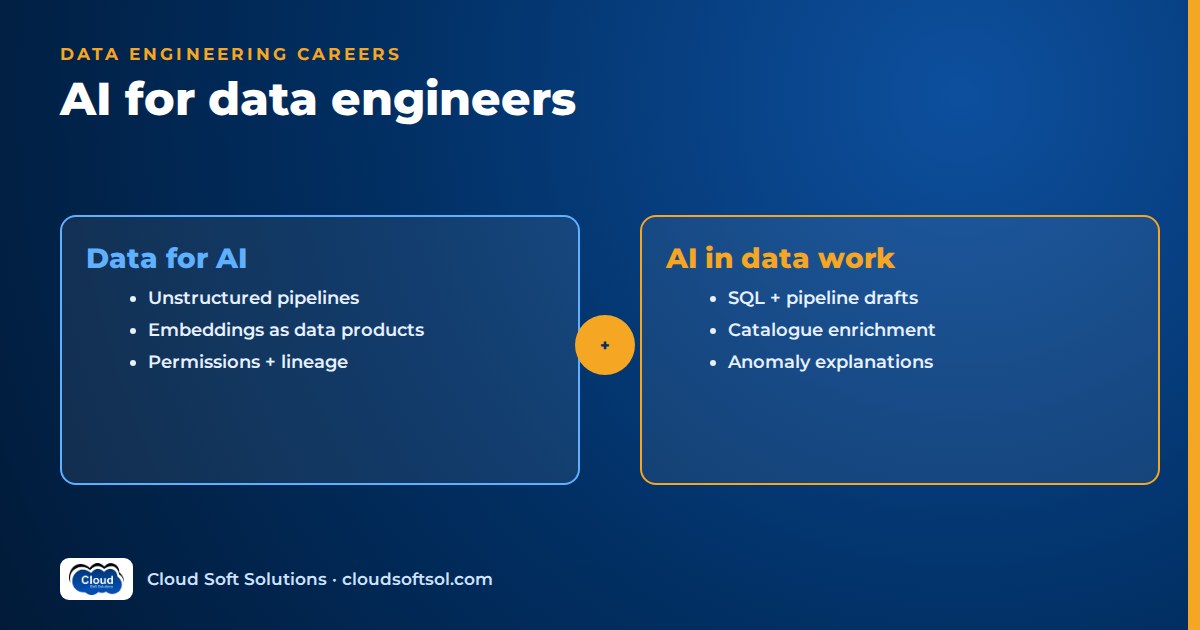
AI for data engineers means two jobs: building the data foundations that generative AI systems depend on, and using AI to speed up everyday data work without letting it ship unreviewed changes. The first half covers unstructured data pipelines, embeddings treated as a data product, vector stores beside the warehouse or lakehouse, lineage, text quality, freshness, permission propagation, evaluation datasets and embedding cost. It also covers the semantic layer that makes text-to-SQL safe. The second half covers code generation, catalogue enrichment, anomaly explanation, schema mapping and data-quality rule suggestions, along with the risks of each. A skills roadmap, an illustrative retail GCC example and an FAQ follow.
Why data engineers end up owning GenAI quality
Most enterprise GenAI applications are retrieval systems with a language model on top. When an assistant gives a wrong answer, the cause is often upstream: a stale document, a table parsed into nonsense, a chunk that lost its permissions, or a metric the model had to guess because nobody defined it. Those are data engineering problems, and the people who already run pipelines, contracts and SLAs are well placed to fix them.
The skill set gets extended, not replaced. The new parts: much of the data is text, the consumers include language models, and "correct" now also means retrievable, permissioned and fresh. If you are new to the retrieval pattern itself, read What is RAG? first; this guide assumes it.
Part 1: Data engineering for generative AI
Unstructured data pipelines: documents to embeddings
An unstructured data pipeline has the same shape as any ELT flow, with different transforms: land raw files, extract text and structure, split into chunks, enrich with metadata, embed and publish. The connector, change-feed and delete mechanics are covered stage by stage in our guide to data pipelines for RAG, and extraction from PDFs, tables and scans in document parsing for RAG. What a data engineer adds is discipline about layers:
raw (bytes)      -> bronze: files + source metadata
parsed (text)    -> silver: sections, tables, pages
chunks + vectors -> gold:   versioned, permissioned
                            retrieval-ready
Treat the chunk-and-vector layer as a data product, not a side effect of an application. It has an owner, a schema (chunk ID, document ID, version, text, embedding model, parser version, ACL, timestamps), a published freshness target and consumers who are told before it changes. Two applications that need the same corpus should read one governed table, not run their own ingestion scripts that drift apart.
Vector stores alongside the warehouse or lakehouse
Vectors do not need a separate universe. Many teams start with a vector-capable extension of a database they already run, such as PostgreSQL with pgvector, or with the vector search features now available in major warehouse and lakehouse platforms, and move to a dedicated vector database only when scale or latency demands it. Our explainer on vector databases covers the trade-offs, and the pgvector RAG tutorial shows the database-native route end to end.
Whichever store you choose, keep the system of record in the lakehouse. The vector index is a serving copy that can be rebuilt from gold tables. That one decision makes backfills, model migrations and disaster recovery ordinary data engineering tasks instead of emergencies.
Metadata and lineage for AI
When someone asks "why did the assistant say that?", you need to trace an answer back to the chunk, the document version, the parser and the embedding model that produced it. Extend your lineage graph so that retrieval indexes, prompts and evaluation sets are first-class nodes. Record at minimum:
- Source system, document ID, version and last-modified time on every chunk.
- Parser name and version, chunking strategy and embedding model identifier per batch.
- Which index build a given application release reads from.
- Business metadata that retrieval filters on: region, product line, document type, effective date, sensitivity.
Good metadata is also a retrieval feature: a filter on effective date and region often improves answers more than model tuning.
Data quality for text
Row counts and null checks do not catch bad text. Add checks that fit the content:
- Extraction quality: empty or near-empty pages, garbled characters, low OCR confidence, tables flattened into one line.
- Boilerplate ratio: headers, footers, disclaimers and signatures that crowd out real content.
- Duplicates and near-duplicates: the same policy in five folders, each slightly different.
- Chunk sanity: length distribution, chunks that start mid-sentence or contain only a heading.
- Sensitive content: PII or secrets detected in a corpus classified as general.
Failing documents go to quarantine with a reason code, exactly as bad rows would. Track quarantine volume as a pipeline health metric.
Feature and context freshness
Freshness used to be a dashboard concern. Now it decides whether an assistant quotes last quarter's return policy. Set a freshness target per corpus, agreed with the business owner: a price list may need near-real-time updates, while an HR handbook can update daily. Measure lag from source change to searchable chunk, alert on it, and expose the index timestamp to the application so it can tell users how current its knowledge is. Structured context injected into prompts, such as a customer's open orders, needs freshness SLAs too.
Permission propagation
Every chunk must carry the access rules of its source, and those rules must stay current when people change teams or leave. The pattern is to store ACLs (users, groups, sensitivity labels) as chunk metadata, filter at query time using the caller's identity from the identity provider, and re-sync permissions on their own faster schedule rather than only when content changes. For structured data, push the user's identity down to the warehouse so row- and column-level security applies to AI queries exactly as it does to dashboards. A service account that sees everything, sitting behind a chatbot, quietly bypasses every control your governance team built.
Evaluation datasets as managed data
Evaluation sets are the test suite for an AI system: questions, expected answers or expected source documents, and labels such as difficulty and category. They deserve the same care as production tables, which means version control, owners, documented provenance, a refresh cadence and protection from leaking into training or prompt examples. When the corpus changes, some expected answers become wrong. Lineage from evaluation items to source documents lets you flag them automatically. Where real examples are scarce or sensitive, generate candidates as described in our guide to synthetic data for AI testing, then have domain experts review them before they count.
Cost of embedding at scale
Embedding is cheap per call and expensive in bulk, especially when you re-embed a whole corpus. Control it the way you would control warehouse compute:
- Hash content and re-embed only changed chunks.
- Filter before embedding. Archives, drafts and duplicates nobody should retrieve do not need vectors.
- Batch requests and respect provider rate limits, rather than embedding row by row.
- Plan model migrations as backfills with a budget, a dual-write period and a cut-over test against the evaluation set.
- Tag embedding jobs with cost-allocation labels so each product team sees its own spend.
Text-to-SQL readiness: the semantic layer
Natural-language questions over the warehouse fail most often because the business never wrote down what its words mean. "Revenue" might be gross or net, include or exclude returns, and use order date or invoice date. A language model given raw table names will guess, and its guesses will look plausible. Before anyone builds a text-to-SQL agent, data engineers should provide:
- A semantic layer or metrics layer with governed definitions of measures, dimensions and joins.
- Curated, documented views exposed to the agent instead of hundreds of raw tables.
- Column descriptions, allowed values and synonyms ("store", "outlet", "branch").
- A test set of business questions with verified SQL and results.
The text-to-SQL agent project walks through the application side: validation, permissions and execution accuracy. The semantic layer underneath is data engineering work that improves your BI tools too.
Building these foundations is the core of Cloudsoft's HORIZON Data Engineering & AI program, which pairs modern pipeline engineering with the GenAI data work described above.
Part 2: Using AI in data engineering work
The second half is about your own productivity. The rule that runs through every use case: AI drafts, a human reviews, and the normal controls (tests, code review, CI, change approval) apply unchanged. AI output is never a reason to skip them.
SQL and pipeline code generation, with review
AI coding assistants are useful for boilerplate transformations, dbt-style models, orchestration DAG skeletons, PySpark conversions and tests. They are weakest where data engineering is hardest: join cardinality, late-arriving data, slowly changing dimensions, time zones and incremental logic. Review generated SQL for fan-out joins, silent filtering by inner joins, wrong grain and non-idempotent writes. Give the assistant your schema and conventions as context, and test against known results before merging. Our guide to AI coding assistants in the enterprise covers policy and rollout.
Documentation and catalogue enrichment
Language models are good at drafting table and column descriptions from schemas, sample values, query history and existing docs. That fills catalogue gaps that never get prioritised otherwise. Treat drafts as suggestions: route them to the data owner for approval, mark AI-generated descriptions until a human confirms them, and never send sample values from sensitive columns to an external model without clearance.
Anomaly explanation
Statistical monitors tell you that a metric moved. An LLM with read-only access to lineage, recent deployments, pipeline run logs and upstream freshness can draft a hypothesis: "Orders dropped for one region; the upstream POS feed for that region last loaded fourteen hours late after a schema change in the source." This shortens triage. It does not replace verification, because a fluent explanation can be wrong. Require the assistant to cite the evidence it used, and keep it read-only.
Schema mapping
Mapping a new source, such as an acquired company's ERP or a partner's product feed, onto your canonical model is tedious and well suited to AI suggestions. A model can propose column matches with reasons, flag type mismatches and suggest transformations. A human confirms each mapping, and you test the result with reconciliation queries such as row counts, sums and key coverage. Store approved mappings as versioned configuration.
Data-quality rule suggestions
Given a table's profile and description, a model can suggest expectations: value ranges, allowed categories, uniqueness, referential checks and freshness thresholds. That speeds up coverage on neglected tables. Suggested rules need calibration against real history, or you end up with alert noise or thresholds that encode today's bugs as normal.
Risks to manage
| Risk | What it looks like | Control |
|---|---|---|
| Plausible but wrong SQL | Runs cleanly, double-counts through a join | Tests with known results, peer review, grain checks |
| Data leakage | Sample rows with PII pasted into an external tool | Approved tools only, masking, enterprise agreements, logging |
| Over-privileged assistants | An agent with write access to production schemas | Read-only credentials, human approval for any change |
| Confident misexplanation | Anomaly blamed on the wrong upstream | Evidence citations, human verification before action |
| Documentation drift | AI descriptions accepted without owner review | "Unverified" flag until approved, periodic review |
| Skill erosion | Juniors who cannot debug the SQL they shipped | Explain-your-query reviews, deliberate practice |
Illustrative example: a retailer's GCC data team
Consider a multinational retailer whose global capability centre in Hyderabad runs the group's data platform. The business wants two things: a store-operations assistant that answers questions from planograms, supplier agreements and standard operating procedures, and natural-language access to sales and inventory for category managers.
The first proof of concept impressed in a demo, then failed in a pilot. It cited an outdated returns SOP, gave a store manager in one country another country's promotion rules, and answered "What was like-for-like sales growth last month?" with a number that matched no dashboard. None of these were model problems.
The GCC data team rebuilt the foundations:
- Moved document ingestion into the lakehouse as bronze, silver and gold layers, with SOP versions, effective dates and country tags on every chunk.
- Published the chunk table as a data product with an owner, a freshness target per corpus and a quarantine for scanned planograms with low OCR confidence.
- Propagated store and regional access groups from the identity provider into chunk ACLs, with a separate permission re-sync.
- Defined like-for-like sales, net sales and stock cover in the semantic layer with finance, and exposed only curated views to the text-to-SQL agent.
- Built a versioned evaluation set with store operations and category managers, linked to source documents so SOP changes flag affected items.
- Kept the vector index rebuildable from gold tables, so a later embedding-model change became a planned backfill.
In parallel, the team used AI for its own work: drafting column descriptions for the sales mart (approved by owners), suggesting quality rules for a new supplier feed, and proposing schema mappings when a franchise partner's POS data was onboarded. Every generated change still went through pull requests and CI. Store managers came to trust the answers because the data behind them was governed. That is what "from AI demo to enterprise outcome" looks like from the data side.
A skills roadmap for data engineers
| Stage | Learn | Prove it with |
|---|---|---|
| 1. Core data engineering | SQL, Python, dimensional modelling, orchestration, lakehouse table formats, testing | An incremental pipeline with tests and documented SLAs |
| 2. GenAI fundamentals | LLMs, tokens, embeddings, RAG, prompt basics, structured outputs | A small RAG app over a public document set |
| 3. Unstructured pipelines | Parsing, chunking, metadata, deduplication, text quality checks | Bronze/silver/gold layers for documents with a quarantine |
| 4. Vectors and retrieval | pgvector or a vector database, hybrid search, metadata filters, index rebuilds | A rebuildable index with permission filtering |
| 5. Governance for AI | Lineage, ACL propagation, PII handling, evaluation datasets, cost tagging | An evaluation set with lineage and a freshness dashboard |
| 6. Semantic layer and text-to-SQL | Metric definitions, curated views, query validation | A metrics layer plus a tested question-to-SQL set |
| 7. AI in your workflow | Coding assistants, catalogue enrichment, rule suggestion, review discipline | A documented before-and-after on a real backlog task |
Data engineers who enjoy sitting with business users, untangling their data and taking an AI system all the way into production inside a customer's environment are doing much of what a Forward Deployed Engineer does. If that direction appeals, the Cloudsoft FDE PRO program covers the full delivery path.
Frequently asked questions
What does AI for data engineers actually involve?
Two things: building data foundations for generative AI, such as document pipelines, embeddings, vector indexes, lineage, permissions, evaluation sets and semantic layers, and using AI tools to speed up data work such as SQL generation, documentation, schema mapping and quality rules, with human review.
Will AI replace data engineers?
AI can draft a lot of routine code and documentation, but GenAI systems create more demand for governed, fresh, permissioned data. The work shifts towards design, review, governance and unstructured data, and engineers who understand both halves become more useful rather than less.
Which data engineer AI skills should I learn first?
Start with embeddings and RAG basics, then build an unstructured data pipeline with parsing, chunking, metadata and quality checks. Add a vector store such as pgvector, then permission filtering, evaluation datasets and a semantic layer for text-to-SQL.
Do I need a separate vector database?
Not always. Many teams start with vector support in a database or platform they already run, such as PostgreSQL with pgvector, and move to a dedicated vector database only when scale, latency or features require it. Keep the lakehouse as the system of record either way.
How is data quality for text different from tabular data quality?
Text checks look at extraction quality, OCR confidence, encoding, boilerplate, near-duplicates, chunk length and sensitive content, rather than nulls and ranges. Failing documents are quarantined with a reason code, just like bad rows.
Why does text-to-SQL need a semantic layer?
Without governed metric definitions, curated views and column descriptions, a language model has to guess what business terms mean and which joins are valid. The semantic layer gives it, and every BI tool, one agreed definition to use.
Is it safe to paste production data into an AI assistant?
Only into tools your organisation has approved for that data classification. Mask or avoid sensitive values, prefer schema and metadata over raw rows, and keep assistants read-only, with all changes going through normal review and CI.
Is an AI data engineering career a good move from traditional ETL work?
Yes, if you build on your existing strengths. Pipelines, modelling, testing and governance all carry over. Adding unstructured data, vectors, evaluation and semantic layers turns them into the foundations GenAI projects need.
If you want structured, hands-on practice with both halves of this role, from lakehouse pipelines to embeddings, evaluation sets and semantic layers, explore the HORIZON data engineering and AI course at Cloudsoft. Classes run in our Ameerpet classroom beside Ameerpet Metro and live online. Call +91 96660 19191 for a free demo.