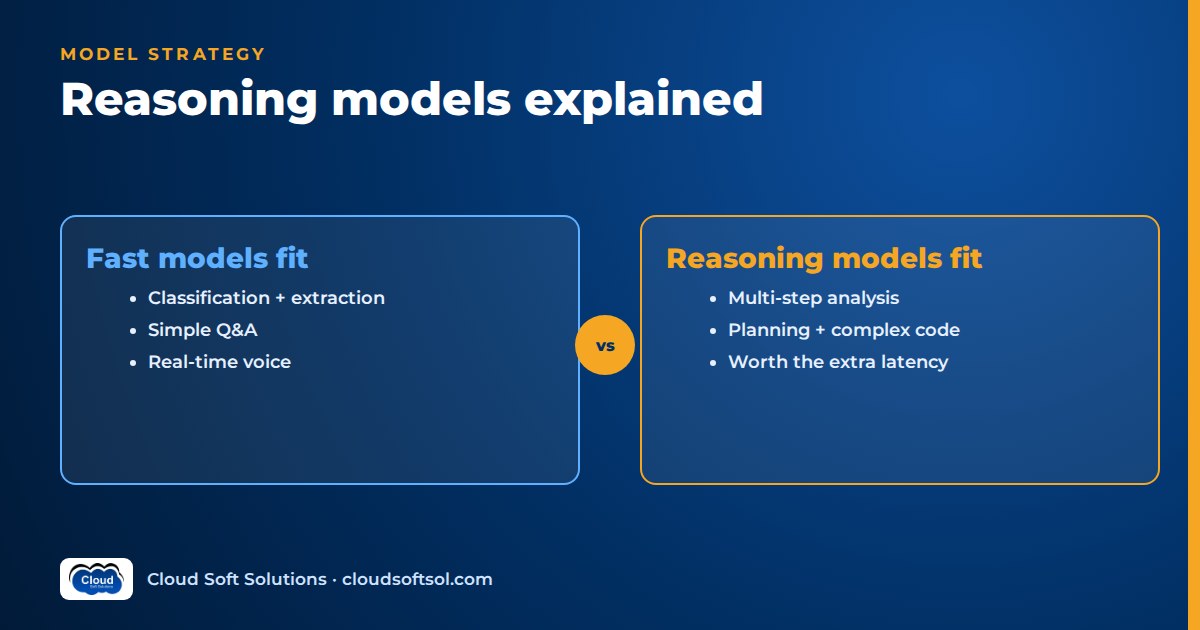
Reasoning models are large language models trained to work through a problem in intermediate steps before they commit to an answer. Use reasoning models when a task needs multi-step logic, planning or careful analysis and a wrong answer costs more than a slow one; use a standard, faster model for classification, extraction, simple Q&A and anything real-time. Most enterprise systems end up using both, with a router or an agent design that sends only the hard steps to the "thinking" model. Decide with a side-by-side evaluation on your own tasks, not a leaderboard.
What reasoning models do differently
A standard LLM starts generating its answer straight away; if you want it to work through a problem, you ask it to "think step by step" in the prompt. (If tokens are unfamiliar, start with what an LLM is.)
A reasoning model, sometimes called a thinking model, is trained to do that work on its own. Before the final answer it generates intermediate reasoning: breaking the problem into parts, trying an approach, checking it and backtracking. Providers typically train this with reinforcement learning on problems whose answers can be checked.
Three practical consequences follow:
- Computation moves to answer time. The model spends more computation per request, often called test-time or inference-time compute.
- Effort is often controllable. Many APIs expose an effort level (low, medium, high) or a reasoning token budget. Some offer thinking as a mode you switch on for a standard model, hence the term extended thinking.
- You pay for the thinking. Reasoning tokens usually count towards output usage and billing even when you never see them.
Major providers now offer reasoning models or thinking modes in some form. Names and controls change with every release, so treat the concepts here as stable and check product details in current documentation.
Reasoning vs standard LLM: where thinking helps
Reasoning helps when the answer depends on getting a chain of steps right, and when an intermediate mistake can be caught by re-checking. In enterprise work, that usually means:
- Multi-step maths and logic. Reconciling figures across documents, applying tiered pricing or tax rules, checking whether a set of conditions is jointly satisfied.
- Planning. Breaking a vague request into ordered steps, choosing which tools to call and in what sequence, scheduling under constraints.
- Complex code. Debugging across several files, writing a migration that must preserve behaviour, reasoning about concurrency or edge cases.
- Tricky analysis. Comparing a contract clause against a policy, spotting inconsistencies in a long case file, weighing evidence that points in different directions.
Reasoning does not add knowledge the model lacks. If the answer depends on your policy wording or last quarter's data, the model still needs that in context through retrieval or tools. A reasoning model can also produce a confident, well-argued wrong answer, so careful thinking reduces some errors without removing the need for grounding and checks (see LLM hallucinations explained).
The costs: latency, tokens and price
Three costs show up in every reasoning deployment.
Latency
Depending on effort and problem, the wait before the first visible answer token can run from seconds to well over a minute, and streaming helps less because there is little to stream while the model thinks. If a user is waiting, design for it: progress indicators, asynchronous jobs or a fast first response with a deeper follow-up. Our guide to LLM latency optimization covers streaming, caching and routing in more depth.
Tokens
On hard problems reasoning tokens can outnumber answer tokens many times over. They occupy context window space, and in multi-turn or agent workflows you need to know whether your provider drops, keeps or expects you to pass back earlier reasoning. The mechanics of budgets and limits are covered in tokens and context windows explained.
Price
Because you pay for output tokens you may never see, cost per request is less predictable than with a standard model. The useful unit is cost per completed business task, including retries and tool calls, not price per token. A reasoning model that gets a hard task right first time can be cheaper per task than a fast model that needs three attempts and a human fix. On easy tasks the reverse is almost always true.
When not to use reasoning models
The most common mistake is switching reasoning on everywhere because it scored well in a demo. Avoid it for:
- Classification and routing. Tagging tickets, detecting intent or sentiment, picking a queue. These are pattern-matching tasks; a fast model, or even a fine-tuned small language model, usually matches the quality at a fraction of the latency and cost.
- Extraction. Pulling fields from invoices, forms or emails into a schema. The difficulty is reading accurately, not reasoning, and structured output features matter more than thinking.
- Simple Q&A and RAG answers. If the answer is in the retrieved passage, the job is to find and restate it faithfully. Extra thinking adds delay and sometimes adds unwanted interpretation.
- Real-time voice and chat. Conversation needs a response in roughly the time a person would pause. Thinking delays break that, which is why voice AI agents typically use fast models and hand hard questions to a background process.
A reasonable default for a new feature is: start with a standard model, measure where it fails, and only then test whether reasoning fixes those failures.
Routing between fast and reasoning models
Since most traffic is easy and some is hard, many teams put a router in front of their models. The pattern is the same multi-model strategy described in how to choose an LLM for enterprise, with reasoning effort as one more dial.
 request
    |
    v
 [ router: rules or small classifier ]
    |                         |
  simple                   complex
    |                         |
    v                         v
 [ fast model ]       [ reasoning model ]
    |                  (effort: med/high)
    |                         |
    +--- low confidence ----->+
    |                         |
    v                         v
          [ validate + log ]
Common ways to decide the route:
- By task type. The simplest and most predictable. The application already knows whether a call is "classify this email" or "draft the analysis", so route in code.
- By a classifier. A small model or rules estimate difficulty from signals such as calculations or document length.
- By cascade. Try the fast model first; escalate to reasoning when validation fails, a confidence signal is low, or the output contradicts a business rule.
- By effort level on one model. With effort controls, route between low and high effort on the same model.
Whatever the method, log which route each request took. Without that, you cannot tell whether a quality regression came from the model, the prompt or the router.
Reasoning in agents: planning steps vs every step
One agent request can trigger many model calls. If every step uses high-effort reasoning, a ten-step task becomes slow and expensive, and trivial steps get over-thought.
Separate the steps by type, as in the planner-executor designs covered in agentic AI design patterns:
- Planning and re-planning: use a reasoning model. Choosing the approach, tool order and recovery from failures is where thinking pays.
- Routine execution: use a fast model for known API calls, templates and summarising tool results.
- Verification at checkpoints: use reasoning again, selectively. Check the final answer against the goal or a policy.
Some models can also think between tool calls, which suits open-ended investigation but wastes money on fixed workflows: if the steps are known, encode them in orchestration code. Evaluate agent configurations end to end, as described in AI agent evaluation, because a cheaper step model can still raise total cost if it causes more retries.
To build routers, planner-executor agents and evaluation harnesses in hands-on labs on Amazon Bedrock, Azure OpenAI and Gemini, see Cloudsoft's AI, GenAI and Agentic AI course.
How to evaluate whether reasoning is worth it
The question is whether reasoning improves your task enough to justify its latency and cost. Benchmarks will not answer it; run a controlled comparison, using the approach in our LLM evaluation guide:
- Build a test set from real work. Label easy, typical and hard cases; reasoning often helps only on the hard slice, which an average can hide.
- Define what correct means. Exact checks where possible, calibrated LLM-as-judge or expert review where judgement is needed.
- Compare configurations, not just models. Standard model, standard model with a good step-by-step prompt (the baseline many teams forget), and reasoning at low and high effort.
- Measure per task: quality, latency percentiles, total tokens including reasoning, cost per completed task and human-correction rate.
- Run each case more than once. Outputs vary between runs, and consistency matters for business processes.
- Decide per slice. Usually: reasoning for the hard slice, a fast model for the rest, which is what a router implements.
Repeat the comparison when models change; a new standard model can close the gap on tasks that once needed reasoning.
Visibility of reasoning: not an audit log
It is tempting to show the model's thinking to auditors as an explanation. Be careful. Some providers hide reasoning entirely, some return a summary rather than the raw text, and some return it in full, and these policies change.
Even when you can see it, the reasoning text is not a reliable record of why the model produced its answer. A model's stated reasoning does not always reflect what actually drove the output; it can omit factors or rationalise after the fact. So:
- Do not use reasoning text as your audit trail. Log inputs, retrieved documents, tool calls and results, model and configuration, outputs and human approvals instead.
- If a decision needs a justification, ask for a structured rationale in the answer itself, citing the specific sources or rules applied, and validate it against those sources.
- Treat any visible reasoning as sensitive data. It can contain restated personal or confidential information from the input, so apply the same retention and access rules as the rest of your logs.
- Use reasoning traces, where available, as a debugging aid during development, not as evidence.
Prompting reasoning models differently
Habits built for standard models can work against reasoning models. Provider guidance differs in detail, but the direction is consistent:
- Less step-by-step micromanagement. Long "first do this, then that" scripts constrain the model's own approach. State the goal, constraints and what a good answer looks like, and let it plan.
- Be precise about the output. Specify format, required fields, length and tone.
- Give the context, not the method. Provide the relevant policies, data and definitions; this is the core idea of context engineering.
- Use effort settings instead of pleading. Phrases like "think very carefully" are a weak substitute for the effort or budget control the API provides.
- Test examples carefully. Few-shot examples help with format, but many worked examples can narrow the model's approach.
Illustrative example: an insurer's underwriting analysis
Consider a commercial insurer whose underwriting team in a Hyderabad GCC reviews submissions for small business property cover. Each submission includes a proposal form, prior claims history, a broker's email and sometimes a survey report. The team wants an assistant that drafts an underwriting summary and flags issues before an underwriter decides.
A first prototype sends everything to a reasoning model at high effort. Quality is good, but it is slow and token-heavy, and most of the effort goes on reading forms, which a standard model does just as well.
The redesigned pipeline splits the work:
- Extraction (fast model, structured output): pull insured values, occupancy, construction type, claims history and requested limits from each document into a schema.
- Rules check (code): deterministic guideline checks such as missing fields, values outside appetite and referral triggers.
- Analysis (reasoning model, medium effort): given the extracted data, the rules results and the relevant guideline sections, identify inconsistencies (a claims history that contradicts the broker's email, a sum insured that looks low for the stated floor area), and explain which guideline each flag relates to.
- Escalation (reasoning model, high effort): only for submissions with conflicting evidence or multiple referral triggers.
- Human decision: the underwriter reviews the draft, the cited sources and the flags, then accepts, edits or rejects. The decision and the underwriter's edits are logged, not the model's internal reasoning.
The team evaluates on past submissions labelled by senior underwriters, comparing missed issues, false flags, processing time and cost per submission across configurations. Getting such a pipeline approved inside a customer's environment, with data access, security review and integration into the underwriting workbench, is the kind of work Forward Deployed Engineers do.
Decision table: when to use reasoning models
| Task or situation | Recommended default | Why |
|---|---|---|
| Ticket, email or intent classification | Fast or small model | Pattern recognition; reasoning adds cost and delay without gain |
| Field extraction into a schema | Fast model with structured output | Accuracy depends on reading, not multi-step logic |
| RAG answer from retrieved passages | Fast model; test reasoning only for multi-document synthesis | Faithful restatement matters more than deliberation |
| Real-time voice or live chat | Fast model; hand hard cases to a background job | Thinking delays break conversational timing |
| Calculations across documents or rules | Reasoning model, low to medium effort | Multi-step logic where intermediate checks catch errors |
| Complex debugging or code changes | Reasoning model | Needs tracing behaviour across files and edge cases |
| Agent planning and re-planning | Reasoning model | Choosing approach and tool order is where thinking pays |
| Routine agent tool calls | Fast model | Steps are known; over-thinking multiplies cost |
| High-stakes analysis with human review | Reasoning model, medium to high effort, plus cited sources | Errors are costly; latency is acceptable |
| Mixed traffic of unknown difficulty | Router or cascade | Pay for reasoning only on the hard slice |
Frequently asked questions
What is a reasoning model in AI?
A reasoning model is a large language model trained to generate intermediate reasoning before giving its final answer. It breaks problems into steps, checks its work and can backtrack, which improves results on multi-step logic, planning and analysis at the cost of more tokens and higher latency.
What is extended thinking?
Extended thinking is a term some providers use for a mode in which a general model reasons at length before answering, usually with a configurable thinking-token budget that you can switch on or off per request.
Are reasoning models always more accurate?
No. They tend to help on tasks that need several dependent steps, such as calculations, planning, complex code and tricky analysis. On classification, extraction and simple Q&A they often give similar quality to a fast model while costing more and responding slower. Measure on your own test set before switching.
Do I pay for reasoning tokens I cannot see?
Usually yes. Providers generally bill reasoning tokens as output and count them against output limits even when the reasoning is hidden or summarised, so track total tokens per task.
Can I use a reasoning model's thinking as an audit trail?
No. Some providers hide or summarise the reasoning, and even visible reasoning is not necessarily a faithful record of why the model answered as it did. Log inputs, retrieved sources, tool calls, outputs, configuration and human approvals instead, and ask for a structured, source-cited rationale in the answer when one is needed.
Should an AI agent use a reasoning model for every step?
Rarely. A common pattern uses a reasoning model for planning, re-planning and final verification, and a fast model for routine tool calls, so latency and cost do not multiply across every step.
How should I prompt a reasoning model?
State the goal, constraints, relevant context and the exact output format, then let the model plan its own approach. Avoid long step-by-step scripts that micromanage its thinking, and use the provider's effort or budget setting rather than phrases like "think very carefully".
Ready to move from reading about reasoning models to building systems that use them sensibly? Cloudsoft's AI, GenAI and Agentic AI training in Hyderabad covers model selection, routing, RAG, agents and evaluation through hands-on labs, in our Ameerpet classroom beside Ameerpet Metro or live online. Call +91 96660 19191 to book a free demo.