The FDE vs prompt engineer question has a short answer. Prompt engineering is a real and useful skill, but it controls only one layer of an AI system, while a Forward Deployed Engineer (FDE) owns the whole system that makes AI work inside a customer's environment: data, integrations, security, deployment and evaluation. A good prompt can fix how a model answers. It cannot fix what the model can see, what it is allowed to touch, or whether anyone can prove it is working. That is why prompting is now treated as part of every AI engineer's toolkit rather than a career on its own.
What prompt engineering really is (and what it is becoming)
Prompt engineering is the practice of designing the instructions, examples and context a large language model receives so that it produces useful, consistent output. Done well, it is careful specification: task, audience, constraints, output format, edge cases and what to do when information is missing.
The field has also grown up. Early prompt work was mostly about a single block of text typed into a chat window. In production systems, the model's input is assembled at runtime from many parts: a system prompt, retrieved documents, conversation history, tool definitions, user profile data and output schemas. Many practitioners now call this broader discipline context engineering, because the hard question is no longer "how should I phrase this?" but "what exactly should the model see, in what order, and within what budget, for this request?"
That shift explains a career trend you may have noticed. During the first wave of generative AI, some companies advertised standalone "prompt engineer" roles. Those titles have become rarer, not because the skill stopped mattering, but because it has been absorbed into engineering roles. Today you are more likely to see prompt and context design listed as a required skill inside AI engineer, applied AI engineer and FDE job descriptions than as a job title of its own.
The FDE role, in contrast, is defined by placement and accountability. Popularised by Palantir, which "forward deployed" engineers into customer organisations, it means an engineer who works inside a client's environment and stays responsible until the AI system delivers a business result. For the full picture, see what a Forward Deployed Engineer does.
FDE vs prompt engineer: side-by-side comparison
| Dimension | Prompt engineer (standalone role) | Forward Deployed Engineer |
|---|---|---|
| Scope | The model's instructions, examples and output behaviour for defined tasks | The full system from customer problem to measured business outcome |
| Artefacts | Prompt templates, few-shot example sets, style guides, test prompts | Services, APIs, retrieval pipelines, agents, tool integrations, infrastructure code, eval suites, runbooks |
| Code depth | Light to moderate; often notebooks, scripts or prompt tooling | Production code: Python services, data pipelines, CI/CD, infrastructure as code |
| Systems touched | The LLM API and perhaps a prompt management tool | Identity providers, databases, vector stores, ticketing and business systems, cloud networking, observability stacks |
| Ownership | Quality of model responses for a given input | Whether the customer's system works, stays secure and is actually used |
| How success is measured | Output quality on sample prompts, tone and format consistency | Go-live, business KPI moved, evaluation scores over time, cost and latency within budget |
| Career trajectory | Increasingly merges into AI engineer, content/AI ops or product roles | Senior FDE, FDE lead, AI architect, solutions architect, engineering manager |
Notice that the FDE column contains the prompt engineer column. FDEs write prompts constantly, but for them the prompt is one component of a system they are accountable for, not the deliverable. The same pattern shows up when you compare FDEs with AI engineers: shared technical core, different ownership.
What prompting can fix and what it can't
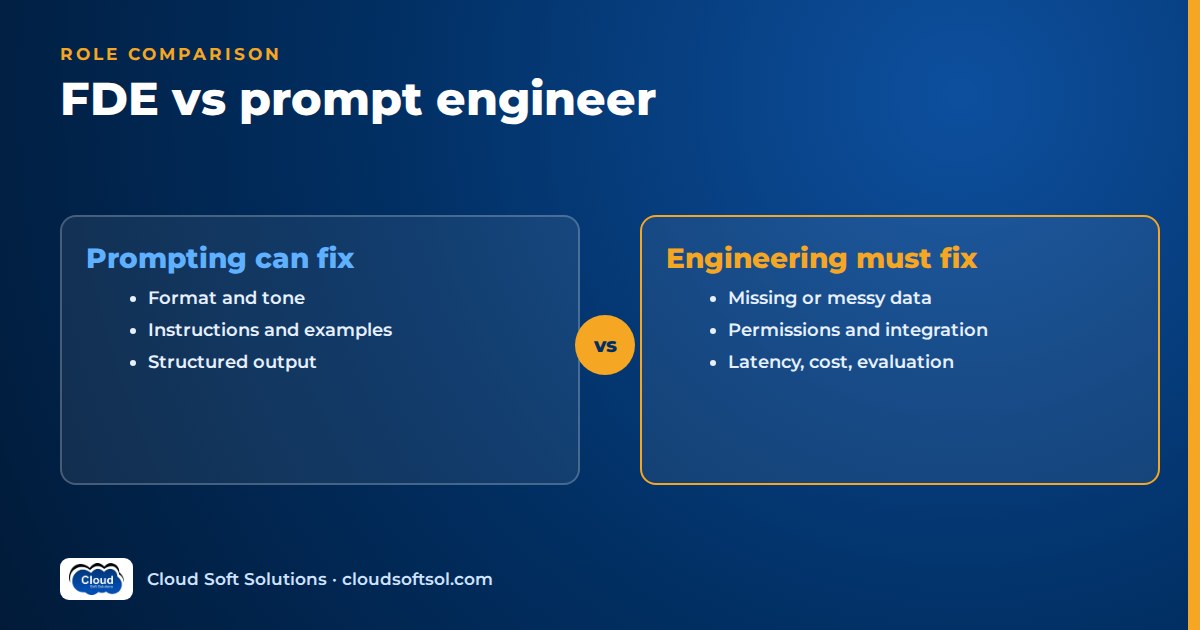
The most useful mental model for this comparison is a simple boundary. Prompting changes how the model uses what it has. It does not change what it has.
Problems prompting can genuinely fix
- Format: answers that ramble, miss required fields or break the JSON your code expects.
- Tone and voice: replies that are too casual for a bank, too technical for frontline staff, or inconsistent across users.
- Task framing: a model summarising when you wanted it to classify, or answering when it should ask a clarifying question.
- Refusal behaviour: telling the model to say "I don't have that information" instead of guessing.
Problems prompting cannot fix
- Missing or stale data: if the current policy document is not in the index, no instruction will make the model know it.
- Permissions: whether a contractor should see a document marked confidential is an access-control decision enforced in retrieval and identity, not a sentence in a system prompt. "Do not reveal confidential data" is a hope, not a control.
- Latency: a slow response caused by oversized context, sequential tool calls or a distant model region is an architecture problem.
- Integration: the model cannot create a ServiceNow ticket or check a leave balance unless someone builds the API connection, authentication and error handling.
- Evaluation: without a test set and metrics, you cannot tell whether yesterday's prompt change improved answers or quietly broke a hundred of them.
Enterprise AI projects usually stall on the second list, which is why AI demos fail in enterprise production even when the prompts looked excellent in the demo.
An illustrative example: the HR-policy bot whose problem was the data
Consider an IT services company with a large GCC-style delivery centre in Hyderabad. HR launches an internal assistant to answer employee questions about leave, travel reimbursement and work-from-home rules. The pilot uses a capable model, a well-crafted system prompt and a folder of policy PDFs.
Within weeks, complaints arrive. The bot allows more leave carry-forward than current policy, quotes travel limits that changed last year, and describes benefits that apply only to one office.
The first response is to rewrite the prompt: "Always use the latest policy." "If unsure, say so." Answers become more cautious, but they are still wrong, because the model is faithfully summarising what it is given.
An engineer who investigates the system, not just the prompt, finds the real causes:
- Duplicate versions: the folder contains three versions of the leave policy, and the old ones have more matching text, so retrieval ranks them higher.
- No metadata: chunks carry no effective date, location or employee category, so the retriever cannot filter to "current policy for this employee".
- Broken tables: the reimbursement limits live in a scanned table that the PDF parser turned into scrambled text.
- No identity context: the bot does not know which office or grade the employee belongs to, because it is not connected to the HR system or the company's single sign-on.
- No evaluation: nobody had a list of real questions with correct answers, so regressions went unnoticed.
The fix is engineering work. Remove superseded documents and add a sync job that marks the current version. Attach metadata (effective date, location, grade) during ingestion and filter on it at query time. Re-parse tables properly. Pass the employee's attributes from the identity provider into retrieval filters. Build an evaluation set of real employee questions, reviewed by HR, and run it on every change. Only then does prompt tuning pay off, for example making the bot cite the policy section and effective date.
This is the FDE pattern in miniature: start from the customer problem, discover the real cause, and fix the data and system before polishing the words. It is also a textbook case of retrieval-augmented generation (RAG) where retrieval quality, not generation, decides the outcome.
Context engineering in production: what it actually involves
None of this makes prompt skill obsolete. In production it becomes a disciplined engineering practice.
Versioned prompts
Prompts live in source control or a prompt registry, not in someone's notes. Each change has an ID, a reason and an evaluation result attached. When answers degrade, you can see which prompt version was live and roll back. LangSmith or Langfuse can link prompt versions to traces.
Structured output
Downstream code needs predictable output. Production systems define a schema (for example with Pydantic in a FastAPI service), use the provider's structured output or tool-calling features, validate the result and fall back safely on failure.
Few-shot examples
Good examples often teach more than paragraphs of instructions. In production they are curated, kept small, covered by evaluation and sometimes selected dynamically to resemble the incoming request.
Retrieval as context
For enterprise knowledge, the most important context is retrieved, not written. Chunking, metadata, hybrid search, re-ranking and permission filters (for example in PostgreSQL with pgvector) decide what the model sees. Context engineering here means choosing how many chunks to include, in what order, labelled for citation.
Tool descriptions
When a model can call tools, the tool name, description and parameter schema are effectively prompts. A vague description leads to the wrong tool being called or the right tool being called with bad arguments. With the Model Context Protocol (MCP), an open protocol for connecting AI applications to tools and data, tool descriptions are exposed by servers to any compatible client, so writing them clearly becomes a shared engineering responsibility.
Evaluation
Every item above is only as good as the evidence behind it. Production teams keep a test set of real queries, measure retrieval and answer quality with frameworks such as Ragas, and add human review for sensitive cases. A prompt change ships when it improves the scores without regressions, not when it "feels better". If evaluation is new to you, read our guide to LLM evaluation.
Prompt engineer's view:
  instruction -> model -> answer

Production context engineering:
  user + identity -> retrieval (filters)
    -> tools / MCP -> versioned prompt
    -> model -> schema check -> answer
    -> trace -> evaluation -> next change
If you can already write strong prompts, this list is your bridge: each item turns a prompt skill into an engineering skill. Want structured, project-based practice in exactly this bridge? The AI Forward Deployed Engineer course at Cloudsoft covers it across 12 weeks of live sessions, including a Customer Engagement Lab every week.
Is prompt engineering a career on its own?
For most engineers, treat it as a core skill, not a destination. Roles where prompt design is central still exist, such as conversation design and AI content operations, but the engineering work enterprises need sits around the prompt: connecting systems, protecting data, deploying reliably and proving results.
Prompt skills transfer well. People who prompt well specify tasks precisely, think about edge cases and test outputs critically, which are exactly the habits needed in evaluation design and requirements discovery. The gap is engineering depth and systems knowledge, and it can be closed. The wider argument for why integration skills are gaining value is laid out in why the future of AI engineering is Forward Deployed Engineering.
A path from prompt skills to FDE: concrete steps
- Get fluent in Python for services, not just scripts. Learn to build a small FastAPI service with typed request and response models, error handling and logging.
- Move your prompts into code. Store prompts in a repository with templates and variables, call models through an API (Amazon Bedrock, Azure OpenAI or Gemini) and enforce structured output with a schema.
- Build a real RAG pipeline. Ingest messy documents, add metadata, store embeddings in pgvector and implement filtered retrieval. Recreate the HR-policy problem deliberately, with duplicate versions, and fix it.
- Add evaluation before you add features. Write 30 to 50 realistic test questions with expected answers, measure with Ragas and trace runs in LangSmith or Langfuse. Make every prompt change go through this test.
- Connect to a system of record. Build a tool that reads from or writes to something real, such as Jira, GitHub or ServiceNow, and expose it through an MCP server. Handle authentication and failures properly.
- Add identity and permissions. Integrate sign-in with an identity provider such as Microsoft Entra ID and pass user attributes into retrieval filters so users only see what they are allowed to.
- Deploy it like production. Containerise with Docker, deploy to AWS, Azure or Google Cloud, add CI/CD with GitHub Actions and basic observability with OpenTelemetry.
- Practise the customer side. Write a one-page discovery summary for your project: the business problem, users, data sources, risks and the metric that defines success. Present it to someone non-technical.
Together these artefacts show the full chain from customer problem to business outcome. For project ideas that match these steps, see projects every AI FDE should build, and for paths by background (fresher, developer, DevOps), read how to become an AI Forward Deployed Engineer.
Frequently asked questions
What is the main difference between an FDE and a prompt engineer?
A prompt engineer focuses on the instructions and examples that shape a model's responses. A Forward Deployed Engineer owns the entire AI system inside a customer's environment, including data, integrations, security, deployment and evaluation, and is accountable for the business outcome. FDEs use prompt engineering as one of many skills.
Is prompt engineering still a career?
Prompt engineering is still a valuable skill, but standalone prompt engineer titles have become rarer as the skill has been absorbed into AI engineer, applied AI engineer and FDE roles. Treat it as a core competency to build on rather than a complete career path.
What is context engineering?
Context engineering is the broader practice of deciding everything a model sees for a given request: system instructions, retrieved documents, conversation history, tool descriptions, user data and output schemas. It treats the model's input as something assembled and tested by a system, not a single hand-written prompt.
Can better prompts fix hallucinations in an enterprise chatbot?
Prompts can reduce some hallucinations, for example by instructing the model to answer only from provided sources and to say when information is missing. But if the underlying problem is missing, outdated or duplicate data, or retrieval that returns the wrong documents, the fix has to happen in the data and retrieval layers, verified by evaluation.
Do FDEs need prompt engineering skills?
Yes. FDEs write system prompts, design few-shot examples, define structured output schemas and write tool descriptions regularly. The difference is that they version, test and evaluate these as part of a production system rather than treating them as the final deliverable.
How long does it take to move from prompt engineering to FDE work?
It depends on your current coding and cloud experience. Someone who already writes Python and has deployed services moves faster than someone starting from no-code tools. A focused, project-based plan covering services, RAG, evaluation, integrations, identity and deployment closes the gap most reliably.
Is prompt engineering vs AI engineering a real choice?
Not really. AI engineering includes prompt and context engineering along with retrieval, agents, evaluation and system design. Choosing AI engineering, or FDE work, means keeping your prompt skills and adding the engineering depth that production systems need.
Which enterprise AI engineering skills matter most beyond prompting?
The most important are Python service development, retrieval and data preparation, evaluation and observability, API and tool integration including MCP, identity and access control, cloud deployment with containers and CI/CD, and the ability to run discovery with business stakeholders.
Prompting gets an AI demo talking. Engineering gets it trusted and running inside the business. If you want to make that move from AI demo to enterprise outcome with guided projects such as an Enterprise Knowledge Assistant and a Secure Banking AI Assistant, explore the Cloudsoft FDE PRO program, available in classroom beside Ameerpet Metro or live online. Call +91 96660 19191 to book a free demo session.