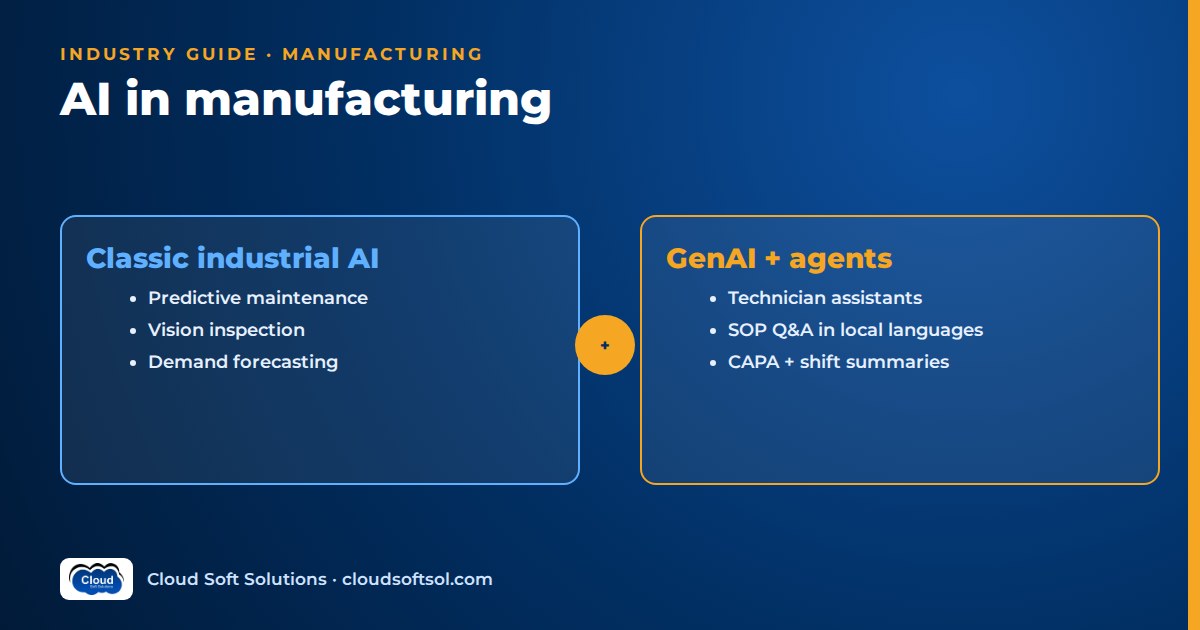
Manufacturing already runs plenty of AI, but most of it is classic machine learning: models trained on sensor readings, images and order history. Generative AI and agents solve a different problem. AI in manufacturing now has two layers: industrial ML that predicts and detects from machine data, and generative AI that reads, drafts and answers from the documents and knowledge people use to run the plant, and the second layer belongs on the IT side of the plant, reading operational data but never writing to a control system. This guide separates the two, then covers the use cases, the OT/IT safety boundary, data problems, architecture and skills.
Two kinds of AI in a plant
Industrial ML and language models are different technologies with different data, failure modes and owners. If the terms still blur for you, the AI vs generative AI vs agentic AI explainer covers the distinction in general terms.
| Aspect | Classic ML / industrial AI | Generative AI and agents |
|---|---|---|
| Typical uses | Predictive maintenance from vibration, temperature and current; vision inspection for surface defects; demand and inventory forecasting; process parameter optimisation | Technician assistants, SOP Q&A, CAPA and incident drafting, supplier document review, shift handover summaries, change impact analysis, helpdesk |
| Main input | Time-series signals, images, structured transactions | Manuals, SOPs, work orders, emails, contracts, reports, free-text logs |
| Output | A score, class, forecast or anomaly flag | An answer, summary, draft or proposed action, with sources |
| Main failure mode | Drift as machines, materials or demand patterns change | Confident but wrong text, missing context, prompt injection through documents |
The two layers work best together. A vibration model flags a bearing on a spindle; a GenAI assistant then helps the technician find the right manual section, past work orders for that asset and the spare part number. The ML says something is wrong; the language model helps a person act on it faster. Neither replaces the other.
Generative AI manufacturing use cases that hold up
In each use case below the model works on documents, a person stays accountable, and nothing reaches a machine. Before building any of them, run a proper AI use case discovery with the plant team.
Maintenance technician assistant
This is often the most useful starting point for AI for maintenance. A technician facing an unfamiliar fault code asks, in plain language, "hydraulic press line two, fault on the clamp pressure, what did we do last time?" The assistant searches OEM manuals, the plant's own maintenance procedures and work-order history in the CMMS, then answers with the likely causes, the relevant manual page and the past work orders that fixed similar faults. It cites every source and never commands the press or closes the work order itself.
SOP and work-instruction Q&A in local languages
Plants in India often have operators who are more comfortable in Telugu, Tamil, Hindi, Marathi or Kannada than in the English the SOPs are written in. A retrieval assistant can answer "what is the torque sequence for this fixture?" in the operator's language while quoting the controlled English source, so supervisors can verify. The controlled document stays the authority; the assistant never becomes a second, uncontrolled version of the procedure. For shop-floor use where typing is awkward, a voice interface helps, and the voice AI agents guide covers the speech pipeline and its latency trade-offs.
Quality deviation and CAPA report drafting
Quality engineers spend a lot of time writing up non-conformances, deviations and corrective and preventive action reports in a structured format such as 8D. A GenAI assistant can pull the inspection records, the defect description, the containment actions already logged and similar past CAPAs, then draft the problem statement, timeline and proposed root-cause candidates. The engineer decides the root cause and signs; a model's root-cause suggestion is never a finding.
Supplier document and contract review
Incoming supplier documents include certificates of analysis, material test certificates, PPAP packages, quality agreements and purchase contracts. An assistant can extract fields, compare them against the specification or the approved terms and flag mismatches: a missing chemical composition value, a delivery clause that differs from the standard template, a liability cap that changed. The same extraction-and-comparison pattern is built step by step in the contract review AI project. Procurement or quality still approves.
Procurement assistant
Buyers repeatedly ask which suppliers are approved for a part, what the last price was and which RFQ responses are missing. An agent with read access to the ERP and supplier portal, through narrow tools, can answer these and draft RFQ emails or comparison sheets. Creating or releasing a PO stays a human action in the ERP, under the existing approval matrix.
Shift handover summaries
Handovers pass on tribal knowledge in a hurry. An assistant can combine the shift log, downtime reasons from the MES, open work orders and quality holds into a short structured summary for the incoming supervisor, flagging anything unresolved. It reads historian and MES data; it does not acknowledge alarms or change anything.
Engineering change impact analysis
When an engineering change request modifies a part, someone has to find every affected drawing, BOM line, routing, work instruction, control plan, PFMEA entry and customer approval. An agent can search across PLM exports, document management and the quality system to produce a first-pass impact list with links. Engineers review it: the value is a better starting checklist, not an automated sign-off.
EHS incident report drafting
After a near miss or injury, the EHS team must record what happened quickly and consistently. An assistant can turn a supervisor's spoken or written account into a draft report in the required format, suggest the relevant hazard categories and pull past similar incidents. Regulatory reporting decisions stay with the EHS lead. The human-in-the-loop design guide covers approval patterns that fit this kind of workflow.
IT/OT helpdesk
Plant users raise tickets about HMI logins, label printers, scanners and MES screens. A helpdesk assistant can answer from the knowledge base, collect diagnostics and route the ticket to the right resolver group, IT or OT. The Microsoft Teams IT helpdesk assistant project shows the IT-side build. On the OT side, the assistant only triages and routes; any change on an OT asset goes through the OT team's own change process.
The OT/IT boundary and safety rules
OT and safety teams read this part first. Operational technology runs physical processes, PLCs, DCS, SCADA, robots and safety systems, and an error there can injure people. The rules for industrial AI agents follow from that.
- No agent writes to control systems. No setpoint changes, no PLC writes, no alarm acknowledgement, no start or stop commands. This is an architecture decision, not a prompt guardrail: the agent has no tool, credential or network path that could do it.
- Read-only historian access. Where the assistant needs process data, it reads from the plant historian or an MES reporting layer through a read-only account, ideally from a replica or a data copy on the IT side, not by querying production control servers directly.
- Network segmentation. Plants usually separate the control network from the business network in layers, with a demilitarised zone between them where data is brokered. AI workloads sit on the IT side. Data moves outward from OT through approved paths, and nothing initiates a connection inward from the AI service.
- Safety-related content stays controlled. Lockout/tagout steps, safety interlock procedures and permit-to-work instructions are answered by quoting the controlled document, never by paraphrasing in a way that could drop a step.
- Write actions on the IT side are narrow and approved. Creating a draft work order in the CMMS or a draft ticket is acceptable with clear labelling. Anything that commits money, changes a controlled document or releases a product needs a named human approval.
Treat documents as untrusted input: a supplier PDF can carry instructions aimed at the model. With only read and draft tools, a successful injection produces at worst a bad draft that a person rejects.
Data challenges specific to plants
Scanned and messy manuals
OEM manuals arrive as old scanned PDFs with exploded diagrams, multi-page fault-code tables and handwritten notes. Naive extraction breaks tables and loses diagram-to-part links; the guide to parsing PDFs, tables and scans for RAG covers the techniques. Keep page references so every answer can cite its page.
A multilingual workforce
Questions mix Indian languages, English technical terms and shop-floor slang. Map local terms to controlled SOP terms in a glossary, and evaluate with real operator questions in each supported language; a model can still mistranslate a specific defect name.
Tribal knowledge
Much of what senior technicians know is unwritten. Work-order free text is the best existing source, though terse; structured capture sessions can turn the rest into reviewed knowledge articles. Do not let the assistant learn from unreviewed chat logs; that turns one person's guess into plant guidance.
System sprawl and data quality
Asset IDs differ between CMMS, historian and ERP, and document versions are not always marked. Someone has to map identifiers and filter to approved revisions; the AI for data engineers guide covers that role.
If you want to learn this end to end, from discovery with a plant team to a deployed, observable assistant, Cloudsoft's AI Forward Deployed Engineer course covers it. Its Enterprise Knowledge Assistant and IT-Ops Multi-Agent Platform projects build the same retrieval, tool-calling and approval patterns these plant use cases depend on.
The architecture pattern
Most plant GenAI systems share one shape; the boundaries do not change by plant.
  OT network (control)       |  IT network (AI side)
  PLC / SCADA / DCS          |
        |                    |
  Historian (read replica) --+--> Read-only data API
                             |          |
  CMMS, MES, ERP, PLM, DMS --+--> Ingestion + parsing
                             |          |
                             |   Vector + keyword index
                             |          |
  Technician / buyer / QE ---+--> Assistant / agent
   (web, Teams, voice)       |    (LLM + narrow tools)
                             |          |
                             |   Drafts, answers, tickets
                             |   -> human approval
                             |   -> logs + evaluation
The main components:
- Ingestion and parsing for manuals, SOPs, CAPAs and contracts, with document version, plant, line and asset metadata attached to every chunk.
- Hybrid retrieval: keyword search for part numbers and fault codes, semantic search for symptoms.
- Narrow, read-only tools for live data: "get open work orders for asset X", "get last 24 hours of downtime reasons for line Y". Tools can be exposed over MCP or plain APIs; either way each one has a clear scope and its own credentials.
- Draft-only write tools for the IT side, such as creating a draft work order or draft CAPA record, clearly labelled as AI-generated.
- Access control tied to the plant's identity system, so a user in one plant does not retrieve another plant's confidential process documents or a supplier's pricing they should not see.
- Observability and evaluation: log every question, retrieved source, tool call and answer; run a test set of real plant questions before each release.
The RAG knowledge assistant project walks through the retrieval core in detail. A plant version adds asset metadata, multilingual evaluation and the OT boundary.
Illustrative example: an auto-components plant
Consider an auto-components supplier near Chennai or Pune that machines and assembles brake and steering parts for several vehicle makers. It runs CNC lines, a few hydraulic presses and an assembly area, with a CMMS, an MES, an ERP and a document management system. Its pains: slow diagnosis when senior technicians are off shift, slow 8D reports and customer engineering changes that ripple through drawings and control plans.
A sensible plan would look like this:
- Discovery. Sit with maintenance, quality and production supervisors for a few days. Collect real questions, work orders and 8D reports. Agree success measures, such as time to locate the right procedure, and record a baseline.
- First release: technician assistant. Ingest OEM manuals for the critical machines, the plant's maintenance SOPs and a cleaned set of past work orders. Read-only CMMS lookup by asset. Answers in English, Tamil and Hindi with citations. No live process data yet.
- Second release: CAPA drafting. Pull inspection data and complaint details into an 8D draft. The quality engineer edits and approves. Track how much of each draft survives review.
- Third release: change impact. Search drawings, BOMs, control plans and PFMEAs for a part number and produce a review checklist for each engineering change.
- Later: shift handover. Add read-only historian and MES summaries once the OT team has approved the data path through the plant's DMZ.
Throughout, the agent never touches a PLC, never changes MES data and never closes a work order or CAPA on its own. Technicians ignore tools their seniors distrust, so adoption needs training, feedback channels and visible fixes. The AI adoption and change management guide covers how to run that side.
Manufacturing AI in India: what engineers should notice
Manufacturing AI in India work comes from several directions: plants modernising their own IT, engineering and IT services firms delivering for global manufacturers, and GCCs in Hyderabad, Bengaluru, Pune and Chennai that support manufacturing groups' engineering, supply chain and IT functions. GCC work leans to the back office: procurement, quality documentation, supplier management, IT/OT support. Shop-floor work needs time on site and patience with production schedules.
This is classic forward-deployed work: earn trust in a messy environment, integrate with old systems and deliver something measurable. If the role is new to you, start with what a Forward Deployed Engineer does.
Skills engineers need
| Skill area | What it means in a plant |
|---|---|
| Domain basics | Maintenance types, CMMS work orders, MES, PLM, BOMs, routings, 8D/CAPA, PPAP, PFMEA, control plans, EHS reporting |
| OT awareness | What PLCs, SCADA and historians do, layered network segmentation, why read-only matters, how OT change control works |
| Document engineering | OCR, table extraction, version filtering, metadata design for assets and lines |
| Retrieval and agents | Hybrid search, citations, narrow tool design, draft-only writes, approval steps |
| Integration | APIs and connectors for ERP, CMMS and MES; Python and FastAPI services; identity integration |
| Multilingual evaluation | Building test sets from real operator questions in each supported language and scoring them |
| Stakeholder work | Running discovery with supervisors, explaining limits to safety teams, getting sign-off from OT |
FAQ
What is the difference between industrial AI and generative AI in manufacturing?
Industrial AI usually means machine learning on sensor data, images and transactions, such as predictive maintenance, vision inspection and demand forecasting. Generative AI works on text and documents, answering questions, summarising and drafting from manuals, SOPs, work orders and reports. Most plants need both, and they complement each other.
Can an AI agent control machines on the shop floor?
It should not. A well-designed plant AI agent has no tool, credential or network path that can write to PLCs, SCADA or other control systems. It reads operational data through read-only access on the IT side and produces answers or drafts for people to act on.
What is a good first generative AI use case for a plant?
A maintenance technician assistant over manuals, SOPs and work-order history is often a good start. It has clear users, existing documents and low risk, because it only answers with citations.
How do you handle scanned OEM manuals for RAG?
Use OCR with quality checks, keep tables intact, preserve page numbers and attach asset and document version metadata to each chunk. Test retrieval with real fault-code questions before rollout.
Can the assistant answer in Indian languages?
Yes, current language models handle major Indian languages, but you must test it. Build a glossary of local shop-floor terms, collect real questions from operators and evaluate answers in each language. The controlled English document should remain the authority, quoted alongside the translated answer.
Should generative AI write CAPA or EHS reports?
It should draft them, not decide them. The assistant gathers records and structures a draft, and the quality engineer or EHS lead determines the root cause, corrective actions and any regulatory reporting, then signs the report.
Where should AI workloads sit relative to the OT network?
On the IT side. Plants typically separate control and business networks in layers with a brokered zone between them. Data flows outward from OT through approved paths, such as a historian replica, and the AI service never initiates connections into the control network.
Do I need a manufacturing background to work on these projects?
No, but you need to learn the basics quickly: work orders, CAPA, BOMs, engineering changes and how OT change control works.
Building a plant assistant means doing discovery, data, retrieval, tools, security, deployment and evaluation in one engagement. That is the arc the Cloudsoft FDE PRO program trains over 12 weeks, ending with the GlobalBank capstone, a simulated customer engagement. Classes run beside Ameerpet Metro or live online; call +91 96660 19191 to book a free demo.