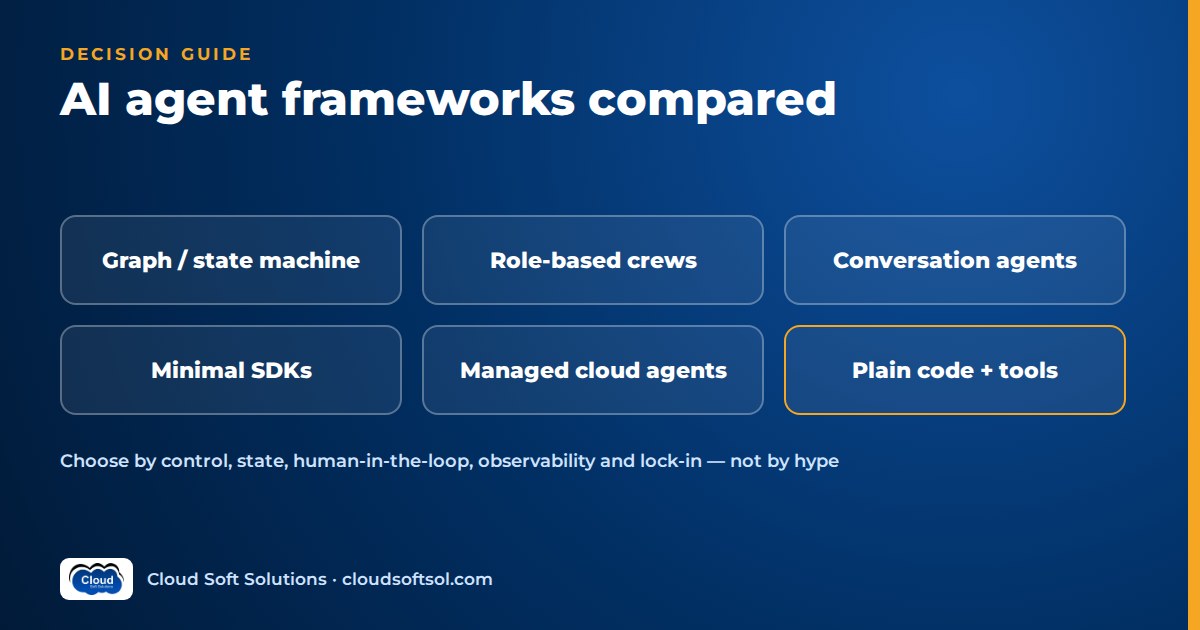
An AI agent frameworks comparison is only useful if it starts from your constraints, not from a feature list. Choose by design approach first: graph and state-machine frameworks (LangGraph, the workflow layer of Microsoft Agent Framework) for regulated, auditable processes; role-based crews (CrewAI) for fast multi-agent prototypes; minimal SDKs (OpenAI Agents SDK, Pydantic AI, Google ADK) when you want little abstraction; managed cloud services (Amazon Bedrock Agents and AgentCore) when operations and identity matter more than portability; and plain code with function calling when the workflow is small. This guide gives you the evaluation criteria, a decision flow, an illustrative GCC choice and advice for keeping your options open.
Dated note (October 2026): agent frameworks merge, rename and change APIs often. Everything below reflects public documentation at the time of writing. Before you commit, check each project's current docs, release notes and licence, and prototype against the version you will actually ship.
Why the framework choice matters less, and more, than you think
Every agent framework wraps the same core loop: send context to a model, let it request a tool call, execute the tool, feed the result back, repeat. Our guide to function calling and structured outputs explains that loop in detail. The framework does not make the model smarter. What it changes is everything around the loop: how state is stored, how control flow is expressed, where a human can step in, how runs are traced and how the whole thing is deployed.
So the choice matters less than online debates suggest (model, tools and data drive quality) and more than teams expect (it decides how painful audit, approval and recovery become later). Design patterns such as routing, planning and orchestrator-worker are framework-neutral; see agentic AI design patterns. Pick the framework that expresses your chosen pattern with the least friction.
The main frameworks, grouped by design approach
Graph and state-machine frameworks
LangGraph (from the LangChain team) models a workflow as nodes, edges and a typed shared state. Conditional edges let the model choose a branch where judgement helps, while fixed edges enforce steps that must always run. Checkpointers save state after every step, which gives you resumption, replay and interrupts for human approval. It is open source in Python and JavaScript/TypeScript, runs wherever you host them, and LangChain sells managed deployment and LangSmith tracing. It reached a stable major release in late 2025. We cover it in depth in LangGraph for enterprise AI.
Microsoft Agent Framework is Microsoft's unified successor to Semantic Kernel and AutoGen. It reached general availability for .NET and Python in April 2026. It combines agent abstractions with a graph-based workflow engine, multi-agent orchestration patterns (sequential, concurrent, handoff, group chat), checkpointing, human-in-the-loop approvals, middleware and MCP and A2A support. The AutoGen repository now states that AutoGen is in maintenance mode and points new users to Agent Framework; Semantic Kernel users get migration guides. If you searched for a "Microsoft agent framework", this is the one to evaluate for new work.
LlamaIndex Workflows takes an event-driven variant of the same idea: steps subscribe to typed events and emit new ones, which suits document-heavy and retrieval-heavy agents. It is available in Python and TypeScript and fits naturally if your team already uses LlamaIndex for RAG.
Role-based crews
CrewAI describes work as a crew of agents, each with a role, goal and backstory, assigned tasks that run sequentially or under a manager agent. That mental model is quick to grasp and produces working multi-agent demos fast. For more deterministic control, CrewAI added Flows, event-driven workflows that can combine crews, direct model calls and ordinary procedural code. It is Python-only and open source, with a commercial platform (CrewAI AMP) for deployment, tracing and access control. The honest trade-off in LangGraph vs CrewAI: crews are faster to start, graphs make the control flow explicit and easier to audit.
Conversation-based multi-agent
The conversation approach, where agents talk to each other in a shared chat until a termination condition is met, was popularised by AutoGen. It suits exploratory tasks but is harder to make predictable. With AutoGen in maintenance mode, the pattern now lives on as the group chat orchestration inside Microsoft Agent Framework. Treat existing AutoGen code as something to migrate, not to extend.
SDK-minimal frameworks
OpenAI Agents SDK keeps the primitive set small: agents (a model with instructions and tools), handoffs (one agent delegating to another), guardrails (input and output validation), sessions (conversation memory) and built-in tracing. It is available in Python and TypeScript, uses OpenAI models by default and supports other providers through adapters. In OpenAI Agents SDK vs LangGraph terms: the SDK gives you less ceremony and a fast path to a working agent; LangGraph gives you explicit state machines and checkpoint-level control that you would otherwise build yourself.
Pydantic AI, from the Pydantic team, is a type-first Python framework: typed tools, typed dependency injection and validated structured outputs, with broad model-provider support. For long-running work it integrates with durable execution engines such as Temporal and DBOS rather than reinventing persistence, offers tool approval for human-in-the-loop, and has a companion graph library when a loop is not enough.
Google Agent Development Kit (ADK) is an open-source toolkit with Python, Java, Go and TypeScript implementations. It supports single agents plus workflow agents (sequential, parallel, loop) and LLM-driven delegation, with native MCP tools and A2A support for remote agents. It is optimised for Gemini and Google Cloud but runs in any container.
Managed cloud services
Amazon Bedrock Agents is the fully managed option: you configure an agent, its instructions, action groups (tool definitions backed by Lambda or API schemas) and knowledge bases, and AWS runs the orchestration. Low operational load, limited control over the loop. Amazon Bedrock AgentCore, generally available since October 2025, is different: it is a set of services (runtime, memory, gateway, identity, observability, code interpreter and browser tools) for hosting agents built with any framework, including LangGraph, CrewAI or plain Python. AgentCore Gateway can turn APIs and Lambda functions into MCP tools, and the runtime supports A2A. Azure and Google Cloud offer comparable services.
Evaluation criteria for an enterprise agent framework
Use this table as a scoring sheet, not a verdict. Characterisations are summaries of documented design at the time of writing.
| Criterion | What to ask | Where frameworks tend to differ |
|---|---|---|
| Control and determinism | Can I force mandatory steps (sanctions check, PII redaction) regardless of model output? | Graph engines (LangGraph, Agent Framework workflows) make this explicit; crews and handoff-style SDKs rely more on instructions unless you add flows or code. |
| State and persistence | Where is state stored? Can a run survive a pod restart and resume days later? | LangGraph checkpointers and Agent Framework checkpointing are built in; Pydantic AI delegates to durable engines; SDK sessions cover conversation memory but not always full workflow state. |
| Human-in-the-loop | Can execution pause for an approval and resume with the decision recorded? | Interrupts (LangGraph), approvals in workflows (Agent Framework), tool approval (Pydantic AI), human-input hooks elsewhere. Test the pause-for-hours case, not just a console prompt. |
| Observability | Do I get traces per step, tool call and token count, exportable to my stack? | Most offer tracing; check OpenTelemetry export so you are not tied to one vendor's dashboard. See AI observability. |
| MCP / A2A support | Can agents consume MCP servers and talk to remote agents over A2A? | MCP client support is now common across the frameworks named here; A2A support varies more. Verify transport and auth options. |
| Deployment model | Library I host, vendor platform, or cloud-managed service? | Open-source libraries run in your containers; CrewAI and LangChain sell platforms; Bedrock and other cloud services run it for you. |
| Lock-in | How much code is framework-specific? Model-agnostic? | Managed services couple you to a cloud; SDKs may default to one model provider; all frameworks couple your control-flow code to their abstractions. |
| Language support | Does it match the team that will maintain it? | Python everywhere; .NET with Agent Framework; Java and Go with ADK; TypeScript with LangGraph, OpenAI Agents SDK, ADK and LlamaIndex. |
| Maturity | Stable API commitment? Clear deprecation policy? Active maintenance? | Check for a stable major release, migration guides and release cadence. Recent mergers (AutoGen, Semantic Kernel) show why this row matters. |
Weight the rows: a bank's payments team weights control and approvals; an analytics team may weight speed and language fit.
The no-framework option: plain code plus function calling
Many production agents are a few hundred lines of ordinary code: a loop around a model API with tool definitions, a dispatcher that maps tool names to functions, a step limit, structured output validation and logging.
Choose no framework when:
- the workflow has one agent, a handful of tools and no long-running pauses;
- your platform team already has a workflow engine (Temporal, Step Functions, a BPM tool) that can own state, retries and approvals;
- you need to pass a security review where every dependency is scrutinised;
Move to a framework when you notice yourself writing a checkpoint store, an interrupt-and-resume mechanism, parallel branches with merge logic or a tracing layer. At that point you are building a worse framework. The middle path is common: plain function calling for the agent loop, with an existing workflow engine around it for durability.
If you want hands-on practice building the same agent in plain code and then in LangGraph, so you can feel the difference, Cloudsoft's AI, GenAI and Agentic AI course covers function calling, RAG, LangGraph and MCP with labs.
A selection decision flow
Walk through these questions in order. The first "yes" usually settles the shortlist.
Start
 |
 v
Small loop, few tools, no pauses?
 |-- yes --> Plain code + function calling
 v no
Must run inside one cloud, minimal ops?
 |-- yes --> Managed service (Bedrock
 |           Agents / AgentCore, etc.)
 v no
Mandatory steps, approvals, audit?
 |-- yes --> Graph engine: LangGraph or
 |           Microsoft Agent Framework
 v no
.NET or Microsoft-centric team?
 |-- yes --> Microsoft Agent Framework
 v no
Role-style multi-agent prototype?
 |-- yes --> CrewAI (add Flows later)
 v no
Want minimal, typed SDK?
 |-- yes --> OpenAI Agents SDK,
 |           Pydantic AI or Google ADK
 v
Prototype two options on one real task
Managed and library options are not exclusive: AgentCore and similar runtimes host LangGraph or CrewAI code. And always finish with a bake-off: build the same thin slice (one real workflow, two tools, one approval) in your top two candidates and compare code, traces and failure handling. A week of prototyping beats a month of spreadsheets.
An illustrative GCC choice
Consider a global capability centre in Hyderabad that runs IT operations for a multinational insurer. The team wants an agent that triages incidents from the ticketing system, pulls logs and recent changes, proposes a remediation and, for anything that touches production, waits for an on-call engineer to approve before running a runbook. The parent company's platform is on AWS, the IT tools team writes Python, and a separate Microsoft-centric team in the same GCC builds internal .NET apps.
A sensible evaluation might go like this:
- No framework? Rejected: approvals can wait hours across shift handovers, so they need durable pause and resume, and the audit team wants a per-step record.
- Bedrock Agents alone? Low ops effort, but fixed steps such as a change-freeze check are easier to enforce in code than in agent instructions.
- Shortlist: LangGraph (Python, explicit graph, checkpointers, interrupts) and Microsoft Agent Framework (graph workflows with checkpointing and approvals). The agent's maintainers write Python, which tips the balance.
- Decision: LangGraph for the control flow, with ticketing, log search and runbook execution exposed as MCP servers so tools are not tied to the framework. Hosting on the company's existing Kubernetes platform or a managed agent runtime, with checkpoints in PostgreSQL and traces exported over OpenTelemetry.
- Escape hatch documented: business logic lives in plain Python modules the graph nodes call, so a future move to another engine means rewriting the wiring, not the logic.
A different GCC, say one whose platform is Azure and whose maintainers write C#, could reasonably reach Microsoft Agent Framework through the same reasoning.
Migration and lock-in advice
The AutoGen and Semantic Kernel consolidation is a reminder that the framework you pick today may be renamed, merged or deprecated within the life of your system. Design for that.
- Keep tools outside the framework. Expose enterprise systems as MCP servers or plain internal APIs. Then any framework can use them, and the tool layer, usually the hardest part to build and secure, survives a migration. See what MCP is.
- Keep business logic in plain functions. Nodes, tasks or handoffs should be thin wrappers that call your own modules. Policy checks, validation and data transforms should be testable without the framework installed.
- Own your prompts and schemas. Store prompts, tool schemas and output schemas as versioned files, not as strings buried in framework configuration.
- Use open interfaces between agents. If agents built by different teams need to collaborate, prefer a protocol such as A2A over importing each other's framework code. See the A2A protocol explained.
- Export traces in an open format such as OpenTelemetry.
- Keep your evaluation suite framework-neutral. The same test cases and graders should run against the old and new implementation. That is what makes a migration safe.
When migrating, run old and new side by side, cut over one workflow at a time, and never change the framework and the model in the same release.
Putting these choices into practice inside a customer's real systems, with their identity, data and change controls, is exactly the work a Forward Deployed Engineer does; Cloudsoft's FDE PRO program is built around that engagement model.
FAQ
What is the best framework for AI agents?
There is no single answer. Graph frameworks such as LangGraph or Microsoft Agent Framework suit regulated workflows that need fixed steps, approvals and audit trails. CrewAI suits fast role-based multi-agent prototypes. Minimal SDKs suit small agents, and managed cloud services suit teams that want low operational effort inside one cloud. Shortlist two and prototype both on a real task.
LangGraph vs CrewAI: which should an enterprise team pick?
Pick LangGraph when you need explicit control flow, checkpointed state and human approval interrupts that you can show to an auditor. Pick CrewAI when you want to get a role-based multi-agent prototype working quickly; its Flows feature adds more deterministic orchestration if the prototype moves toward production.
OpenAI Agents SDK vs LangGraph: what is the difference?
The OpenAI Agents SDK offers a small set of primitives: agents, handoffs, guardrails, sessions and tracing, with little ceremony. LangGraph models the workflow as an explicit graph with typed state, checkpointers and interrupts. The SDK is quicker for straightforward agents; LangGraph gives more control over complex, long-running, approval-heavy processes.
What happened to AutoGen and Semantic Kernel?
Microsoft unified them into Microsoft Agent Framework, which reached general availability for .NET and Python in April 2026. The AutoGen repository states it is in maintenance mode and directs new users to Agent Framework, and Microsoft provides migration guides for both AutoGen and Semantic Kernel. Check Microsoft's current documentation for the latest status.
Do I need a framework to build an AI agent?
No. A loop around a model API with function calling, a tool dispatcher, step limits, validation and logging is enough for many single-agent use cases. Adopt a framework when you find yourself building checkpointing, pause and resume, parallel branches or tracing by hand.
Should I use Amazon Bedrock Agents or AgentCore?
Bedrock Agents is a fully managed agent where AWS runs the orchestration loop, which means low operational effort but less control. AgentCore is a set of services for hosting and operating agents built with any framework, including runtime, memory, gateway, identity and observability. Many teams use an open-source framework for control flow and AgentCore for hosting.
How do I avoid framework lock-in?
Expose tools as MCP servers or internal APIs, keep business logic in plain functions, version prompts and schemas as files, export traces in OpenTelemetry format and keep a framework-neutral evaluation suite. Then changing frameworks means rewriting the orchestration wiring, not the whole system.
Which framework should I learn first for interviews?
Learn plain function calling first so you understand the underlying loop, then one graph framework such as LangGraph, because graph-based control flow, state and human-in-the-loop questions come up often in agent design interviews. Being able to explain the trade-offs between frameworks matters more than knowing every API.
Ready to build agents you can defend in an architecture review, not just demo? Join Cloudsoft's Agentic AI training in Hyderabad, in the Ameerpet classroom or live online. Call +91 96660 19191 to book a free demo session.