Enterprise AI hiring at large IT organisations such as Tata Consultancy Services (TCS) increasingly expects freshers to understand LLMs, Retrieval-Augmented Generation (RAG), AI agents, Agentic AI frameworks, MCP, vector databases and embeddings in addition to Python, DSA and cloud fundamentals. This concise guide covers the TCS hiring tracks and the topics most worth preparing — with links to our full, detailed answer sets.
TCS hires freshers mainly through the TCS National Qualifier Test (NQT), feeding into tiers such as Ninja (foundation), Digital (advanced tech incl. AI/cloud/full-stack) and Prime (premium engineering). AI/GenAI-specific evaluation appears in Digital/Prime tracks and project interviews, where — alongside Python, DSA, SQL and cloud basics — candidates are increasingly asked about LLMs, RAG, vector databases and Agentic AI for enterprise automation.
Top 10 AI / RAG / Agentic questions TCS freshers should prepare
- What is RAG and why do enterprises use it?
Retrieval-Augmented Generation retrieves relevant documents from a knowledge base before the LLM answers, grounding responses in current, private company data and reducing hallucinations — which is why it is the default pattern for enterprise AI. Full answers: see our RAG interview guides linked below. - What is Agentic AI vs Generative AI?
Generative AI produces content in a single response; Agentic AI plans, uses tools, executes multi-step tasks, observes results and iterates toward a goal. Enterprises use agents to automate workflows, not just draft text. - What are embeddings and a vector database?
Embeddings are numeric vectors capturing text meaning; a vector database (FAISS, Pinecone, Chroma, Weaviate, Qdrant, Milvus) stores and searches them by similarity — the retrieval backbone of RAG. - What is chunking and why does it matter?
Chunking splits large documents into smaller pieces (often with overlap) before embedding, improving retrieval accuracy and keeping context within the LLM window. - RAG vs fine-tuning — when to use which?
Use RAG for knowledge that changes or must be cited; use fine-tuning (LoRA/QLoRA) for specialized style/behaviour. Many enterprise systems combine both. - What is MCP and A2A?
MCP (Model Context Protocol) standardises how models connect to tools and data; A2A (Agent-to-Agent) lets multiple agents collaborate and share tasks. - What is LangChain / LangGraph / CrewAI?
LangChain builds LLM apps; LangGraph builds stateful, graph-based agent workflows with loops and human-in-the-loop; CrewAI orchestrates teams of role-based agents. - How do you reduce hallucinations?
Ground with RAG, rerank retrieval, use structured prompts and validated outputs, restrict tool permissions, and add human approval for high-risk actions. - How do you evaluate a RAG or agent system?
RAG: faithfulness, answer relevancy, context precision/recall (RAGAS), Precision@K, Recall@K. Agents: task success rate, tool-call correctness, steps-to-completion, latency and cost. - How do you secure an enterprise AI agent?
Authentication, role-based access control, secrets in a vault, least-privilege sandboxed tools, PII redaction, audit logging, and defences against prompt injection.
These are summaries. For full detailed answers, work through our canonical guides:
- Top 50 RAG interview questions for freshers — fundamentals first
- Top 45 RAG interview questions (freshers & experienced) — advanced & production
- Top 60 Agentic AI interview questions — agents, tools, MCP, LangGraph, evaluation
- Top 60 AI & ML interview questions — fundamentals, deep learning, MLOps
TCS-style scenario questions
Build an internal knowledge assistant for a banking client
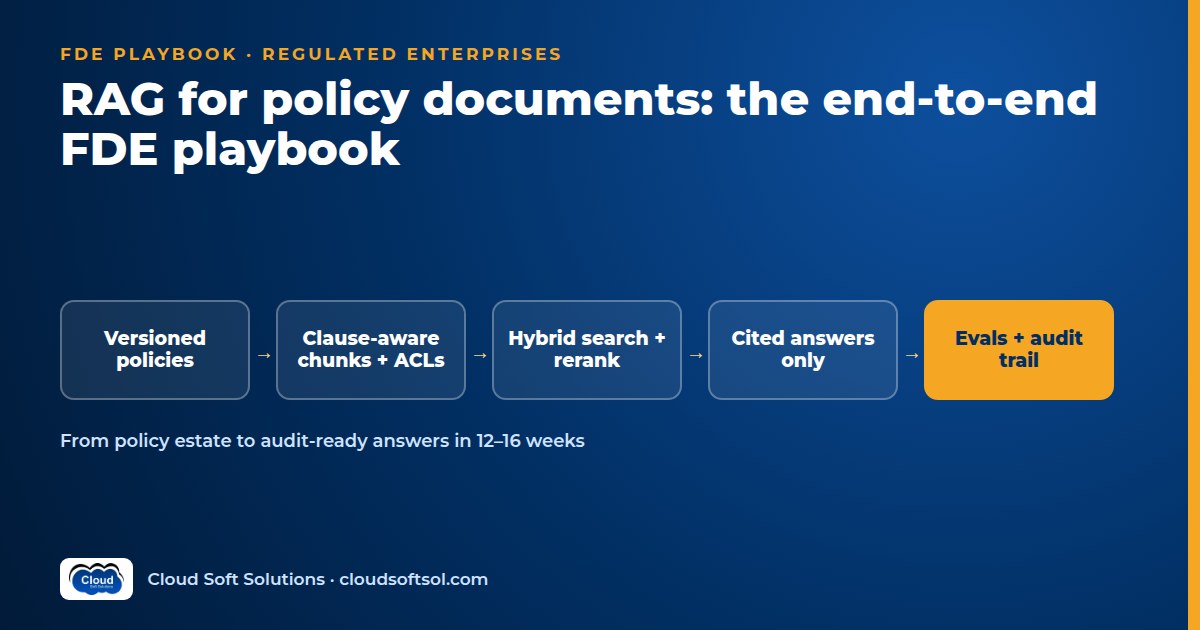
Ingest banking policies/docs → generate embeddings → store in a vector DB → retrieve with RAG → answer with an LLM, enforcing role-based access control and audit logging (critical in BFSI).
Automate cloud deployments with an AI agent
Interpret the natural-language request → plan the workflow → generate Infrastructure as Code → provision via cloud APIs → validate → produce a deployment report, with human approval for production changes.
Freshers preparation roadmap
Prepare in this order: Python → DSA (basic) → SQL → ML basics → LLM fundamentals → prompt engineering → embeddings → vector databases → RAG → LangChain → LangGraph → AI agents → MCP/A2A → one cloud (AWS/Azure). Build one end-to-end RAG project and one simple AI-agent project with GitHub documentation to discuss in interviews. Follow the full plan in our Fresher-to-Hired 2026 roadmap and browse live roles in the 2026 fresher jobs hub.
Crack Enterprise AI Interviews
APEX — AI, ML, Cloud & Cyber Security Engineering Program
Hands-on Generative AI, RAG and Agentic AI (LangGraph) with MLOps and cloud, plus mock interviews and a 100% placement guarantee — in Ameerpet, Hyderabad.
Explore the APEX Program →📞 Want mock interviews or a structured AI learning path? Call or WhatsApp +91 96660 19191 / +91 99496 16388, or email info@cloudsoftsol.com. Explore our AI & Cloud training and full course catalogue.
Frequently Asked Questions
Does TCS ask RAG interview questions?
The exact interview depends on the role and project, but RAG is an increasingly common AI-engineering topic because it underpins enterprise AI. This guide reflects commonly-assessed concepts, not an official TCS list.
Is Agentic AI important for TCS AI roles?
Knowledge of planning, memory, tool use, workflows and agent frameworks (LangGraph, CrewAI) strengthens your profile for modern AI-engineering and enterprise-automation roles at large IT services firms.
Which frameworks should I learn for TCS AI interviews?
A practical path: LangChain, LangGraph, LlamaIndex, CrewAI and AutoGen, on top of Python, SQL, ML basics and one cloud (AWS/Azure).