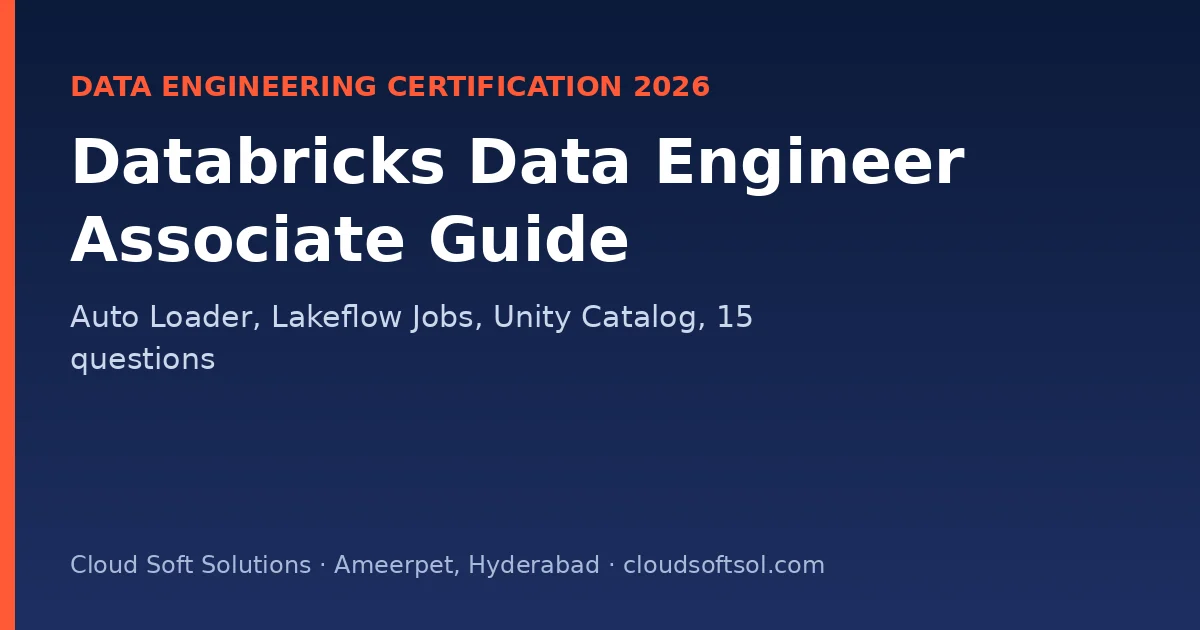
Databricks Certified Data Engineer Associate is the entry-level data engineering certification on the Databricks platform. The current exam (published 4 May 2026, guide updated 6 August 2026) tests ingestion with Auto Loader and Lakeflow Connect, PySpark and SQL transformations across bronze, silver and gold layers, orchestration with Lakeflow Jobs, CI/CD with Git folders and bundles, Spark UI troubleshooting, and governance in Unity Catalog.
Databricks skills appear in a large share of data engineer openings in Hyderabad, Bengaluru and Pune. This guide follows the official exam guide: seven sections with weights, the code you must read fluently, a 5-week plan and 15 original practice questions.
Quick facts (Databricks, November 2026)
| Item | Detail |
|---|---|
| Questions | 45 scored multiple-choice, plus up to 10 unscored items |
| Time | 90 minutes (extra time for unscored items is already included) |
| Fee | USD 200 plus applicable taxes |
| Languages | English, Japanese, Brazilian Portuguese, Korean |
| Delivery | Online-proctored or at a test centre; no test aids |
| Prerequisites | None; 6 months of hands-on Databricks experience recommended |
| Validity | 2 years; recertify with the renewal exam or the current full exam |
Read the official Data Engineer Associate page and download the current exam guide. Databricks asks candidates to check the guide again two weeks before the exam date. You can practise everything in Databricks Free Edition.
Who should take it?
- Freshers and SQL or Python developers aiming for data engineer roles.
- Data analysts moving into pipelines and lakehouse work.
- Engineers who already hold AWS DEA-C01, DP-700 or Google PDE and want a platform-specific credential.
Not sure between platforms? Read Snowflake vs Databricks for data engineers in India.
Sections and weights
| Section | Weight |
|---|---|
| 1. Databricks Intelligence Platform | 6% |
| 2. Data Ingestion and Loading | 21% |
| 3. Data Transformation and Modeling | 22% |
| 4. Working with Lakeflow Jobs | 16% |
| 5. Implementing CI/CD | 10% |
| 6. Troubleshooting, Monitoring, and Optimization | 10% |
| 7. Governance and Security | 15% |
Section by section
- Platform (6%): architecture, Delta Lake and Unity Catalog; compute options, their limits and cost models.
- Ingestion (21%): batch, streaming and incremental patterns; COPY INTO from ADLS, S3 or GCS; Auto Loader with schema enforcement and evolution (directory listing or file notification); Lakeflow Connect standard and managed connectors; JDBC, ODBC and REST from notebooks; choosing the right method; JSON and nested data.
- Transformation (22%): cleaning bronze into silver with PySpark or SQL; joins (inner, left, broadcast, cross), union and union all; adding, renaming, splitting and exploding columns; deduplication and aggregates; tuning
spark.sql.shuffle.partitionsandautoBroadcastJoinThreshold; gold objects (materialised views, views, streaming tables); data quality checks. - Lakeflow Jobs (16%): retries, branching and looping; notebook, SQL, dashboard and pipeline tasks; DAG dependencies; scheduled, file-arrival and table-update triggers.
- CI/CD (10%): Databricks Git folders (formerly Repos): branches, commits, pull requests; Declarative Automation Bundles (formerly Databricks Asset Bundles) with variables and per-target overrides; the Databricks CLI to validate and deploy.
- Troubleshooting (10%): job run history against baselines; job and task status; data skew, shuffle and disk spill in the Spark UI; Liquid Clustering and predictive optimisation; cluster start failures, library conflicts and out-of-memory errors.
- Governance (15%): managed vs external tables; GRANT, REVOKE and DENY to users, groups and service principals; column masks and row filters; Unity Catalog ABAC policies.
Code you must read fluently
# Auto Loader: incrementally land JSON files into a bronze table
(spark.readStream.format("cloudFiles")
   .option("cloudFiles.format", "json")
   .option("cloudFiles.schemaLocation", "/Volumes/main/raw/_schemas/orders")
   .load("/Volumes/main/raw/orders/")
 .writeStream
   .option("checkpointLocation", "/Volumes/main/raw/_chk/orders")
   .trigger(availableNow=True)
   .toTable("main.bronze.orders"))

# Bronze to silver: clean, cast and deduplicate
from pyspark.sql import functions as F
silver = (spark.table("main.bronze.orders")
  .filter(F.col("order_id").isNotNull())
  .withColumn("amount", F.col("amount").cast("decimal(10,2)"))
  .dropDuplicates(["order_id"]))
silver.write.mode("overwrite").saveAsTable("main.silver.orders")
-- Incremental load with COPY INTO
COPY INTO main.bronze.customers
FROM 's3://my-bucket/customers/'
FILEFORMAT = CSV
FORMAT_OPTIONS ('header' = 'true')
COPY_OPTIONS ('mergeSchema' = 'true');
-- Unity Catalog permissions
GRANT USE CATALOG ON CATALOG main TO `analysts`;
GRANT SELECT ON TABLE main.gold.daily_sales TO `analysts`;5-week study plan
| Week | Focus | Practice in Free Edition |
|---|---|---|
| 1 | Platform, compute, Delta Lake, Unity Catalog objects | Create a catalog, schema, managed and external tables |
| 2 | COPY INTO, Auto Loader, Lakeflow Connect, JSON and nested data | Land files into bronze with Auto Loader and schema evolution |
| 3 | PySpark and SQL: joins, explode, dedup, aggregates; gold objects; data quality | Bronze to silver to gold with one materialised view |
| 4 | Lakeflow Jobs (tasks, triggers, retries, branching); Git folders; bundles and the CLI | Deploy a two-task job to dev and prod with a bundle |
| 5 | Spark UI (skew, shuffle, spill), Liquid Clustering, OOM errors; GRANT, masks, row filters, ABAC; sample questions | Fix a skewed join; add a column mask; book the exam |
15 practice questions with answers
These are original practice questions written for this guide, not exam questions.
1. New files arrive in cloud storage all day, and each should be loaded exactly once. Which feature?
Auto Loader (cloudFiles) with a checkpoint, or COPY INTO for simpler scheduled loads.
2. Incoming JSON gains new fields over time. What lets the pipeline keep running?
Auto Loader schema evolution with a schema location.
3. You must ingest from Salesforce or a SaaS app with little code. What do you use?
A Lakeflow Connect managed connector.
4. Raw data has nulls and string-typed amounts. Which layer do you fix it in?
Silver: clean, cast and deduplicate from bronze.
5. A small dimension table is joined to a huge fact table. Which join helps?
A broadcast join.
6. An order array must become one row per item. Which function?explode().
7. You need an approximate distinct count of users over billions of rows quickly.approx_count_distinct().
8. BI users need a precomputed daily sales table that refreshes automatically. Which object?
A materialised view in the gold layer.
9. A job should start as soon as a new file lands, not on a clock. Which trigger?
A file-arrival trigger in Lakeflow Jobs.
10. A downstream task must run only if a row-count check passes. What do you configure?
A conditional (if/else) task in the Lakeflow Jobs DAG.
11. The same job must deploy to dev and prod with different cluster sizes. What do you use?
Declarative Automation Bundles with per-target variables and overrides, deployed with the Databricks CLI.
12. One task in a stage runs for 10 minutes while the rest finish in seconds. What is the likely cause?
Data skew on the join or group-by key.
13. Dropping a table must also delete its data files. Managed or external?
Managed table.
14. Analysts must see salary only as masked values unless they are in HR.
A column mask in Unity Catalog (or an ABAC policy) based on group membership.
15. Give the analysts group read access to one gold table.GRANT SELECT on the table, plus USE CATALOG and USE SCHEMA on its parents.
After Data Engineer Associate
- Practise Databricks interview questions and data engineering interview questions.
- Add a cloud data exam such as AWS DEA-C01 or DP-700.
- See live data engineering jobs.
Cloud Soft Solutions in Ameerpet, Hyderabad teaches data engineering with PySpark, Databricks and cloud data platforms through real-time projects. See the APEX program and all courses.
📞 Call +91 96660 19191 · WhatsApp · Flat No. 513, 5th Floor, Nilagiri Block, Aditya Enclave, Ameerpet, Hyderabad
Frequently Asked Questions
How many questions are on the Databricks Data Engineer Associate exam?
45 scored multiple-choice questions, plus up to 10 unscored items, in 90 minutes.
How much does the exam cost?
USD 200, plus applicable taxes.
Which section has the most weight?
Data Transformation and Modeling, at 22%, followed by Data Ingestion and Loading at 21%.
How much experience is recommended?
Six months of hands-on experience on the Databricks platform. There are no formal prerequisites.
How long is the certification valid?
2 years. You recertify with the renewal exam or the current full exam.
What are Declarative Automation Bundles?
The new name for Databricks Asset Bundles: packaged jobs, pipelines and workspace assets deployed across dev, test and prod with the Databricks CLI.