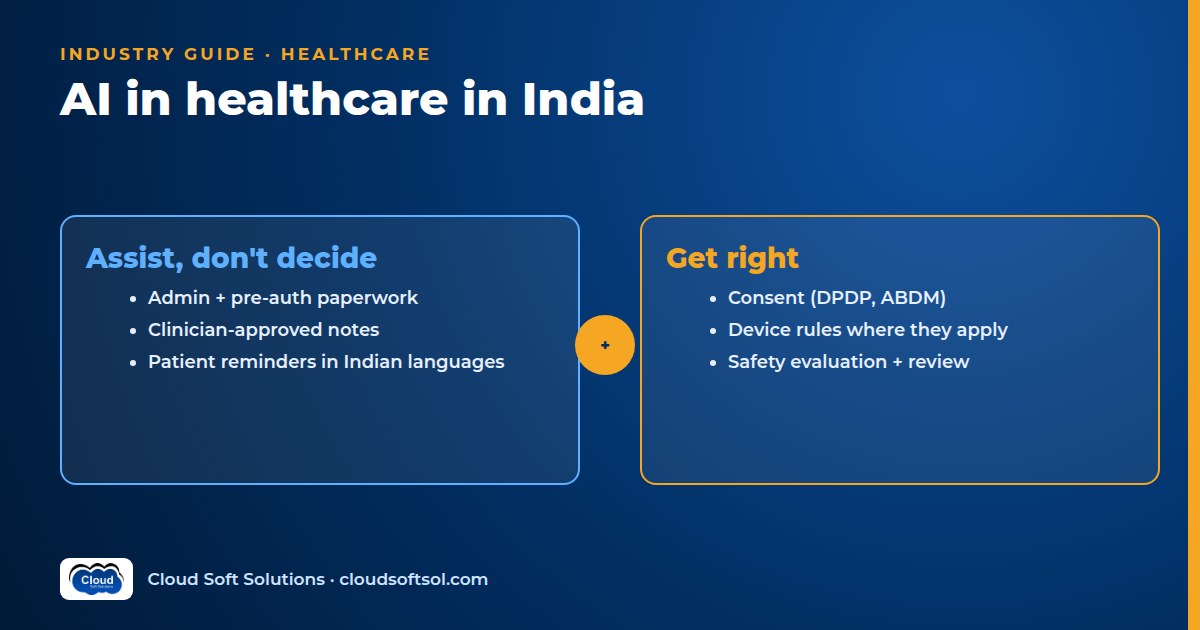
AI in healthcare in India is moving fastest where it takes paperwork off people, not where it takes decisions away from clinicians. The safest and most useful systems today draft, summarise, schedule, translate and forecast, and a qualified person reviews anything that touches a patient's care. For engineers, the hard part is not calling a model. It is consent, de-identification, data residency, human review, logging and safety evaluation, built so that a hospital's clinical, legal and IT teams can all sign off.
Not medical or legal advice. This is an engineering guide. It does not tell anyone how to diagnose or treat patients, and it is not legal advice on the DPDP Act, ABDM, CDSCO rules or ICMR guidelines. Regulations and guidance change. Hospitals should confirm their obligations with qualified clinical, regulatory and legal advisers before deploying any AI system.
Why healthcare AI is different from other enterprise AI
In a hospital, a wrong answer can reach a patient. That changes three defaults.
- The cost of errors is uneven. A clumsy reminder costs nothing; a wrong dosage line in a discharge summary is a patient-safety incident. Your design has to know which kind of output it is producing.
- The data is highly sensitive. Diagnoses, prescriptions, lab values and insurance claims are personal data under the DPDP Act, and patients expect stricter handling than for retail data.
- Accountability stays with people. A clinician signs the note, a coder submits the claim. AI assists a responsible professional, and the system should make that explicit.
Generative AI adds fluent text that is wrong; see why LLMs hallucinate and how to reduce it. In healthcare the mitigation is grounding, constrained outputs and a human who checks, not a better prompt.
Hospital AI use cases, each with a risk level
"Risk" below means patient-safety and compliance exposure, not technical difficulty.
| Use case | What AI does | Who stays responsible | Risk level |
|---|---|---|---|
| Appointment scheduling and reminders | Finds slots, books, reschedules, sends reminders | Front office | Low |
| Billing and insurance pre-authorisation paperwork | Assembles documents, fills forms from records, flags missing items | Billing and TPA desk | Low to medium |
| Medical coding assistance | Suggests codes from the clinical record with supporting text | Certified coder | Medium |
| Discharge summary drafting | Drafts a summary from the encounter record for review | Treating clinician | Medium to high |
| Patient communication in Indian languages | Reminders, preparation instructions, hospital FAQs; never diagnosis | Patient services, with clinical sign-off on content | Medium |
| Clinical documentation and ambient scribing | Drafts consultation notes from a recorded conversation | The clinician who approves the note | High |
| Literature and guideline Q&A for staff | Answers from the hospital's approved protocols, with citations | The staff member using it, and the protocol owners | Medium to high |
| Operations and bed management forecasting | Forecasts admissions, discharges and occupancy | Operations and nursing leadership | Low to medium |
| Medical imaging AI | Flags or prioritises findings on scans | Radiologist or reporting clinician | High; regulated as a medical device where applicable |
Administrative work: scheduling, billing, pre-auth and coding
This is where most hospitals should start. Scheduling assistants work against the hospital information system's calendar through APIs, so the model only chooses among real slots. Insurance pre-authorisation is mostly document assembly: pulling the admission note, estimates and reports into the format a TPA or insurer expects, and flagging what is missing. The model arranges; the billing desk submits.
Coding assistance is a step up in risk because codes drive reimbursement and audits. Design it as "suggest with evidence": each code links to the supporting sentence, and a certified coder accepts, edits or rejects. Never auto-submit, and track coder overrides as your real quality signal.
Discharge summary drafting for clinician review
Discharge summary inputs already exist in the record: admission and progress notes, procedures, investigations and the medication chart, so a grounded system can assemble a first draft. Two rules matter. First, structured facts such as medications, doses and follow-up dates should be copied from the source system by deterministic code, not generated by the model. Second, the draft is not a document until the treating clinician reviews, edits and signs it, and the interface should make unreviewed sections obvious.
Patient communication in Indian languages
Many patients prefer Telugu, Hindi, Tamil or another Indian language over English, and WhatsApp or a phone call over an app. Multilingual AI can send reminders, share preparation instructions clinicians have already approved, answer hospital FAQs (timings, billing counters, document checklists) and route people to a human.
The hard boundary: the assistant never diagnoses, never interprets symptoms or reports, and never advises on medication. Symptom-like messages get a fixed, clinically approved response directing the patient to a doctor or emergency services, and translated clinical instructions come from a reviewed library, not live generation. Our WhatsApp AI assistant project for an Indian business covers the channel mechanics, and the voice AI agents guide covers phone-based assistants, including speech recognition across accents and languages.
Clinical documentation and ambient scribing
Ambient scribing records a consultation, transcribes it and drafts a structured note, giving clinicians time back. It is also high risk: errors on drug names, dropped negations ("no history of" becoming "history of") and attributing a relative's statement to the patient are realistic failure modes.
Engineering requirements: explicit patient consent before recording, a visible recording indicator, audio retention limits agreed with the hospital, a draft that highlights low-confidence spans, and a clinician approval step before anything enters the record. The note belongs to the clinician who approves it.
Literature and guideline Q&A for staff
Staff often need what the hospital's own protocol says: an antibiotic policy, an infection-control procedure, a nursing checklist. A retrieval-augmented assistant over approved, versioned documents can answer with citations to the exact section. Show the document version and review date, and refuse when retrieval finds nothing rather than falling back on the model's general knowledge. It is a search aid that points to the source, not a decision-maker.
Operations and bed management forecasting
Forecasting admissions, discharges and occupancy is mostly classical time-series work, not generative AI, and it uses aggregate inputs such as historical census, scheduled surgeries and seasonal patterns. Risk is lower, but forecasts still need backtesting, drift monitoring and an owner, and should never drive decisions about individual patients.
Medical imaging AI
Imaging AI that detects, flags or prioritises findings has a medical purpose, so in India it can fall within the definition of a medical device under the Medical Devices Rules, 2017, regulated by CDSCO. Hospitals typically buy such products, and the engineering work is integration with PACS and the reporting workflow, presenting output as an aid to the reporting clinician, and logging what was shown. Building software with a diagnostic purpose is a regulatory question before it is an engineering one.
Regulatory context in India, described generally
Four frameworks come up repeatedly. This is general orientation, not a compliance checklist.
The DPDP Act and health data
The Digital Personal Data Protection Act, 2023 governs digital personal data, which includes patient data held by hospitals, labs and health apps. The DPDP Rules were notified in November 2025 with a phased timeline, with core obligations such as notice, consent, security safeguards and breach reporting taking effect after a transition period. For AI systems this means a lawful basis for each purpose, purpose limitation (treatment data is not automatically available for model training), security safeguards, breach notification and honouring data principal rights. Our DPDP Act guide for AI applications maps these obligations to engineering controls in detail.
Ayushman Bharat Digital Mission (ABDM) and its consent framework
ABDM is the government's digital health infrastructure: ABHA accounts and addresses for individuals, registries for facilities and professionals, and a health information exchange in which records move between a Health Information Provider and a Health Information User only after the patient approves a consent request through a consent manager. Consent artefacts specify purpose, the types of records, the date range and an expiry, and patients can revoke them. A system consuming ABDM records must stay within the consented purpose, stop when consent expires or is revoked, and record which consent each access relied on.
CDSCO and software as a medical device
Under the Drugs and Cosmetics Act, 1940 and the Medical Devices Rules, 2017, software intended for a medical purpose, such as diagnosis, monitoring or treatment, can be a medical device. CDSCO has issued guidance on medical device software, which distinguishes software in a device from standalone software as a medical device and classifies it by risk from Class A (low) to Class D (high), largely according to its role in healthcare decisions. Administrative tools such as schedulers and billing assistants generally sit outside this, but intended use decides, so get regulatory advice before giving a tool any clinical function.
ICMR ethical guidelines for AI in biomedical research and healthcare (2023)
In 2023 ICMR published Ethical Guidelines for Application of Artificial Intelligence in Biomedical Research and Healthcare. They set out principles including autonomy, safety and risk minimisation, trustworthiness, data privacy, accountability and liability, accessibility, equity and inclusiveness, and non-discrimination, along with guidance on ethics review, governance and informed consent. Engineers can treat them as a design checklist: what does the system do, who is accountable, how was bias tested and how did patients consent?
If you want structured practice in the RAG, agent and evaluation patterns behind systems like these, Cloudsoft's AI, GenAI and Agentic AI course teaches them hands-on, in the classroom in Ameerpet or live online.
What engineers must get right
Consent
Model consent as data, not as a checkbox. Store a consent record per patient and purpose (communication, ambient recording, analytics) with timestamp, language, notice version and status. Every pipeline checks consent for its own purpose at run time, and revocation stops new processing. For ambient scribing, capture consent per encounter, not once at registration.
De-identification
De-identify anything leaving the clinical system for analytics or evaluation. Remove or tokenise direct identifiers (names, phone numbers, ABHA numbers, MRNs), and treat free text carefully because notes bury identifiers in sentences. Combine rule-based detection with NER models and sample outputs manually. Rare conditions, small towns and exact dates can re-identify someone without a name, so generalise them. Prefer synthetic records for test data.
Data residency
Many Indian hospitals prefer, or are contractually required, to keep patient data in India. Use India cloud regions for storage, vector indexes, logs and inference where possible, and confirm where your model provider actually processes requests. Document the full data path, including backups and observability tools, where logs often leak data.
Human review
Decide the review pattern per use case: none for a booking confirmation, sampling for FAQ answers, mandatory approval for anything clinical. Make review real: show the source beside the draft, highlight uncertain spans, record who approved what, and watch for rubber-stamping. See our human-in-the-loop AI design guide for approval queues and reviewer load.
Logging and audit
For every AI interaction, log the user and role, the patient context reference (not the raw record), the consent relied on, retrieved document IDs and versions, model and prompt versions, guardrail results, the output, and the human action taken. Keep logs encrypted, access-controlled and in-region, so any output can be reconstructed if questioned.
Safety evaluation
Build an evaluation set with clinicians before launch, including negations, sound-alike drug names, mixed-language conversations and symptom messages sent to an administrative bot. Score faithfulness to source (does the draft claim anything the record does not say?), omissions, refusal behaviour and harmful-advice attempts. Re-run the set on every model, prompt or retrieval change. Test performance across languages, age groups and genders; our sibling guide on bias and fairness testing for AI covers how to slice results so one group's errors are not hidden in an average.
Failure modes to design for
- Fabricated facts: a medication or test result that appears in a draft but not in the record. Mitigate with deterministic copying of structured fields and source-attribution checks.
- Dropped negations and wrong speaker: common in transcription. Highlight these for review.
- Scope creep in patient chat: patients asking "is this serious?" Detect and route to fixed, approved responses and a human.
- Automation bias: reviewers trusting drafts too much. Monitor edit rates and approval times.
- Silent degradation: pin model versions and gate upgrades on evaluation.
- Outages: every AI feature needs a manual fallback.
Input and output filters are covered in our AI guardrails guide.
Illustrative example: a multi-specialty hospital
Consider a multi-specialty hospital in a large Indian city with outpatient clinics, inpatient wards and an insurance desk handling many cashless claims. The medical superintendent insists nothing clinical goes live without clinician sign-off. This is illustrative, not a real deployment.
The team phases the work by risk:
- Phase one, administrative: a WhatsApp assistant in Telugu, Hindi and English for appointment booking, reminders and FAQs, connected to the HIS calendar. A pre-authorisation helper assembles documents for the TPA desk. Symptom messages trigger a fixed, approved reply and a call-back from patient services.
- Phase two, documentation with review: discharge summary drafting in one department first, with medications and follow-up dates copied from the source systems, and every draft signed by the treating consultant. A staff Q&A assistant over approved hospital protocols, with citations.
- Phase three, pilot only: ambient scribing in a few outpatient clinics with per-encounter consent and mandatory clinician approval, evaluated against a clinician-built test set before any expansion.
Patient / staff request
   |
Consent + role check ---- no --> human / fallback
   | yes
De-identify or scope data (in-region)
   |
Retrieve approved sources + call model
   |
Guardrails + safety checks
   |
Draft --> clinician / staff review
   |              |
 audit log      approve, edit or reject
Success is measured against pre-launch baselines the hospital already tracks: front-office call volume, time to signed discharge summary, pre-auth rework, clinician edit rates and patient complaints.
Skills engineers need for healthcare AI
Engineers who do well here combine standard AI engineering (RAG, function calling, evaluation, observability) with privacy engineering, consent modelling, integration with HIS, LIS and PACS through APIs and standards such as HL7 FHIR, multilingual testing, and patience in agreeing with clinicians what "correct" means. Working on-site with hospital teams like this is what a Forward Deployed Engineer does; Cloudsoft's FDE PRO program trains for that role.
FAQ
What are the safest uses of AI in healthcare in India to start with?
Administrative ones: scheduling, reminders, hospital FAQs, pre-authorisation paperwork and operations forecasting. Clinical documentation can follow, with a clinician approving every draft.
Can a hospital chatbot answer patients' medical questions?
It should not diagnose, interpret symptoms or reports, or advise on medication. A patient-facing assistant should handle logistics and clinically approved information, and route anything that sounds clinical to a doctor, nurse or emergency services using a fixed, approved response.
Does the DPDP Act apply to hospital AI systems?
Yes, the DPDP Act applies to digital personal data, which includes patient data processed by hospitals and their technology vendors. The DPDP Rules were notified in November 2025 with phased timelines. Hospitals should confirm their specific obligations with legal advisers.
Is AI software in healthcare regulated as a medical device in India?
It can be. Software intended for a medical purpose such as diagnosis, monitoring or treatment can fall under the Medical Devices Rules, 2017, regulated by CDSCO, which classifies it by risk. Administrative tools generally do not, but intended use decides, so seek regulatory advice early.
How does ABDM consent affect AI applications?
Records move through ABDM's health information exchange only after the patient approves a consent request with a purpose, record types, date range and expiry. An AI application must stay within that purpose and stop when consent expires or is revoked.
Is ambient clinical scribing safe to use?
It is useful but high risk. It needs per-encounter patient consent, careful audio handling, evaluation on realistic consultations and clinician approval before a note enters the record. The approving clinician remains responsible.
What do the ICMR AI ethics guidelines require from engineers?
They set out principles such as safety, data privacy, accountability, equity and non-discrimination, plus guidance on ethics review and informed consent. Engineers should be able to explain what the system does, who is accountable, how bias was tested and how consent was obtained.
Can patient data be sent to an AI model hosted outside India?
It depends on the data, contracts and hospital policy. Many hospitals prefer to keep patient data in India and use in-region cloud services. Legal and compliance teams should decide.
Healthcare AI rewards engineers who take grounding, review and evaluation seriously. To build those skills on real projects, explore Cloudsoft's GenAI and agentic AI training in Hyderabad, in the classroom beside Ameerpet Metro or live online. Call +91 96660 19191 for a free demo.