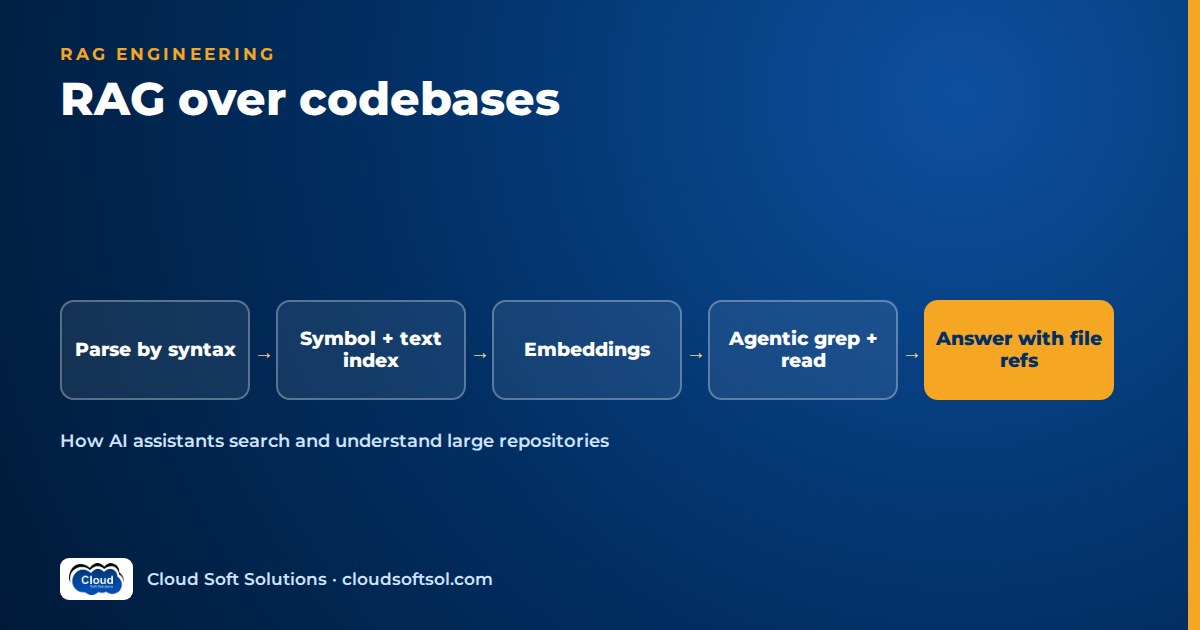
Ask a general chatbot "where do we calculate the late-payment penalty?" and it will guess. Ask an assistant wired into your repository and it should open the right file. Codebase RAG is retrieval-augmented generation built for source code: it finds the exact symbols, files and call paths that answer a developer's question, using syntax-aware chunking, identifier search, symbol indexes, code graphs and embeddings together, then hands the model a tight, permission-checked context. Document RAG techniques carry over only partly. Code has structure and exact names that prose does not, and retrieval has to respect both.
If you are deciding whether to adopt coding assistants at all, start with AI coding assistants for enterprise teams. This article is about the retrieval layer underneath them.
Why code is different from prose
Prose is read top to bottom. Code is read by jumping: call site to definition, interface to implementation, failing test to the function it exercises. Four properties make RAG for code its own problem.
- Structure. A function, class or SQL migration is a natural unit of meaning. Fixed-size cuts split methods in half and glue unrelated ones together.
- Symbols. Meaning lives in names:
PenaltyCalculator,applyGracePeriod,LOAN_STATUS_NPA. A developer asking aboutapplyGracePeriodwants that exact method, not something semantically similar. - Cross-file references. A trivial-looking method may be the only caller of a stored procedure. Understanding a change means following imports, calls, inheritance and injection across files and repositories.
- Exact identifiers and literals. Error codes, config keys, feature flags, table names and log messages must match exactly. Embedding models blur these.
ERR_4012andERR_4021look nearly identical to a vector model and mean entirely different things to an on-call engineer.
Code also changes constantly, carries secrets by accident and sits behind per-repository access controls.
Chunking code by syntax
General RAG chunking strategies split on headings and paragraphs. For code, the equivalent is splitting on the syntax tree. Incremental parser generators such as tree-sitter produce a concrete syntax tree for many languages, and an indexer walks it to emit chunks at meaningful boundaries.
- One chunk per function or method is the usual default, including its signature, annotations and doc comment.
- Classes get a summary chunk: the class declaration, fields, and the signatures of every method without their bodies. That is what a developer skims first.
- Large methods that exceed the chunk budget are split at statement blocks, and each piece repeats the enclosing signature so it still makes sense alone.
- Non-code files such as build files, SQL migrations, OpenAPI specs and ADRs need their own splitting rules.
Every chunk carries metadata: repository, path, language, fully qualified symbol name, start and end lines, commit SHA, and the owning team. That metadata powers filtering, citations ("LoanService.java, lines 210 to 260") and permission checks later. Generated code, vendored libraries and lockfiles are usually excluded.
Hybrid retrieval: lexical, symbol and semantic
No single retrieval method works for every developer question. Production systems combine three, then merge and rerank, a pattern explained in depth in hybrid search and reranking for RAG.
| Method | What it is good at | Where it fails |
|---|---|---|
| Lexical / identifier search (grep, ripgrep-style regex, BM25 with code-aware tokenising) | Exact names, error codes, config keys, log strings, quick and always fresh | Questions phrased in business language ("where do we handle overdue loans?") |
| Symbol index (definitions, references, implementations) | "Go to definition", "who calls this", "which classes implement this interface" | Dynamic dispatch, reflection, string-built SQL, config-driven wiring |
| Code embeddings (vectors of chunks or summaries) | Intent-level questions, finding similar logic written under different names | Exact identifiers, near-duplicate names, recently changed code if the index lags |
Code-aware tokenising matters for lexical search: splitting calculateLatePenalty into calculate, late, penalty lets a plain-language query match camelCase and snake_case names. For code embeddings, many teams embed a short natural-language summary of each function alongside the raw code, because a question written in English often matches an English summary better than raw Java.
A simple router helps: identifiers, paths and error codes favour lexical and symbol search; domain language favours embeddings. Usually you run all three and let a reranker decide.
Code graphs: calls, imports and ownership
Retrieval finds starting points. Code graphs let the system walk outward from them. A code graph stores nodes such as files, classes, methods, tables, endpoints and teams, with edges like:
- Calls: from static analysis, enriched from runtime traces where available.
- Imports and dependencies: module, package and build-level, including shared internal libraries.
- Inheritance: crucial in Java, where interesting code often sits behind an interface.
- Data access: which methods read or write which tables, queues and topics.
- Ownership: CODEOWNERS entries, recent committers and on-call rotations.
Graphs answer what embeddings cannot: "what breaks if I change this signature?" or "which services write to LOAN_LEDGER?". They are never complete. Reflection, dependency injection, message handlers and string-built SQL hide edges, so present graph results as "known callers", not the full truth.
Agentic search vs pre-indexed embeddings
There are two broad ways for an assistant to explore a repository, and many tools now mix them.
Pre-indexed retrieval builds embeddings, symbol tables and graphs ahead of time. A question triggers one retrieval pass, and the model answers from what came back.
Agentic search gives the model tools instead: search the repository with a regex, list a directory, read a file range, find references. The model runs them in a loop, reading results and deciding what to look at next, much as a developer would in a terminal. This is agentic RAG applied to code.
question
   |
   v
plan: guess names, paths
   |
   v
grep / find-symbol ----+
   |                   |
   v                   |
read file ranges       | refine
   |                   |
   v                   |
enough evidence? -- no-+
   | yes
   v
answer with file:line citations| Factor | Pre-indexed embeddings | Agentic search |
|---|---|---|
| Freshness | Only as fresh as the last index run | Reads the working tree directly, always current |
| Latency and cost | One fast retrieval call | Several tool calls and model turns per question |
| Exact identifiers | Weak unless paired with lexical search | Strong, since grep matches exactly |
| Vague, intent-level questions | Strong | Weak start if the model cannot guess any names |
| Infrastructure | Index pipeline, vector store, re-index jobs | A sandboxed checkout and tool permissions |
| Risks | Stale or over-shared index | Loops, runaway token use, reading files it should not |
In practice, use both: the index finds starting points for vague questions, and the agent greps and reads to confirm. Cap tool calls, tokens and time, and accept "not found" as a valid result.
Context assembly: what the model actually sees
Retrieving the right files is half the job. The other half is deciding what goes into a limited context window, which is where context engineering meets code.
- Signatures first. Signatures and doc comments of relevant classes and methods are cheap and give the model a map.
- Bodies selectively. Full bodies only for the few methods on the path the question asks about.
- Graph neighbours. Direct callers and callees of the key method, as signatures.
- Tests. Tests are executable documentation. A test named
penaltyWaivedDuringMoratoriumtells the model about a business rule more reliably than a stale comment. - Docs and decisions. READMEs, ADRs and runbooks for those paths, excluding superseded ones.
- Provenance. Path, line range and commit SHA on every snippet, so answers can cite them.
Deduplicate overlapping snippets and leave room for the answer. Dumping twenty whole files into a large context window is slower, costlier and often less accurate than curated signatures plus three bodies.
Keeping indexes fresh with commits
An index that is a week old will cite methods that were renamed on Tuesday. Freshness is a pipeline problem.
- Incremental re-indexing. On each push or merge, re-parse only changed files, update their chunks, symbols and graph edges, and use content hashes to skip re-embedding unchanged code.
- Branch awareness. Index the default branch fully. For feature branches, overlay the branch diff at query time or fall back to agentic search on the checkout.
- Deletions. Removed files and symbols must leave the index promptly, or the assistant will confidently describe dead code.
- Version stamping and rebuilds. Record the commit SHA behind each answer, and schedule full rebuilds to catch incremental drift or an embedding-model change.
Design docs, wikis and runbooks go stale even faster than code. Getting enterprise knowledge ready for AI covers ownership, freshness and clean-up for that side.
Monorepos and multi-repo estates
Monorepos make cross-references easy to resolve but are large enough that naive indexing becomes slow and noisy. Scope by path and service directory, reuse the build system's dependency graph, and filter results to the developer's area unless they ask wider.
Multi-repo estates, common in banks and services firms, have the opposite problem. Each repository is manageable, but the interesting questions cross them: a shared client library, a contract between two services, a schema owned by a third team. You need a cross-repo symbol index keyed on published packages and versions, API contracts (OpenAPI, protobuf) linked to implementations, and a catalogue mapping repositories to services and owners.
Want to build these retrieval pipelines hands-on rather than read about them? Cloudsoft's AI, GenAI and Agentic AI course covers hybrid retrieval, agents with tools, and RAG evaluation through labs.
Permissions: repository ACLs and secrets in code
A codebase RAG system can leak code faster than any individual developer, because it reads everything and answers anyone. Two controls are non-negotiable.
Enforce repository access at query time. Filter retrieval by what the asking user can read in source control now, not by a copy of permissions taken at index time. Agentic tools run with the user's permissions or a narrowly scoped identity, never a super-user service account. Otherwise a restricted payments repository becomes something every intern can query.
Keep secrets out of the index. Repositories hold API keys in old configs, private keys in fixtures and customer data in samples. Scan before indexing, skip or redact matches, and scan answers too. A secret that reached the index is exposed: rotate it.
Treat retrieved code and comments as untrusted input: a comment telling the assistant to ignore its instructions is prompt injection, handled as data.
Evaluating retrieval on real developer questions
Generic benchmarks tell you little about your codebase. Build an evaluation set from questions your developers actually ask: onboarding threads, support channel questions, incident retros and code review discussions.
- Label answer locations. An engineer who knows the area records the files and symbols that answer each question.
- Score retrieval separately from answers. Recall at k (did the right files appear in the top results?) and mean reciprocal rank show whether retrieval works before any model is involved. RAG evaluation metrics explains these and the generation-side measures.
- Score answers for groundedness and citations. Does every claim trace to a cited file and line that says so? Unsupported claims about code are worse than no answer.
- Cover question types. Include exact-identifier lookups, intent-level questions, cross-file "who calls this" questions, and questions whose honest answer is "not in this codebase".
- Re-run on every change to chunking, embeddings, routing or prompts, and track tool calls, tokens and time per question for agentic search.
Use cases that justify the effort
- Onboarding Q&A. New joiners get cited answers to "where does X happen?" without waiting for a senior engineer. Often the first win.
- Impact analysis. Before changing a method, table or API, find callers, readers, writers and owning teams across repositories, with an honest note about edges static analysis cannot see.
- Migration planning. Inventory every use of a deprecated library or internal API, group by pattern and size the work. Engineers verify the draft plan.
- Incident debugging. From a stack trace or error code, jump to the throwing code, recent commits, config and runbook. Exact-match search does the heavy lifting.
- Code review context. Related code, tests and ADRs sharpen first-pass review, as in the GitHub AI agent project.
Illustrative example: a bank GCC's legacy Java monolith
Illustrative scenario. Consider a bank's GCC in Hyderabad that maintains a loan-servicing monolith: a large Java codebase built over many years with Spring and older frameworks, stored procedures, XML configuration and batch jobs. Several engineers who wrote the core modules have moved on. The team is planning to extract repayment processing into a separate service and keeps hitting the same questions: what calls this, what writes this table, and which rules live only in code.
Discovery. Before building anything, the team collects real questions from onboarding chats and past incidents, with known answers, as the evaluation set.
Index. Java, SQL and XML are parsed by syntax. Each method becomes a chunk with its class signature attached. A symbol index covers definitions, references and implementations. A graph links methods to the stored procedures and tables they touch, since much logic sits in the database, and parsed Spring XML wiring adds injected dependencies as edges. Each method gets a short summary for embedding.
Retrieval. Questions containing class names, table names or error codes go to lexical and symbol search first. Domain questions, such as "how is the moratorium period applied to EMIs?", start with embeddings over summaries. An agent then greps and reads to confirm, within a fixed budget.
Context. Answers include signatures of the repayment classes, two or three full method bodies, the relevant tests, and the ADR on ledger posting, each cited with path, lines and commit.
Controls. The index lives in the bank's approved cloud account and region. Retrieval is filtered by the user's repository access, payment-gateway modules are restricted to their owning team, and secret scanning runs before indexing. Old property files with credentials are flagged for rotation.
Outcome. The assistant does not do the migration. It produces an impact map of callers, tables and batch jobs touching repayment logic, flags paths the graph cannot see, and gives new engineers cited answers. That is the move from AI demo to enterprise outcome: retrieval a senior engineer trusts enough to plan with. Java teams can go further with AI for Java developers.
Building this inside a customer's estate, with discovery, access controls, evaluation and handover, is the kind of work Forward Deployed Engineers do, and it is what the Cloudsoft FDE PRO program prepares engineers for.
Frequently asked questions
What is codebase RAG?
Codebase RAG is retrieval-augmented generation applied to source code. It retrieves the relevant functions, files, tests and docs for a developer's question using syntax-aware chunks, identifier search, symbol indexes, code graphs and embeddings, and gives them to an LLM to answer with file and line citations.
Why can't I use normal document RAG for code?
Document RAG splits text into fixed chunks and relies mostly on semantic similarity. Code needs chunks that follow functions and classes, exact matching for identifiers and error codes, and cross-file links such as calls and imports, which plain embeddings do not capture.
Are code embeddings enough for code search for LLMs?
No. Embeddings help with intent-level questions but are weak on exact identifiers and near-duplicate names. Combine them with lexical search and a symbol index, then rerank the merged results.
Is agentic search better than a pre-built index?
Neither wins everywhere. Agentic search is fresh and exact but slower and costlier. A pre-built index is fast and handles vague questions but can go stale. Many systems combine them.
What is tree-sitter used for in RAG for code?
Tree-sitter is a parser generator that builds syntax trees for many languages. Indexers use it to split code at function and class boundaries and extract symbol names.
How do you keep a codebase index up to date?
Re-index incrementally on each push or merge using the diff, skip unchanged chunks by content hash, remove deleted files promptly, stamp answers with the commit SHA, and run periodic full rebuilds to catch drift.
How do you stop a code assistant from leaking restricted code or secrets?
Filter retrieval by the asking user's current repository permissions, run agent tools with scoped identities, scan for secrets before indexing and in answers, and rotate any secret that reached the index.
How do you evaluate repository understanding AI?
Build a test set from real developer questions with engineer-labelled answer locations. Measure retrieval recall and rank first, then score answers for groundedness and correct citations, and track cost and latency for agentic search.
Codebase RAG is less about a clever model and more about parsing, indexing, permissions and evaluation done carefully. To practise these skills on real labs, from hybrid retrieval to tool-using agents and RAG evaluation, explore Cloudsoft's GenAI and Agentic AI training in Hyderabad, in our Ameerpet classroom or live online. Call +91 96660 19191 for a free demo.