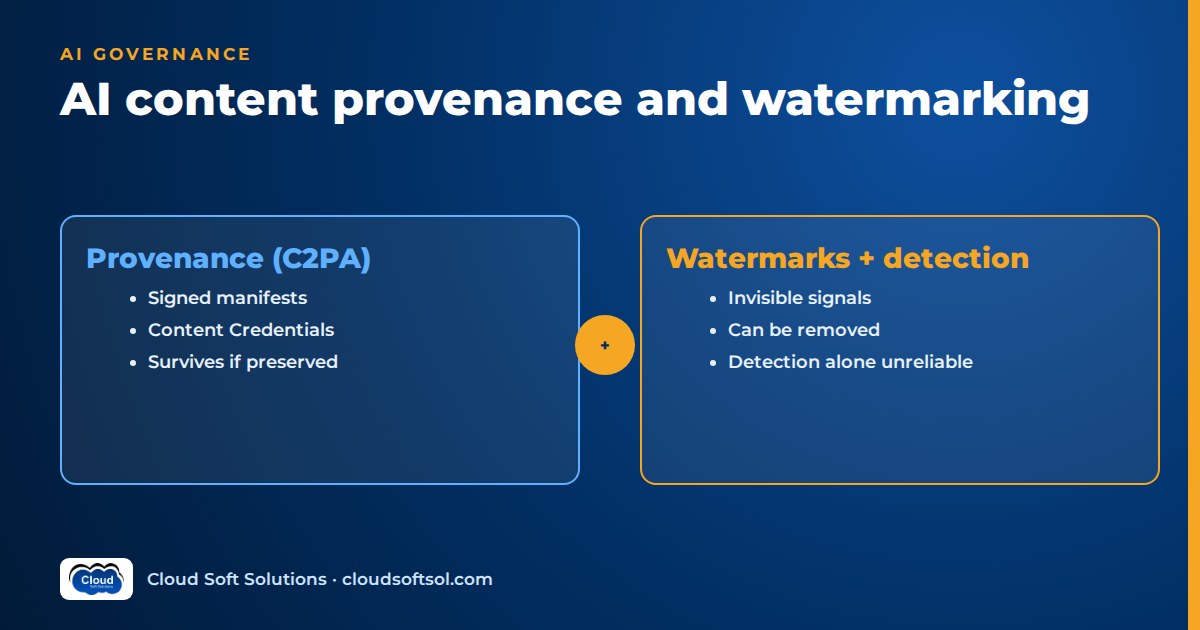
AI content provenance is the practice of attaching verifiable information to a piece of media that says where it came from, which tools touched it and whether AI generated or edited it. In practice, engineering teams combine three different things: signed provenance metadata (the C2PA standard, shown to users as Content Credentials), invisible watermarks embedded in the pixels, audio or tokens, and detection classifiers, and only the first two give you evidence rather than a guess. With EU AI Act Article 50 transparency duties applying from 2 August 2026 and India's IT Rules amended in February 2026 to cover synthetically generated information, marking generated media is now a pipeline requirement, not a research topic.
Not legal advice. This is an engineering guide written in October 2026. Regulations, codes of practice and the C2PA specification keep moving. Check current texts with your legal and compliance teams before making decisions.
Provenance, watermarking and detection are different tools
These three techniques answer different questions and fail in different ways.
| Approach | What it is | Question it answers | Main weakness |
|---|---|---|---|
| Provenance (C2PA manifest) | Cryptographically signed metadata attached to or referenced by the file | "Who signed this, with what tool, and has it changed since?" | Easily stripped by screenshots, re-encoding or platforms that drop metadata |
| Invisible watermark | A signal embedded in the content itself (pixels, audio samples, token choices) | "Was this produced by a system that applies this watermark?" | Can be weakened or removed by heavy editing, rewriting or adversarial attacks; usually only detectable by the vendor's own detector |
| Detection classifier | A model trained to guess whether content is synthetic | "Does this look AI-generated?" | Probabilistic, drifts as generators improve, produces false positives on real content |
Provenance and watermarks are applied at creation time by a cooperating party. Detection is applied afterwards to content from anyone, including adversaries, which makes it the weakest evidence, though the only option for unmarked content.
Why detection alone is unreliable
- It is an arms race. Classifiers learn the artefacts of known generators; new models and simple post-processing change those artefacts.
- False positives hurt real people. Edited real photos, compressed video and non-native writing get flagged, which becomes a fairness problem when a genuine customer selfie is rejected.
- A clean score proves nothing. The content may come from a generator the model has never seen.
Use detection as one risk signal, with human review for consequential decisions.
How the C2PA standard works
The Coalition for Content Provenance and Authenticity (C2PA) publishes an open technical standard for recording the origin and edit history of digital content. Its steering committee includes Adobe, Google, Microsoft, Meta, OpenAI, Amazon, Sony and the BBC, among others. The specification is in its 2.x series and is revised regularly, so check the current version rather than pinning one release in your designs.
Manifests, claims and assertions
The core unit is the C2PA manifest, a cryptographically signed data structure describing an asset's provenance. A manifest store can hold several, one per step in the asset's life.
- Assertions are individual statements about the asset. Standard ones include actions (created, edited, including by an AI system), ingredients (source assets) and thumbnails; custom assertions can carry, say, a campaign ID.
- The claim gathers references to the assertions and states who is making them.
- The claim signature signs the claim with a private key whose X.509 certificate identifies the signer. A trusted timestamp can record when the signing happened.
Hard binding and soft binding
Hard binding ties the manifest to the content with cryptographic hashes: change a pixel and validation fails. Soft binding uses an invisible watermark or a perceptual fingerprint that survives some changes. Its purpose is recovery: if metadata was stripped, a validator reads the watermark or fingerprint and looks up the original manifest in a repository (C2PA publishes a Soft Binding API for this). That is why provenance and watermarking are complementary.
Certificates and trust
A valid signature tells you the manifest was not tampered with and who signed it. Whether you trust that signer is a separate decision. C2PA maintains a trust list, similar in spirit to a browser's root certificates, and organisations can add their own trust anchors. The C2PA explainer is explicit that Content Credentials do not judge whether content is "true": they prove who made claims and that the file is unchanged, not that the scene happened.
What Content Credentials mean for users
Content Credentials is the user-facing name for C2PA provenance data. Supporting apps show a small "CR" pin on media; clicking it reveals how the content was made, which tools were used, whether AI was involved and the edit history. Content Credentials is hosted by C2PA, and verification tools let anyone inspect a file's credentials. C2PA is the format and trust model; Content Credentials is the label people see.
Invisible watermarking: what it can and cannot do
Invisible watermarking embeds a signal in the content itself, so it travels with screenshots and many re-encodes that would strip metadata. Google DeepMind's SynthID is a widely known example: Google describes it as embedding imperceptible watermarks in AI-generated images, audio, text and video, and it has open-sourced SynthID Text, which is available through Hugging Face Transformers.
Media watermarks are spread across the signal to survive compression, resizing and cropping. Limits to design around:
- Robustness is not absolute. Heavy edits, regeneration through another model or adversarial attacks can weaken or remove a watermark.
- Detection is usually vendor-specific. There is no universal reader across watermark schemes.
- A watermark carries little information. It identifies a source or ID, not the edit history; that is the manifest's job.
- It only covers cooperating generators. Content from a model that does not watermark has no signal to find.
Text watermarking limits
Text is the hardest modality. SynthID Text works by adjusting the model's token probabilities during generation with a pseudorandom function, leaving a statistical pattern a detector can test for. Google's own documentation notes that watermarking is less effective on factual responses, where there is little freedom in word choice, and that detector confidence can drop sharply when text is thoroughly rewritten or translated. Short texts carry too few tokens to detect reliably. Do not build policy on the assumption that AI-written text can be reliably identified; interface disclosure and logging are more dependable.
Regulatory drivers: EU AI Act and India's IT Rules
EU AI Act Article 50
Article 50 of the EU AI Act sets transparency duties that apply from 2 August 2026 regardless of risk tier. Providers of generative systems must ensure that synthetic audio, image, video and text outputs are marked in a machine-readable format and detectable as artificially generated or manipulated. Deployers must disclose deepfakes and AI-generated text published to inform the public on matters of public interest, unless it has gone through human review and editorial responsibility.
The 2026 Digital Omnibus amendment did not delay Article 50 overall. It added a short grace period for the machine-readable marking duty in Article 50(2): generative systems placed on the market before 2 August 2026 have until 2 December 2026 to comply, while systems placed on the market from 2 August 2026 must comply from launch. In June 2026 the Commission also published a voluntary Code of Practice on marking and labelling AI-generated content. It says no single technique is enough and expects at least two layers of machine-readable marking where necessary, such as metadata plus watermarks, plus a way for others to check content. For roles and timelines, see our EU AI Act guide for Indian IT and GCC teams.
India's IT Rules on synthetically generated information
MeitY notified the Information Technology (Intermediary Guidelines and Digital Media Ethics Code) Amendment Rules, 2026 in February 2026, in force from 20 February 2026. They cover audio, visual and audio-visual content algorithmically created or altered to appear authentic, excluding good-faith routine editing and text-only content. In summary:
- Intermediaries that offer tools to create or modify such content must label it prominently (an audio disclosure for audio) and ensure permanent metadata or a unique identifier travels with the file, which users must not be able to remove or suppress.
- Significant social media intermediaries must ask uploaders to declare whether content is synthetic and deploy technical measures to verify those declarations.
- Takedown timelines for unlawful content were shortened sharply, to a few hours for certain categories.
The notified rules dropped the draft's fixed label-size rule for qualitative standards ("prominent"). If your product generates images, voice or video for Indian users, embedded metadata plus a visible label is now the baseline, and personal data in that metadata still falls under the DPDP Act.
What engineers should implement
Generate --> Sign (C2PA) --> Watermark --> Store
   |            |              |           |
 model ID    cert + TSA    vendor/own   manifest repo
                                           |
Edit/resize --> Re-sign (ingredient) --> CDN
                                           |
          Verify --> Show label in UI --> Log
1. Sign generated images, audio and video at the source
Sign in the service that calls the model, not in a later batch job. The manifest should record a generative-AI creation action, the model or service used, your organisation as signer, and a timestamp. The open-source C2PA SDKs (a Rust core with bindings for other languages, plus the c2patool command line) handle manifest building and embedding for common formats. Some generation services already attach credentials, so check what you receive.
Treat the signing key like any production secret: keep it in a KMS or HSM, use certificates validators will trust, and plan rotation and revocation; a leaked key lets anyone sign fakes as you. This belongs in your enterprise AI security threat model.
2. Preserve credentials through pipelines and CDNs
The most common failure is your own pipeline stripping metadata: image optimisers, thumbnailers, transcoders, CMS uploads and social platforms often drop it. To keep the chain intact:
- Push a credentialed test asset through upload, resize, transcode and CDN delivery, and check what comes out.
- When your system legitimately changes the asset, re-sign it with a new manifest that lists the previous version as an ingredient.
- Choose services that preserve credentials. Cloudflare Images, for example, has a setting to preserve Content Credentials and sign its own transformations.
- Store manifests in a repository and add a soft binding (watermark or fingerprint) to recover provenance for stripped copies.
3. Display labels to users
Machines read markings; people need visible labels. Show a clear "AI-generated" or "edited with AI" label with a details view, and keep it honest: "Content Credentials: created with an AI tool by Brand X" is accurate; "Verified real" is a claim provenance cannot support. For audio, use a spoken disclosure. Put the label in your design system so every team ships it consistently.
4. Log and govern
Keep a record of what your systems generated, when, for which user or campaign, and with which manifest ID. These logs answer regulators, settle takedown disputes and feed your enterprise AI governance reviews. Add provenance checks to your release checklist for any feature that generates media.
To build pipelines like this hands-on, with model APIs, guardrails, evaluation and cloud deployment, Cloudsoft's AI, GenAI and Agentic AI course in Hyderabad covers the engineering behind production generative AI systems.
Enterprise use cases
Brand assets and marketing content
Brands want to disclose honestly when creative uses AI and to prove official assets really came from them. Signing published assets with the company's certificate lets partners, journalists and platforms check genuine brand material. Agencies can sign as themselves and list the brand's source assets as ingredients.
KYC and deepfake defence
Here you are receiving content, often from someone trying to deceive you: face-swapped selfies, replayed videos and injected camera feeds during onboarding. Provenance helps only when capture happens in an app you control, where your SDK can sign the capture so the server knows it came from a real camera session. Beyond that, combine liveness checks (active challenges or passive analysis of whether a live person is present), device and injection-attack signals, document checks and deepfake detection scores, with manual review for borderline cases. No single signal should decide alone. Our generative AI in banking guide covers the wider risk context.
Illustrative example: a media and marketing team
Consider a consumer-goods company whose marketing team, working with a GCC content studio in Hyderabad, generates image and video campaign variants for India and Europe. The team ships provenance in stages:
- Discovery. They map every route an asset takes: generation service, design tool, digital asset management (DAM) system, CMS, CDN and social scheduler. An end-to-end test shows the DAM thumbnailer and CMS optimiser both strip metadata.
- Signing. A signing service behind the generation API adds a C2PA manifest with a generative-AI action, the campaign ID as a custom assertion and the company as signer, using a KMS-held key, and keeps the vendor's watermark where available.
- Edits. Designers' tools add edit manifests; final exports are re-signed, listing earlier versions as ingredients.
- Delivery. The optimiser is reconfigured to preserve credentials, manifests go to a repository keyed by fingerprint, and a nightly job checks live URLs.
- Labelling. The website shows a "Made with AI" label with a details panel; social posts use each platform's AI label.
- Governance. Brand guidelines state which content needs disclosure, and legal reviews label wording against Article 50 and India's IT Rules.
The result is not "deepfake-proof" content; it is an auditable record of what the company created and consistent disclosure to customers.
Common pitfalls
- Treating a missing credential as proof of fakery. Most genuine content has none; missing means unknown.
- Signing with personal data. Manifests are public; keep employee names, customer IDs and locations out.
- Buying a detector and calling it compliance. Marking duties are met at generation time, not by detection.
- Forgetting video and audio. Teams sign images and ignore voice and video, where deepfake risk is highest. Multimodal AI systems need provenance across every output type.
Designing these controls across generation services, content platforms, CDNs and compliance teams is the kind of cross-system delivery work Forward Deployed Engineers do inside enterprise customers.
Frequently asked questions
What is AI content provenance?
AI content provenance is verifiable information attached to or linked from a media file that records where it came from, which tools created or edited it and whether AI was involved. The C2PA standard is the main open format for it, using cryptographically signed manifests.
What is the difference between C2PA and Content Credentials?
C2PA is the open technical standard that defines manifests, assertions, signing and validation. Content Credentials is the user-facing name for that provenance data, usually shown as a small CR pin that reveals how the content was made.
Is watermarking the same as C2PA provenance?
No. A C2PA manifest is signed metadata carrying detailed history, but it can be stripped. A watermark is embedded in the content itself and survives more transformations, but carries little information. C2PA soft binding links the two so a watermark can be used to recover a stripped manifest.
Can AI watermarks be removed?
Yes, with enough effort. Watermarks are designed to survive common edits such as compression and resizing, but heavy editing, regeneration through another model or adversarial attacks can weaken or remove them. Treat them as a strong signal, not tamper-proof evidence.
Why is AI detection alone unreliable?
Detection classifiers guess from statistical patterns, lose accuracy on new generators, flag some genuine content as fake and cannot prove content is real. Use them as one risk signal with human review, alongside provenance and watermarks.
Can AI-generated text be reliably watermarked?
Only partly. Text watermarks such as SynthID Text are less effective on factual answers and short passages, and detection weakens when text is rewritten or translated. For text, interface disclosure and logging are more dependable.
Do EU AI Act marking rules apply to Indian companies?
They can, if you provide generative AI systems placed on the EU market or whose output is used in the EU. Article 50 duties apply from 2 August 2026, with a grace period until 2 December 2026 for machine-readable marking on systems placed on the market before 2 August 2026.
Does provenance stop KYC deepfakes?
Not on its own. Signing captures inside your own app helps prove they came from a real camera session, but onboarding also needs liveness checks, injection-attack and device signals, document checks, detection scores and manual review for borderline cases.
Provenance, watermarking and detection are now everyday engineering decisions for anyone shipping generative AI. To build these skills with hands-on labs, explore Cloudsoft's AI, GenAI and Agentic AI training, in our Ameerpet classroom beside Ameerpet Metro or live online. Call +91 96660 19191 to book a free demo.