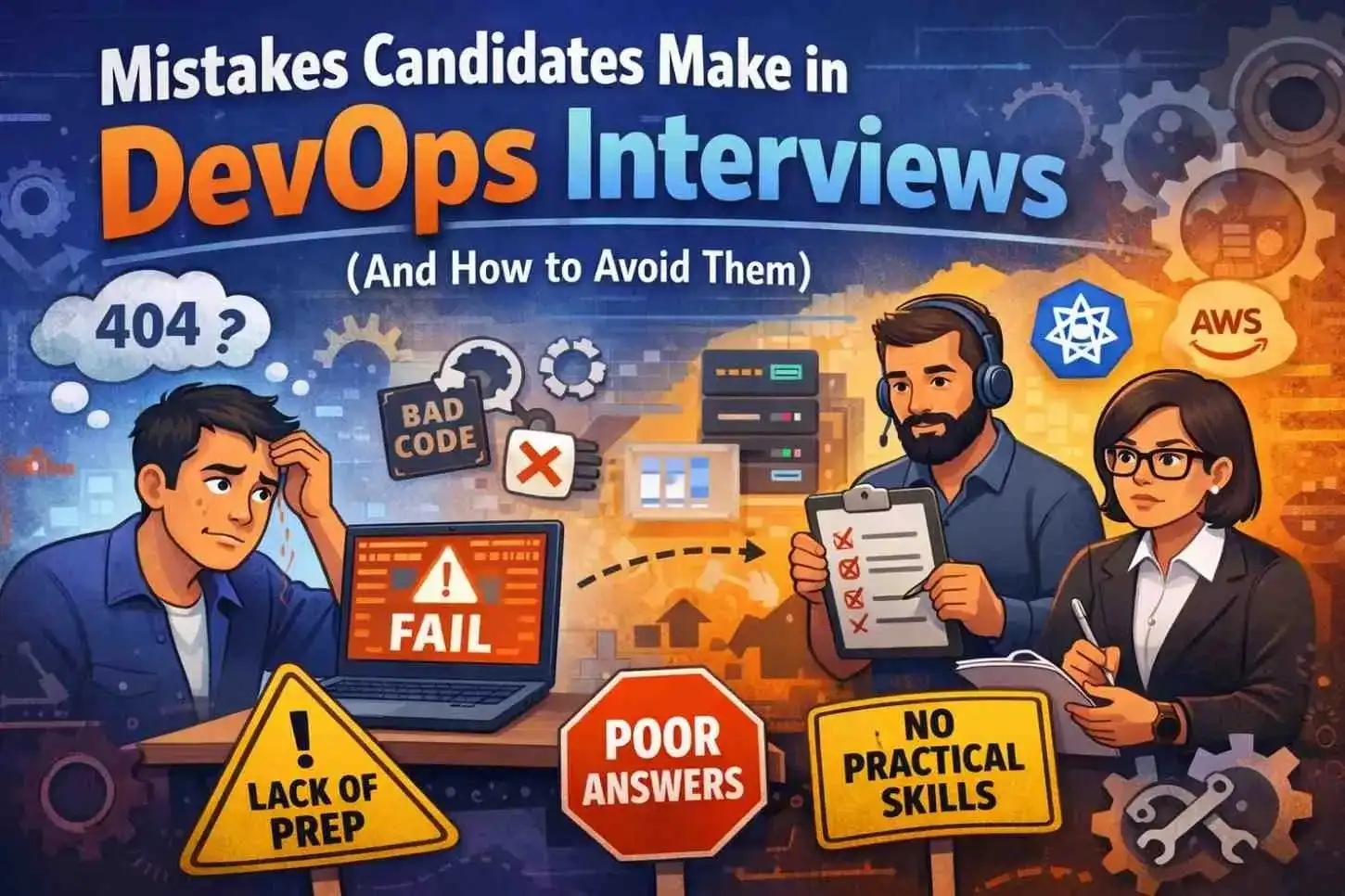
Mistakes Candidates Make in DevOps Interviews (And How to Avoid Them)
Introduction
DevOps interviews are no longer limited to theoretical questions. Hiring managers at top MNCs and startups expect hands-on expertise, troubleshooting ability, and real-world problem-solving skills.
Yet, many capable candidates fail DevOps interviews—not due to lack of knowledge, but due to avoidable mistakes.
In this article, Cloudsoft Solutions breaks down the most common DevOps interview mistakes and provides practical tips to help you stand out and succeed.
1. Lack of Strong Linux Fundamentals
 Common Mistake
 Common Mistake
Many candidates jump straight into tools like Docker, Kubernetes, or Terraform without mastering Linux basics.
Interviewers often reject candidates who cannot:
- Explain file permissions
- Debug system issues
- Analyze logs
- Manage processes
What Interviewers Expect
 What Interviewers Expect
grep,awk,sed,find- Process management (
ps,top,htop) - Disk and memory troubleshooting
- Systemd and service management
 Tip: If you cannot troubleshoot a Linux server, you are not ready for DevOps.
2. Treating DevOps as Just Tools, Not Culture
Common Mistake
Candidates list 15 tools on their resume but fail to explain:
- Why a tool was chosen
- What problem it solved
- How it improved delivery or reliability
What Interviewers Expect
- Understanding of DevOps principles
- CI/CD mindset
- Collaboration between Dev, QA, Security, and Ops
- Automation over manual work
DevOps is not Jenkins + Docker + Kubernetes—it’s about faster, safer, and reliable delivery.
3. Weak CI/CD Pipeline Knowledge
Common Mistake
Many candidates say:
“I worked on Jenkins pipelines”
But fail to explain:
- Pipeline stages
- Rollback strategies
- Artifact versioning
- Failure handling
What Interviewers Expect
- CI vs CD difference
- Blue-Green, Canary deployments
- Pipeline as Code
- Handling failed builds and approvals
Example Question:
“What happens if a deployment fails in production?”
If you can’t answer this clearly, it’s a red flag.
4. Poor Kubernetes Fundamentals
Common Mistake
Candidates memorize Kubernetes terms but lack real understanding.
Common failures include:
- Confusing Pods, Deployments, and Services
- Not knowing how scaling works
- Unable to debug CrashLoopBackOff
What Interviewers Expect
- Pod lifecycle
- ConfigMaps vs Secrets
- Liveness vs Readiness probes
kubectltroubleshooting commands
Real-world debugging matters more than YAML memorization.
5. Ignoring Cloud Architecture Basics
Common Mistake
Candidates focus only on services but ignore cloud design concepts.
What Interviewers Expect
- High availability
- Auto scaling
- Fault tolerance
- Cost optimization
AWS / Azure / GCP Examples:
- Difference between ALB and NLB
- Private vs Public subnets
- IAM best practices
- Multi-AZ vs Multi-Region
6. No Understanding of Security (DevSecOps)
Common Mistake
Security is treated as an afterthought.
Candidates often:
- Hardcode secrets
- Ignore least privilege
- Skip vulnerability scanning
What Interviewers Expect
- Secrets management (Vault, AWS Secrets Manager)
- Image scanning
- SAST / DAST tools
- IAM and RBAC knowledge
DevOps without security is a deal-breaker in modern interviews.
7. Unable to Explain Real Production Issues
Common Mistake
Candidates avoid or fake production experience.
What Interviewers Expect
- Incident handling
- Root Cause Analysis (RCA)
- Monitoring and alerting
- Downtime reduction strategies
Sample Interview Question:
“Tell me about a production outage you handled.”
Honest, structured answers matter more than exaggeration.
8. Overloading Resume with Buzzwords
Common Mistake
Resumes filled with:
Kubernetes, Terraform, Helm, ArgoCD, Prometheus, Grafana, Istio, Kafka…
But no depth in any.
What Interviewers Expect
- Fewer tools
- Deeper expertise
- Clear project impact
It’s better to know 5 tools deeply than 15 tools superficially.
9. Poor Communication and Explanation Skills
Common Mistake
Candidates know answers but cannot explain clearly.
What Interviewers Expect
- Clear thought process
- Architecture explanation
- Diagram-based thinking
- Calm troubleshooting approach
DevOps engineers communicate with developers, managers, and security teams daily.
10. Not Practicing Hands-On Scenarios
Common Mistake
Only theoretical preparation.
What Interviewers Expect
- Live debugging
- Scenario-based answers
- Architecture discussions
If you haven’t broken things and fixed them, you’re not interview-ready.
How to Avoid These DevOps Interview Mistakes
Follow This Preparation Strategy
 Follow This Preparation Strategy
- Master Linux + Networking
- Build real CI/CD pipelines
- Deploy applications on Kubernetes
- Practice cloud architecture
- Focus on security
- Do mock interviews
Why Cloudsoft Solutions DevOps Training Works
At Cloudsoft Solutions, our DevOps training is:
- Interview-focused
- Hands-on
- Real production scenarios
- Resume & mock interview support
- Placement-oriented
 We don’t just teach tools—we build DevOps engineers.
Final Thoughts
DevOps interviews test mindset, problem-solving, and real-world experience, not just tools.
Avoid these common mistakes, prepare smartly, and you’ll stand out in any DevOps interview.
 Bookmark this guide and revisit before every interview.