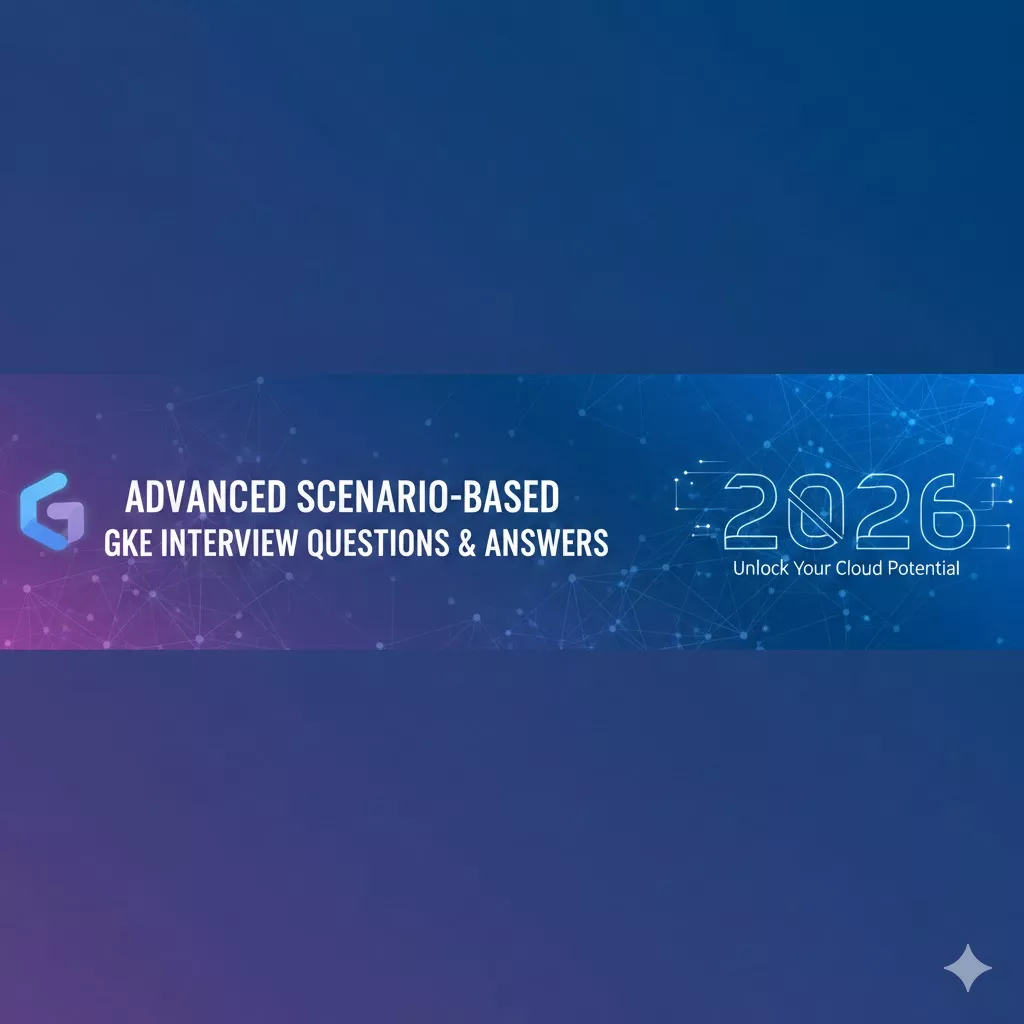
Advanced Scenario-Based GKE Interview Questions and Answers (2026)
Introduction
Modern enterprises rely on GKE for mission-critical workloads. Interviewers increasingly test real-time troubleshooting, architecture decisions, security hardening, and cost optimization scenarios.
This article covers 20+ advanced, scenario-based GKE interview questions with detailed solutions, designed for 5–10+ years experience professionals.
1. Scenario: Pods Are Pending Even Though Nodes Have Free CPU
Problem:
Pods remain in Pending state, but nodes show available CPU.
Root Cause & Solution:
- Check memory requests
- Verify node selectors / affinity
- Inspect taints and tolerations
- Check PodDisruptionBudgets
Commands:
kubectl describe pod <pod-name>
kubectl describe node <node-name>
2. Scenario: Sudden Traffic Spike Crashes Your Application
Solution Strategy:
- Enable HPA (Horizontal Pod Autoscaler)
- Configure Cluster Autoscaler
- Use GKE Ingress with Cloud Load Balancer
- Apply requests/limits
3. Scenario: Node Goes Down and Pods Don’t Restart
Root Cause:
- Autorepair disabled
- Single-zone cluster
Fix:
- Enable node auto-repair
- Use regional clusters
- Use ReplicaSets
4. Scenario: Secure Pod Access to Google Cloud APIs Without Keys
Best Practice:
- Enable Workload Identity
- Map Kubernetes Service Account to GCP IAM Service Account
Why?
- Eliminates long-lived service account keys
5. Scenario: Zero-Downtime Application Deployment
Solution:
- Use Rolling Updates
- Configure maxSurge & maxUnavailable
- Implement Readiness Probes
6. Scenario: High GKE Costs Due to Over-Provisioned Nodes
Optimization Steps:
- Enable Cluster Autoscaler
- Use Node Auto-Provisioning
- Use Autopilot
- Right-size pod requests
7. Scenario: Need Isolation for Different Teams in One Cluster
Solution:
- Use Namespaces
- Apply RBAC
- Use ResourceQuotas
- NetworkPolicies
8. Scenario: Pods Can’t Communicate Across Namespaces
Cause:
- NetworkPolicy restrictions
Fix:
- Modify NetworkPolicy to allow cross-namespace traffic
9. Scenario: Application Needs Static Public IP
Solution:
- Use Ingress
- Reserve a global static IP
- Attach IP to Ingress
10. Scenario: GKE Upgrade Causes Application Downtime
Prevention:
- Use PodDisruptionBudgets
- Use Surge upgrades
- Test in staging clusters
11. Scenario: Logs Missing From Pods
Troubleshooting:
- Verify Cloud Logging enabled
- Check container logs to
stdout/stderr - Validate logging agent status
12. Scenario: Stateful Application Loses Data After Pod Restart
Solution:
- Use PersistentVolumeClaims
- Use StatefulSets
- Use Regional Persistent Disks
13. Scenario: External Users Can’t Access Service
Check:
- Service type (
LoadBalancer) - Firewall rules
- Ingress backend health
- SSL certificates
14. Scenario: Pod Needs GPU for ML Workloads
Steps:
- Create GPU-enabled node pool
- Apply nodeSelector
- Install NVIDIA drivers (auto in GKE)
15. Scenario: Prevent Unauthorized Image Deployments
Security Controls:
- Enable Binary Authorization
- Use Artifact Registry
- Enforce signed images
16. Scenario: Need Canary Deployment in GKE
Implementation:
- Use Istio / Service Mesh
- Use multiple Deployments
- Traffic splitting via Ingress
17. Scenario: Multi-Region Disaster Recovery Strategy
Solution:
- Use multiple GKE clusters
- Use GKE Fleet / Anthos
- Global Load Balancer
- Backup using Velero
18. Scenario: Internal Service Must Not Be Exposed Publicly
Fix:
- Use ClusterIP
- Internal Load Balancer
- Private GKE cluster
19. Scenario: CI/CD Pipeline Deploys Broken Code
Prevention:
- Use Blue-Green deployments
- Automated tests
- Rollback strategy using Helm
20. Scenario: Need to Control API Access at Pod Level
Solution:
- Use RBAC
- Kubernetes Service Accounts
- Workload Identity
21. Scenario: Pods Evicted Frequently
Cause:
- Memory pressure
- No resource limits
Fix:
- Set proper resource requests & limits
- Use Vertical Pod Autoscaler (VPA)
22. Scenario: GKE Cluster Must Meet Compliance Standards
Best Practices:
- Private clusters
- Shielded nodes
- CIS benchmarks
- Audit logs enabled
23. Scenario: Sudden DNS Resolution Failures
Fix:
- Enable NodeLocal DNS Cache
- Check CoreDNS pods
- Validate DNS policies
24. Scenario: Multi-Tenant GKE Cluster Security
Controls:
- Pod Security Standards
- Namespace isolation
- Network policies
- Separate node pools
25. Scenario: GKE API Server Access Restricted
Solution:
- Enable Authorized Networks
- Use private endpoint
- Use Bastion host
Conclusion
These advanced scenario-based GKE interview questions reflect real production challenges faced by DevOps and SRE professionals in 2026.
Mastering these scenarios will help you: Crack senior-level interviews Design resilient architectures Troubleshoot faster in production
For more GKE, Kubernetes, DevOps, and Cloud interview guides, visit www.cloudsoftsol.com