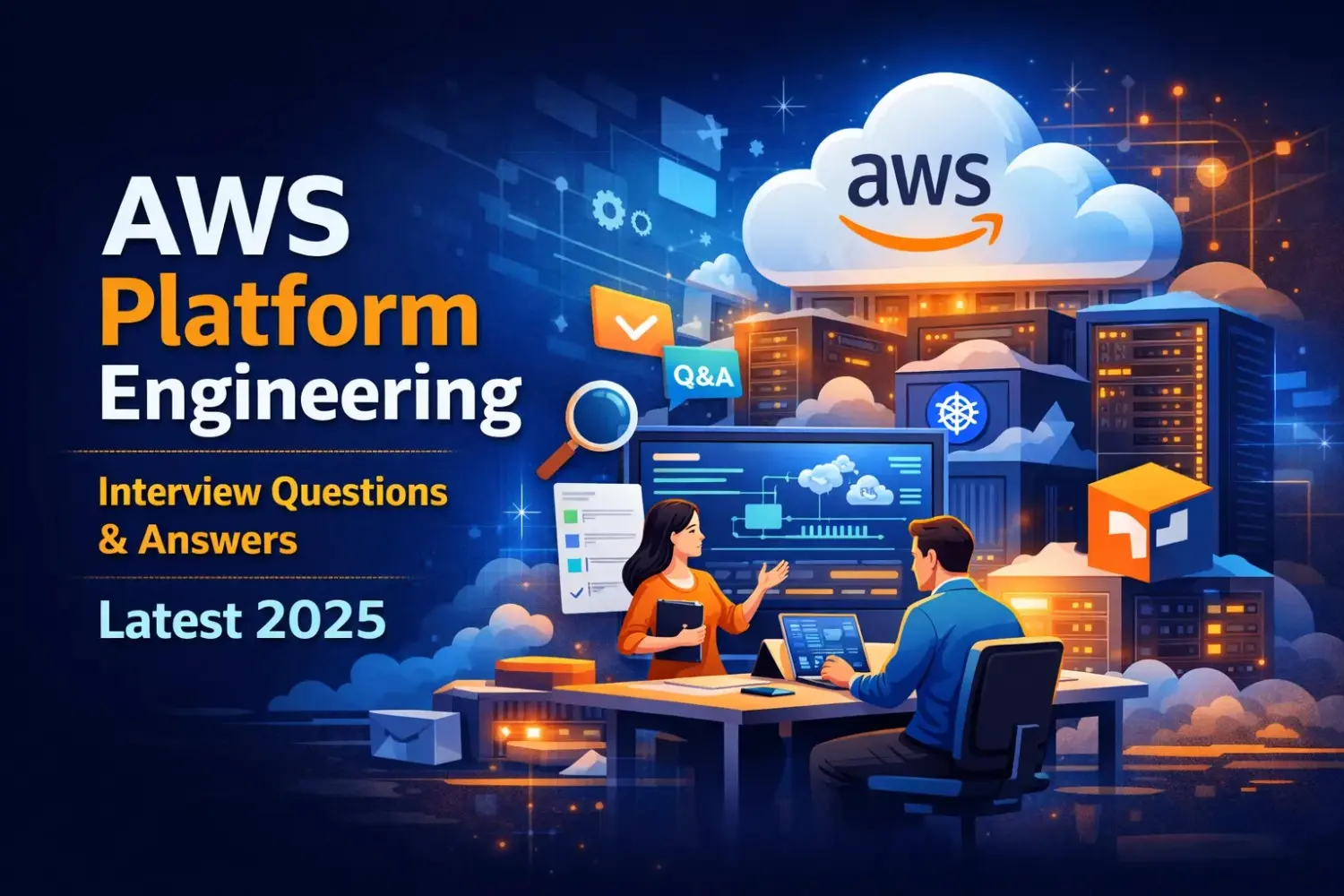
AWS Platform Engineering Interview Questions & Answers Latest 2025
Introduction
Platform Engineering has emerged as a critical discipline in modern cloud-native organizations. Unlike traditional DevOps, AWS Platform Engineers focus on building internal developer platforms (IDPs) that abstract infrastructure complexity, improve developer productivity, and enforce governance at scale.
This guide from CloudSoftSol covers real-world AWS Platform Engineering interview questions with clear explanations, architectural insights, and best practices—ideal for mid to senior-level interviews in 2025.
1. What Is Platform Engineering in AWS?
Answer:
Platform Engineering is the practice of designing and operating reusable cloud platforms that enable developers to self-serve infrastructure securely and efficiently.
Key Responsibilities:
- Build Internal Developer Platforms (IDPs)
- Standardize infrastructure using IaC
- Enable self-service deployments
- Enforce security, compliance, and cost controls
- Improve developer experience (DevEx)
AWS Services Used:
- AWS EKS / ECS
- AWS CDK / CloudFormation / Terraform
- IAM, Organizations, SCPs
- CI/CD (CodePipeline, GitHub Actions)
- Observability (CloudWatch, X-Ray, OpenTelemetry)
2. Platform Engineering vs DevOps in AWS
| Aspect | DevOps | Platform Engineering |
|---|---|---|
| Focus | CI/CD automation | Developer platforms |
| Scope | App-level pipelines | Org-wide infrastructure |
| Users | Ops + Dev teams | Internal developers |
| Output | Pipelines | Golden paths & self-service |
 Platform Engineering is DevOps at scale
3. Explain Internal Developer Platform (IDP) on AWS
Answer:
An IDP is a curated set of tools, APIs, templates, and workflows that allow developers to deploy applications without managing AWS resources directly.
AWS IDP Components:
- Infrastructure Templates: CDK / Terraform modules
- Compute Layer: EKS, ECS, Lambda
- CI/CD: GitOps, CodePipeline
- Security: IAM roles, Secrets Manager
- Observability: Centralized logging & metrics
 Goal: Reduce cognitive load on developers
4. How Do You Design a Multi-Account AWS Platform?
Answer:
Using AWS Organizations with a Landing Zone architecture.
Best Practices:
- Separate accounts: Dev, QA, Prod, Security, Shared Services
- Use SCPs for guardrails
- Centralize logging and billing
- Use IAM Identity Center (SSO)
Common Tools:
- AWS Control Tower
- Terraform + Organizations
- Account vending machine (AVM)
5. How Do You Enable Self-Service Infrastructure in AWS?
Answer:
By providing opinionated templates and automated workflows.
Methods:
- Terraform modules with limited variables
- AWS CDK constructs
- Service Catalog products
- GitOps-based provisioning
Example:
Developer requests an EKS namespace → Platform auto-creates:
- IAM roles
- Network policies
- Monitoring
- Cost tags
6. How Do You Secure a Platform Engineering Setup?
Answer:
Security must be built into the platform, not added later.
AWS Security Best Practices:
- IAM least privilege with role-based access
- SCPs to restrict risky actions
- Secrets Manager instead of env vars
- Network isolation (VPC, PrivateLink)
- Shift-left security with IaC scanning
Tools:
- AWS Config
- GuardDuty
- Security Hub
- OPA / Kyverno (for EKS)
7. How Do You Manage Kubernetes (EKS) at Scale?
Answer:
By standardizing clusters and enforcing policies.
Key Strategies:
- Use managed node groups / Fargate
- Namespace-based isolation
- GitOps with ArgoCD or Flux
- Centralized logging (FluentBit)
- Cluster autoscaling
Interview Tip:
Mention golden clusters and platform-owned add-ons.
8. Infrastructure as Code Strategy for Platform Teams
Answer:
Platform teams maintain core IaC, while app teams consume it.
Recommended Stack:
- Terraform for account & network
- AWS CDK for application stacks
- Module versioning
- Policy-as-Code
Key Concept:
Developers use interfaces, not raw AWS services
9. How Do You Handle Cost Optimization in Platform Engineering?
Answer:
By making cost visibility and control part of the platform.
Techniques:
- Mandatory cost allocation tags
- AWS Budgets & alerts
- Savings Plans
- Autoscaling
- Chargeback / showback models
 Platform engineers design for FinOps
10. Observability in AWS Platform Engineering
Answer:
Observability must be platform-provided, not app-specific.
Core Pillars:
- Metrics: CloudWatch, Prometheus
- Logs: Centralized logging accounts
- Traces: X-Ray, OpenTelemetry
- Alerts: SLO-based alerts
Advanced Concept:
Error budgets & reliability engineering
11. CI/CD Design for Platform Engineering
Answer:
Platform teams provide standard pipelines, not custom scripts.
Best Practices:
- Pipeline templates
- GitOps deployments
- Policy enforcement in pipelines
- Environment promotion workflows
Tools:
- AWS CodePipeline
- GitHub Actions
- ArgoCD
12. How Do You Measure Platform Success?
Answer:
Using Developer Experience (DevEx) metrics.
KPIs:
- Deployment frequency
- Lead time for changes
- MTTR
- Platform adoption rate
- Developer satisfaction
Platforms succeed when developers don’t notice infrastructure
13. Common AWS Platform Engineering Interview Scenarios
Scenario 1:
Developers bypass platform and create resources manually
 Solution:
- Improve UX
- Enforce SCP restrictions
- Educate teams
Scenario 2:
EKS cluster sprawl
Solution:
- Centralized clusters
- Namespace isolation
- Cost governance
14. Advanced AWS Platform Engineering Interview Questions
- How would you build a Paved Road strategy?
- How do you design zero-trust networking on AWS?
- How do you prevent configuration drift?
- How do you manage secrets across multiple AWS accounts?
- How would you migrate from DevOps to Platform Engineering?
Final Thoughts
AWS Platform Engineering is about scaling DevOps, empowering developers, and building cloud foundations that last. Interviewers look for system thinking, trade-off awareness, and real-world AWS experience.
At CloudSoftSol, we help engineers master AWS, DevOps, and Platform Engineering with interview-focused guides and hands-on insights.