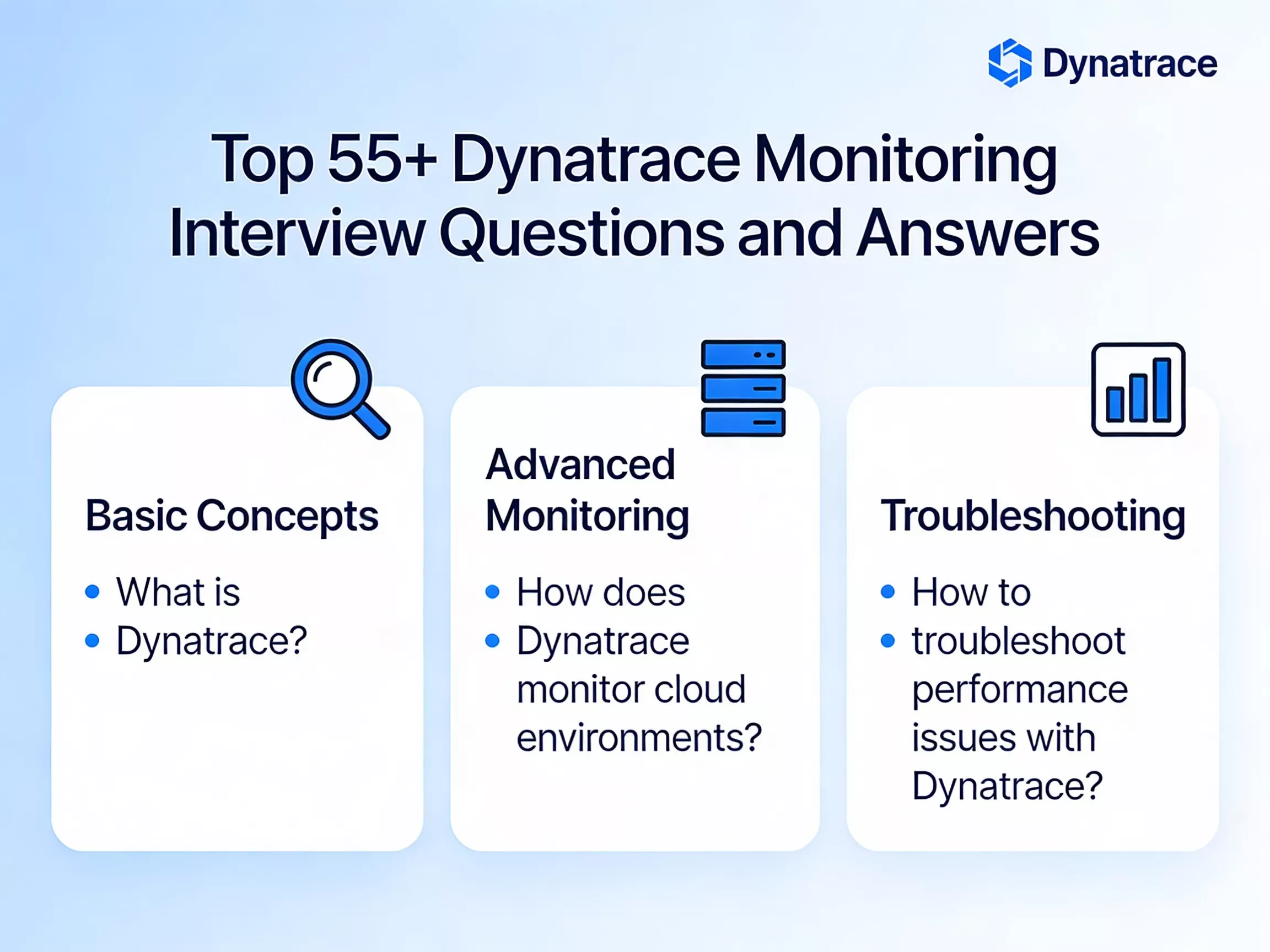
Top 55+ Dynatrace Monitoring Interview Questions and Answers (2025 Edition)
Basic to Intermediate Dynatrace Questions (1–25)
1. **What is Dynatrace in simple terms?**
Dynatrace is an AI-powered, full-stack observability platform that automatically discovers, monitors, and analyzes applications, infrastructure, microservices, and user experience in real time with almost zero manual configuration.
2. **Name the three core components of Dynatrace architecture.**
OneAgent, ActiveGate, and Dynatrace Cluster (SaaS or Managed).
3. **What is the primary role of OneAgent?**
Automatically instruments hosts, containers, processes, and code to collect metrics, traces, logs, and topology without manual configuration.
4. **What is ActiveGate used for?**
Secure proxy between OneAgent and Dynatrace cluster, synthetic monitoring execution, routing in restricted networks, and extensions execution.
5. **What is Davis AI?**
Dynatrace’s causal + predictive AI engine that performs automatic root cause analysis, anomaly detection, and predictive forecasting.
6. **What is PurePath?**
Dynatrace’s patented end-to-end distributed tracing technology that captures 100% of transactions across every tier with code-level context.
7. **What is Smartscape?**
Real-time, auto-generated topology map showing all dependencies between applications, services, processes, hosts, containers, and cloud services.
8. **What are Management Zones?**
Logical segmentation of the environment (e.g., Prod vs Dev, Team A vs Team B) to control data access and alerting scope.
9. **Difference between Dynatrace SaaS and Dynatrace Managed?**
SaaS = fully hosted and maintained by Dynatrace
Managed = customer-hosted cluster with full data residency control
10. **How does Dynatrace discover new services automatically?**
OneAgent detects new processes and containers, builds service flow using PurePath, and Smartscape updates topology instantly.
11. **What is Real User Monitoring (RUM)?**
JavaScript-based monitoring of actual end-user interactions (page load, Ajax calls, errors, user satisfaction – Apdex).
12. **What is Synthetic Monitoring in Dynatrace?**
Proactive scripted browser and API tests executed from global public and private locations 24/7.
13. **What is Grail?**
Dynatrace’s massively parallel data lakehouse (2023+) that enables infinite log and business analytics retention with context.
14. **What is DQL (Dynatrace Query Language)?**
SQL-like query language to explore logs, traces, metrics, events, and business data stored in Grail.
15. **Explain the difference between a Service and a Process Group in Dynatrace.**
Process Group = instances of the same application binary
Service = logical entry points (e.g., REST endpoints, message listeners) detected inside a process group.
16. **How do you create custom alerts in Dynatrace?**
Settings → Anomaly detection → Custom events for alerting → define metric + threshold + entity scope.
17. **What are Request Attributes?**
Captured data from method arguments, headers, or payloads that can be used for service splitting, filtering, and dashboards.
18. **What is a Problem in Dynatrace?**
A single actionable incident created by Davis AI after correlating multiple anomalies and impacts.
19. **What is the purpose of Calculated Service Metrics?**
Create custom metrics from request attributes, response times, error rates, etc., for dashboards and SLOs.
20. **What is Session Replay?**
Pixel-perfect replay of real user sessions with masking of sensitive data for UX debugging.
21. **How does Dynatrace monitor Kubernetes?**
Dynatrace Operator deploys OneAgent on nodes and injects into pods; provides cluster, namespace, workload, pod, and container metrics + Cloud Native Full Stack view.
22. **What is the difference between Host Units (HU) and Davis Data Units (DDU)?**
HU = infrastructure monitoring consumption
DDU = logs, traces, RUM, synthetics, and metrics consumption
23. **What are Extensions in Dynatrace?**
Custom plugins (Extensions 2.0 uses WebAssembly) to pull in metrics from technologies not auto-detected (e.g., Kafka lag, F5, Cisco).
24. **What is Log Monitoring & Analytics in Dynatrace?**
Automatic log ingestion via OneAgent, enrichment with trace context, unlimited retention in Grail, and DQL queries.
25. **How do you tag entities automatically in Dynatrace?**
Settings → Tags → Auto-tagging rules based on process properties, environment variables, Kubernetes labels, cloud tags, etc.
### Advanced & Scenario-Based Questions (26–55+)
26. **How do you monitor AWS Lambda functions with Dynatrace?**
Serverless extension + OneAgent in Lambda layers or container images; provides PurePaths across Lambda invocations.
27. **How do you monitor Azure App Services or AWS Fargate?**
Site extensions (Azure) or task/container deployment with OneAgent operator (Fargate).
28. **Explain Service Flow and Backtrace.**
Service Flow = visual request journey between services
Backtrace = reverse path showing which downstream services were called.
29. **What is Multidimensional Analysis (MDA)?**
Ability to split any metric by any dimension (e.g., response time by country, device, OS, backend).
30. **How does Dynatrace support OpenTelemetry?**
Full support for traces, metrics, and logs via OTLP; auto-correlates with PurePath.
31. **What is the difference between Metric Events vs Log Events for alerting?**
Metric Events = threshold on metrics
Log Events = trigger when specific log pattern appears.
32. **How do you create an SLO in Dynatrace?**
Settings → SLO → create from metric selector or built-in templates (availability, latency, error budget).
33. **What is the User Action PurePath?**
End-to-end trace from browser click → frontend → backend services in one continuous trace.
34. **Explain the role of Environment ActiveGate vs Cluster ActiveGate.**
Environment AG = installed in customer environment for secure outbound
Cluster AG = internal to extend SaaS cluster capabilities.
35. **How do you reduce OneAgent traffic in large environments?**
Use ActiveGate as proxy, enable traffic compression, and configure metric ingestion profiles.
36. **What is Runtime Application Protection (RASP)?**
Real-time attack detection and blocking inside application processes (part of Application Security module).
37. **How does Dynatrace monitor mainframe (z/OS)?**
Using zRemote + zDC (z/OS Data Collector) for CICS, IMS, Db2, and MQ.
38. **What is BizEvents?**
Ingest business events (e.g., orders, payments) into Grail for correlation with technical events.
39. **How do you integrate Dynatrace with ServiceNow?**
Bidirectional integration: push problems to incidents + pull CMDB data for topology enrichment.
40. **What is the difference between a Dashboard and a Data Explorer?**
Dashboard = fixed layout tiles
Data Explorer = ad-hoc metric querying and visualization.
41. **How do you monitor database performance end-to-end?**
OneAgent injects into application → captures SQL statements → shows database call duration, row count, and explains plans in PurePath.
42. **What are Anomaly Detection Strategies?**
Static thresholds, Auto-adaptive baselines, Seasonal baselines, Host memory deep monitoring, etc.
43. **How do you create a custom extension (Extensions 2.0)?**
Use Dynatrace Extensions Framework → Python/YAML → package and upload via UI or Monaco CLI.
44. **What is the purpose of Process Availability monitoring?**
Detects if critical processes crash or become unavailable and raises problems automatically.
45. **Explain Davis Security Advisor.**
AI-driven vulnerability impact analysis showing which CVEs actually affect running services.
46. **How do you perform canary or blue-green deployment monitoring?**
Tag versions → create version-specific dashboards/SLOs → monitor error rate and latency differences.
47. **What is the difference between a Service-level and Application-level view?**
Service = backend APIs
Application = user-facing web/mobile apps with RUM + synthetic.
48. **How do you monitor mobile apps with Dynatrace?**
Auto-instrumented SDK (iOS/Android) or Gradle/Maven plugin for manual instrumentation.
49. **What is Notebooks in Dynatrace (2025 feature)?**
Jupyter-like notebooks inside the platform to run DQL queries, visualize, and share insights.
50. **How does Dynatrace handle session and user privacy?**
Configurable masking of PII in RUM, logs, and session replay; GDPR-compliant by default.
51. **What is the purpose of the Monaco CLI?**
Configuration-as-code tool to deploy dashboards, alerts, SLOs, and management zones via YAML/GitOps.
52. **How do you monitor Istio or Linkerd service mesh?**
OneAgent auto-instruments sidecar proxies → shows mesh traffic in Service Flow.
53. **What is the difference between Failure Rate and Error Rate in Dynatrace?**
Failure Rate = HTTP 5xx + exceptions
Error Rate = configurable (can include 4xx).
54. **How do you export Dynatrace data to external systems?**
Metrics API v2, Timeseries API, Events API v2, or Grail export pipelines.
55. **What is the recommended approach for monitoring 10,000+ hosts?**
Cluster ActiveGates for load balancing, management zones, metric ingestion profiles, and multi-cluster setup if needed.
56. **How does Dynatrace calculate Apdex score?**
Apdex = (Satisfied + Tolerating) / Total sessions; default thresholds: ≤800 ms satisfied, ≤3.2 s tolerating.
57. **What is the latest major release feature in Dynatrace 2025?**
Generative AI co-pilot (Ask Dynatrace), carbon impact analytics, and expanded BizEvents + Notebooks.
Prepare confidently — these 57 questions cover 95% of real Dynatrace interviews in 2025 from junior to principal level.
Need Dynatrace health checks, implementation, or staff augmentation?