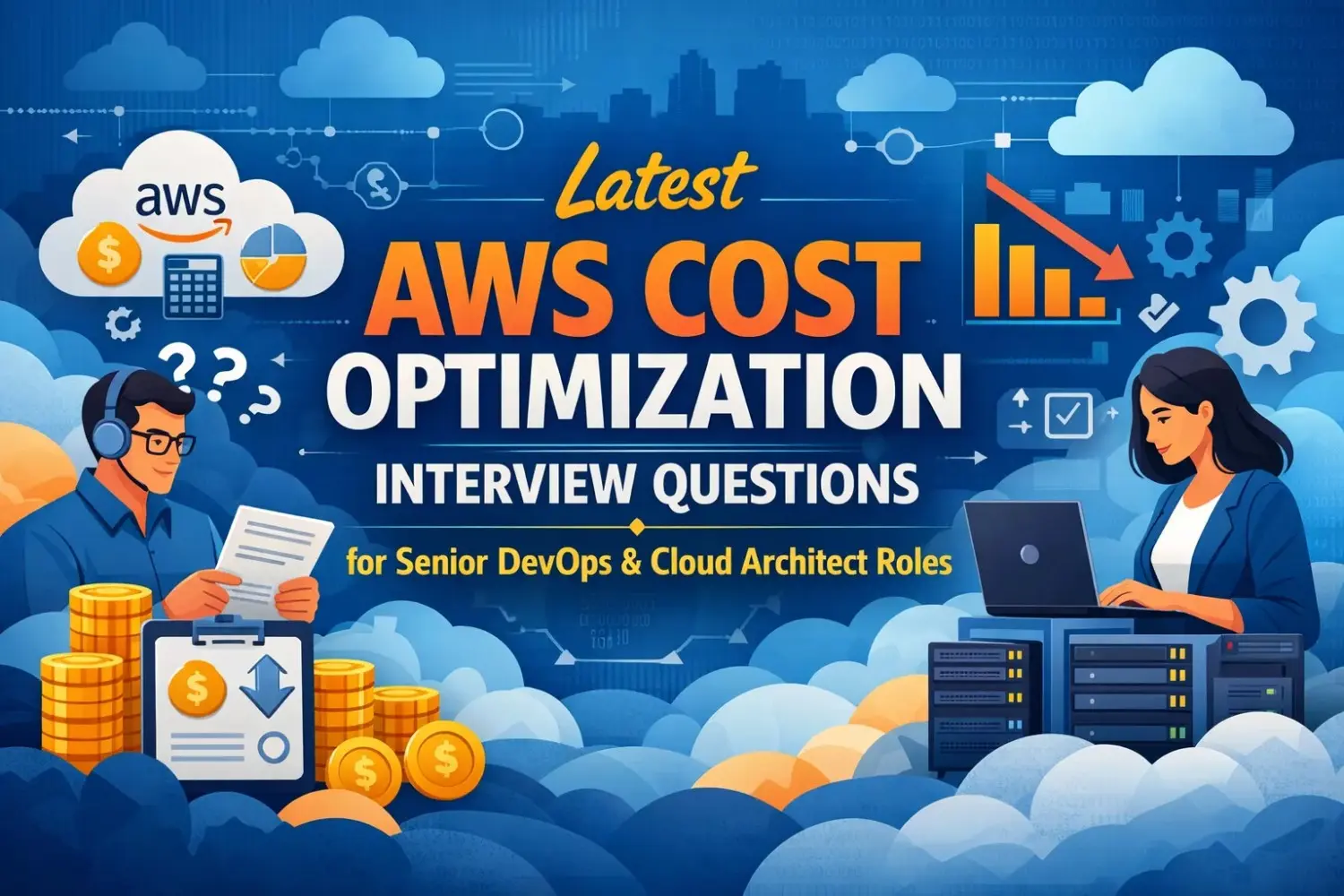
Latest AWS Cost Optimization Interview Questions for Senior DevOps & Cloud Architect Roles (2025)
Author: Cloud Softsol Team
Website: www.cloudsoftsol.com
Category: AWS, DevOps, Cloud Architecture, Senior Interviews
Experience Level: Senior DevOps Engineers, Cloud Architects, SREs
Introduction
For senior AWS DevOps and Cloud Architect roles, cost optimization is no longer optional—it is a core responsibility. Interviewers expect candidates to demonstrate deep cost-awareness, architectural decision-making, and FinOps thinking, not just service-level knowledge.
At Cloud Softsol, we analyze real senior-level interview panels, architecture discussions, and leadership rounds. This guide covers AWS Cost Optimization interview questions for senior roles, with scenario-based answers, best practices, and trade-off explanations expected in 2025 interviews.
Why Cost Optimization Is Critical for Senior Roles
Senior engineers are expected to:
- Design cost-efficient architectures
- Optimize large-scale AWS environments
- Balance cost vs performance vs reliability
- Lead FinOps initiatives
- Justify cloud spend to leadership
 Interviewers evaluate how you think, not just what tools you know.
Core AWS Cost Optimization Concepts (Senior-Level)
Before interviews, be fluent in:
- On-Demand vs Reserved vs Spot pricing
- Right-sizing strategies
- Auto Scaling & elasticity
- Storage lifecycle management
- Multi-account cost governance
- Cost visibility & accountability (FinOps)
Top AWS Cost Optimization Interview Questions & Answers (Senior Roles)
1. What is AWS Cost Optimization from a senior architect’s perspective?
Answer:
AWS cost optimization is the practice of continuously reducing cloud spend while maintaining performance, security, and availability.
For senior roles, it includes:
- Architectural cost decisions
- Usage-based scaling
- Governance and tagging strategies
- Predictive cost planning
- Business-aligned cloud spend (FinOps)
2. How do you approach cost optimization in a large AWS environment?
Answer:
A structured approach:
- Visibility – Enable Cost Explorer, CUR, tagging
- Right-sizing – Optimize EC2, RDS, EKS
- Pricing model optimization – RI, Savings Plans, Spot
- Storage optimization – Lifecycle policies
- Automation – Auto Scaling, scheduling
- Governance – Budgets, alerts, policies
- Continuous review – Monthly cost audits
3. Explain Reserved Instances vs Savings Plans vs Spot Instances
Answer:
| Pricing Model | Use Case | Discount |
|---|---|---|
| On-Demand | Variable workloads | 0% |
| Reserved Instances | Steady workloads | Up to 72% |
| Savings Plans | Flexible compute usage | Up to 66% |
| Spot Instances | Fault-tolerant workloads | Up to 90% |
Senior tip: Savings Plans are generally preferred over RIs due to flexibility.
4. How do you decide between Spot Instances and On-Demand?
Answer:
Use Spot Instances for:
- Batch jobs
- CI/CD pipelines
- Data processing
- Kubernetes worker nodes
- Non-critical workloads
Use On-Demand for:
- Stateful workloads
- Production critical systems
- Applications requiring guaranteed capacity
Senior candidates should mention Spot Fleet / EC2 Auto Scaling with Spot + On-Demand mix.
5. How do you optimize EC2 costs at scale?
Answer:
- Right-size instance types using CloudWatch metrics
- Use Auto Scaling Groups
- Migrate to Graviton (ARM) where possible
- Schedule non-prod shutdowns
- Use Savings Plans
- Replace EC2 with serverless (Lambda/Fargate) where feasible
6. How do you optimize storage costs in AWS?
Answer:
- S3 Lifecycle policies (Standard → IA → Glacier)
- Delete unattached EBS volumes
- Snapshot retention policies
- Compress logs
- Use S3 Intelligent-Tiering
- Monitor storage access patterns
7. How do you reduce RDS and database costs?
Answer:
- Right-size DB instances
- Use Aurora Serverless where applicable
- Enable storage auto-scaling
- Remove idle read replicas
- Use Multi-AZ only where required
- Snapshot & delete unused databases
8. How does Auto Scaling help in cost optimization?
Answer:
Auto Scaling:
- Matches capacity to demand
- Eliminates over-provisioning
- Reduces idle compute costs
- Enables scale-in during low traffic
Senior insight: Scaling policies must be tuned carefully to avoid thrashing.
9. How do you optimize costs in EKS or ECS?
Answer:
- Use Spot Instances for worker nodes
- Cluster Auto Scaling
- Right-size pod requests/limits
- Use Fargate for burst workloads
- Remove unused namespaces
- Monitor with Container Insights
- Prefer ECS for simpler workloads if Kubernetes isn’t required
10. What is FinOps and why is it important?
Answer:
FinOps is a cultural and operational model that brings finance, engineering, and business teams together to manage cloud costs.
Senior roles require:
- Cost accountability
- Chargeback/showback models
- Budget ownership
- Cost-aware architecture decisions
11. How do you implement cost governance in AWS?
Answer:
- Mandatory tagging policies
- AWS Budgets with alerts
- SCPs (Service Control Policies)
- Separate prod/non-prod accounts
- Cost anomaly detection
- Regular cost reviews
12. Explain AWS Cost Explorer vs CUR (Cost & Usage Report)
Answer:
- Cost Explorer: High-level visualization and trends
- CUR: Granular, line-item cost data for deep analysis
Senior roles often require CUR + Athena + QuickSight setup.
13. How do you detect and prevent unexpected AWS cost spikes?
Answer:
- Enable AWS Budgets
- Cost Anomaly Detection
- CloudWatch billing alarms
- Limit resource creation using IAM/SCP
- Monitor unusual scaling behavior
14. How do you balance cost vs reliability?
Answer:
Senior engineers must:
- Identify business-critical components
- Apply HA only where needed
- Avoid over-engineering
- Use SLAs to guide architecture
- Optimize cost without compromising customer experience
15. Scenario-Based Interview Question (Very Common)
Question:
Your AWS bill suddenly increased by 40%. How do you investigate?
Expected Senior Answer:
- Check Cost Explorer trends
- Identify service-level spikes
- Drill down using CUR
- Identify new resources or scaling
- Validate tagging
- Fix root cause
- Implement alerts to prevent recurrence
Senior-Level Cost Optimization Tools in AWS
- AWS Cost Explorer
- AWS Budgets
- AWS Cost Anomaly Detection
- Compute Optimizer
- Trusted Advisor
- Athena + CUR
- QuickSight dashboards
Why Cloud Softsol for Senior AWS & DevOps Interview Prep?
At Cloud Softsol, we focus on:
- Senior & leadership interview rounds
- Real-world architecture discussions
- Cost + reliability trade-offs
- FinOps-driven cloud design
- Multi-cloud optimization strategies
 Visit www.cloudsoftsol.com
Conclusion
For senior AWS DevOps and Cloud Architect interviews, cost optimization is a decision-making skill, not just a technical checklist. Interviewers expect clear reasoning, financial awareness, and architectural maturity.
Master these AWS cost optimization interview questions and you’ll stand out as a true senior engineer.