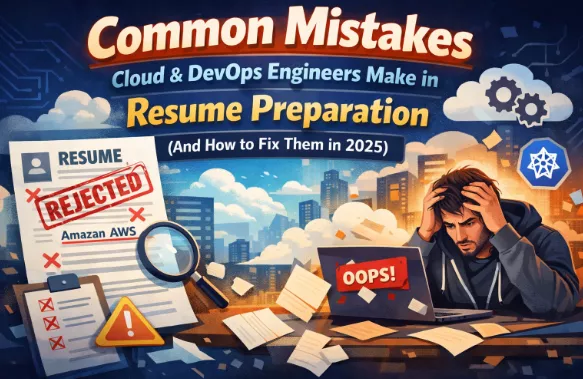
Common Mistakes Cloud and DevOps Engineers Make in Resume Preparation (And How to Fix Them in 2025)
In today's ultra-competitive cloud job market, even highly skilled Cloud Engineers, DevOps Engineers, and SREs get passed over because of avoidable resume mistakes. Recruiters and hiring managers spend only 6–10 seconds scanning resumes — and ATS systems filter out up to 75% before a human ever sees them.
Here are the most frequent mistakes Cloud & DevOps professionals make when preparing their resumes, based on real recruiter feedback and industry trends in 2025.
1. Listing Tools Instead of Business Impact (The #1 Killer Mistake)
Many engineers proudly list: "AWS, Kubernetes, Terraform, Jenkins, Docker, CI/CD, Prometheus…"
Problem: This reads like a shopping list. Recruiters already know the tools — they want to know what business value you delivered.
Fix: Always lead with results + metrics. Use the formula: Action + Tool + Result (with numbers)
Examples that win interviews:
- Reduced deployment time from 4 hours to 12 minutes by implementing GitOps with ArgoCD and Kubernetes, accelerating release cycles by 80%
- Cut monthly AWS costs by $42K (38%) through rightsizing EC2 instances, Reserved Instances, and auto-scaling policies
- Improved system uptime to 99.99% by designing multi-region disaster recovery with Terraform and Route 53 failover
2. Overloading with Technical Jargon Without Context
Sentences like: "Implemented IaC with Terraform modules for EKS clusters utilizing Helm charts and operators"
Problem: Too dense → hard to read quickly. Junior recruiters/HR may skip it.
Fix: Balance technical depth with readability. Explain impact in simple terms first, then add details.
Better version: "Automated provisioning of EKS clusters using Terraform, reducing manual setup time by 90% and ensuring consistent environments across dev, staging, and production."
3. Including Outdated or Irrelevant Technologies
Listing old versions (e.g., Jenkins 1.x, Docker without mentioning containerd, on-prem tools from 2018) hurts credibility in 2025.
Fix:
- Focus on current hot stack (2025): AWS/Azure/GCP, Kubernetes + operators, Terraform/OpenTofu, GitHub Actions/ArgoCD/Flux, GitOps, Prometheus + Grafana/Loki, OpenTelemetry, serverless (Lambda/Fargate), AI/ML ops tools
- Remove anything >5–6 years old unless it's still relevant to the job you're applying for
4. Weak or Generic Professional Summary
Bad examples seen every day: "Hard-working DevOps Engineer with good knowledge of AWS and Azure" "Experienced professional seeking new opportunities"
Problem: No differentiation — sounds like everyone else.
Fix: Make it powerful and keyword-rich (great for ATS too):
Strong 2025 examples:
- AWS Certified DevOps Engineer | Reduced cloud spend by 45%+ across multi-cloud environments | Expert in Kubernetes, Terraform & GitOps
- Senior Cloud DevOps Engineer | 99.99% uptime at scale | Cut deployment frequency from weekly to daily with zero-downtime strategies
5. Forgetting to Quantify Achievements (Biggest Missed Opportunity)
"Improved CI/CD pipelines" "Monitored infrastructure" "Managed Kubernetes clusters"
Problem: No one cares about tasks. Everyone wants outcomes.
Fix: Hunt for numbers — even estimates are better than nothing:
- Increased deployment frequency from 2/week → 15/day
- Reduced mean time to recovery (MTTR) from 4 hours → 22 minutes
- Automated 85% of manual operations, freeing 2 FTEs
6. Ignoring ATS Optimization
Common issues:
- Fancy graphics/templates
- Using tables/columns
- Missing exact keywords from the job description
Fix:
- Use standard fonts (Arial, Calibri)
- Include exact phrases: "AWS Certified DevOps Engineer", "Infrastructure as Code", "CI/CD pipelines", "Kubernetes orchestration", "Terraform", "containerization"
- Keep it simple, one-column, PDF format
7. Other Quick Fixes to Avoid Rejection
- Don't add photo, age, marital status (especially for international applications)
- Keep resume to 1–2 pages max (3–4 only for very senior/niche experts)
- Don't lie about tools/experience — technical interviews expose this quickly
- Include relevant certifications prominently: AWS DevOps Professional, Azure DevOps Expert, CKA/CKAD, Google Professional Cloud DevOps Engineer
- Highlight soft skills briefly: collaboration, problem-solving, mentoring juniors
Final Checklist Before Sending Your Cloud/DevOps Resume in 2025
 Results-first bullets with metrics Current relevant tools & versions Powerful, keyword-rich summary Clean ATS-friendly format Relevant certifications highlighted No generic statements
Fix these common resume mistakes, and you'll dramatically increase your interview chances in the 2025 cloud & DevOps job market.
Need personalized resume review or Cloud/DevOps training with real-time projects & placement assistance?
Visit us at www.cloudsoftsol.com — Leader in Cloud & DevOps Training with 5500+ placements!
Stay updated with the latest AWS, Azure, Kubernetes, and DevOps interview questions, projects, and career tips on our blog.
What resume mistake are you guilty of? Drop a comment below — let's discuss!